An ST connector is a round, bayonet-locking single-fiber connector built around a 2.5 mm spring-loaded ferrule. "ST" stands for Straight Tip, and the connector is also known as the BFOC (Bayonet Fiber Optic Connector). Today it is used mostly for legacy network maintenance, industrial and control systems, and test equipment - not for new high-density data centers or fiber-to-the-home builds. This guide explains where ST came from, how it works, where it still fits, and how to specify the right ST cable or adapter.
ST is no longer a default choice, but it is far from obsolete. Older patch panels, media converters, transceivers, and benchtop instruments still carry ST ports, and re-terminating an existing ST link is usually cheaper and faster than replacing the hardware around it. Knowing how the connector behaves - and where it falls short - is what keeps you from buying the wrong cable or chasing an intermittent fault.
What Is an ST Connector?
An ST connector terminates a single optical fiber inside a 2.5 mm ceramic or zirconia ferrule and locks into its mating adapter with a quick half-turn bayonet. Three features define it: a cylindrical metal or composite body, the spring-loaded ferrule that holds the fiber on center, and a keyed bayonet coupling. To mate it, you insert the connector, align the key, and twist until it seats and locks. That "insert and twist" action is the fastest way to identify an ST in the field, and it is what separates ST from the otherwise similar-looking, screw-on FC. FOCC supplies these as terminated ST fiber optic connectors in both single mode and multimode versions.
Why the ST Connector Was Created
ST was developed by AT&T in the mid-1980s as a more practical alternative to the bulky biconic and earlier threaded connectors of the era. The bayonet coupling was the headline feature: a half-turn lock is faster and more repeatable to work with than spinning a threaded nut. It was first aimed at multimode fiber, and by the late 1980s it was refined to work with single mode fiber as well.
The connector's mechanical interface is standardized as the IEC 61754-2 BFOC/2.5 connector family, which fixes the dimensions of the 2.5 mm ferrule interface so connectors and adapters from different manufacturers mate reliably. ST was one of the most widely deployed fiber connectors through the 1990s and into the early 2000s, especially on budget-conscious multimode projects. As the push-pull SC arrived and then the compact LC and MPO/MTP took over high-density work, ST steadily moved into the legacy and industrial niche it occupies today.
ST Connector Design and How It Works
The ferrule holds the fiber end face centered in the connector. When two ST connectors mate through an adapter, the adapter's alignment sleeve brings the two end faces into physical contact so light crosses from one fiber core to the other with minimal loss. The internal spring keeps that contact pressed together as the bayonet locks, which is what gives the connection its stability, and the keyed slot ensures the ferrule always seats in the same rotational position.
For a clean, properly polished, fully seated ST mating, insertion loss is typically only a few tenths of a decibel. The important phrase is "fully seated": the bayonet must be turned all the way until it clicks home. A half-locked ST can look connected and even pass light, then drift in loss or drop intermittently when the cable is disturbed - one of the most common ST faults technicians run into. ST links are usually simplex; duplex ST cords exist, but each connector still locks on its own.

Where ST Connectors Are Still Used
ST shows up in older and specialized systems far more than in new builds.
Legacy LAN and campus backbones
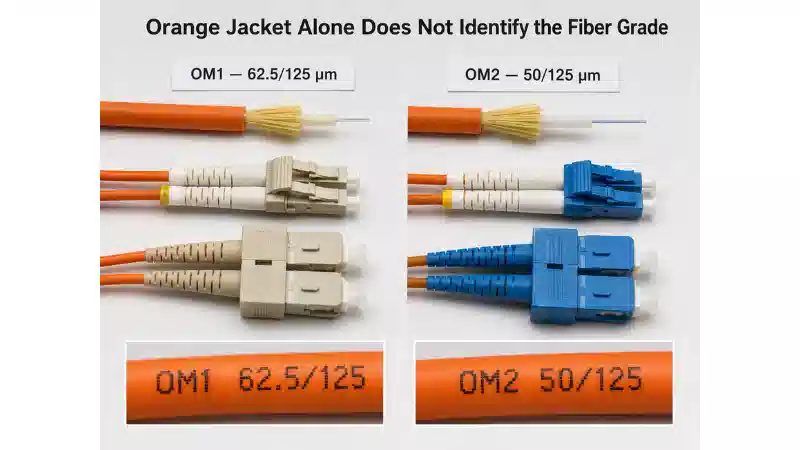
Many enterprise LANs and campus backbones from the 1990s and early 2000s were built on multimode ST, often over OM1 62.5/125 or OM2 50/125 fiber. Those plants are still running. When a riser link or an old patch field needs a replacement cord, an ST patch cord is frequently the only thing that will mate the existing hardware - this overview of ST fiber patch cords covers the common builds.
Industrial and control systems
In older plant networks, ST ports still appear on media converters, optical transceivers, PLC communication modules, and the patch fields inside control cabinets. The bayonet lock gives a firmer, more positive feel than a loose push-in interface, which matters where cables are handled, moved, and reconnected. That tactile certainty is a big reason ST persists in industrial settings.
Test equipment and labs
Optical power meters, light sources, and older test sets often have ST bulkheads, so lab and maintenance work regularly calls for ST-to-LC, ST-to-SC, or ST-to-FC hybrid cords to connect an instrument to whatever the device under test uses.
Some legacy military, broadcast, and datacom links
ST may still be found in some legacy military, broadcast, transportation, and older datacom installations. In those environments, replacement compatibility with what is already installed usually matters more than adopting the newest connector style.
ST Connector Advantages and Disadvantages
ST earns its continued use in specific situations but carries clear trade-offs for modern work.
Advantages
- Secure twist-lock mating. The bayonet gives a positive mechanical lock that is easier to secure than a loose push-in interface in older cabinets and resists casual disturbance.
- Durable, easy-to-grip body. The round housing is rugged and simple to handle - well suited to environments where connectors are not packed tightly together.
- Low cost and legacy fit. ST has long been an affordable connector, and where equipment already has ST ports, a correct cord or adapter keeps the system running without a full upgrade.
- Shared 2.5 mm ferrule family. ST, SC, and FC all use a 2.5 mm ferrule, which makes hybrid cords between them practical in transition projects. Adapter compatibility, though, still depends on the exact mechanical interface, not the ferrule size alone.
Disadvantages
- Lower port density than LC. ST is physically large; LC's 1.25 mm ferrule allows roughly twice the ports in the same panel space, so where space is tight ST is usually the wrong choice.
- Awkward in crowded panels. The twist-lock motion needs finger clearance that is hard to get in a dense cabinet.
- Not a first choice for new networks. Modern data centers favor LC and MPO/MTP; FTTH commonly uses SC or LC.
- Easy to under-seat. A partially turned bayonet can pass a quick inspection yet perform poorly, causing intermittent loss.
ST vs SC vs LC vs FC
Each connector solves a different installation problem. The table below compares them on the factors that actually drive a selection decision; for a broader visual walk-through, see this guide to fiber optic connector types.
| Connector | Ferrule | Coupling | Port density | Typical polish | Typical fiber mode | New-install fit | Best fit / legacy use |
|---|---|---|---|---|---|---|---|
| ST | 2.5 mm | Bayonet twist-lock | Low | PC / UPC | Mostly multimode (also single mode) | Rarely | Durable legacy LAN, industrial, test gear |
| SC | 2.5 mm | Push-pull latch | Medium | UPC / APC | Single mode and multimode | Common | Telecom, FTTH, general enterprise |
| LC | 1.25 mm | Small push-pull latch | High | UPC / APC | Single mode and multimode | Preferred | Data centers, switches, high-density panels |
| FC | 2.5 mm | Threaded coupling | Low | UPC / APC | Single mode (also multimode) | Niche | Test, measurement, vibration-prone systems |
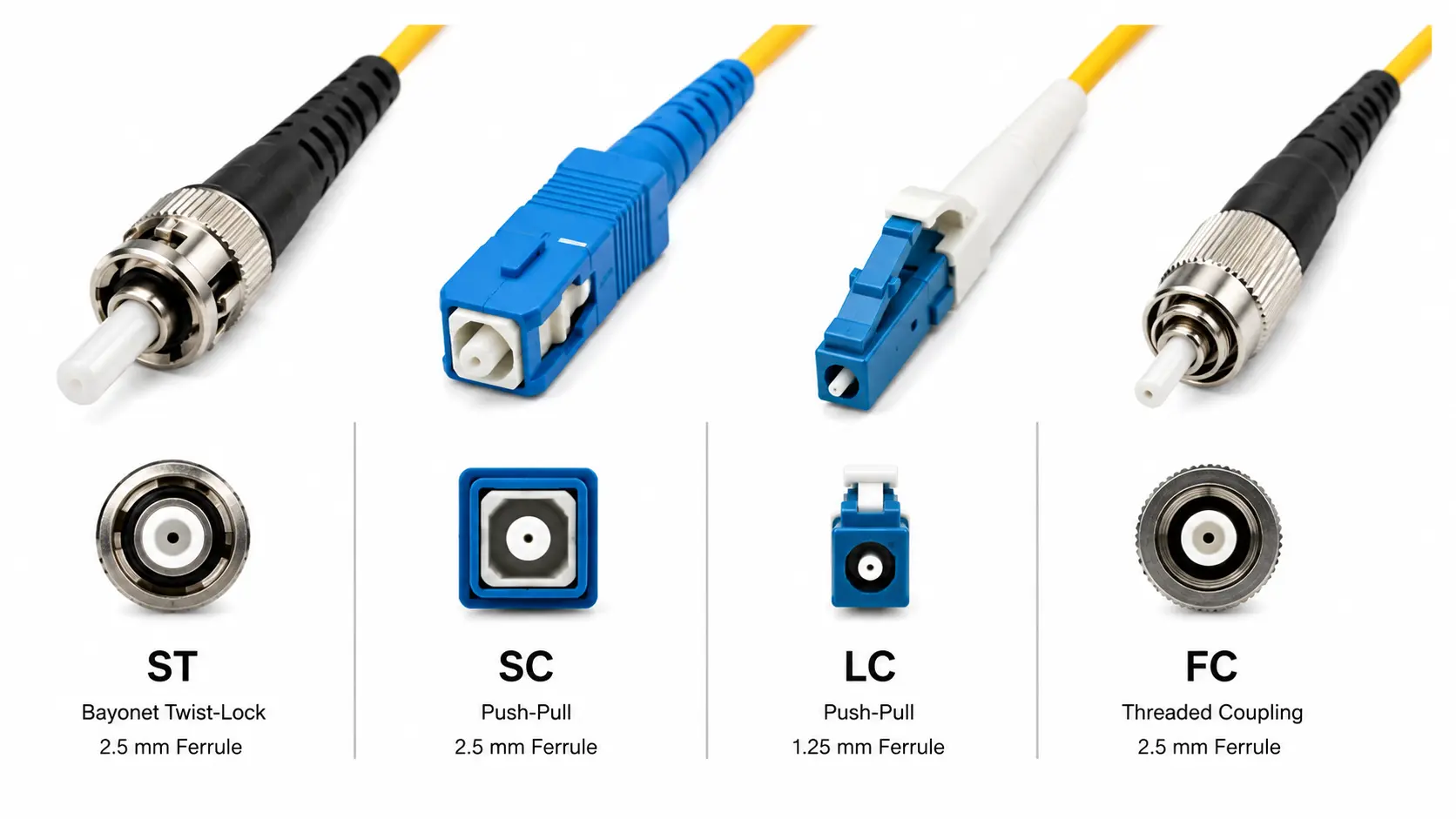
When ST is the better call
Choose ST when you are maintaining existing ST equipment, working on older multimode plant, or re-terminating an industrial link that already uses ST. For replacing an in-place ST-to-ST link in an older control system, ST is usually the most practical option.
When SC is better
The SC connector is the safer pick for telecom, FTTH, and general-purpose enterprise links where a simple push-pull connection is preferred over a twist-lock.
When LC is better
LC wins wherever space matters - modern data centers, high-density switches, and packed patch panels. It is also the de facto connector on SFP/SFP+ and QSFP transceivers.
When FC is better
FC's threaded coupling resists vibration and holds precise alignment, which is why it persists in certain test, measurement, and vibration-sensitive applications.
Single Mode vs Multimode ST Connectors
ST works with both fiber types, but the version has to match the cable and the system. Mixing the two is one of the most common ways to wreck a link budget, so confirm the fiber before you order. If you are unsure which you have, this comparison of single mode and multimode fiber is a good place to start.
Multimode ST
Multimode ST is the classic case - older LANs and short-reach links, commonly on OM1 62.5/125 or OM2/OM3/OM4 50/125 fiber depending on the era of the install.
Single mode ST
Single mode ST is used for longer reaches or specific equipment, typically over OS2 9/125 fiber. When ordering single mode ST cords, confirm fiber type, polish, and optical performance grade rather than assuming the connector shape tells the whole story.
UPC and APC polish
Most ST is supplied with PC or UPC polish; APC ST exists but is far less common than APC SC or APC LC. Never mate an APC interface to a UPC one unless the system is explicitly designed for it - the angled APC end face does not seat correctly against a flat UPC face, which raises reflection and can damage the end faces. If the difference is unfamiliar, see this explanation of UPC and APC connectors.
How to Choose an ST Fiber Patch Cable
Do not order by connector shape alone. A cable described only as an "ST fiber cable" is underspecified. Work through the full specification before you buy.

ST connector specification checklist
- Fiber mode: single mode (commonly OS2 9/125µm) or multimode (OM1 62.5/125, or OM2/OM3/OM4 50/125µm).
- Both connector ends: ST-ST, or a hybrid such as ST-SC, ST-LC, or ST-FC.
- Polish: PC, UPC, or APC, matched to the existing interface.
- Simplex or duplex: one fiber, or two for transmit and receive.
- Jacket: PVC/OFNR riser or OFNP plenum for building cabling, LSZH where low-smoke halogen-free is required, or outdoor/armored where mechanical protection matters.
- Length, color, and insertion-loss grade appropriate to the application environment.
A complete order reads more like: "ST/UPC to ST/UPC, single mode OS2 9/125, duplex, LSZH, 3 m." That single line removes almost all of the guesswork that causes returns.
Adapters and hybrid cables
When one side of a link is ST and the other is SC, LC, or FC, you have two common paths. A hybrid patch cord - for example an ST-to-LC patch cord - carries the conversion in the cable itself. Alternatively, a hybrid adapter joins two existing cords of different types. The nuance worth getting right: hybrid patch cords are routine, but a hybrid adapter is only viable when its mechanical interfaces actually accept both connectors. A shared 2.5 mm ferrule does not by itself guarantee a workable adapter, so select the adapter by its exact interface rather than inferring compatibility from ferrule size alone.
Common ST Connector Mistakes
- Not twisting until fully locked. A partially seated bayonet causes intermittent loss that is hard to chase down later.
- Mixing single mode and multimode. Connector shape does not confirm compatibility; a 9/125 and a 50/125 component on the same link will blow the optical budget.
- Skipping end-face cleaning. Dust and oils on the ferrule raise insertion loss and reflection. Inspect and clean before mating - the FOA's reference on inspecting and cleaning fiber optic connectors is a solid procedure to follow.
- Mixing APC and UPC. The angled and flat end faces do not mate properly, risking reflection problems and physical damage.
- Ordering the wrong hybrid cable. Confirm both ends and the polish before purchase.
ST Connector FAQ
Q: What does ST stand for in fiber optics?
A: ST stands for "Straight Tip." The connector is also known as a BFOC (Bayonet Fiber Optic Connector) and was developed by AT&T in the mid-1980s.
Q: Are ST connectors still used today?
A: Yes, but mainly in legacy LANs and campus backbones, industrial and control systems, and test equipment. They are uncommon in new high-density or FTTH installs.
Q: Is ST single mode or multimode?
A: Both versions exist. ST is most often seen on multimode legacy networks, but single mode ST is available for longer reaches and specific equipment.
Q: What is the difference between ST and SC connectors?
A: Both use a 2.5 mm ferrule, but ST uses a bayonet twist-lock while SC uses a push-pull latch. SC is generally easier to use in panels and far more common in telecom and FTTH.
Q: Can an ST connector connect to LC or SC?
A: Not directly - the connector bodies differ. You bridge them with a hybrid patch cord (for example ST-to-LC) or a matching ST-to-SC hybrid adapter chosen for the exact interface, keeping fiber mode and polish consistent across the link.
Q: How do I tell ST and FC apart? They both look round.
A: Watch the coupling motion: ST uses a half-turn bayonet (push and twist), while FC uses a screw-on threaded nut. The bayonet versus thread is the quickest tell.
Q: What ferrule size does an ST connector use?
A: ST uses a 2.5 mm ferrule - the same nominal size as SC and FC, which is why hybrid cords between those families are common.
The Bottom Line
The ST connector is a durable, bayonet-style connector built on a 2.5 mm ferrule and defined by the IEC 61754-2 (BFOC/2.5) interface. Created by AT&T in the mid-1980s, it was a mainstay of multimode networks for years before SC, LC, and MPO/MTP took over modern installs. It remains genuinely useful for legacy LANs, industrial and control systems, test equipment, and other specialized links. If your network already uses ST, focus on getting fiber mode, polish, jacket, simplex/duplex format, and the opposite-end connector right. If you are designing something new, weigh ST against SC, LC, and FC first - for most modern projects LC or SC will be more practical, while ST stays the sensible choice for maintenance, replacement, and legacy compatibility. For more background on connector families and identification, the FOA fiber optic connector identifier is a useful reference.