Should You Choose Single Mode vs Multimode Fiber?
Multimode fiber is not cheaper. I need to say this upfront because I've spent too many hours on calls with procurement teams who got burned by this misconception. The cable costs less per meter, yes. But when you add transceivers, factor in the upgrade cycle, and account for the likelihood that your 10G network will need 100G capacity within four years, single mode frequently comes out ahead.
That said, I'm not here to tell you single mode is always the answer. It isn't. Plenty of applications genuinely benefit from multimode. The problem is that most comparison articles treat this like a neutral technical exercise when it's actually a financial planning question with a ten-year time horizon.
I work on the commercial side at FOCC, and I've been involved in fiber projects across data centers, 5G deployments, and enterprise campus networks. What I've learned is that the choice between single mode and multimode almost never comes down to technical capability. Both work. The question is which one costs less over the life of your infrastructure, and that calculation depends on factors that rarely appear in spec sheets.

Distance determines everything else
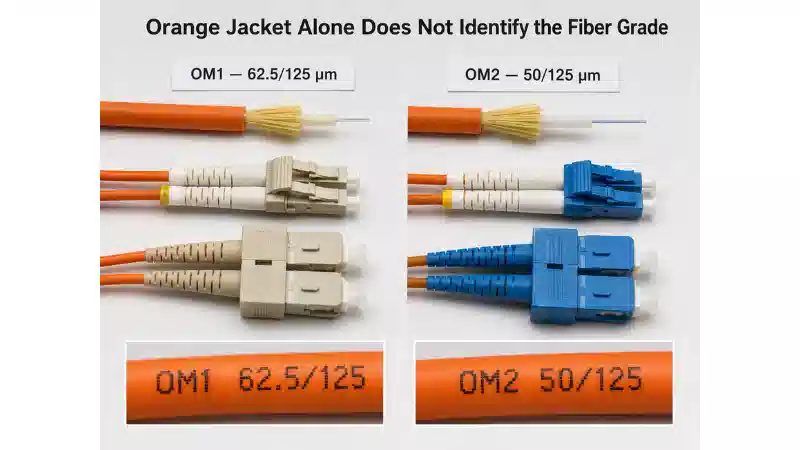
The core diameter difference explains why these fibers behave so differently. Single mode uses a 9μm core, roughly one-tenth the width of a human hair. Light travels through in a single path with minimal dispersion. Multimode fiber has a 50μm core (or 62.5μm in legacy OM1/OM2 grades), allowing hundreds of light modes to propagate simultaneously. Those modes travel different path lengths, arriving at slightly different times. This modal dispersion limits how far the signal can travel before becoming unreadable.
10Gbps Limit
OM4 < 400m
100Gbps Limit
OM4 < 150m
400Gbps Limit
OM4 < 100m
At 10Gbps, this dispersion effect keeps OM4 multimode under 400 meters. At 100Gbps, the limit drops to 150 meters. At 400Gbps, you're looking at barely 100 meters.
Single mode doesn't have this problem. The same OS2 fiber carries 10Gbps for 40 kilometers using ER optics, or 400Gbps for 10 kilometers using LR4 modules. The fiber itself isn't the limiting factor. Only the transceivers determine your reach.
So the first question in any fiber decision is simply: how long is your longest run?
If every link in your project stays under 150 meters, multimode remains viable for 100Gbps. If even one critical backbone link hits 300 meters, you need single mode for that segment. And once you're buying single mode transceivers anyway, the cost dynamics shift.
The real cost breakdown
I'm going to show you actual numbers because vague statements about "multimode being cheaper" don't help anyone make decisions.
Fiber cable pricing (approximate, bulk orders):
Single mode OS2 indoor/outdoor: $0.06 to $0.10 per meter
OM3 multimode: $0.18 to $0.22 per meter
OM4 multimode: $0.25 to $0.32 per meter
OM5 multimode: $0.35 to $0.45 per meter
Single mode cable costs 60-70% less than equivalent multimode cable. This surprises people. The assumption that "simpler = cheaper" doesn't hold here because multimode's graded-index core profile requires more complex manufacturing than single mode's step-index design.
Transceiver pricing (third-party compatible, 2024-2025 market):
These transceiver costs dominate short-distance deployments. A 50-meter link doesn't use much cable either way, so the $110 difference between 100G SR4 and CWDM4 transceivers overwhelms the cable savings.
Link cost comparison at different distances (100Gbps):
50 Meters
Multimode Path:
$99 (Optics) + $16 (Cable)
Total: ~$214
Single Mode Path:
$209 (Optics) + $8 (Cable)
Total: ~$227
Multimode wins by $13
150 Meters
Multimode Path:
$99 (Optics) + $48 (Cable)
Total: $147
Single Mode Path:
$209 (Optics) + $12 (Cable)
Total: $221
Multimode wins by $74
300 Meters
Multimode SR4:
Link Fails
Single Mode Path:
$209 (Optics) + $24 (Cable)
Total: $233
Single mode is essential
The crossover point sits around 200-250 meters for 100Gbps applications. Below that, multimode costs less per link. Above that, multimode doesn't work at all.

Five-year cost projection
Here's where procurement decisions get interesting. Or painful, depending on whether you planned ahead.
A company installs OM3 multimode for a 10Gbps network today. Each link costs maybe $45 including transceivers and cable. Seems economical.
Three years later, bandwidth demands push them toward 100Gbps. But OM3 only reaches 100 meters at that speed, and several backbone runs hit 180-250 meters. Those links won't work with 100G SR4 optics.
Options at that point:
- Replace OM3 with OM4 (marginal improvement, still limited to 150m at 100G)
- Replace multimode with single mode (correct solution, expensive)
- Accept bandwidth limitations on long runs (technical debt)
Replacing fiber infrastructure costs far more than initial installation. You're paying for removal, new cable, new terminations, testing, and the project management overhead of coordinating a retrofit while keeping the network operational.
I've seen estimates ranging from €40 to €75 per meter for complete fiber replacement in occupied facilities, compared to €15 to €25 per meter for new construction installation.
TCO projection for 200-link deployment, 10G initial with 100G upgrade planned:
| Cost element | Multimode OM4 path | Single mode OS2 path |
|---|---|---|
| Initial fiber (avg 80m runs) | €3,200 | €1,280 |
| Initial 10G transceivers | €4,000 | €5,400 |
| Year 1 total | €7,200 | €6,680 |
| Year 3: 100G transceiver upgrade | €19,800 | €41,800 |
| Year 3: Fiber replacement (if needed) | €12,000+ | €0 |
| 5-year infrastructure total | €39,000+ | €48,480 |
Wait. Single mode costs more in this scenario?
Yes, if all your runs stay under 150 meters and you don't need fiber replacement. The transceiver premium adds up with high link counts.
But change the assumptions slightly. Push average run length to 120 meters. Suddenly some links exceed OM4's 100G reach. Now you need fiber replacement for 15-20% of runs:
| Adjusted scenario | Multimode path | Single mode path |
|---|---|---|
| Year 3 fiber replacement (40 links × €60/m × 120m) | €28,800 | €0 |
| Revised 5-year total | €55,800 | €48,480 |
Single mode saves €7,320. And you have headroom for 400Gbps and beyond.
The lesson: multimode wins on pure cost only when distances stay short AND you never need to upgrade beyond what OM4 supports. Both conditions must hold.
Why hyperscale operators moved to single mode
Meta's engineering team published analysis of their 100G optical infrastructure back in 2017. The key finding: single mode fiber delivered lower total cost of ownership for data center interconnects despite higher transceiver costs. Their phrase was "future-proofing distance through multiple generations of data rate evolution" (source: engineering.fb.com/2017/03/08/data-center-engineering/designing-100g-optical-connections/).
They weren't optimizing for today's deployment. They were optimizing for the cumulative cost of 40G, then 100G, then 400G, then whatever comes after, all running over the same fiber plant.
Google, Microsoft, Amazon have made similar infrastructure decisions. When you're deploying millions of fiber links across hundreds of facilities, getting the lifetime cost calculation right matters more than minimizing year-one spend.
Enterprise buyers usually have different constraints. Smaller scale means the percentage savings from cheaper multimode transceivers can dominate. Shorter planning horizons make the upgrade cost question feel remote. Budget cycles reward low initial expenditure over lifecycle optimization.
I understand these pressures. I've sat in meetings where the finance team pushed back on any option that increased this quarter's capital expenditure, regardless of long-term implications. That's a legitimate business consideration. Just recognize it as a financial trade-off, not a technical one.
Multimode grades explained
If you've determined multimode fits your application, selecting the right grade matters.
OM1 and OM2 (Legacy)
Their 62.5μm cores cannot support modern high-speed transmission efficiently. The current TIA-568.3-E standard recommends against new OM1/OM2 installations. If someone quotes you these grades, question their expertise.
OM3
Uses a laser-optimized 50μm core with 2000 MHz·km effective modal bandwidth at 850nm. Maximum reach at 10Gbps is 300 meters. At 100Gbps with SR4 optics, you get 100 meters.
OM4
Increases bandwidth to 4700 MHz·km, extending 10G reach to 400 meters and 100G reach to 150 meters. Also uses aqua jacket, so labeling matters for identification.
OM5
Maintains OM4's bandwidth at 850nm while adding performance across the 850-953nm range for shortwave wavelength division multiplexing (SWDM). This enables higher capacity over the same fiber pairs by using multiple wavelengths. Jacket color is lime green. The technology is proven but adoption remains limited because parallel optics (SR4, SR8) have satisfied most short-reach bandwidth needs without requiring SWDM complexity.
Critical compatibility note:
OM1/OM2 use 62.5μm cores. OM3/OM4/OM5 use 50μm cores. You cannot connect different core sizes directly. The mismatch causes severe signal loss, typically 3-4dB or more, often enough to break the link entirely. Upgrading from legacy OM1/OM2 requires complete replacement in affected segments, not just transceiver changes.
Single mode standards that matter
Single mode fiber follows ITU-T G.652 and G.657 recommendations rather than OM designations.
G.652.D
The current standard for general-purpose single mode fiber. Key specifications include maximum attenuation of 0.4 dB/km at 1310nm and 0.25 dB/km at 1550nm, polarization mode dispersion under 0.2 ps/√km, and low water peak characteristics that enable CWDM across the 1260-1625nm spectrum. This grade handles essentially all enterprise and data center applications.
G.657
Adds bend-insensitivity for installations where tight routing is unavoidable. G.657.A1 tolerates 10mm bend radius while maintaining full compatibility with G.652.D. G.657.A2 pushes that limit to 7.5mm. G.657.B3 reaches 5mm but with some splice compatibility trade-offs.
For 5G fronthaul deployments
Where fiber routes through cramped junction boxes and dense cable trays, G.657.A2 has become the default choice. Standard G.652.D fiber experiences measurable loss increases at bend radii below 15mm. Bend-insensitive fiber avoids this problem without requiring special handling procedures.
OS1 and OS2
TIA designations that map approximately to G.652 variants. OS2 specifies tighter attenuation limits (0.4 dB/km max) and is generally preferred for new installations.
The connector problem nobody wants to discuss
I've seen more network failures caused by connector contamination than by any fiber type mismatch.
The Fiber Optic Association states that dirty connectors cause the majority of fiber network issues. A single 1μm dust particle on a single mode connector endface blocks roughly 1% of the light, translating to about 0.05dB insertion loss. Accumulate a few contaminated connections across a link and you've consumed your entire loss budget.

Cleaning every connection before mating isn't optional. It's mandatory.
And yet I regularly visit sites where technicians skip this step because they're in a hurry or assume factory-terminated assemblies arrive clean. They don't always.
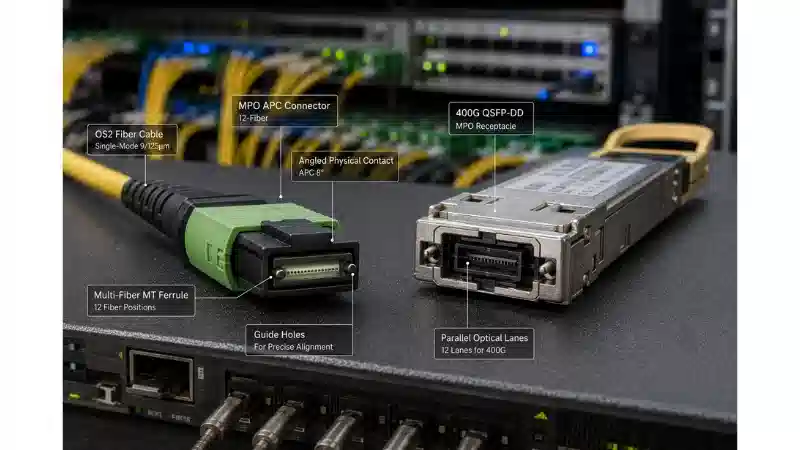
The APC versus UPC polish type creates another failure mode. APC connectors have an 8-degree angled end face that minimizes back-reflection. UPC connectors have a flat polish. These are mechanically incompatible. Connecting green APC to blue UPC creates an air gap that introduces 10dB or more of loss. Enough to completely break any link.
Color coding exists for this reason. Green means APC. Blue means UPC. Never, under any circumstances, mate them together.
Application recommendations
Data center ToR and intra-rack
Multimode OM4 with LC duplex or MTP/MPO connectors. Distances under 10 meters make transceiver cost dominant. 100G SR4 works perfectly.
Data center spine-leaf interconnects
Evaluate distance. Under 100 meters, multimode remains cost-effective. Above 150 meters or planning 400G migration, specify single mode from the start.
Data center interconnect (campus or metro)
Single mode only. Distances range from hundreds of meters to tens of kilometers. No multimode option exists.
Enterprise building backbone
Single mode for runs exceeding 150 meters or where future 100G+ speeds are anticipated. Multimode acceptable for shorter runs with no upgrade plans.
5G fronthaul (RU to DU)
Single mode, typically G.657.A2 for bend tolerance. Distances commonly reach 100 meters to 20 kilometers. The CPRI and eCPRI protocols used in fronthaul require consistent low-latency connectivity that multimode's distance limitations would compromise.
Industrial and manufacturing
Either type depending on distance. Fiber's electromagnetic immunity makes it ideal for environments with heavy electrical equipment, welding operations, or variable frequency drives. The choice becomes purely a distance and upgrade calculation.
Making your decision
Ignore anyone who tells you there's a universal answer. The right choice depends on your specific distances, your bandwidth roadmap, your link count, and your organization's appetite for infrastructure refresh projects.
For deployments with runs predominantly under 100 meters and no plans to exceed 100Gbps, multimode OM4 minimizes total cost. The transceiver savings compound across high link counts.
For deployments with mixed distances, including some runs in the 150-500 meter range, single mode eliminates the risk of discovering post-installation that certain links cannot support your target bandwidth.
For deployments planning eventual migration to 400Gbps or beyond, single mode provides the clearest upgrade path. The fiber itself won't need replacement when transceiver technology advances.
We manufacture both types. We have no financial incentive to push one over the other. What we do have is experience watching clients succeed with appropriate choices and struggle with mismatched infrastructure. The goal is matching the fiber to your actual requirements, not selling you whatever generates the largest order.
If you're uncertain about your specific situation, send us your link schedule with distances and planned speeds. We can model the cost scenarios and show you exactly where the breakpoints fall for your project.
FOCC Fiber supplies MTP/MPO trunk assemblies, fiber patch cables, PLC splitters, and FTTA solutions for data center and telecommunications infrastructure. Engineering support available for custom configurations and high-volume projects.