


Fiber Optic CWDM DWDM MUX
Passive CWDM & DWDM mux demux modules for metro, data center and telecom networks.
FOCC manufactures passive wavelength division multiplexing modules that expand the capacity of fiber already in the ground — no new cable, no powered equipment at the multiplexing point. The range covers 2 to 18 channel CWDM at 20 nm spacing across 1270–1610 nm and 4 to 96 channel DWDM at 200, 100 and 50 GHz on the ITU grid, in single fiber and dual fiber configurations. Channel plans, wavelengths, connectors and packaging are all configurable for OEM and ODM programs.

Eighteen coarse channels sit 20 nm apart across 1270–1610 nm. The ten shortest run through the water peak region and are normally dropped beyond 40 km, leaving the eight channels from 1471 nm upward for longer spans. A complete 40-channel dense system fits inside a single 20 nm coarse slot — which is how CWDM and DWDM share one fiber pair.
WDM Product Categories
Organised by multiplexing platform — thin film filter, planar waveguide or arrayed waveguide grating.
Each suits a different channel count and cost point.
Thin film filter multiplexers on the 20 nm coarse grid, 2 to 18 channels, single or dual fiber. The cost-efficient way to add wavelengths to metro and enterprise links.
C-band and L-band multiplexers at 200, 100 and 50 GHz spacing — up to 48 channels in filter form, up to 96 in AAWG. Amplifier compatible.
Add-drop modules that pull selected wavelengths off a passing line while the rest continue through the express port — the building block of ring topologies.
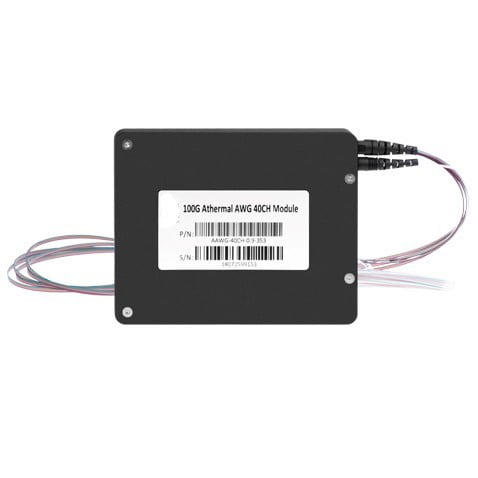
Athermal arrayed waveguide grating on a planar lightwave circuit. High channel counts in a compact footprint, flat loss across the band, no power or temperature control.
Compact CWDM built on a free-space optical path instead of cascaded filter stages, cutting both package size and the accumulated loss of high channel counts.
Two- and three-port band splitters for 1310/1550 nm, 1490/1550 nm and custom pairs, used to overlay video or a management channel on an existing fiber.
FOCC Fiber Optic CWDM/DWDM Multiplexer Series
-
![IP68 Outdoor MINI Fast Connect Field Assembly Optical Connector]() IP68 Outdoor MINI Fast Connect Field Assembly Optical Con...Mini SC assemblies provide a rugged and sealed connectivity solution for Fiber to the Home (FTTH) connections. The connector end incorporates an SC/APC style connection within a slim, sealed,
IP68 Outdoor MINI Fast Connect Field Assembly Optical Con...Mini SC assemblies provide a rugged and sealed connectivity solution for Fiber to the Home (FTTH) connections. The connector end incorporates an SC/APC style connection within a slim, sealed, -
![CWDM & DWDM Modules (Standard)]() CWDM & DWDM Modules (Standard)CWDM & DWDM modules are based on Thin-Film Technology and All-Glass Packaged platform, keeping the device in compact size and excellent performance. Excellent device qualification test ensure the
CWDM & DWDM Modules (Standard)CWDM & DWDM modules are based on Thin-Film Technology and All-Glass Packaged platform, keeping the device in compact size and excellent performance. Excellent device qualification test ensure the -
![Compact Coarse Wavelength Division Multiplexer]() Compact Coarse Wavelength Division MultiplexerCompact Coarse Wavelength Division Multiplexer 紧凑型粗波分复用器 Dense Wavelength Division Multiplexing (DWDM) is a combination of a group of optical wavelengths that can be transmitted with a single fiber.
Compact Coarse Wavelength Division MultiplexerCompact Coarse Wavelength Division Multiplexer 紧凑型粗波分复用器 Dense Wavelength Division Multiplexing (DWDM) is a combination of a group of optical wavelengths that can be transmitted with a single fiber. -
![1X2 WDM]()
-
![1x2 3ports CWDM]() 1x2 3ports CWDM3-port CWDM device is mainly used in the passive wavelength division multiplexing module. It is a kind of wavelength division multiplexing technology based on TFF (thin film filter). It has a variety
1x2 3ports CWDM3-port CWDM device is mainly used in the passive wavelength division multiplexing module. It is a kind of wavelength division multiplexing technology based on TFF (thin film filter). It has a variety -
![DWDM AAWG Module]() DWDM AAWG ModuleDWDM AAWG (Athermal Arrayed Waveguide Grating) module of FOCC is a kind of passive module based on PLC (Planar Waveguide) technology, which does not need additional power supply or temperature
DWDM AAWG ModuleDWDM AAWG (Athermal Arrayed Waveguide Grating) module of FOCC is a kind of passive module based on PLC (Planar Waveguide) technology, which does not need additional power supply or temperature -
![CCWDM Module]() CCWDM ModuleCCWDM module of FOCC is a wavelength division multiplexing technology based on TFF (thin film filter). It works in the same way as the CWDM module. The difference is that CCWDM adopts free space
CCWDM ModuleCCWDM module of FOCC is a wavelength division multiplexing technology based on TFF (thin film filter). It works in the same way as the CWDM module. The difference is that CCWDM adopts free space -
![PLC+WDM Module]() PLC+WDM ModulePLC+WDM module of FOCC is a based on planar waveguide technology and TFF (thin film filter) WDM technology. It has a variety of package sizes and number of channels to choose from. PLC + WDM module
PLC+WDM ModulePLC+WDM module of FOCC is a based on planar waveguide technology and TFF (thin film filter) WDM technology. It has a variety of package sizes and number of channels to choose from. PLC + WDM module -
![CWDM OADM Module]() CWDM OADM ModuleCWDM OADM ABS module of FOCC is a wavelength division multiplexing technology based on TFF (thin film filter), which has a variety of package sizes and wavelength options; In the transmission optical
CWDM OADM ModuleCWDM OADM ABS module of FOCC is a wavelength division multiplexing technology based on TFF (thin film filter), which has a variety of package sizes and wavelength options; In the transmission optical -
![DWDM MUX&DEMUX ABS Module]() DWDM MUX&DEMUX ABS ModuleDWDM MUX&DEMUX ABS module of FOCC is a wavelength division multiplexing technology based on TFF (thin film filter), which has a variety of package sizes and wavelength options; It MUX the optical
DWDM MUX&DEMUX ABS ModuleDWDM MUX&DEMUX ABS module of FOCC is a wavelength division multiplexing technology based on TFF (thin film filter), which has a variety of package sizes and wavelength options; It MUX the optical -
![DWDM Insert-box Module]() DWDM Insert-box ModuleDWDM insert-box module of FOCC is a wavelength division multiplexing technology based on TFF (thin film filter), which has a variety of wavelength and link structure; It MUX optical signals of
DWDM Insert-box ModuleDWDM insert-box module of FOCC is a wavelength division multiplexing technology based on TFF (thin film filter), which has a variety of wavelength and link structure; It MUX optical signals of -
![DWDM MUX&DEMUX 19in Rack]() DWDM MUX&DEMUX 19in RackDWDM MUX&DEMUX 19 rack of FOCC is a wavelength division multiplexing technology based on TFF (thin film filter), which has a variety of package sizes and wavelength options; It MUX the optical
DWDM MUX&DEMUX 19in RackDWDM MUX&DEMUX 19 rack of FOCC is a wavelength division multiplexing technology based on TFF (thin film filter), which has a variety of package sizes and wavelength options; It MUX the optical


CWDM vs DWDM
The choice comes down to three numbers: channels needed today, distance to cover,
and wavelengths expected over the life of the route. Everything else follows from channel spacing.
| Criterion | CWDM | DWDM |
|---|---|---|
| Channel spacing | 20 nm | 200 / 100 / 50 GHz |
| Standard | ITU-T G.694.2 | ITU-T G.694.1 |
| Wavelength range | 1270–1610 nm | 1528–1610 nm (C + L) |
| Channels per fiber | 2, 4, 8, 16, 18 | 4, 8, 16, 32, 40, 48, 80, 96 |
| Transceiver | Uncooled DFB | Cooled, wavelength-locked DFB / EML |
| Amplification | Not amplifiable across full band | EDFA and Raman compatible |
| Typical reach | 70–80 km unamplified | 80 km/span, 100s km amplified |
| Cost per channel | Lower | Higher |
| Best fit | Metro access, enterprise campus, CATV, fixed channel count | Data center interconnect, backbone, long-haul, routes that scale |
Hybrid designs are common and often cheapest: a full dense system feeds one 20 nm coarse slot — usually 1531 or 1551 nm — so both grids share a single fiber pair without interfering.
Choose by Configuration
Six decisions define the part number. Each one changes the bill of materials, so all six belong in the enquiry.
Channel count |
Order the count you will grow into. Insertion loss rises with every filter stage a wavelength passes, so an 8 channel unit is not half a 16 channel unit — a later upgrade means replacing the module and re-testing the budget. Where growth is uncertain, an expansion port is the cheaper hedge. |
Single or dual fiber |
Dual fiber uses one strand each way and both ends are identical. Single fiber carries both directions on one strand — halving fiber consumption but consuming two wavelengths per bidirectional service. That is why single fiber units ship as an A/B pair: Side A transmits on the odd wavelengths and receives on the even ones, Side B is mirrored, and the two are not interchangeable.
|
Channel spacing |
Within DWDM, 100 GHz is the practical default: mature filters, widely available optics, 40 channels comfortably inside the C-band. 200 GHz relaxes wavelength tolerance and lowers cost below 20 channels. 50 GHz doubles capacity to 80 or 96 but demands tighter laser control and leaves less margin for drift. |
Optional ports |
A monitor port taps a fraction of line power so the composite signal can be measured on a spectrum analyser without breaking traffic. An expansion port passes the unused spectrum through so a second module can be cascaded later. A 1310 or 1550 nm express port carries a legacy or management service alongside the multiplexed channels. These ports on CWDM and DWDM mux demux units cannot be added after manufacture. |
Package |
ABS box for shelves and wall mounting. LGX cassette where three modules share a 1U slot alongside patch panels and an optical distribution frame. Insert-box for integration inside third-party equipment. 1U 19-inch rack with a sliding tray where all channel ports need front access — the usual carrier-site specification. |
Connector and polish |
LC/UPC is the density default; SC and FC remain common on older frames. Angled polish is specified where reflection matters — analogue video, or a fiber shared with a PON overlay. The choice between UPC and APC must be consistent across every mated pair in the path; mixing the two is the most common field fault. |

Technical Specifications
CWDM Mux Demux — Thin Film Filter
| Parameter | 4CH | 8CH | 16CH | 18CH |
|---|---|---|---|---|
| Channel spacing | 20 nm · ITU-T G.694.2 | |||
| Operating wavelength | 1270–1610 nm | |||
| Passband | ±6.5 nm | |||
| Insertion loss, dual fiber | ≤1.5 dB | ≤2.5 dB | ≤3.5 dB | ≤4.0 dB |
| Adjacent isolation | ≥30 dB | |||
| Non-adjacent isolation | ≥40 dB | |||
| Return loss | ≥45 dB | |||
| Directivity | ≥50 dB | |||
| PDL / PMD | ≤0.2 dB / ≤0.1 ps | |||
| Max optical power | 300 mW | |||
| Operating temperature | −5 to +70 °C standard · −40 to +85 °C industrial | |||
DWDM Mux Demux — Thin Film Filter
| Parameter | 8CH | 16CH | 40CH | 48CH |
|---|---|---|---|---|
| Channel spacing | 200 / 100 GHz · ITU-T G.694.1 | |||
| Operating band | C-band · L-band on request | |||
| Passband @ 100GHz | ±0.11 nm | |||
| Insertion loss, dual fiber | ≤3.0 dB | ≤4.5 dB | ≤6.5 dB | ≤7.0 dB |
| Adjacent isolation | ≥25 dB | |||
| Non-adjacent isolation | ≥40 dB | |||
| Return loss / directivity | ≥45 dB / ≥50 dB | |||
| PDL | ≤0.3 dB | |||
| Wavelength accuracy | ±0.1 nm | |||
| Operating temperature | −5 to +70 °C | |||
Two of these numbers do most of the engineering work. Insertion loss is consumed twice on a point-to-point link — once at the multiplexer, once at the demultiplexer — so a 40 channel dense pair can take more than 13 dB out of the span before a kilometre of fiber is counted. Adjacent isolation determines how much neighbouring-channel energy reaches the receiver as crosstalk, which appears as a noise floor no amount of launch power will fix. Reading a budget therefore means reading insertion loss and return loss together with receiver sensitivity and fiber attenuation; where a channel arrives too hot, the correction is a fixed optical attenuator, not a different module.
Network Applications
Metro access
An 8 or 16 channel multiplexer at the central office and matching units at each aggregation site. CWDM in metropolitan area networks stays attractive because nothing in the outside plant needs power.
Data center interconnect
40 to 96 channels of 10G, 100G or 400G on leased dark fibre. The lease cost is fixed, so every added wavelength lowers cost per bit — which is why DCI designs start at 40 channels even when few are lit.
5G fronthaul
Radio sites are fibre-poor and rented by the strand, so single fiber COT/RT pairs connect active antenna units back to the DU. The same driver behind 25G WDM-PON for fronthaul.
Backbone and long-haul
C-band systems with EDFA amplification and dispersion compensation per hut. Ring protection is built from add-drop nodes; where wavelengths must switch remotely rather than sit fixed, weigh OADM against ROADM.
Enterprise and dark fiber
Where a campus leases a limited number of strands, a passive multiplexer converts a fibre shortage into a transceiver purchase. Storage and Fibre Channel links benefit most, since the module is rate-transparent.
FTTx and PON coexistence
GPON and XGS-PON overlays share a feeder through band-splitting filters. The wavelength plan follows the PON architecture, with a PLC splitter and an FWDM working together in the path.
FAQ
Q: Does a passive mux demux need a power supply?
A: No. The modules are optical filters only — no active components, no power connection, no cooling. That is why they are deployed in unpowered outside-plant cabinets and at cell sites.
Q: Will it work with third-party transceivers?
A: Yes, provided the transceiver wavelength matches the channel it is plugged into and the optical power falls inside the module's range. The multiplexer is transparent to protocol and bit rate, so one unit carries Gigabit Ethernet, 10G, Fibre Channel and SDH traffic simultaneously. Wavelength and power matter; vendor does not.
Q: How many channels can CWDM support?
A: Eighteen, on the full 1270–1610 nm grid at 20 nm spacing. Beyond about 40 km the eight channels from 1471 nm upward are the ones normally used, because shorter wavelengths carry higher attenuation on standard single-mode fiber.
Q: Monitor port or expansion port — what is the difference?
A: A monitor port taps a small percentage of the line signal for measurement without interrupting traffic. An expansion port passes the unused spectrum through so a second module can be cascaded later. Different purposes, ordered separately.
Q: Are Side A and Side B interchangeable?
A: No. Single fiber units are a matched pair. Side A transmits on one wavelength set and receives on the other; Side B is the mirror image. Two Side A units at opposite ends will not pass traffic.
Q: How is the link budget calculated?
A: Add multiplexer insertion loss, demultiplexer insertion loss, fiber attenuation over the route, the loss of every connector and splice, and a maintenance margin of 2 to 3 dB. The total must sit inside the difference between transmitter launch power and receiver sensitivity — and on short links, check the receiver overload threshold at the same time.
Q: Can CWDM and DWDM share one fiber?
A: Yes. A full dense system feeds one 20 nm coarse slot, usually 1531 or 1551 nm, so both grids travel the same fiber pair. The coarse channels either side stay available for other services.

One-stop Cosmetic Tube Factory in China
请替换当前内容 Send your inquiry about cosmetic tubes to us and experience the transformative power it can have on your business or brand. With our premium packaging solutions, you can elevate your products, captivate your customers, and unlock new opportunities for growth and success in the beauty indsty.
What Are CWDM and DWDM Mux Demux Modules?
A wavelength division multiplexing mux demux combines several optical signals, each on its own wavelength, onto a single fiber pair — or onto one fiber — and separates them again at the far end. The modules are entirely passive: no electronics, no power, transparent to protocol and bit rate. An existing route can be multiplied in capacity without trenching new cable and without changing the equipment at either end beyond the transceivers.
CWDM spaces channels 20 nm apart across 1270–1610 nm under ITU-T G.694.2. That wide spacing is the entire economic argument: the passband is loose enough that lasers need no cooling or wavelength locking, which is why CWDM SFP transceivers and coarse multiplexers cost a fraction of their dense equivalents per channel. Reach is typically 70–80 km unamplified, and beyond about 40 km deployments are usually limited to the eight channels above 1470 nm, because the shorter wavelengths sit near the water peak of standard G.652 single-mode fiber. Cable television networks were an early adopter, separating downstream and upstream onto widely spaced wavelengths; the same principle underlies 10GBASE-LX4, where four wavelengths near 1310 nm each carry 3.125 Gbit/s. In SDH transport, coarse multiplexing is a standard way of stacking STM circuits onto one fiber pair.
DWDM places channels on the ITU-T G.694.1 frequency grid at 200, 100 or 50 GHz — roughly 1.6, 0.8 and 0.4 nm — inside the C-band and L-band. Packing channels this tightly requires temperature-stabilised, wavelength-locked lasers and sharper filters, which raises cost per channel. What it buys is capacity and distance: 40, 48, 80 and 96 channel systems are routine, and because every channel falls inside the erbium gain window the line can be boosted by an EDFA and carried hundreds of kilometres. Over long spans the limiting factor shifts from loss to chromatic dispersion, corrected with a dispersion compensation module at the amplifier site.
CWDM Module Coarse Wavelength Division Multiplexing
Originally, the term coarse wavelength division multiplexing (CWDM) was fairly generic and described a number of different channel configurations. In general, the choice of channel spacings and frequency in these configurations precluded the use of erbium doped fiber amplifiers (EDFAs). Prior to the relatively recent ITU standardization of the term, one common definition for CWDM was two or more signals multiplexed onto a single fiber, with one signal in the 1550 nm band and the other in the 1310 nm band.

CWDM Applications
CWDM is being used in cable television networks, where different wavelengths are used for the downstream and upstream signals. In these systems, the wavelengths used are often widely separated. For example, the downstream signal might be at 1310 nm while the upstream signal is at 1550 nm.
Some GBIC and small form factor pluggable (SFP) transceivers utilize standardized CWDM wavelengths. As a classic synchronous digital transmission solution in optical fiber communications, SDH is often paired with CWDM technology to achieve efficient networking. GBIC and SFP CWDM optics allow a legacy switch system to be “converted” to enable wavelength multiplexed transport over a fiber by selecting compatible transceiver wavelengths for use with an inexpensive passive optical multiplexing device.
The 10GBASE-LX4 10 Gbit/s physical layer standard is an example of a CWDM system in which four wavelengths near 1310 nm, each carrying a 3.125 gigabit-per-second (Gbit/s) data stream, are used to carry 10 Gbit/s of aggregate data.
Passive CWDM is an implementation of CWDM that uses no electrical power. It separates the wavelengths using passive optical components such as bandpass filters and prisms. Many manufacturers are promoting
passive CWDM to deploy fiber to the home.
What Is DWDM Dense Wavelength Division Multiplexing?
Unlike CWDM, DWDM (Dense Wavelength Division Multiplexing) connections can be amplified and can, therefore, be used for transmitting data much longer distances.
As the demand for Dark Fibre and capacity has increased, Dense Wavelength Division Multiplexing (DWDM) has been an important component. This involves multiplexing of multiple virtual fibres – that is, the splitting out the colours of the infrared spectrum using laser transmitters tuned to each colour wavelength – meaning more data can be sent via a single fibre at the same time thus increasing bandwidth.
CWDM supports up to 18 wavelength channels transmitted through a fiber at the same time. To achieve this, the different wavelengths of each channel are 20nm apart. DWDM, supports up to 80 simultaneous wavelength channels, with each of the channels only 0.8nm apart. CWDM technology offers a convenient and cost-efficient solution for shorter distances of up to 70 kilometers. For distances between 40 and 70 kilometers, CWDM tends to be limited to supporting eight channels.
Focc Technology is one of the leading China manufacturers and suppliers providing you with fiber optic CWDM DWDM MUX. Our factory has applied the most advanced equipment and technology to better serve you. Please be free to buy our fiber optic CWDM DWDM MUX products with competitive price. The customized service and the quotation consultation are available.
, DWDM System , CWDM System , CWDM SFP , 100GHz DWDM , CWDM Filter


