Why Fiber Pigtails Matter
In the world of fiber optic communications, reliability and precision are everything. As networks scale to support FTTH rollouts, 5G base stations, and hyperscale data centers, the way fiber is terminated and managed at every endpoint can determine whether a project succeeds or fails.
One component that plays a critical role in this process-though often overlooked by those outside the industry-is the fiber optic pigtail.
Fiber pigtails are simple in appearance, yet essential in function. They are the bridge between fiber optic cables in the field and the equipment or patch panels that manage them. By combining factory-installed connectors with spliced bare fiber, pigtails ensure that network installers can create fast, reliable, and cost-effective terminations.
Without pigtails, every termination in an ODF, terminal box, or splice closure would require field-installed connectors-an approach that is both time-consuming and less reliable. For procurement managers and engineers, understanding fiber pigtails is not only about knowing another product type, but about saving deployment time, reducing installation costs, and improving long-term performance.
In this guide, we will break down what fiber optic pigtails are, how they differ from patch cords, what types exist, and how to select the right one for your project. By the end, you will have a comprehensive understanding of why pigtails deserve a place in every fiber deployment toolkit.
What Is a Fiber Optic Pigtail?
A fiber optic pigtail is a short length of optical fiber-typically 0.5m to 2m-that has a factory-terminated connector on one end and bare fiber on the other end.

● The connector end is polished and tested under factory conditions, ensuring low insertion loss and high return loss.
● The bare fiber end is designed to be fusion spliced or mechanically spliced to the fiber optic cable in the field.
This design makes pigtails the ideal choice for applications where fibers from a large cable must be terminated at an ODF (Optical Distribution Frame), terminal box, or patch panel.
Why Not Just Use Field-Terminated Connectors?
While it is technically possible to polish and install connectors in the field, this process is slow and requires highly skilled technicians. More importantly, field-installed connectors rarely achieve the same performance, precision, or reliabilityas factory-terminated connectors.
By contrast, a pigtail offers:
● Factory-grade quality on the connector side.
● Flexibility to splice into any cable system.
● Time and labor savings compared to on-site termination.
Fiber Pigtail vs Fiber Patch Cord
At first glance, a fiber pigtail looks similar to a fiber patch cord. However, there are key differences that matter both technically and commercially.

Structural Difference
● Pigtail: Connector on one end, bare fiber on the other.
● Patch Cord: Connector on both ends (e.g., LC-LC, SC-SC, LC-SC).
Application Difference
● Pigtail: Designed to be spliced inside ODFs, terminal boxes, or splice closures.
● Patch Cord: Designed for direct device-to-device or panel-to-device connections.
Protection
● Pigtail: Usually has a 0.9mm tight-buffered fiber with minimal protective jacket, because it will be placed inside protected enclosures.
● Patch Cord: Typically uses 2.0mm or 3.0mm jacketed cable for durability in open routing environments.
Cost & Flexibility
● Pigtail: More cost-effective for permanent terminations.
● Patch Cord: More versatile for temporary or reconfigurable connections.
Comparison Table: Fiber Pigtail vs Patch Cord
| Feature | Fiber Pigtail | Fiber Patch Cord |
| Connector Ends | One side only | Both sides |
| Fiber End | Bare fiber (for splicing) | Factory-terminated on both ends |
| Typical Jacket | 0.9mm tight-buffer | 2.0mm / 3.0mm buffered cable |
| Main Use Case | ODFs, splice boxes, terminations | Device-to-device, patch panels |
| Cost Efficiency | Lower cost, permanent install | Slightly higher, flexible connections |
Some installers even take patch cords, cut them in half, and create two pigtails-though this is not as efficient as purchasing dedicated pigtails.
Why Fiber Pigtails Are Critical in Deployments
1.Reliability: By combining a factory-polished connector with a fusion splice, pigtails deliver low loss and high return loss performance.
2.Scalability: Large multi-core cables can be terminated quickly and neatly.
3.Flexibility: Available in singlemode, multimode, armored, waterproof, and ribbon types.
4.Cost-Effectiveness: Avoids expensive field termination labor.
5.Compatibility: Works with all major connector standards (LC, SC, FC, ST, etc.).
Types of Fiber Optic Pigtails
Fiber optic pigtails come in a wide range of types to meet different network requirements. For a procurement manager or engineer, understanding these variations is critical to making the right choice. Below, we classify pigtails by fiber type, connector type, polish style, application environment, fiber count, and construction.
2.1 By Fiber Type – Singlemode vs Multimode
Singlemode Pigtails (OS1 / OS2)
● Core size: 9 μm.
● Applications: Long-haul transmission, telecom networks, FTTH, data centers.
● Standards:
OS1: Indoor, tight-buffered, optimized for up to 2 km.
OS2: Outdoor/long-haul, loose tube, optimized for up to 10 km or more.
● Color Jacket: Yellow.
Multimode Pigtails (OM1–OM5)
● Core sizes:
OM1: 62.5 μm
OM2/OM3/OM4/OM5: 50 μm
● Applications: Shorter distance, enterprise LANs, data centers, parallel optics.
● Color Jacket:
OM1/OM2: Orange
OM3: Aqua
OM4: Violet or Aqua
OM5: Lime Green
Quick Reference – Fiber Types
| Fiber Type | Core Size | Jacket Color | Typical Use |
| OS1 / OS2 | 9 μm | Yellow | Long-distance, FTTH, 5G |
| OM1 | 62.5 μm | Orange | Legacy LAN, short links |
| OM2 | 50 μm | Orange | 1G / 10G LAN |
| OM3 | 50 μm | Aqua | 40G/100G up to 100m |
| OM4 | 50 μm | Violet/Aqua | 40G/100G up to 150m |
| OM5 | 50 μm | Lime Green | 400G SWDM, data centers |
Buyer Tip: 99% of singlemode deployments today use OS2. For multimode, OM4 is the safest investment.
2.2 By Connector Type
Fiber pigtails are available with almost all common connector types. Each connector type is chosen depending on the equipment interface or patch panel in use.
● LC Pigtail: Small form factor, duplex-friendly, widely used in data centers.
● SC Pigtail: Square connector, push-pull, common in telecom and FTTH.
● FC Pigtail: Screw-type, secure connection, often used in lab/testing.
● ST Pigtail: Bayonet-style, older networks, some industrial use.
● E2000 Pigtail: High-performance, dust cap, often in premium telecom.
● MT-RJ Pigtail: Duplex multimode, compact, less common today.

Most Popular: LC and SC dominate >80% of modern projects.
2.3 By Polish Type – PC / UPC / APC
The polish of the connector ferrule directly affects return loss performance.
● PC (Physical Contact):
Basic polish.
Return loss: ~ -40 dB.
Mostly legacy.
● UPC (Ultra Physical Contact):
Flat polish, tighter tolerance.
Return loss: ~ -50 dB.
Common in data centers and enterprise links.
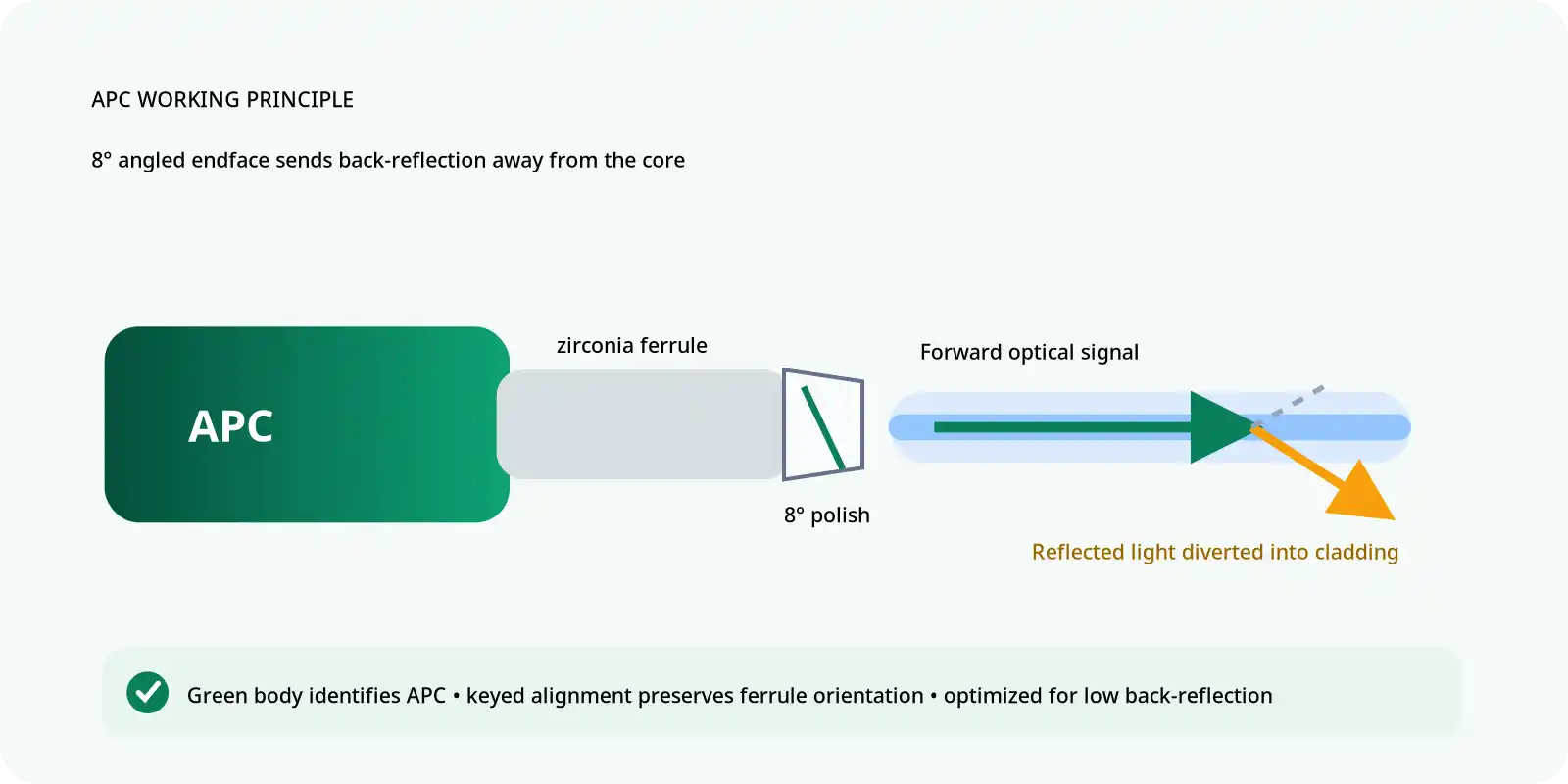
● APC (Angled Physical Contact):
8° angled polish.
Return loss: -60 dB or better.
Essential for FTTH, CATV, WDM, and 5G networks.

End-Face Polish Performance
| Type | Angle | Return Loss | Common Applications |
| PC | 0° | -40 dB | Legacy multimode |
| UPC | 0° | -50 dB | Data centers, LAN |
| APC | 8° | -60 dB+ | FTTH, 5G, CATV, WDM |
Buyer Tip: If your project involves FTTH or 5G, always request APC pigtails.
2.4 By Application Environment
Indoor Standard Pigtails

● Simple tight-buffer, cost-effective.
● Best for protected ODF/terminal box use.
Armored Pigtails
● Stainless steel tube inside for protection.
● Resistant to crushing, rodent bites, and bending stress.
● Used in industrial, outdoor-to-indoor transitions.
Waterproof Pigtails

● With ruggedized waterproof connectors.
● PE jackets, stainless reinforcement.
● Suitable for towers, outdoor enclosures, military, harsh climates.
👉 Example: In 5G base station deployments, waterproof APC SC pigtails are widely used.
2.5 By Fiber Count
While most pigtails are single-fiber, multi-fiber options exist:

● Single-fiber: The most common (LC, SC, FC).
● Multi-fiber: 2, 4, 6, 12, 24, 48, or 72 fibers.
● Multi-fiber pigtails often come in ribbon format for splicing into high-count cables.
Fiber Count vs Application
| Fiber Count | Typical Use |
| 1–2 | Device connections, ODF terminations |
| 4–12 | Terminal boxes, mid-size networks |
| 24–72 | Large data centers, backbone splicing |
2.6 By Construction
0.9mm Tight Buffer
● Common in ODFs.
● Flexible, minimal jacket.
2.0/3.0mm Jacketed Pigtails
● Added protection.
● Easier to handle and identify.
Ribbon Pigtails
● Multiple fibers in flat ribbon form.
● High-density splicing applications.
Color Coding, Applications & Benefits
3.1 Color Coding Standards (TIA/EIA-598-A)
When dealing with multi-fiber pigtails, identifying each fiber quickly and accurately is crucial. To avoid confusion, the industry follows the TIA/EIA-598-A color coding standard, which assigns colors to each fiber in a cable or pigtail bundle.
Standard 12-Fiber Color Sequence

For cables larger than 12 fibers, the sequence repeats with different binder colors (e.g., striped versions).
📌 Why It Matters:
Ensures that fiber #1 on one end corresponds to fiber #1 on the other.
Prevents cross-connections during splicing.
Simplifies troubleshooting during network maintenance.
👉 Buyer Tip: Always confirm that your supplier follows TIA/EIA-598-A or provides a clear fiber identification chart with each shipment.
3.2 Applications of Fiber Optic Pigtails
Fiber optic pigtails are versatile. They appear in nearly every structured cabling project, from FTTH to data centers. Let's look at the most common use cases.

1.Optical Distribution Frames (ODFs)
● Pigtails are fusion spliced to incoming fiber cables.
● The connectorized ends are mounted on adapter panels.
● Provides organized, accessible terminations.
2.Fiber Terminal Boxes
● Used in residential and enterprise FTTH installations.
● Pigtails connect incoming fibers to customer drop cables.
● Typically SC/APC pigtails for GPON or EPON.
3.Splice Closures
● Outdoor closures for backbone or access networks.
● Pigtails provide the interface between raw cable fibers and distribution connectors.
4.Passive Optical Components
● Pigtails are attached to splitters, couplers, and WDM devices.
● Ensures factory-grade termination for reliable performance.
5.Data Centers
● High-density racks often use pigtails with LC connectors.
● Deployed inside patch panels and cassettes for structured cabling.
6.5G and FTTA (Fiber to the Antenna)
● Waterproof APC SC pigtails used in outdoor enclosures.
● Essential for minimizing reflection in high-frequency RF environments.
Global Example – Latin America
A telecom operator in Peru rolled out FTTH in suburban areas using pre-terminated SC/APC pigtails in customer terminal boxes. By standardizing on APC connectors, they minimized reflection issues and improved PON stability.
📍 Global Example – Europe
A major ISP in Poland deployed 24-fiber ribbon pigtails in ODFs for metro networks. This reduced splicing time by 60% compared to single-fiber pigtails.
3.3 Benefits of Using Fiber Pigtails
The decision to use pigtails instead of field-installed connectors or direct patch cords brings multiple advantages.
1.Ease of Installation
● Fusion splicing is faster and more reliable than polishing connectors in the field.
● Pigtails reduce the need for specialized field kits.
2.High Performance
● Factory-polished connectors guarantee low insertion loss and high return loss.
● Consistent quality across all terminations.
3.Cost-Effective
● While each pigtail adds some material cost, it saves far more in labor and rework prevention.
● Lower long-term maintenance costs.
4.Durability & Reliability
● Pigtails placed inside ODFs or terminal boxes are protected from environmental stress.
● Options like armored or waterproof pigtails ensure rugged deployments.
5.Flexibility
● Available in all connector types, fiber types, and polish types.
● Customizable lengths and jackets.
6.Reduced Downtime
● Fast troubleshooting thanks to color coding and organized terminations.
● Spares can be easily swapped in.
ROI Example – FTTH Deployment
● Without pigtails: Field-installed connectors → High error rate, slow process.
● With pigtails: Fusion splicing to SC/APC pigtails → 40% faster rollout, fewer failures.
👉 This is why nearly all modern FTTH, data center, and 5G projects standardize on pre-terminated pigtails.
Procurement Guide, FAQ, Future Trends & Conclusion
4.1 Procurement Guide – How to Select the Right Fiber Pigtail
When purchasing fiber optic pigtails, the goal is to balance performance, compatibility, and cost-efficiency. Below are the critical parameters to evaluate:
1.Fiber Type (Singlemode vs Multimode)
● Singlemode (OS2): Best for FTTH, 5G, long-distance telecom.
● Multimode (OM3/OM4/OM5): Best for data centers and short-range high-speed links.
2.Connector Type
● LC: Compact, ideal for high-density racks.
● SC: Widely used in FTTH and telecom.
● FC: Lab or secure screw-type environments.
● ST: Legacy or industrial networks.
3.Polish Type
● UPC: Data centers, low reflection environments.
● APC: FTTH, CATV, WDM-reflection-sensitive links.
4.Fiber Count
● Single-fiber pigtails: Common in FTTH and ODFs.
● Multi-fiber pigtails: 12/24/48/72-fiber bundles for backbone or metro networks.
5.Jacket & Protection
● Indoor: 0.9mm or 2.0mm jacket.
● Armored: For industrial or rodent-prone environments.
● Waterproof: Outdoor enclosures, telecom towers, harsh conditions.
6.Length
● Standard: 1m or 2m.
● Custom lengths available based on project routing.
7.Testing & Certification
● Insertion loss (IL) and return loss (RL) test reports should be provided.
● Compliance with IEC/TIA standards is essential.
📌 Buyer Checklist Before Ordering:
● Confirm connector type, fiber type, and polish.
● Request IL/RL test results.
● Ensure color coding and labeling match your documentation.
● For outdoor/harsh deployments, request armored or waterproof options.
4.2 FAQ – Common Questions About Fiber Pigtails
Q1. Can a fiber patch cord be cut to make two pigtails?
Yes, but it is not ideal. Dedicated pigtails are cheaper and easier to manage.
Q2. Why are most pigtails 0.9mm in diameter?
Because they are designed to be spliced and housed inside ODFs or boxes, where they are protected.
Q3. What's the difference between UPC and APC pigtails?
UPC: flat polish, lower cost, less reflection resistance.
APC: angled polish, superior reflection control, essential for FTTH/5G.
Q4. Can pigtails be used outdoors?
Yes, but only armored or waterproof pigtails with PE jackets are suitable.
Q5. What color coding standard should I follow?
TIA/EIA-598-A is the global reference. Always check fiber charts.
Q6. Can I get custom lengths or connectors?
Yes, most suppliers can provide custom lengths, connectors, and jackets.
4.3 Future Trends in Fiber Pigtails
The role of pigtails is evolving with network growth:
1.5G and Beyond
● More outdoor deployments mean higher demand for waterproof APC SC pigtails.
2.High-Density Data Centers
● Multi-fiber pigtails (12/24/48/72) will grow in importance for metro networks and hyperscale projects.
3.Armored Pigtails in Industrial Networks
● Smart factories, transportation, and defense projects will require rugged pigtails.
4.Customization
● As FTTH and enterprise networks expand, buyers will increasingly demand custom lengths, labeling, and pre-installed adapters.
5.Integration with Pre-Terminated Systems
● Pigtails will increasingly be combined with cassettes and pre-terminated solutions, minimizing splicing work.
4.4 Conclusion – Why Fiber Pigtails Should Not Be Overlooked
Fiber optic pigtails may be small, but they are indispensable in modern fiber networks. By providing a reliable, factory-tested connector on one end and a splice-ready fiber on the other, pigtails deliver:
● Ease of installation
● High reliability
● Cost savings
● Flexibility across applications
From FTTH to hyperscale data centers, pigtails are the unsung heroes that make structured cabling practical and efficient.