When OpenAI's GPT-6 model entered the training phase, its daily data interaction volume exceeded 100PB, and traditional 400G Ethernet clusters experienced 37% congestion in training tasks. This industry case in early 2025 marked 800G Ethernet's official leap from an "alternative technology" to a "must-have standard". According to the latest report from CINNO Research, the global shipment of 800G Ethernet ports will reach 4.5 million in 2025, a year-on-year growth of 287%, with a penetration rate of over 60% in fields such as AI data centers and supercomputing interconnection, becoming a core pillar supporting the computing power base of the digital economy.
What is 800G Ethernet?
800G Ethernet is a high-speed network technology designed to meet the needs of modern communications, with a data transmission rate of an astonishing 800 gigabits per second (800Gbps). This speed is twice that of the previous generation 400G Ethernet, providing strong support for data centers, cloud services and high-bandwidth applications.
It runs through 8 channels, with each channel transmitting at a rate of 100Gbps, which doubles the transmission speed compared to the 50Gbps per channel of the previous generation PAM4 signal. This high-speed transmission capability enables 800G Ethernet to achieve higher throughput and better network performance in large-scale data centers and cloud environments, making data communications faster and more efficient.
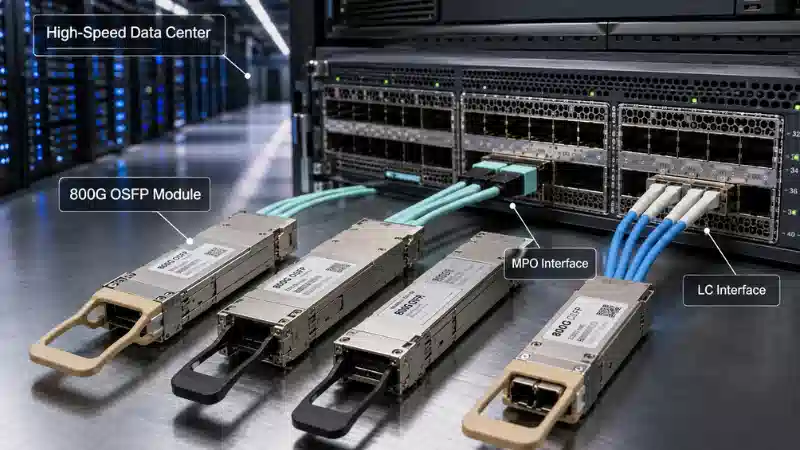
The implementation of 800G Ethernet relies on advanced network hardware and optical modules that not only support high-speed data transmission, but also adopt low-power design to improve energy efficiency. The Institute of Electrical and Electronics Engineers (IEEE) is responsible for the standardization of 800G Ethernet to ensure seamless interoperability between equipment from different vendors. This standardization process is critical to building a unified and efficient global network. The process enables 800G Ethernet to realize its maximum potential in different application scenarios.
Technical Deconstruction: Comprehensive Innovation from Physical Layer to Protocol Stack
The technological breakthrough of 800G Ethernet is not a simple bandwidth overlay but a coordinated evolution of the physical layer, packaging layer, and protocol layer. At the physical layer, 56G SerDes PAM4 modulation technology is adopted, which increases the single-channel rate to 56Gbps through four-level pulse amplitude modulation. Combined with the Enhanced Forward Error Correction (E-FEC) algorithm, the bit error rate is controlled below 10⁻¹⁸ within a transmission distance of 10km, achieving a three-order-of-magnitude improvement in reliability compared to 400G technology.
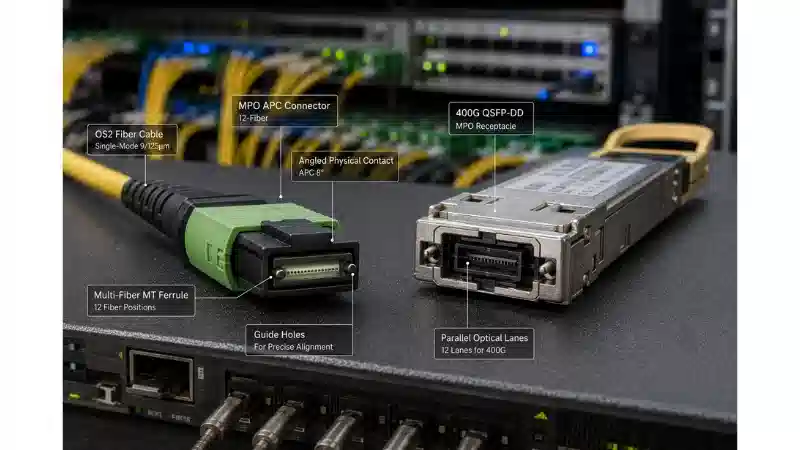
Innovation in packaging technology is equally crucial: the QSFP-DD800 packaging interface adopts a dual-density design, integrating 8 electrical channels within a 28mm×18mm package and supporting 112Gbps signal transmission per channel. Compared with the traditional QSFP56 package, it achieves a 200% increase in port density and a 35% reduction in power consumption in the same cabinet space. At the chip level, Broadcom's Tomahawk 6 chip uses a 5nm process, integrating 512 112G SerDes channels in a single chip, supporting wire-speed forwarding of 256 800G ports, and controlling the chip-level latency within 3μs.
Industrial Pattern: Competition, Cooperation and Breakthroughs in the Global Supply Chain
The current 800G Ethernet industry has formed a three-level competitive echelon: the first echelon is led by Broadcom and Intel, occupying 85% of the global high-end switching chip market, and their products are mainly supplied to ultra-large-scale cloud vendors such as Amazon AWS and Microsoft Azure; the second echelon includes Chinese manufacturers such as Siflower Communications and ZTE, which have made breakthroughs in 25.6T/12.8T chips, with a domestic market share of 32% in 2024; the third echelon is emerging startups focusing on innovation in niche areas such as optical engines and PHY chips.
As a core component, optical modules present a competitive pattern dominated by Chinese manufacturers. Companies such as Zhongji Innolight and New H3C Technologies occupy more than 60% of the global 800G optical module market. Among them, the 800G DR8 optical module using silicon photonics technology has achieved mass production, with power consumption reduced to below 12W, a 40% reduction compared to traditional solutions, supporting the cost optimization needs of internal interconnection in data centers.
Scenario Implementation: In-depth Penetration from AI Training to Operator Backbone Networks
In different application scenarios, 800G Ethernet demonstrates differentiated technical adaptability:
|
Application Scenario |
Key Technical Indicators |
Typical Deployment Case |
|
AI Training Cluster |
RDMA over RoCE v3, End-to-end Latency < 15μs |
Tesla's Dojo supercomputer adopts 800G Ethernet interconnection, increasing the training efficiency of 1000-node clusters by 55% |
|
Operator Backbone Network |
800G ZR+ Optical Module, 40km Transmission Distance |
China Radio and Television's backbone network adopts the 800G OTN solution, increasing the single-fiber transmission capacity to 16Tbps |
|
Edge Computing Node |
PoE++ Power Supply, Industrial-grade Temperature Range Design |
Huawei's intelligent mining solution deploys 800G industrial Ethernet, compressing the device response latency to 20ms |
Future Evolution: Collaborative Development Path of 800G and 1.6T
Facing the 1.6T Ethernet era that will arrive in 2027, the industry has launched technical pre-embedding: the IEEE 802.3ck standard has completed the formulation of the 1.6T Ethernet physical layer specification, adopting 112G SerDes PAM4 technology to increase the single-channel rate to 112Gbps; the OIF organization is promoting the standardization of 1600ZR+ optical modules, aiming to achieve 80km unrepeatered transmission. The "800G/1.6T dual-mode switches" launched by mainstream manufacturers currently can achieve smooth upgrades through pluggable optical engine design, helping users reduce the transition investment cost by more than 30%.
|
It is worth noting that 800G Ethernet is integrating with cutting-edge technologies such as quantum communication and terahertz transmission. The team from the University of Science and Technology of China has realized a quantum key distribution network based on 800G Ethernet, achieving a key generation rate of 1.2Gbit per second within a 10km distance, laying the foundation for the next-generation secure computing power network. |
Conclusion: The Battle for Computing Power Sovereignty Behind the Standard
The popularization of 800G Ethernet is not only a technological upgrade but also a reshuffle of the right to speak in global digital infrastructure. China's breakthroughs in optical modules and mid-to-low-end chips form a balance with Europe and America's advantages in high-end chips and basic software. As the technological competition for 1.6T Ethernet has begun, only by continuously investing in basic research and industrial chain collaboration can we take the initiative in this game related to computing power sovereignty and build a solid network base for the high-quality development of the digital economy.