Hollow-core fiber (HCF) is a cutting-edge optical fiber technology that uses an air-filled core instead of traditional solid glass or silica, enabling light to travel through air. This innovation tackles key limitations of conventional optical fibers, offering lower latency, reduced signal loss, and minimal nonlinear effects. Ideal for applications like 5G/6G networks, data centers, and high-power laser systems, hollow-core fiber is transforming optical communications. This article explores its structure, working principles, and advantages over traditional optical fibers.

What is Hollow-Core Fiber? Understanding Its Structure
Unlike traditional optical fibers with a high-refractive-index glass core and lower-refractive-index cladding, hollow-core fibers feature a hollow, air-filled core, typically tens of microns wide, surrounded by a microstructured cladding. These structures, often designed as photonic crystals or anti-resonant systems (e.g., thin glass tubes or honeycomb patterns), confine light within the air core.
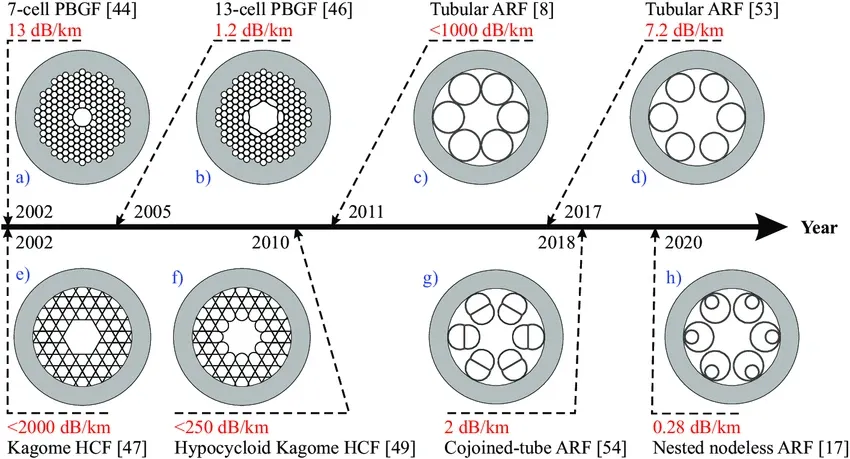
Light propagation in hollow-core fibers relies on:
Photonic Bandgap: Periodic cladding creates a bandgap to prevent light leakage.
Anti-Resonant Guiding: Light reflects off core walls, enabling efficient air-based transmission.
About 99% of light travels through air, minimizing interaction with glass. This contrasts with traditional fibers, where light travels through a silica core, causing losses and nonlinearities. Advanced designs like Nested Anti-Resonant Nodeless Fiber (NANF) have reduced losses from 13 dB/km in 2002 to 0.28 dB/km by 2020, highlighting rapid progress in hollow-core fiber technology.
Key Advantages of Hollow-Core Fiber in Optical Communications
Hollow-core fiber offers significant benefits over traditional silica-based single-mode or multimode fibers, making it a game-changer for high-speed data transmission, long-haul networks, and specialized applications. Below are its primary advantages:
1. Reduced Latency for Faster Data Transfer
In traditional fibers, light travels through silica (refractive index ~1.45), slowing to about two-thirds of vacuum light speed. Hollow-core fibers, with light propagating in air (refractive index ~1), achieve near-vacuum speeds, cutting latency by 30%-50%. For a 1000 km link, this saves milliseconds, critical for high-frequency trading, real-time communications, and applications like VR/AR. Studies show hollow-core fibers enable 45% faster signal transmission than traditional fibers.
2. Lower Signal Loss for Efficient Long-Haul Transmission
Traditional fibers suffer from Rayleigh scattering and absorption in solid cores. Hollow-core fibers reduce light-material interaction, cutting backscattering to 1/10,000th of traditional levels. Recent advancements have achieved losses as low as 0.28 dB/km, with some bands showing 35% less attenuation than conventional fibers. This supports longer transmission distances without repeaters, reducing costs and power consumption in data centers and telecom networks.
3. Minimal Nonlinear Effects for High-Capacity Systems
Nonlinear effects like self-phase modulation and four-wave mixing distort signals in traditional fibers during high-power transmission. Hollow-core fibers have nonlinear coefficients 1,000-10,000 times lower, enabling distortion-free high-power transmission. This makes them ideal for wavelength division multiplexing (WDM) systems, supporting terabit-per-second data rates for future-proof networks.
4. Wider Bandwidth and Low-Loss Spectrum
Hollow-core fibers offer a low-loss window extending to 2100 nm, broader than the C-band (1550 nm) of traditional fibers. This allows more wavelength channels, boosting total capacity. Reduced dispersion also eliminates the need for complex compensation modules, simplifying high-bandwidth, long-distance systems.
5. High-Power Handling and Versatile Applications
Traditional fibers risk material damage in high-power laser applications. Hollow-core fibers handle intense laser radiation without degradation, suiting medical, industrial, and military uses. Their low sensitivity to temperature and radiation enhances reliability in harsh environments.
Challenges and Future of Hollow-Core Fiber
Despite its advantages, hollow-core fiber faces challenges like complex manufacturing, fusion splicing difficulties, and higher costs. Bandwidth and bending loss limitations are being addressed through ongoing research. As these issues are resolved, hollow-core fiber is poised for widespread commercial adoption.
Conclusion: The Future of Optical Communications
Hollow-core fiber is revolutionizing optical communications with its air-core design, delivering unmatched speed, efficiency, and capacity. As 5G, AI, and cloud computing drive demand for faster networks, hollow-core fiber is set to become a cornerstone of global data infrastructure, enabling seamless, high-speed connectivity.