CMP cable is a communications cable with a plenum jacket rating, designed for installation in plenum or air-handling spaces where flame spread and smoke generation are tightly controlled. It is not a data-speed category. A cable can be Cat6 CMP, Cat6A CMP, or fiber CMP - the letters describe the jacket and the installation environment, not the bandwidth.
Specify CMP when the cable route passes through a plenum, when the project specification calls for it, or when the authority having jurisdiction requires it. The most expensive mistake on a structured cabling job is rarely overpaying for CMP - it is installing the wrong jacket rating and pulling cable back out after inspection.
What Does CMP Stand For?
CMP stands for Communications Multipurpose Cable, Plenum. The operative word is plenum. It tells you where the cable is allowed to be installed under fire-rating rules. It says nothing about bandwidth, shielding, conductor size, or PoE capability.
That is why a complete spec always combines two things - a transmission category and a jacket rating. For example, a typical commercial line item looks like:
Cat6A U/UTP CMP, 23 AWG solid bare copper, 4-pair, 1000 ft pull box
Common pairings you will see on a bill of materials include Cat6 and Cat6A network cable with a CMP jacket, fiber plenum cable, and CMP patch cords used for plenum-area cross-connects.
CMP Is a Fire Rating, Not a Speed Category
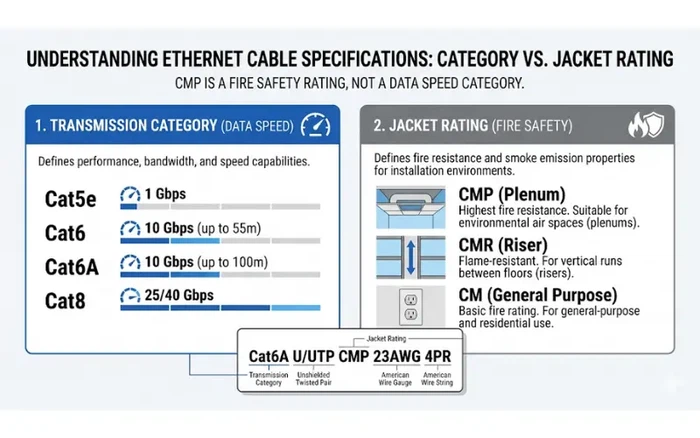
One of the most common procurement mistakes is treating CMP as a performance upgrade. It is not. CMP describes how the jacket behaves under flame and smoke testing. Cat5e, Cat6, Cat6A, and Cat8 describe transmission performance - bandwidth, alien crosstalk, and channel design.
If the route is plenum and you need 10G Ethernet, you need both: Cat6A and CMP. Choosing one without the other is how submittals get kicked back.
What Is a Plenum Space?
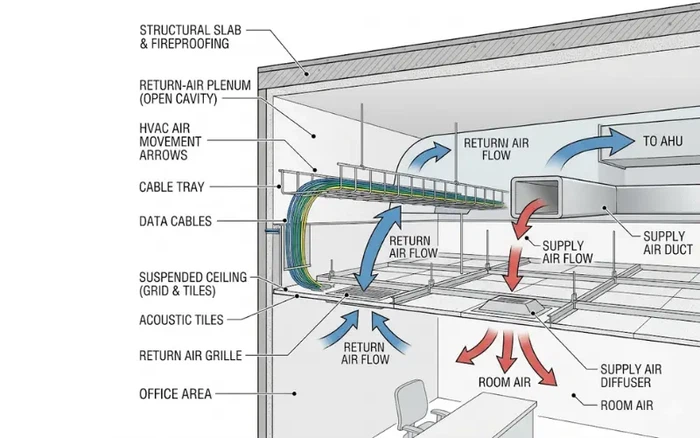
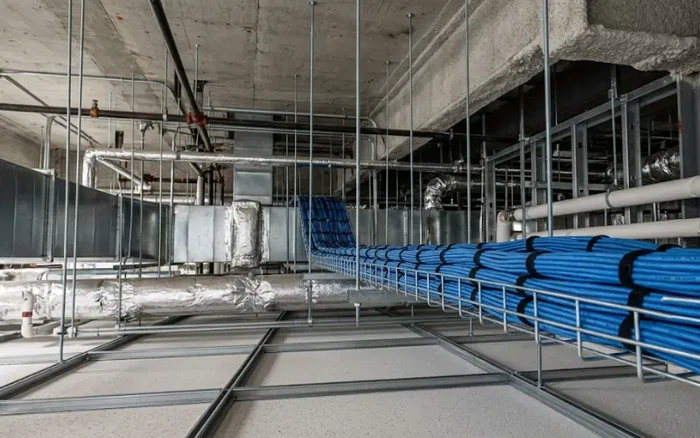
A plenum space is a building cavity used to move conditioned or return air, typically as part of an HVAC system. Because air movement can carry smoke between rooms and floors, cables in those spaces must meet stricter flame-spread and smoke-density limits.
Typical plenum spaces include:
- Return-air ceiling cavities above suspended ceilings
- Raised floors used as supply or return air paths
- Concealed shafts used for environmental air movement
- Certain HVAC plenums and air-handling chambers
Not every space above a drop ceiling is a plenum. Some ceilings are non-plenum - air is ducted separately. Do not guess from photos or a single floor plan. Confirm with the project specification, mechanical drawings, the local code, and the authority having jurisdiction. In submittal review, the most common dispute is not the cable category but a mismatched jacket rating that no one verified against the mechanical drawings.
CMP vs CMR vs CM vs CMX: Which Jacket Rating Do You Need?
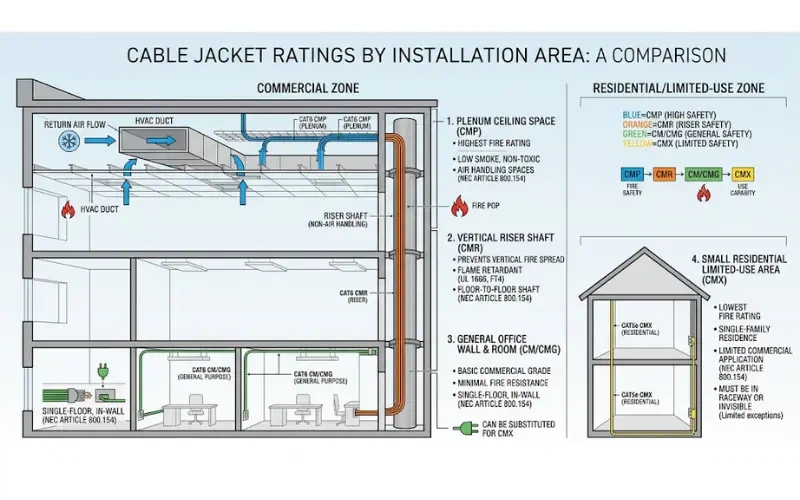
CMP, CMR, CM, and CMX are not quality grades stacked on top of each other. They are jacket classifications tied to specific installation environments under the National Electrical Code. Choose the rating based on where the cable is going, then choose the category.
| Rating | Typical Installation Area | Practical Meaning | Risk if Misused |
|---|---|---|---|
| CMP | Plenum / air-handling spaces | Required where plenum-rated cable is specified | CMR or CM in a plenum route can fail inspection |
| CMR | Riser shafts between floors | Designed for vertical riser applications | Should not be assumed acceptable in plenum spaces |
| CM / CMG | General-purpose communications areas | Used where neither riser nor plenum is required | May be rejected if route enters a rated space |
| CMX | Limited-use / dwelling applications | Often restricted to light-duty or residential use | Usually unsuitable for commercial structured cabling |
The hierarchy works upward - CMP can generally substitute for CMR or CM, but not the other way around. On mixed routes, contractors often either split the BOM by area or standardize on CMP for the whole pull to reduce approval risk.
Do You Need CMP Cable Above a Drop Ceiling?
Not always. The deciding question is whether the cavity above the ceiling is used to move environmental air. If the ceiling cavity is a return-air plenum, CMP is typically required. If air is ducted separately and the cavity is non-plenum, CMR or CM may be acceptable depending on the project rules.
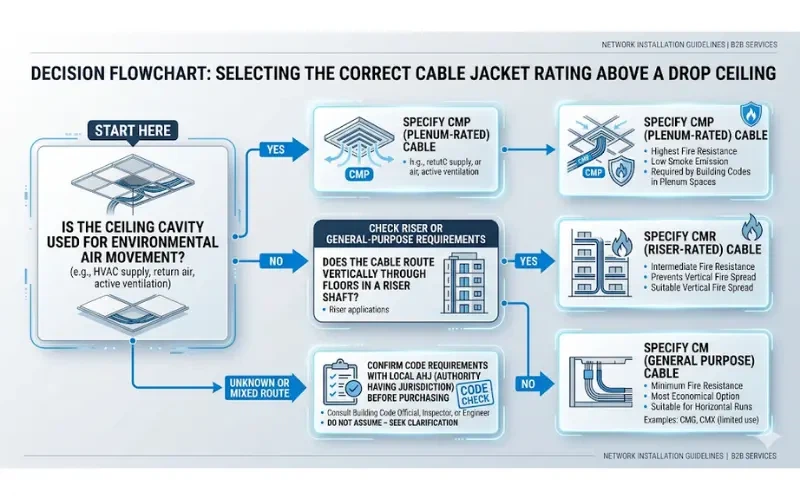
A simple decision flow:
- Route is plenum → specify CMP
- Route is riser only → CMR is typically appropriate
- Route is general-purpose, non-plenum, non-riser → CM/CMG may be acceptable
- Route is unknown or mixed → confirm with the AHJ before purchasing
What Does NFPA 262 Mean for CMP Cable?
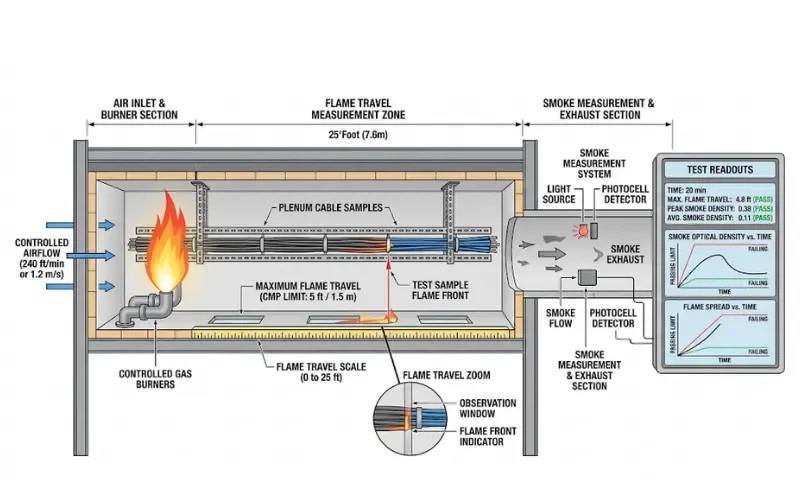
NFPA 262 is the test method used to evaluate flame travel distance and smoke characteristics of wires and cables installed in spaces used for environmental air. The standard is published by the National Fire Protection Association, and its scope covers measurement of flame travel distance and optical density of smoke for electrical and optical fiber cables in those spaces.
For buyers, NFPA 262 is the compliance backbone behind plenum-rated cable. UL Solutions describes its plenum predictive model as relating to NFPA 262 compliance for plenum flame testing, while riser-rated cable is associated with UL 1666 testing for vertically installed shafts.
What NFPA 262 Tests
In practical buying language, NFPA 262 addresses flame travel along the cable, peak smoke density, and average smoke density. These are the metrics that decide whether a cable can carry CMP marking on its jacket.
What NFPA 262 Does Not Tell You
NFPA 262 does not say anything about transmission category, channel performance, alien crosstalk, PoE thermal behavior, shielding effectiveness, or installation workmanship. A cable that passes NFPA 262 is not automatically Cat6A - it is simply allowed in plenum spaces under the relevant code.
For procurement, the better questions are:
- Is the cable physically marked CMP on the jacket?
- Is the product listed under a recognized scope (such as in UL Product iQ)?
- Does the listing scope match the actual construction being supplied?
- Does the datasheet match the line marking and the carton label?
UL 910 vs NFPA 262: Are They the Same?
Buyers sometimes see "UL 910" referenced in older specifications. Historically, UL 910 was the steiner tunnel test for plenum cables, and its technical content has long been incorporated into NFPA 262. In modern specifications, NFPA 262 is the standard reference. If a project document still cites UL 910, the safest course is to ask whether the design team intends NFPA 262 compliance and confirm with the listing evidence on the proposed cable.
CMP Cable vs LSZH Cable: Common Confusion in Export Projects
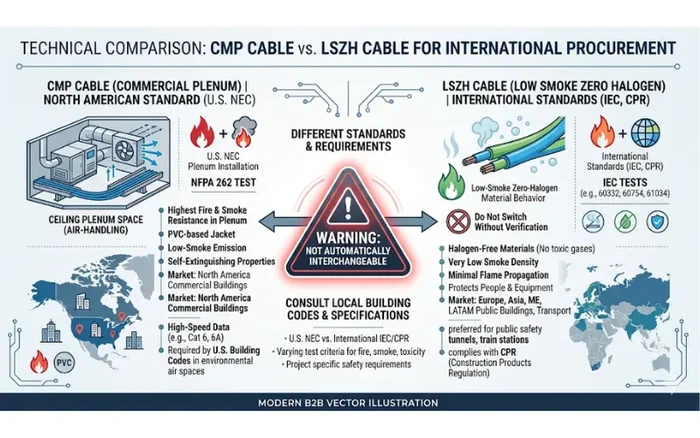
CMP and LSZH are frequently conflated in international procurement, but they describe different things.
| Term | What It Describes | Can It Replace CMP? |
|---|---|---|
| CMP | NEC-recognized plenum jacket rating | Yes - when correctly listed and marked |
| LSZH | Low-smoke zero-halogen material behavior (often referenced in IEC/CPR markets) | Not automatically |
| "Flame retardant" | Generic fire-performance description | Insufficient without a defined standard |
| UL Listed CMP | Product certified under a recognized scope, marked CMP | Strong evidence for NEC-based projects |
LSZH describes how the jacket material behaves when burning - particularly low halogen emission. CMP describes a jacket's eligibility for plenum installation under U.S. code. A cable can be LSZH without being CMP, and vice versa. For export projects, do not translate "low smoke" into "CMP." Confirm the actual standard the customer's local authority recognizes before quoting.
How to Choose CMP Cable: A 5-Step Procurement Checklist?
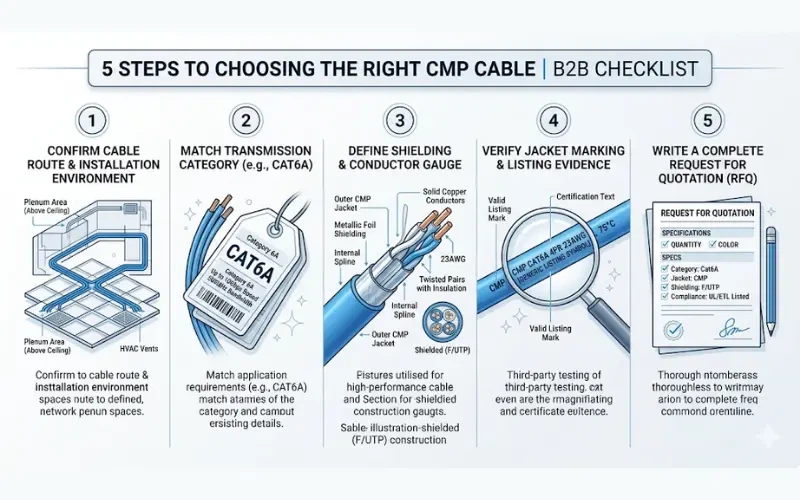
Step 1 - Confirm the Cable Route Before Anything Else
Start with the route, not the price. Walk through the questions:
- Does the cable pass through a return-air ceiling?
- Will it run under a raised floor used for air distribution?
- Will it pass through a vertical riser shaft?
- Are the drawings or specs explicit about plenum?
If any segment is plenum, CMP is on the table. For mixed routes, many contractors either separate the BOM by area or standardize on CMP for the entire pull to simplify approval.
Step 2 - Match the Transmission Category
Once the jacket rating is settled, choose the category based on bandwidth and PoE plans:
- Cat5e CMP for basic gigabit networks
- Cat6 CMP for typical commercial office runs
- Cat6A CMP for 10G-ready and dense PoE deployments
- Fiber plenum cable where copper is unsuitable for distance, EMI, or bandwidth
Cat6 CMP and Cat6A CMP share a jacket rating but differ significantly in transmission design. Don't assume they are interchangeable on a project where the channel is engineered to a specific category.
Step 3 - Define Shielding, Conductor, and PoE Requirements
Then decide the electrical and mechanical details:
- U/UTP, F/UTP, U/FTP, or S/FTP based on the EMI environment
- Solid bare copper conductors for permanent links - recommended by structured cabling practice for stable PoE behavior, mechanical reliability, and predictable insertion loss
- 23 AWG vs 24 AWG depending on PoE current and bundle size
- Bonding and grounding strategy if shielded
For high-density PoE, conductor size and bundle heat behavior matter - a topic addressed in TIA cabling standards and worth confirming early in the design.
Step 4 - Verify Marking and Listing Evidence
A serious CMP order is approved on documents, not on logos. Check:
- Jacket print legend showing CMP, category, AWG, pair count, and listing info
- Brand and traceable batch/lot codes
- Carton label consistent with print legend
- Datasheet matching both the marking and the certificate scope
- Listing scope that actually covers the construction supplied
Step 5 - Write a Complete RFQ
"CMP cable" alone is not an RFQ. Suppliers can only quote accurately when the request includes:
- Cable type and category (e.g., Cat6A U/UTP)
- Jacket rating: CMP
- Conductor: solid bare copper, AWG specified
- Shielding structure
- Jacket color and required print marking
- Length and packaging (reel, pull box, length per box)
- Certification and listing evidence required
- Destination market and quantity
How to Read CMP Cable Markings on the Jacket
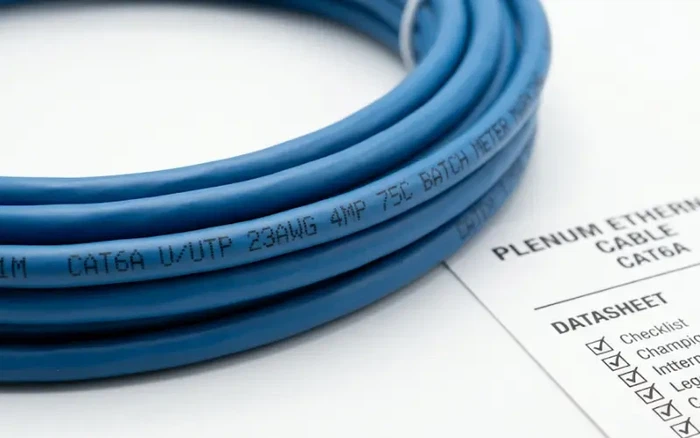
A typical jacket print legend repeats along the cable in a format like:
BRAND CAT6A U/UTP 23AWG 4PR CMP 75°C [LISTING] [BATCH] [METER MARKING]
| Marking Element | What to Verify |
|---|---|
| Brand / manufacturer | Source and traceability |
| Cat6 / Cat6A | Transmission category |
| U/UTP / F/UTP / S/FTP | Shielding structure |
| 23AWG / 24AWG | Conductor size |
| 4PR | Pair count |
| CMP | Plenum rating claim |
| Temperature rating | Operating condition |
| Listing info | Certification evidence |
| Batch / lot code | Quality tracking |
| Meter marking | Installation and inventory control |
If the datasheet, carton label, certificate, and jacket print do not align, pause approval and ask the supplier for clarification before committing to the order. This is also why structured cabling buyers often pair CMP cable with verified connector and termination components from suppliers that maintain consistent traceability.
Why Is CMP Cable More Expensive?
CMP cable typically costs more than CMR or CM cable, and the reasons are physical, not artificial. Plenum jackets use compounds engineered to limit flame travel and smoke density under NFPA 262 conditions - most commonly fluorinated polymers such as FEP, which are more expensive than the PVC compounds used in CMR or general-purpose cable. The insulation around individual conductors may also use FEP or comparable materials, raising the total bill of materials.
The result is a cable that is genuinely more costly to manufacture, not just better marketed. Whether that cost is "worth it" depends entirely on the route - CMP is mandatory in some installations and a waste in others.
When Do You Need CMP Cable? Practical Installation Scenarios
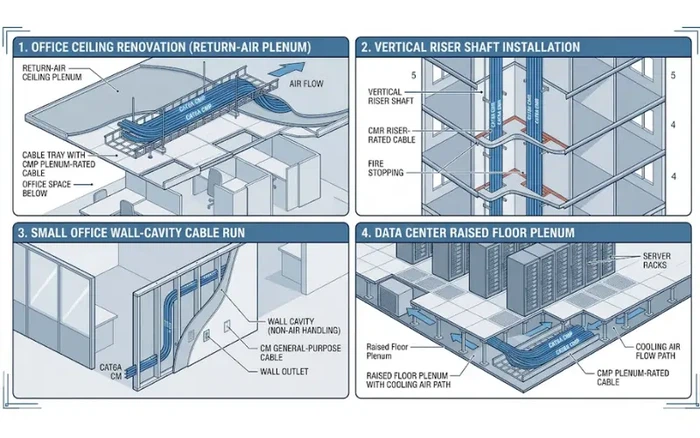
Scenario 1: Office Renovation With Return-Air Ceiling
An office tenant build-out routes data cabling above a suspended ceiling that doubles as a return-air plenum. The mechanical drawings show the entire ceiling cavity feeding back to the AHU. Recommended specification: CMP for the full ceiling run. Verify jacket print, datasheet, and a listing reference matching the supplied cable.
Scenario 2: Vertical Shaft Between Floors
Cable runs vertically between floors through a riser shaft separated from any air-handling system. CMR is typically appropriate. CMP is acceptable as a higher-rated option, but only worth specifying when the same SKU is also used elsewhere for inventory simplification.
Scenario 3: Small Office, Wall-Cavity Run
A short run inside drywall in a single office, with no plenum or riser involvement. CM or CMG often suffices under the project rules. Don't over-specify CMP unless the standardization decision has already been made.
Scenario 4: Data Center Raised Floor
If the raised floor is part of the cooling air path (a common arrangement in legacy data centers), CMP is often required. If the raised floor is purely structural and air is ducted overhead, the requirement may differ. Verify with the mechanical design, not assumptions.
Scenario 5: Export Project With "Low-Smoke" Requirement
An overseas buyer requests "low-smoke cable." Don't translate this directly to CMP. Ask whether the project follows NEC/NFPA/UL rules, CPR (the EU Construction Products Regulation), or a national LSZH-based standard. The right answer determines whether you quote CMP, LSZH, or a CPR-rated equivalent - three different products.
Common Mistakes Buyers Make With CMP Cable
Mistake 1: Treating CMP as a Performance Upgrade
CMP does not make a cable faster. It makes the cable eligible for plenum installation when properly listed.
Mistake 2: Substituting CMR for CMP to Save Money
CMR is appropriate for risers, not for plenum routes. Pulling CMR through a plenum because it's cheaper is exactly the kind of decision that creates rework after inspection.
Mistake 3: Assuming LSZH Means CMP
LSZH and CMP overlap in spirit (both relate to fire behavior) but not in standard. Verify the project's actual reference standard.
Mistake 4: Buying by Jacket Color
Jacket color helps with on-site identification, but it does not prove rating, category, shielding, or listing scope.
Mistake 5: Accepting Vague Certification Claims
"Flame retardant" or "low smoke" on a product page is not equivalent to documented CMP compliance. Ask for the datasheet, jacket print legend, listing evidence, and traceability data.
FAQ
What does CMP cable mean?
CMP stands for Communications Multipurpose Cable, Plenum. It is a jacket rating for cables installed in plenum or air-handling spaces under U.S. fire code.
Is CMP cable better than CMR cable?
"Better" depends on the installation. CMP has stricter flame-spread and smoke requirements and is required for plenum spaces. CMR is appropriate for riser applications. Choose by route, not by which sounds higher-grade.
Can CMR cable be used in plenum spaces?
Don't assume so. If the project specifies CMP, substituting CMR is likely to fail inspection and trigger replacement.
Is plenum cable required above every drop ceiling?
No. Plenum cable is required when the ceiling cavity is used for environmental air movement. A non-plenum ceiling cavity may not require it. Confirm with mechanical drawings and the AHJ.
Is CMP the same as Cat6A?
No. CMP is a jacket rating; Cat6A is a transmission category. A cable can be Cat6A CMP, but CMP alone says nothing about bandwidth.
Is CMP the same as LSZH?
No. LSZH refers to low-smoke zero-halogen material behavior, common in IEC/CPR markets. CMP is a U.S. plenum jacket rating. Verify which standard the project follows.
Is Cat6 CMP different from regular Cat6?
Same transmission performance, different jacket. Cat6 CMP uses a plenum-rated jacket for installation in air-handling spaces. Regular Cat6 typically refers to CMR or CM versions.
Does CMP cable need to be UL Listed?
Most U.S. projects expect UL listing or an equivalent recognized certification. Listing logos alone are not evidence - verify the listing scope matches the cable being supplied.
Is CMP cable worth the extra cost?
It is worth it when the installation route is plenum and inspection requires it. It is not worth it when the route does not need it. The cost comparison only makes sense after the route is confirmed.
What should I check before placing a CMP cable order?
Confirm the route, the cable category, the CMP marking, the conductor type and AWG, the shielding, the listing evidence, the datasheet, the carton label, and the batch traceability.
Summary
CMP is a jacket rating, not a performance category. Specify it when the cable route is plenum, when project documents demand it, or when the AHJ requires it - and pair it with the right transmission category, conductor design, and shielding for the application. Confirm the route first, then build the spec around it.
Before sending an RFQ, prepare the cable category, CMP requirement, shielding type, conductor and AWG, jacket color, packaging, quantity, destination market, and required certification evidence. Suppliers that work in structured cabling and network cable can quote accurately and avoid approval delays when the request is complete from the start. If the design also includes optical links, fiber alternatives such as MTP/LC plenum harness cables, OM4 patch cords, or OS2 single-mode patch cords are commonly specified alongside CMP copper. For fiber-route distribution, fiber termination boxes, plug-in adapters, and PLC splitters typically share the same compliance review path as the copper cabling. For an overview of CMP vs CMR fire ratings, the related comparison guide expands on this trade-off, and a deeper read of Ethernet cable categories from Cat5 to Cat8 covers how transmission category interacts with jacket selection.