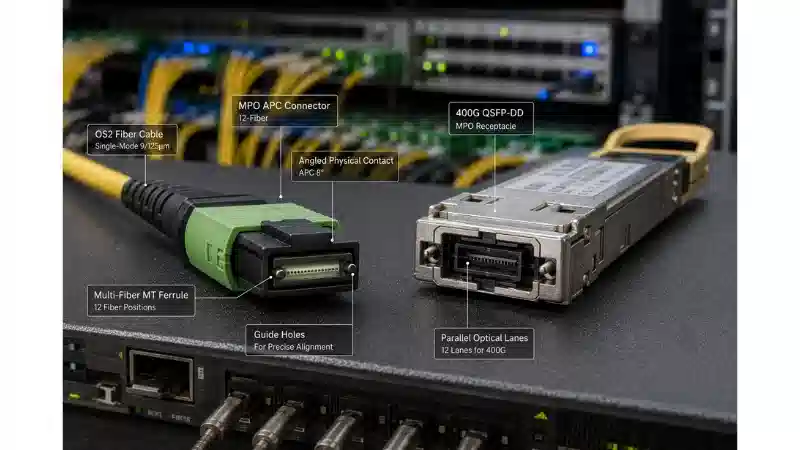
Picking the right fiber optic cable is rarely just a question of connector type, fiber mode, or bandwidth. Long before optical performance enters the picture, the fiber optic cable jacket fire rating decides whether a cable is legal - and safe - to run through a plenum ceiling, a riser shaft, an office pathway, or an outdoor route. Get this wrong and the cable may still light up; it just may not pass inspection, and in a fire it may behave in ways the building was never designed for.
This guide is written for network installers and infrastructure buyers who need to verify fiber cable ratings before purchase. It walks through jacket materials, U.S.-style NEC fire ratings such as OFNP and OFNR, how to read what is printed on the cable, and the mistakes that quietly cause project re-work.

Quick Answer: Which Fiber Optic Cable Jacket Fire Rating Do You Need?
For a U.S./NEC-based installation, start with where the cable will actually run:
- Plenum or air-handling space (return-air ceilings, environmental air ducts) - use OFNP or OFCP. Plenum cables are required to pass the most stringent flame and smoke test of the listed optical fiber cable types.
- Vertical riser shaft (floor-to-floor backbone) - use OFNR or OFCR, or a higher-rated cable.
- General indoor horizontal run (single-floor, non-plenum) - OFNG, OFCG, OFN, OFC, or a higher rating.
- Outdoor run - outdoor-listed cable, typically with a PE jacket for moisture, UV, and abrasion resistance.
- Public, enclosed, or smoke-sensitive environments - pair the required fire rating with an LSZH jacket where the specification calls for it.
Always confirm the final requirement with the project specification, applicable local code, and the authority having jurisdiction (AHJ). In U.S. installations, listed optical fiber cable types are covered by UL safety standards, and plenum cables are tested to NFPA 262. Outside North America, European installations follow the Construction Products Regulation (CPR) and IEC-based Euroclasses, which use a different vocabulary and are not directly equivalent.

What a Fiber Optic Cable Jacket Actually Does?

The jacket is the outer sheath wrapped around the cable's fiber, strength members, and buffer layers. It protects against mechanical abrasion, moisture ingress, chemicals, UV, and the rough handling of real installs. It does not, on its own, define optical performance - bandwidth and distance come from the fiber itself, whether that is OS2 single-mode, OM3, OM4, or OM5 multimode.
What the jacket does decide is where the cable can be legally and safely installed. A good selection process answers three questions at the same time:
- Will the cable survive the physical environment for the next 15–25 years?
- Does its listed rating match the pathway it will occupy?
- Will the printed marking on the cable satisfy the inspector and the project spec?
Jacket Material vs Fire Rating vs Jacket Color: Three Different Things

Most bad cable purchases come from confusing these three.
Jacket material is the compound - PVC, LSZH, PE, PVDF - that determines mechanical flexibility, smoke behavior, chemical and UV resistance, and cost.
Fire rating is the code classification (OFNP, OFNR, OFNG, OFN) that tells you where the cable is listed for installation. It is the answer the inspector cares about.
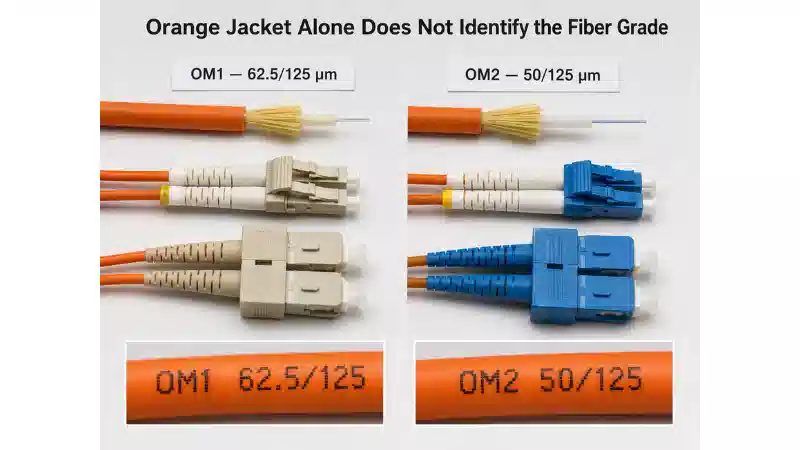
Jacket color is mainly for fiber identification, not fire performance. TIA-598 recommends yellow for single-mode OS1/OS2, orange for legacy multimode, aqua for OM3/OM4, and lime green for OM5. The FOA notes that other colors may be used if the print legend identifies the fiber type, and that some plenum-rated materials restrict available colors. The takeaway: do not judge a cable's fire rating by its color. Read the print.
Common Fiber Optic Cable Jacket Materials

PVC: Practical for Standard Indoor Runs - Until the Pathway Changes
Polyvinyl chloride is widely used because it is flexible, easy to manufacture, and cheap. It can be formulated to be flame-retardant and is the default material on many general-purpose and riser-rated indoor cables. The trade-off is fire behavior: under combustion, PVC tends to produce dense smoke and corrosive hydrogen chloride. PVC is often the practical choice for standard indoor cabling, but it should not be chosen on price alone when the route crosses a plenum space or a smoke-sensitive area.
LSZH: Low-Smoke, Halogen-Free - But Not Automatically Plenum
Low Smoke Zero Halogen (LSZH) describes a material designed to emit minimal smoke and no halogen acid gases when burned. That makes it attractive for enclosed public spaces - transit tunnels, hospital corridors, ship interiors - where evacuation visibility and equipment survival matter. You can find LSZH variants of common patch cords, including LC-to-LC LSZH single-mode jumpers.
The critical point: LSZH is a chemistry, not an NEC installation rating. A cable can be LSZH and still need a separate OFNR, OFNP, or other listed marking depending on the pathway. Always read both.
PE: The Outdoor Workhorse
Polyethylene jackets are standard on outdoor fiber optic cables because PE resists moisture, abrasion, and UV well. PE is excellent for buried, aerial, and direct-exposure routes. It is not, however, an indoor pass: when an outdoor cable enters the building, NEC rules typically limit how far it can run before transitioning to a listed indoor cable, an approved raceway, or being terminated in a splice enclosure.
PVDF: A Specialty Choice for Stricter Flame and Smoke Profiles
Polyvinylidene fluoride is used where the specification calls for tighter flame resistance, lower smoke, and better chemical tolerance than standard PVC. It is more expensive and more specialized, and it shows up most often in plenum constructions or industrial settings. As always, verify the listed rating on the cable rather than assuming the material name implies a particular code classification.
Fiber Optic Fire Ratings: What the Letters Actually Mean

U.S. optical fiber cable types use a short letter code. Read it left to right:
- OF - Optical Fiber
- N - Nonconductive (no metallic components that could carry current)
- C - Conductive (contains metallic strength members or armor)
- P - Plenum
- R - Riser
- G - General-purpose
So OFNP is a nonconductive plenum cable; OFCR is a conductive riser cable. Conductive cables - including many armored fiber patch cords - carry additional bonding and grounding obligations under the NEC because their metallic elements can conduct fault current.
OFNP and OFCP: Plenum-Rated Cables
Plenum-rated cables are intended for ducts, plenums, and air-handling ceilings used to transport environmental air. They must pass the flame and smoke limits of NFPA 262 - the most stringent test among standard optical fiber cable listings.
OFNR and OFCR: Riser-Rated Cables
Riser-rated cables are intended for vertical shafts and floor-to-floor pathways. The riser test is demanding but less so than the plenum test; it is designed to keep fire from propagating vertically between floors. A riser cable is not a substitute for plenum cable in an air-handling space.
OFNG, OFCG, OFN and OFC: General-Purpose
General-purpose cables are for indoor pathways that are neither plenum nor riser - most single-floor, non-air-handling routes. They should not be substituted into riser or plenum spaces unless installed through a code-permitted alternative (such as inside an approved metal raceway).
The Substitution Hierarchy: Up, Not Down

The rule is straightforward:
Plenum > Riser > General-purpose
Higher-rated cable can substitute downward. Plenum cable is acceptable in riser and general-purpose spaces; riser cable is acceptable in general-purpose spaces. Going the other way is not allowed under standard NEC rules. If a contractor proposes using OFNR in a return-air ceiling because it is cheaper, that is a specification failure waiting to happen at inspection.
How to Read a Fiber Optic Cable Marking

The print legend on the cable jacket is the single most important piece of evidence at inspection. A typical marking on an indoor jumper might include:
12F OS2 9/125 OFNR LSZH [Manufacturer Name] [UL Listing Mark] [Date Code]
Reading it piece by piece:
- 12F - fiber count (12 fibers)
- OS2 9/125 - single-mode fiber, 9/125 µm core/cladding
- OFNR - Optical Fiber Nonconductive Riser, listed for riser pathways
- LSZH - low-smoke, zero-halogen jacket material
- UL listing mark - confirms the rating has been tested and listed
When the print is faded, abraded off in the pull, or simply not there, treat the cable as unverified. Ask for the manufacturer datasheet and the UL listing reference before installing it.
How to Choose the Right Fiber Optic Cable Jacket and Rating
Step 1: Map the Pathway Before You Pick Anything
Walk the route (or read the drawings carefully) and answer:
- Does the cable cross an air-handling plenum or return-air ceiling at any point?
- Does it travel vertically through a riser shaft between floors?
- Is it confined to a single floor in non-plenum space?
- Does it run outdoors - aerial, buried, or duct?
- Does it transition from outdoor to indoor, and if so, where is the terminating enclosure?
- Is any section in a smoke-sensitive area such as a hospital corridor, transit station, or evacuation route?
This step usually fixes the minimum rating.
Step 2: Verify Code, Specification, and AHJ Requirements
Do not rely on a generic product description. Cross-check the project spec, the local adopted edition of the NEC (or local equivalent), the AHJ's interpretation, and the manufacturer's listing documentation. For sensitive sites - hospitals, schools, data centers, airports, transit - there is almost always a project requirement stricter than the base code, and missing it can mean tearing out and replacing the run.
Step 3: Match the Jacket Material to Environmental Risk
Once the required fire rating is locked in, pick the material:
- PVC where the rating allows it and budget matters.
- LSZH where smoke and corrosive gas behavior are part of the specification.
- PE for outdoor exposure.
- PVDF for stricter flame, smoke, or chemical-resistance requirements.
Rating and material must both be right. A cable can have an excellent jacket material and still fail because it lacks the required installation listing.
Step 4: Verify the Printed Markings and Datasheet Before Purchase
This is the step that most often gets skipped under time pressure. Before ordering bulk quantities or pre-terminated assemblies, confirm:
- Printed rating (e.g., OFNP, OFNR)
- UL or other listing mark
- Jacket material (PVC, LSZH, PE, PVDF)
- Indoor / outdoor / indoor-outdoor designation
- Fiber type (OS2, OM3, OM4, OM5) and count
- Regional applicability (NEC, CPR Euroclass, etc.)
- Match against the project specification
Worked Examples: Pathway, Decision, and Verification Checks

Example 1: Data Center Return-Air Ceiling
Scenario: A 96-fiber backbone runs above a suspended ceiling that the mechanical drawings show as a return-air plenum.
Decision: Plenum-rated cable (OFNP or OFCP) is required for the section in the plenum. Substituting OFNR because it costs less is not acceptable, even if "it's only ten feet."
Verification: Confirm OFNP marking on the jacket print, confirm UL listing, confirm the spec does not also require LSZH chemistry on top of plenum rating.
Example 2: Office Backbone Between Floors
Scenario: A 24-fiber OS2 single-mode backbone runs from a ground-floor MDF to a fourth-floor IDF through a vertical shaft, with no plenum involvement.
Decision: OFNR is the baseline. OFNP is acceptable and sometimes specified as a future-proofing measure.
Verification: Confirm riser marking, confirm fire-stopping at each floor penetration is part of the install plan (the cable's rating does not exempt the building from sealing the penetration).
Example 3: Outdoor-to-Indoor Transition

Scenario: A loose-tube outdoor cable with PE jacket enters the building at a basement entrance, terminates in a splice closure, and an indoor cable continues to the equipment room 80 ft away.
Decision: The outdoor PE cable cannot continue indoors indefinitely. Standard practice - and what most AHJs expect - is to terminate the outdoor cable at or near the building entrance and transition to a listed indoor cable, or place the outdoor cable in an approved raceway for any extended indoor run. Indoor-outdoor rated indoor-outdoor fiber cable is purpose-built for this transition zone.
Verification: Check building entrance distance limit under the adopted code, confirm splice closure or transition method, confirm the indoor cable has the right rating for whatever it crosses next.
Example 4: Hospital Corridor Above a Return-Air Ceiling
Scenario: A 12-fiber OM4 horizontal run above a return-air ceiling in a hospital wing.
Decision: Plenum rating is required because of the ceiling, and the hospital spec calls for LSZH chemistry as well. Both conditions must be met - neither replaces the other.
Verification: Look for OFNP and LSZH in the print legend. If only one appears, request datasheet confirmation or pick a different SKU.
Common Mistakes That Cause Re-Work
Treating LSZH as a Plenum Substitute
This is the most common confusion in our experience. LSZH describes how a material burns; plenum describes where a cable is listed to be installed. A cable can be LSZH without being plenum-rated, and using one in place of the other can fail inspection.
Running Riser Cable Through a Plenum
Often happens when the ceiling type changes mid-route and nobody re-checks. If even a short section of the run is in an air-handling plenum, that section needs plenum-rated cable or an approved raceway.
Judging Fire Rating by Jacket Color
Yellow does not mean single-mode plenum, and aqua does not mean OM4 riser. Colors identify fiber type per TIA-598. The fire rating is what is printed alongside it.
Extending Outdoor PE Cable Indoors Without Limit
Outdoor cables are mechanically rugged, but their jackets are not tested under indoor-fire criteria. Check the building entrance distance limit and the indoor pathway requirement before letting an outdoor cable continue tens of meters into the building.
Following Code but Missing the Project Spec
The applicable rule is always the stricter one. A project that specifies OFNP for the entire building backbone trumps the code minimum of OFNR for riser sections.
Before You Buy: Specification Checklist
Before issuing a purchase order for bulk cable or pre-terminated assemblies, walk this list:
- Pathway type confirmed (plenum, riser, general, outdoor, indoor-outdoor)
- Required fire rating identified and matched against the project spec
- Jacket material requirement clear (PVC acceptable / LSZH required / PVDF specified)
- Fiber type and count match the link budget and migration plan
- Connector style and polish (UPC vs APC) defined where pre-terminated
- Region-specific compliance confirmed (NEC listing for North America, CPR Euroclass for EU, etc.)
- UL or equivalent listing mark present on the printed jacket
- Datasheet on file for project records and AHJ inquiries
- Lead time and lot size align with the install schedule
For projects that involve MTP/MPO trunk assemblies, this same checklist applies to the trunk jacket and to any fanout assemblies that come out of breakout enclosures.
A Note on Regional Standards
The OFNP/OFNR vocabulary in this guide is U.S./NEC-based. In Europe, the Construction Products Regulation (CPR) classifies cables by Euroclass (Aca, B1ca, B2ca, Cca, Dca, Eca, Fca) with separate s/d/a designations for smoke, droplets, and acidity. These are not direct translations of NEC ratings - a CPR Cca-s1,d1,a1 cable is not the same thing as an OFNR cable, even if both are reasonable choices for vertical building backbones. For global deployments, design the cable schedule region by region rather than assuming one rating system maps onto another.
FAQ
What is a fiber optic cable jacket fire rating?
A classification that indicates where the cable is listed to be installed based on its flame and smoke performance. Common U.S. ratings include OFNP (plenum), OFNR (riser), and OFNG/OFN (general-purpose).
What does OFNP stand for?
Optical Fiber Nonconductive Plenum. It indicates a nonconductive optical fiber cable listed for installation in plenums and air-handling spaces, tested to NFPA 262.
What does OFNR stand for?
Optical Fiber Nonconductive Riser. It indicates a nonconductive optical fiber cable listed for vertical riser runs between floors.
OFNP vs OFNR: which is stricter?
OFNP is stricter. Plenum-rated cables face the tougher flame and smoke test of NFPA 262 and can typically be used in riser and general-purpose spaces, while riser cables are not approved substitutes for plenum cables.
Can OFNP cable be used instead of OFNR?
Generally yes. Because plenum is the higher tier, OFNP is usually acceptable in riser pathways. Confirm with the project spec and AHJ.
Can OFNR cable be used in a plenum space?
Not as a direct substitute. Riser-rated cable is not approved for plenum installation unless installed in an approved raceway or under another code-permitted exception.
Is LSZH the same as OFNP?
No. LSZH is a jacket material designed to emit low smoke and no halogen acid gases. OFNP is a fire-rating classification for plenum installation. A cable can be LSZH without being OFNP.
Is plenum cable required above a drop ceiling?
If the space above the drop ceiling is used for environmental air return, yes - plenum-rated cable or an approved alternative is typically required. If the ceiling is purely decorative and not part of the air-handling system, requirements may differ. Check the mechanical drawings and confirm with the AHJ.
Can outdoor fiber optic cable be used indoors?
For limited transitions, yes - but most codes restrict how far an outdoor-jacketed cable can run inside a building before transitioning to listed indoor cable or being placed in an approved raceway. Indoor-outdoor rated cables exist specifically to bridge this gap.
Does jacket color affect fire rating?
No. Color indicates fiber type under TIA-598 conventions (e.g., yellow for single-mode, aqua for OM3/OM4, lime green for OM5). Fire rating must be read from the print legend on the jacket.
Does OM3 or OM4 jacket color indicate fire rating?
No. Aqua is the conventional OM3/OM4 identifier - it tells you the fiber type, not whether the cable is plenum, riser, or general-purpose.
What is the difference between PVC and LSZH jackets?
PVC is flexible and economical but produces dense smoke and corrosive hydrogen chloride when burned. LSZH is engineered to emit low smoke and no halogen acid gases, making it preferable in enclosed public spaces - though it does not by itself satisfy plenum or riser code requirements.
Which jacket material is best for outdoor fiber cable?
Polyethylene (PE) is the standard outdoor jacket because it resists moisture, abrasion, and UV. For indoor segments after the transition, switch to listed indoor or indoor-outdoor cable.
What fire rating is required for data center fiber cabling?
It depends entirely on the pathway. Plenum spaces require OFNP; vertical risers require OFNR; non-plenum horizontal runs may accept general-purpose. Most modern data center specs prefer plenum-rated cable throughout for simplicity and future-proofing.
How do I read fiber optic cable jacket markings?
Read left to right on the print legend. Look for the fiber count and type (e.g., 12F OS2 9/125), the fire rating (OFNP, OFNR, etc.), jacket chemistry where marked (LSZH), the manufacturer, and the UL or equivalent listing mark.
Final Takeaway
The right fiber optic cable jacket is not the toughest, the cheapest, or the most familiar - it is the one that matches the pathway, the fire rating requirement, the material specification, and the regional code, all at once. Walk the route, read the spec, verify the print legend, and keep the datasheet on file. When something does not match, escalate before the cable goes into the wall - not after.
For deeper background on related topics, see our notes on multimode fiber types (OM1 through OM5), loose tube vs tight buffered fiber cables, and the difference between CM, CMR, and CMP fire ratings for copper cabling - which often runs alongside fiber in the same pathways and faces the same rating questions.
References
- NFPA 70 - National Electrical Code (NEC)
- NFPA 262 - Standard Method of Test for Flame Travel and Smoke of Wires and Cables for Use in Air-Handling Spaces
- UL safety standards for listed optical fiber cables
- Fiber Optic Association (FOA) - Fiber Optic Cable Reference
- Telecommunications Industry Association (TIA) - including TIA-598 color coding
Technical review: FOCC fiber optic product engineering team.