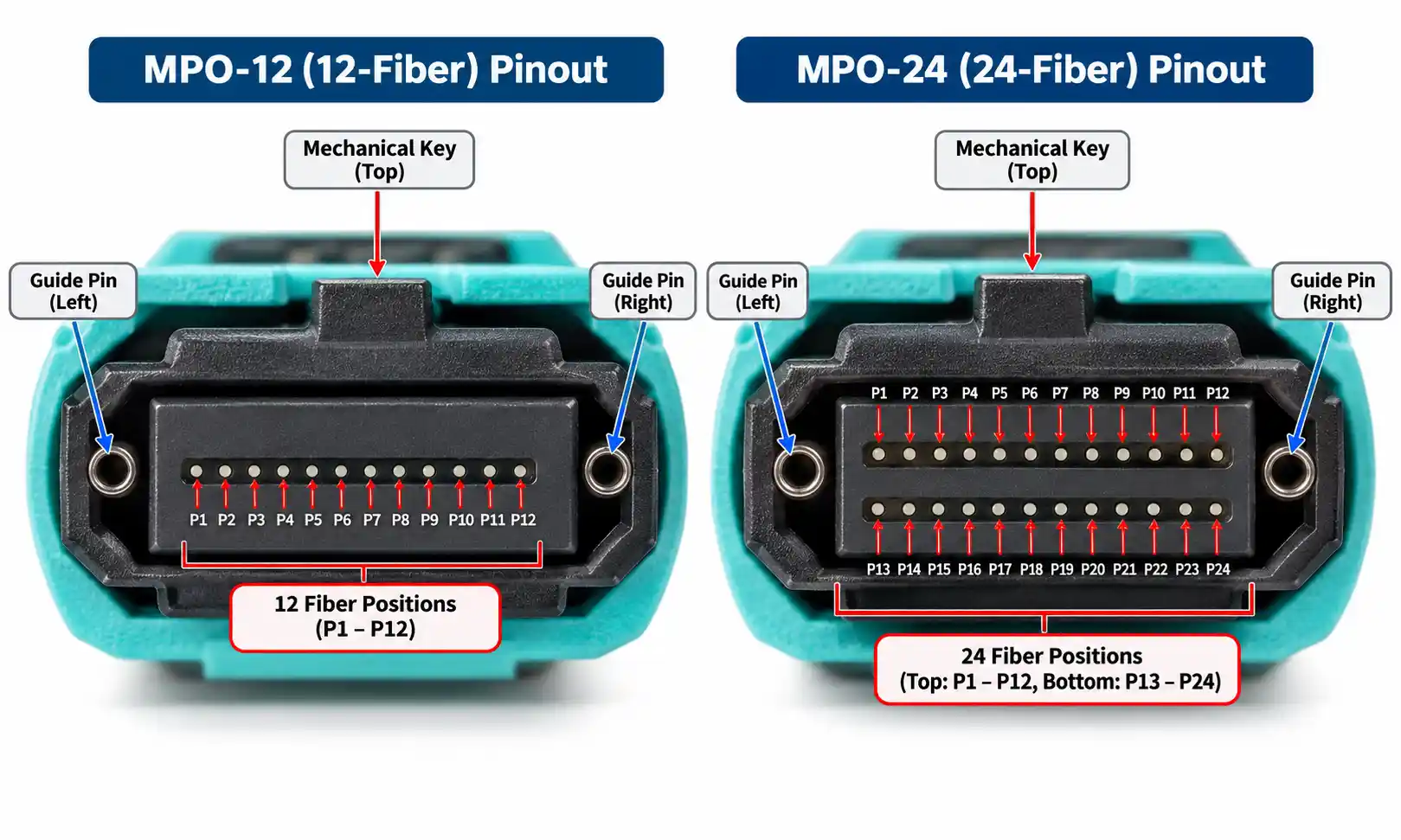
Data center infrastructure teams face this challenge daily: a single 24-port switch requires 288 individual fiber terminations when using traditional LC connectors. MTP MPO connectors consolidate 12 or 24 fibers into a single interface, reducing that complexity to just 12 connections. This consolidation saves rack space and simplifies cable management, but knowing when to deploy MTP MPO connector solutions-and which variant to choose-determines whether your network achieves maximum efficiency or faces performance bottlenecks.

Multi-Fiber Connectivity: The Foundation of Modern Data Centers
The MTP MPO connector has become the backbone of modern high-speed optical networks, particularly as bandwidth demands escalate beyond what traditional duplex connections can efficiently support. Network architects designing for 40G, 100G, and 400G transmission speeds encounter a space constraint problem: conventional LC duplex connections require multiple cables per link, consuming valuable rack space and creating management complexity.
Factory-terminated MTP MPO connector cables come pre-assembled, eliminating the need for skilled technicians to terminate each fiber individually in the field. This pre-termination approach reduces installation time by approximately 60% compared to field-terminated solutions and significantly lowers the risk of contamination or misalignment that plagues field terminations.
The architectural advantage extends beyond space savings. MTP MPO connector arrayed designs support parallel fiber connectivity for both multimode and singlemode fiber types, enabling 40GBASE-SR4 transceivers to use eight fibers within a single MPO-12 connector-four for transmit and four for receive. As networks scale to 100G and 400G, this parallel transmission architecture becomes essential rather than optional.
Modern implementations commonly deploy MPO-12 and MPO-24 configurations for standard data center applications, though specialty applications can accommodate 32, 48, 60, or even 72 fibers in large-scale optical switches. The scalability factor matters when planning five-year infrastructure roadmaps: pre-installing higher-count MTP MPO connector trunks allows organizations to "light" additional fibers as bandwidth requirements increase, without physical reconfigurations.
Decoding the Terminology: MPO vs MTP
The industry uses these terms interchangeably, creating confusion for procurement teams. MPO stands for Multi-Fiber Push On and represents a standardized MTP MPO connector type conforming to IEC-61754-7 and EIA/TIA-604-5 standards. Any manufacturer can produce MPO connectors provided they meet these specifications.
MTP is a registered trademark of US Conec for an enhanced MPO connector design that incorporates several patented improvements. The critical point: all MTP connectors are MPO-compatible, but not all MPO connectors deliver MTP-level performance. Interoperability exists between MTP MPO connector variants, yet performance characteristics differ measurably.
The engineering enhancements in MTP connectors address specific failure modes observed in generic MPO designs. Standard MPO connectors use plastic pin clamps which may break with repeated mating cycles, while MTP MPO connector designs employ metal pin clamps ensuring stronger grip and minimizing pin breakage. This material upgrade matters significantly in environments requiring frequent reconfigurations.
The floating ferrule design in MTP connectors allows physical contact maintenance under load or strain, whereas standard MPO ferrules remain fixed. When MTP MPO connector cables connect directly to active transceivers experiencing thermal expansion or mechanical stress, this floating mechanism prevents micro-gaps that degrade optical performance. The insertion loss difference-0.6dB maximum for MTP multimode versus 0.75dB for standard MPO-seems small but compounds across multiple connection points in long-distance links.
Guide pin geometry also differs: MPO uses flat-ended pins while MTP features elliptical stainless steel pins. The elliptical design reduces debris generation during connector mating and extends connector lifespan by minimizing ferrule end-face damage. Testing data shows MTP connectors typically withstand 500+ mating cycles while maintaining performance specifications, compared to 200-300 cycles for standard MPO designs.
One often-overlooked distinction: MTP connectors feature removable housings, allowing field technicians to rework ferrules, change connector gender, or perform interferometer scans after assembly. Standard MPO connectors lack this serviceability, requiring complete cable replacement if connector issues arise.
When Performance Margins Matter: Choosing Between MTP and MPO
The MTP MPO connector decision framework centers on three variables: link budget requirements, operational environment, and total cost of ownership over the deployment lifespan.
Link Budget Analysis
For 40G and 100G applications, standard MPO connectors typically provide sufficient performance. A 40GBASE-SR4 link with 100-meter reach tolerates the 0.75dB MPO insertion loss comfortably within its 7.3dB link budget. However, 400GBASE-SR8 applications operating near maximum reach specifications benefit from the MTP MPO connector's lower loss characteristics.
Calculate cumulative loss across your architecture. A typical spine-leaf topology might include: transceiver interface (0.5dB) + trunk cable (2.0dB for 100m OM4) + patch panel connection (0.75dB) + patch cord (0.5dB) + equipment connection (0.5dB). That totals 4.25dB before accounting for splice losses and connector pairs. Using MTP MPO connector technology instead of standard MPO saves approximately 0.3dB across three connection points-potentially the difference between meeting or exceeding IEEE specifications with safety margin.
Environmental Durability
High-vibration environments such as mobile command centers, naval vessels, or industrial automation systems demand MTP's metal pin clamps and floating ferrule design. Environmental MPO/MTP connectors with IP68 ratings exist for military communications, railways, and outdoor installations, but the internal MTP enhancements provide superior reliability under shock and vibration conditions.
Temperature cycling also affects connector performance. Data centers maintaining 18-27°C (64-80°F) stable environments rarely stress connectors thermally. Edge computing deployments in unconditioned spaces experiencing -20°C to +60°C ranges benefit from MTP's thermoplastic materials that maintain constant diameter for guide holes across temperature variations, versus thermoset compounds in standard MPO that absorb moisture and degrade.
Reconfiguration Frequency
Networks requiring frequent patching-test labs, staged rollout environments, or multi-tenant colocation facilities-accumulate mating cycles rapidly. MTP connectors are engineered for longer service life, reducing misalignment and signal loss risks. A facility performing weekly network reconfigurations might execute 250 mating cycles annually; MTP connectors reach 500-cycle ratings while MPO designs show performance degradation around 200-300 cycles.
Conversely, permanent backbone installations connecting switches to distribution panels experience minimal mating events post-installation. These applications rarely justify MTP's 30-40% price premium over standard MPO.

Application Scenarios That Demand MTP Connectors
400G/800G Backbone Deployments
As data centers scale to 400G Ethernet capable of running across 32, 16, and 8 fibers, MTP connectors become the optimal solution. The QSFP-DD transceivers powering these links operate with tighter optical budgets than previous generations. A 400GBASE-SR8 link allocates just 4.5dB maximum channel insertion loss across its 100-meter reach. Every 0.1dB saved through superior connector performance extends viable reach or accommodates additional connection points for flexibility.
Consider a typical 400G implementation: spine switch to leaf switch over 80 meters of OM4 fiber. MPO cables in several configurations including MPO-to-MPO trunk cables directly connect switches equipped with SR multimode optical transceivers. Using MTP MPO connector interfaces at both ends saves 0.4dB compared to standard MPO-translating to approximately 15 meters of additional reach potential or margin for future splices.
Direct-Attach Transceiver Applications
Fiber optic connectors that plug directly into active transmitter or receiver devices may experience applied loads, making MTP MPO connector floating ferrule design particularly advantageous. QSFP28 and QSFP-DD modules mount female MPO interfaces directly on the transceiver faceplate. Thermal expansion during operation can stress the connector interface; MTP's floating ferrule accommodates this movement without losing physical contact between mated ferrules.
Testing performed on direct-attach configurations shows MTP connectors maintain insertion loss specifications across operating temperatures from 0°C to 70°C, while standard MPO connectors can experience 0.3-0.5dB loss increases at temperature extremes due to thermal expansion mismatches.
Pre-Terminated Structured Cabling Systems
Enterprise networks deploying plug-and-play MPO/MTP connectors for Gigabit Ethernet infrastructure, telecommunications networks, and FTTB applications prioritize installation speed and long-term reliability. Pre-terminated MTP trunk cables reduce deployment time by 65-75% compared to field termination, while the enhanced durability ensures the 15-20 year lifespan typical of structured cabling investments.
Organizations standardizing on pre-terminated solutions should specify MTP connectors for permanent infrastructure despite higher initial costs. The avoided truck rolls for connector replacements over two decades offset the upfront premium. Field data from large enterprise deployments shows MTP-based systems require 40% fewer maintenance interventions than MPO-based equivalents over 10-year periods.
Cost-Effective MPO Use Cases
Standard MPO connectors deliver excellent performance in scenarios where their limitations don't impact operations. Understanding these use cases prevents over-engineering and unnecessary expenditure.
Low-Cycle-Count Permanent Infrastructure
Backbone trunk cables in the mpo mpo configuration connecting main distribution areas to intermediate distribution frames typically experience 5-10 mating cycles total: initial installation, acceptance testing, and occasional troubleshooting. MPO-terminated trunk cables used in duplex backbone links take up less pathway space and ease cable management while meeting performance requirements at lower cost than MTP alternatives.
For these permanent installations, insertion loss differences between MPO and MTP matter less than proper installation practices. A well-installed MPO trunk with clean end faces and correct polarity outperforms a poorly-installed MTP trunk. Budget-conscious projects can allocate savings from using MPO trunks toward professional installation training or better test equipment.
40G Multimode Applications Under 50 Meters
A typical 40GBASE-SR4 transceiver uses MPO-12 with eight fibers-four for transmit and four for receive. At distances under 50 meters, the insertion loss budget provides substantial margin even with standard MPO connectors. A 40-meter link over OM4 fiber accumulates approximately 1.2dB cable attenuation plus 1.5dB total connector loss (assuming two MPO connections), leaving comfortable margin within the 7.3dB budget.
Many enterprise top-of-rack to end-of-row aggregation switches fall within this distance range. Standard MPO cables priced 25-35% below MTP equivalents deliver identical functional performance for these applications.
Test and Staging Environments
Test environments, legacy patch panels, and small office setups where cost is primary concern and performance requirements are ordinary make standard MPO connectors more cost-effective. Lab networks used for equipment validation or training purposes rarely require the durability or ultimate performance of MTP connectors. The budget difference funds additional test equipment or more diverse transceiver inventory.
Staging environments preparing configurations for production deployment benefit from using the same connector types slated for production. However, if production uses mtp/mpo hybrid approaches-MTP at critical points and MPO elsewhere-staging can economize by using MPO throughout, recognizing the performance characteristics differ from final production topology.
Implementation Considerations and Common Pitfalls
Successful MTP MPO connector deployments require attention to polarity management, gender pairing, and cleaning protocols that differ from duplex connector practices.
Polarity Architecture Planning
MPO polarity methods A, B, and C ensure transmit and receive fibers align correctly. Type A and B are most common in data centers while Type C is typical for duplex applications. No single polarity type is universally superior; the correct choice depends on network architecture and equipment requirements.
Type A polarity (straight-through) transmits signals from fiber 1 in the first cable to fiber 1 in the second cable through Type A adapters that mate key-up with key-down connectors. This configuration suits architectures where trunk cables run between similarly-configured equipment on both ends. Type B polarity reverses the fiber order, connecting fiber 1 to fiber 12, accommodating different equipment port configurations.
The most costly deployment mistakes involve polarity mismatches. Document your polarity scheme during design phases and implement color-coding standards. MPO connectors can be color-coded to distinguish between different types and specifications-aqua for OM3/OM4 multimode, yellow for singlemode, lime for OM5. Supplement manufacturer color codes with custom labels indicating polarity type to prevent field technician errors.
Gender Configuration Requirements
All MPO transceiver ports use male connectors with guide pins, requiring female patch cables for proper mating. Connecting male to male results in pin collision and potential damage without establishing optical contact; female to female creates alignment problems. This absolute rule differs from duplex connectors where both ends typically use the same configuration.
When designing patch panel layouts, ensure proper gender assignment across the architecture. Trunk cables often use female-female configurations, with male-female patch cords providing final connections. Maintaining consistent standards across the facility prevents field technicians from improvising solutions that violate gender pairing rules.
Cleaning and Inspection Protocols
MTP MPO connector end faces must meet specific geometry parameters defined by IEC PAS 61755-3-31. The 12-fiber array increases contamination risk twelvefold compared to simplex connectors-a single dust particle on any fiber path degrades performance. Automated fiber endface analysis eliminates guesswork and provides consistent results regardless of technician experience.
Implement pass/fail inspection before every connection event. MPO-specific cleaning tools using one-click cleaners or cassette-style cleaners outperform methods adapted from duplex connector practices. The investment in automated inspection microscopes pays for itself through reduced troubleshooting time for mysterious performance issues traced to contaminated end faces.
Transceiver Compatibility Verification
Not all transceivers accept all MPO variants. Applications should verify transceiver specifications for fiber count requirements-either 12 or 24 fibers. A 100GBASE-SR4 transceiver expects MPO-12 with specific fiber assignments; connecting MPO-24 or incorrectly-configured cables prevents link establishment.
Vendor-specific implementations sometimes deviate from standards. Test sample cables with actual transceivers during procurement rather than assuming standards compliance guarantees interoperability. This validation catches edge cases where mechanical tolerances or optical specifications fall at opposite ends of acceptable ranges, causing compatibility issues despite both components meeting published standards.

Frequently Asked Questions
What is the main difference between MPO and MTP connectors?
MTP is a trademarked brand name for an MTP MPO connector manufactured by US Conec with enhanced specifications. The core differences include metal pin clamps in MTP versus plastic in MPO, floating ferrule design in MTP for better load tolerance, and elliptical guide pins in MTP versus flat pins in MPO. These enhancements result in lower insertion loss (0.6dB max for MTP versus 0.75dB for MPO in multimode applications) and improved durability.
When should I choose MTP over standard MPO connectors?
Select MTP connectors when applications involve: direct transceiver attachment where floating ferrule benefits matter, 400G/800G deployments requiring minimal insertion loss, environments with frequent reconfigurations exceeding 300 mating cycles, or extreme temperature/vibration conditions. Standard MPO suits permanent low-cycle installations, 40G/100G applications under 100 meters, and budget-constrained projects where 0.15dB loss difference doesn't impact link budgets.
Are MPO and MTP connectors interchangeable in existing infrastructure?
Yes, MTP MPO connector variants are fully compliant and can interconnect directly with MPO-based infrastructure. Physical compatibility exists at the mechanical interface level. However, in high-performance applications, an MPO connector is not operationally equal to an MTP due to performance differences. Mixing connector types within a link is acceptable but consider the link's performance will be limited by the lower-performing component.
How do I determine the correct polarity type for my application?
Type A and B are most common in data centers while Type C is typical of duplex applications, with no single polarity type being universally better. The appropriate choice depends on your network architecture design and equipment manufacturer requirements. Consult transceiver documentation for port configuration requirements, then select polarity types that maintain transmit-to-receive fiber alignment through your architecture. Document your chosen standard and implement color-coding to prevent field errors.
What fiber counts are available in mpo mtp configurations?
MPO connectors are commonly available with 8, 12, 16, or 24 fibers for standard data center and LAN applications. Specialized applications support 32, 48, 60, and 72 fiber counts in large-scale optical switches for super high-density multi-fiber arrays. The most common configurations remain MPO-12 for 40G/100G applications and MPO-24 for higher-density 100G implementations or future 400G readiness.
Do I need special cleaning equipment for MPO/MTP connectors?
Yes, MTP MPO connector cleaning requires different approaches than duplex connectors due to their multi-fiber arrays. One-click MPO cleaners or cassette-style cleaning tools specifically designed for rectangular MPO ferrules are essential. Automated fiber endface analysis provides consistent inspection results and should be standard practice before every connection. Standard simplex cleaning tools cannot effectively clean all 12 or 24 fibers simultaneously and risk missing contamination on individual fiber positions.
Conclusion
The choice between MTP and MPO connectors ultimately reflects your specific performance requirements and operational constraints rather than following universal prescriptions. MTP's enhanced engineering delivers measurable advantages in insertion loss, durability, and temperature stability-factors that matter significantly in ultra-high-speed applications, direct-attach configurations, and high-cycle-count environments.
Standard MPO connectors serve effectively in permanent installations, moderate-speed applications, and scenarios where link budgets provide comfortable margins. The 25-40% cost differential between MTP MPO connector types can fund other infrastructure improvements when properly allocated. Smart network architects assess total cost of ownership across expected deployment lifespans, factoring in potential maintenance interventions and performance limitations.
Regardless of connector choice, success depends on rigorous polarity planning, proper gender configuration, and disciplined cleaning protocols. These operational practices often impact long-term reliability more than the connector technology itself.
Key Takeaways
MTP MPO connector technology offers 0.15dB lower insertion loss and 2x longer lifespan compared to standard MPO, justifying their premium in 400G+ applications and high-cycle environments
Standard MPO delivers cost-effective performance for permanent installations and 40G/100G applications under 100 meters where link budgets provide margin
All transceiver ports use male MTP MPO connector interfaces requiring female patch cables-mixing genders incorrectly prevents connections or causes damage
Polarity planning (Type A/B/C) must occur during design phases with consistent color-coding and documentation to prevent field installation errors
Automated end-face inspection before every connection prevents contamination-related performance degradation in multi-fiber arrays