Rework costs run three to five times the original cable investment when an inspection fails. Schedule delay is the expensive part. The cable itself is the smallest number on that invoice. NEC Article 800 treats CMP and CMR as binary classifications. The cable jacket is either marked correctly for the space, or the installation fails (nfpa.org).
We supply Cat6 plenum and riser cable from our Shenzhen facility to projects across North America, Europe, and Asia. What we've learned from supporting these installations: the compliance failures almost never come from product defects. They come from procurement decisions made without accurate space classification data.

CMP vs CMR: What Determines the Requirement
CMP (Communications Multipurpose Plenum) cables pass UL 910 testing with a 300,000 BTU/hour flame in a 25-foot Steiner tunnel under forced air circulation. CMR (Communications Multipurpose Riser) cables pass the UL 1666 vertical flame test. The rating you need depends entirely on where the cable runs.
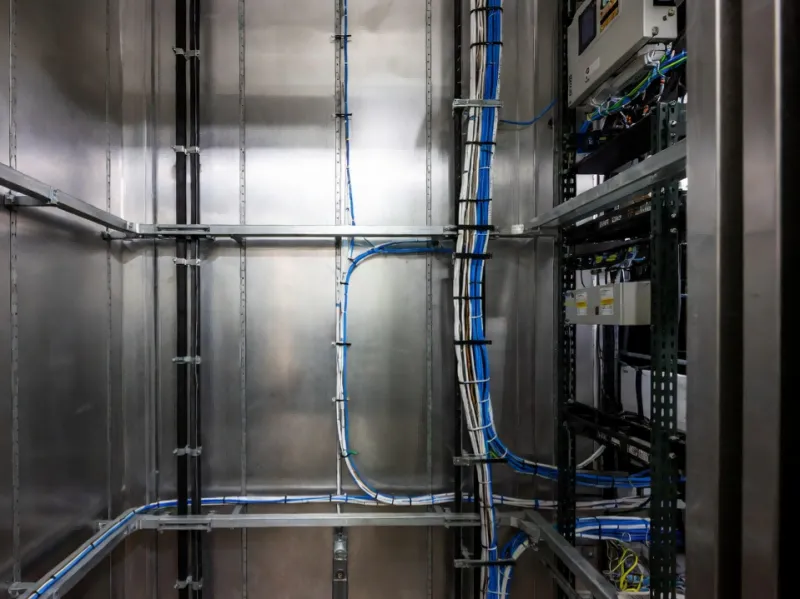
CMP cable is required wherever HVAC air circulates through the space containing your cables. In practice, that rule creates more ambiguity than it resolves.
Most commercial drop ceilings don't qualify as "plenum spaces" under strict NEC definitions, but they often fall under "other spaces used for environmental air," which carries identical CMP requirements. The distinction doesn't appear on any cable spec sheet. Last year, a 180-drop office renovation in Texas came to us with CMR already on the purchase order. The building drawings showed a standard drop ceiling, but the HVAC as-built revealed the ceiling cavity served as a return air path. We flagged it at quoting, the spec changed to CMP, and the project passed inspection on the first walkthrough. That's the kind of check we run before confirming any bulk order.
When CMR Works
CMR cable serves vertical risers: elevator shafts, cable chases, conduit runs between telecom rooms. The UL 1666 test targets vertical flame propagation, which is the primary hazard in these pathways.
Material cost difference is real. Cat6 CMR runs roughly 30-40% less than equivalent CMP at wholesale quantities. For a 200-drop office buildout averaging 75 feet per run, that's $1,000 to $1,500 in cable savings before you touch labor.
The counterweight: CMP-rated cable can substitute for CMR in any application, but the reverse isn't true. On mixed-space projects, standardizing on CMP eliminates sorting, labeling, and pathway-tracking overhead. We've seen the inventory simplification pay for the material premium on projects over 150 drops. For orders above 50 boxes, our tiered pricing closes that gap further. Request a quote with your space mix and we'll calculate both scenarios.
Our standard lead time is 5-7 business days for bulk plenum cable orders. 72-hour express is available if your project timeline requires it.
PoE Compatibility
Cat6 plenum cable supports all current Power over Ethernet standards through IEEE 802.3bt Type 4 at 100 watts. The limitation isn't the plenum rating. It's conductor gauge and bundle density.
Most Cat6 uses 23 AWG solid copper, which handles PoE++ within the 100-meter channel limit. Watch for 24 AWG cables marketed as Cat6; they meet transmission specs but generate measurably more heat under sustained high-wattage loads.
Bundle density becomes the constraint on high-power deployments. TIA TSB-184-A recommends limiting bundle sizes when running PoE above 30 watts. A 48-port PoE++ switch feeding access points at full power pushes 4,800 watts through a single pathway. On our data center projects, we've spec'd bundle separation at 24 cables maximum for PoE++ runs over 50 meters.
CCA: The Procurement-Level Problem
Copper-clad aluminum appears in suspiciously cheap Cat6 listings, typically priced 30-50% below legitimate solid copper. It's prohibited under NEC for premises communications wiring, fails TIA specifications, and creates failure modes that surface months after installation (truecable.com).
CCA has 55% higher DC resistance than copper. Under PoE loads, that resistance converts to heat. Fluke DSX-8000 tests on documented CCA samples show DC resistance readings of 31 ohms against a 21-ohm limit. That's automatic channel failure.
Field checks exist: weight comparison, jacket markings, conductor inspection. But these are verification methods for receiving teams, not procurement safeguards. The procurement-level solution is supplier qualification. We source exclusively from manufacturers with verified UL/ETL listings and auditable production chains. Every shipment includes traceable certification documentation. When a quote from another supplier looks 35% cheaper than ours, we can usually explain exactly what's missing.

Brand Positioning
Belden, CommScope, and Panduit appear on most enterprise specification documents. Their warranty programs, documentation depth, and channel certifications carry weight in compliance-sensitive environments.
We're not those brands. We're a Shenzhen manufacturer whose engineering team runs every bulk order through UL listing verification before production starts. That step catches spec mismatches, documentation gaps, and compliance edge cases before they become jobsite problems. Our value proposition is factory-direct pricing on cable that meets identical performance specifications, with documentation packages that satisfy the same audit requirements.
For projects where the spec mandates a named brand, we're not your supplier. For procurement teams evaluated on total project cost and first-pass inspection rate, we deliver at 20-35% below branded alternatives without compromising the compliance paper trail.
MOQ is one piece. We don't penalize small orders, and we don't require commitment before you've tested the product.
Inspection Documentation
Building inspectors check cable jacket markings against installation location. Every foot of installed cable must show manufacturer identification, CMP or CMR designation, and third-party listing marks. Unmarked or illegibly printed cable gets flagged regardless of actual performance (ecmweb.com).
Firestopping at penetrations receives equal scrutiny. NEC 300.21 requires sealed penetrations through fire-rated assemblies. Cable rating and pathway firestopping are separate compliance items.
We ship documentation packages with every bulk order: UL listing verification, test reports, and material compliance certifications. If an inspector requests additional paperwork on site, we respond within 48 hours. If a batch issue surfaces post-installation, we have a documented replacement protocol with defined response windows. Ask us about it before you order.

Next Step
Send us your project footage and deadline. We'll come back with pricing, lead time, and the spec questions we need answered. You don't need to prepare a requirements list first.
No commitment required. Get the numbers, then decide.
focc@focc-fiber.com | WhatsApp: +86 138 2323 7984 | Contact Us