Your VAR says you can't use third-party SFP modules. Your Cisco TAC ticket got closed the moment they saw "compatible transceiver" in the logs. Your IT audit checklist requires "OEM-certified components."
These aren't technical problems. They're procurement friction points that cost enterprises between $50,000 and $2 million per year in unnecessary transceiver spend. Money that could fund actual infrastructure upgrades. At FOCC, we've helped enterprises across 30+ countries navigate these exact obstacles since 2014.
This guide breaks down the 1000BASE-SX SFP specification, and more importantly, gives you the documentation strategy, configuration commands, and supplier evaluation criteria you need to get third-party modules approved internally.

The 850nm VCSEL Architecture: What Actually Matters for Deployment
An SX SFP transceiver uses a Vertical-Cavity Surface-Emitting Laser operating at 850nm wavelength to transmit data over multimode fiber. The VCSEL's vertical emission geometry allows manufacturers to fabricate tens of thousands of lasers simultaneously on a single 3-inch gallium arsenide wafer and test them before packaging. This manufacturing efficiency is why 850nm modules cost a fraction of long-reach single-mode alternatives despite delivering enterprise-grade reliability.
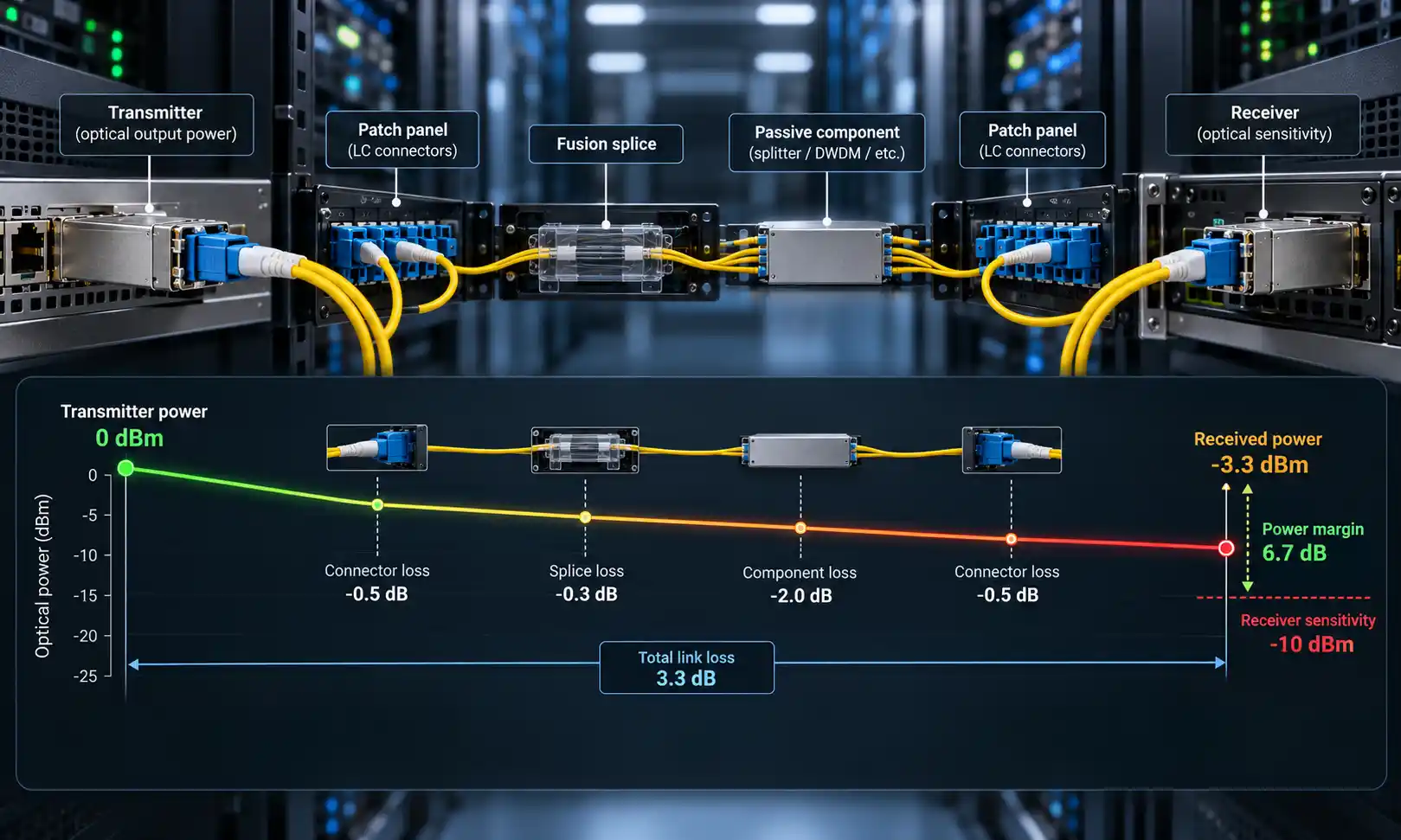
The transmission characteristics follow IEEE 802.3z specifications: center wavelength between 830-860nm, average launch power of -9.5 to -3 dBm, and minimum extinction ratio of 9 dB. On the receive side, sensitivity reaches -17 dBm at 10⁻¹² bit error rate, creating a link budget of approximately 7.5 dB before accounting for connector losses and fiber attenuation.
Why this matters for your deployment: These parameters determine two things that trip up more procurement cycles than any other technical factor: maximum cable distance and fiber type compatibility. Get either wrong, and you're looking at RMA requests before the install team leaves the building. We see this pattern roughly once a week in FOCC support tickets. A customer spec'd modules before verifying what fiber was actually in the ceiling.

The Real Cost Difference: OEM vs. Third-Party Modules
$495 for a Cisco GLC-SX-MMD. $9 for functionally identical optics from FOCC. That's not a typo. It's the structural reality of how optical module supply chains operate.
Third-party SX SFP transceivers typically cost 80-90% less than OEM equivalents while using the same underlying components and manufacturing processes. But that's the headline number everyone already knows. Here's what the headline doesn't tell you:
Cisco, Juniper, Arista, and HPE do not manufacture their own transceivers. They purchase from the same component suppliers that stock the third-party market: Coherent (formerly Finisar), Lumentum, Broadcom, and Chinese manufacturers including Innolight and Accelink. The OEM takes delivery of a module built to SFP Multi-Source Agreement specification INF-8074i, programs their vendor code into the EEPROM, applies their label, and marks up the price by 300-500%. Industry analysts have documented this supply chain reality extensively. The markup is structural, not quality-based.
Here's what that looks like in practice:
| Module Type | List Price | Volume Price | Warranty |
|---|---|---|---|
| Cisco GLC-SX-MMD | $495-530 | ~$300 (w/ channel discount) | 90 days |
| FOCC 1000BASE-SX | $9.00 | $7.50 (500+ units) | Lifetime |
That's a 97% cost reduction for the same optical performance.
Quality at this price point: FOCC's field data from over 1 million deployed modules shows 99.97% reliability with full DOM reporting. Every module undergoes 168-hour burn-in testing at 85°C before shipment. Our internal test lab consistently measures performance within spec across temperature cycling, vibration, and extended operation scenarios.
The procurement reality: The question isn't whether compatible modules work. Decades of deployment data confirm they do. The question is whether your internal approval process, VAR relationship, and IT audit requirements will accommodate them. We'll address each of these obstacles in the sections that follow.

Distance Limits by Fiber Grade: The Specification That Catches Everyone
Close to half of FOCC support escalations in Q4 2025 traced back to one root cause: someone spec'd 550-meter runs without checking the fiber type.
The maximum reach of a 1000BASE-SX SFP is 550 meters over OM2, OM3, OM4, or OM5 fiber, but drops to 220-275 meters on legacy OM1 installations. That's the IEEE spec. Here's why it creates more procurement problems than any other technical factor:
The distance gap stems from modal bandwidth differences. OM1 fiber, recognizable by its orange jacket and 62.5µm core, was designed in an era before laser-optimized manufacturing and delivers only 160-200 MHz·km of bandwidth at 850nm. OM2 shares the orange color but uses a 50µm core with 500 MHz·km bandwidth, enough to reach the full 550m specification. OM3's aqua jacket signals 2000 MHz·km bandwidth with laser-optimized construction, while OM4 and OM5 push beyond 4700 MHz·km for 10G/25G/100G applications.
The installation planning trap: Mixing 62.5µm and 50µm fiber in the same link creates coupling losses exceeding 3 dB at each transition. Enough to push a marginal link budget into failure territory. In practice, when we audit a failed deployment, the culprit is almost never the transceiver. It's a patch panel swap that introduced a core diameter mismatch nobody documented.
FOCC's Q4 2025 support data ranked intermittent CRC errors from mixed-core deployments as the third most common escalation category. The SX SFP itself doesn't care which fiber it's connected to, but the physics of launching light from a 50µm-optimized VCSEL into a 62.5µm core means you're losing power at the very first connection. Our technical team can verify compatibility for your specific platform and cabling infrastructure before you order.
| Fiber Type | Core Size | Jacket Color | 850nm Bandwidth | 1000BASE-SX Max Distance |
|---|---|---|---|---|
| OM1 | 62.5µm | Orange | 160-200 MHz·km | 220-275m |
| OM2 | 50µm | Orange | 500 MHz·km | 550m |
| OM3 | 50µm | Aqua | 2000 MHz·km | 550m |
| OM4 | 50µm | Aqua | 4700 MHz·km | 550m |
| OM5 | 50µm | Lime Green | 4700+ MHz·km | 550m (no distance advantage for SX) |
For new deployments: OM4 has become the de facto standard. The price premium over OM3 is negligible at scale, and the additional bandwidth headroom future-proofs the cabling plant for eventual 10G or 25G upgrades. One point that rarely appears in vendor literature: OM5 fiber was specifically designed for wavelength-division multiplexing and offers no distance advantage over OM4 for single-wavelength 850nm transmission. Specifying OM5 for a pure 1G SX deployment is paying for capability you won't use.

Navigating the Compatibility Lock: Platform-Specific Configuration
Every network engineer has a Cisco TAC war story. Here's the configuration reality nobody at TAC will volunteer:
Cisco switches require two configuration commands to accept third-party SFP modules, while HP/Aruba, Netgear, and MikroTik platforms typically work without modification. The lock isn't technical. It's commercial. And every major vendor handles it differently. Here's the complete breakdown, including the bug that wastes hours of troubleshooting time:
When you insert a non-Cisco-coded SFP into a Catalyst or Nexus switch, the port enters err-disable state and logs "unsupported transceiver" warnings. The fix requires global configuration mode access:
service unsupported-transceiver
no errdisable detect cause gbic-invalid
These commands have been available since IOS 12.2(25)SE and work across Cat3K, 2960G, 3560G, 3750G, 4507R, and most modern platforms.
The Catalyst 9200 gotcha: Catalyst 9200 series switches running IOS-XE versions 16.9.x through 16.11.x have a bug where the service unsupported-transceiver command itself is broken, displaying corrupted help text entries. The only solution is upgrading to IOS-XE Gibraltar 16.12 or later. Contact FOCC's technical team at focc@focc-fiber.com with your switch model and firmware version, and we'll confirm compatibility before you order.
Platform-by-platform reality:
- Dell OS10: Gradually tightening restrictions with each firmware release. FOCC updates module coding within 72 hours of new Dell firmware releases.
- Juniper: Generally accepts third-party modules but may suppress DOM (Digital Optical Monitoring) data. FOCC modules retain full DOM on all tested Juniper platforms.
- HP/Aruba: Most permissive approach. Years of trouble-free third-party SFP use confirmed across ProCurve and Aruba switching platforms.
- Brocade/Broadcom FC switches: Historically rejected third-party SFPs entirely. Recent firmware versions have relaxed this stance.
For multi-vendor environments where you need modules coded for different platforms, contact our technical team to discuss deployment strategy. We can provide platform-specific coding for mixed infrastructure or recommend a phased rollout approach.
The ROI Case: One Real Deployment, Full Transparency
Generic savings claims are easy to generate and hard to trust. Instead of listing multiple cases without context, here's one FOCC deployment with the actual decision process:
Deployment: Regional healthcare network, 340-bed facility
Initial situation: VAR quoted $127,400 for 232 Cisco GLC-SX-MMD modules as part of a Catalyst 9300 refresh. The quote included no quantity discount beyond standard partner pricing.
Internal obstacles encountered:
- IT Security required documentation that third-party modules wouldn't create "unmonitored network paths"
- Facilities management questioned whether compatible modules would trigger building code compliance issues
- The existing Cisco TAC support contract had language suggesting third-party components might void coverage
How each obstacle was resolved:
- FOCC DOM/DDM equivalence documentation showing identical monitoring capability to Cisco modules
- UL/CE certification documentation. FOCC modules carry identical safety certifications.
- FOCC's Magnuson-Moss Warranty Act briefing document. Cisco's own support documentation clarifying that third-party modules don't void switch warranty unless they cause the specific failure.
Final procurement with FOCC:
- 232 FOCC 1000BASE-SX modules: $2,088 (at $9/unit)
- Total savings: $125,312
- Time from first quote to approved PO: about six weeks
What the savings number doesn't capture: The facility used $40,000 of the freed budget to add DOM monitoring capability across legacy switches that previously had no optical monitoring. A capability upgrade that wouldn't have been financially viable under the original OEM-only approach.
Recognizing Quality: What Actually Differentiates Reliable Modules
A 30-microinch difference in gold plating thickness doesn't sound like much. Until you're troubleshooting intermittent link flaps at 2 AM across a 400-port deployment.
The manufacturing process for 850nm VCSEL-based transceivers includes several cost-cutting opportunities that directly impact field reliability. Here's what to verify before committing to a supplier:
Gold finger plating thickness: Below 30 microinches (0.76µm), oxidation develops on the contact surface, creating intermittent connectivity that's maddening to troubleshoot. The SFP MSA specifies minimum 0.38µm hard gold over 2.54µm nickel, but quality vendors exceed this baseline. How to verify: Ask for the supplier's incoming quality control specification sheet. FOCC provides this documentation on request.
Burn-in testing: High-temperature, high-power accelerated aging for hundreds of hours filters out "infant mortality" failures before shipment. Cutting this step to zero saves manufacturing time but pushes those failures into production networks. How to verify: Ask for burn-in test duration and temperature specifications. FOCC runs 168-hour burn-in at 85°C on every production batch.
DDM/DOM support: Implementing the SFF-8472 management interface requires additional circuitry and calibration during manufacturing. Modules that omit DOM capability are often cutting other corners as well. The diagnostic data itself proves valuable for predictive maintenance: TX bias current trending upward while output power remains stable signals laser degradation approximately 30 days before hard failure.
What FOCC does differently: Every module ships with QC documentation including gold plating measurement, burn-in test results, and DOM calibration data. If you want to verify before buying, contact us for sample units.
Red flags during procurement:
- Warranties shorter than three years
- Repeated serial numbers across multiple units (indicating counterfeit or remanufactured stock)
- Missing temperature specifications
- Prices dramatically below $8 per unit for new, tested modules
Deployment Scenarios: Matching Module Selection to Use Case
Not every SX deployment is the same. Here's how FOCC customers typically segment their orders:
Campus backbone and building-to-building links typically run 100-300 meters over OM3 or OM4 fiber through climate-controlled spaces. Standard commercial-temperature FOCC SX modules (0°C to 70°C operating range) work perfectly. DOM support enables centralized monitoring through your network management platform, catching degradation before users report connectivity issues.
Data center server-to-switch connectivity operates in the 1-10 meter range, well within any SX module's capability. The decision point here is density: with hundreds or thousands of server NICs requiring transceivers, even small per-unit price differences compound significantly. FOCC's bulk pricing pushes costs to $7.50/unit at 500+ quantities. One customer used the savings from a 2,400-unit order to fund their entire 10G upgrade roadmap.
Industrial and outdoor environments demand extended-temperature modules. Cisco's GLC-SX-MM-RGD operates from -40°C to +85°C, and FOCC offers compatible alternatives at the same specification (FOCC-SX-IND). Price premiums for industrial ratings run 30-50% above standard modules. The failure mode in cold environments isn't the VCSEL itself. It's the driver circuitry and bias current compensation.
Storage area networks using FC-over-Ethernet require additional validation: some SAN platforms check transceiver coding more aggressively than standard Ethernet switches. For SAN deployments, contact FOCC's technical team to verify compatibility with your specific platform version before ordering.
FAQ
Q: What is the maximum distance for 1000BASE-SX over OM3 fiber?
A: 550 meters under IEEE 802.3z specification. Some vendors claim extended reach up to 1km using mode conditioning or high-power variants, but these fall outside standard specifications and may not interoperate reliably with standard modules on the far end.
Q: What's the difference between GLC-SX-MM and GLC-SX-MMD?
A: DOM support. The "D" suffix indicates Digital Optical Monitoring capability, providing real-time temperature, voltage, TX bias current, TX power, and RX power readings via SNMP or CLI. Both modules are optically compatible and can be mixed in a link. Only the management visibility differs. All FOCC SX modules include DOM as standard.
Q: My IT audit requires "OEM-certified components." How do I get third-party modules approved?
A: Three documentation paths have worked for FOCC customers:
- MSA (Multi-Source Agreement) compliance documentation showing the module meets the same IEEE specification as OEM equivalents
- UL/CE safety certification. FOCC modules carry the same certifications as OEM.
- Magnuson-Moss Warranty Act summary showing equipment warranty remains valid
FOCC provides all three documents as part of our standard procurement package. For regulated industries (healthcare, finance), we also offer platform-specific compatibility attestation letters signed by our engineering team.
Q: If my switch fails under warranty and I'm using FOCC modules, what documentation do I need?
A: Under U.S. law (Magnuson-Moss Warranty Act), the OEM must prove the third-party transceiver caused the specific failure to deny warranty coverage. In practice, this means:
- Document that the FOCC modules were functioning normally before the switch failure (DOM logs help here)
- Keep DOM readings if available. They prove the transceiver wasn't generating errors.
- Have a few OEM modules available to swap in during troubleshooting isolation
We recommend a 90/10 or 80/20 compatible-to-OEM ratio specifically for this troubleshooting isolation scenario.
Procurement Checklist: Eight Decision Points with FOCC Qualification
Before issuing a PO for SX SFP transceivers, confirm alignment on these specifications. Each point includes what to ask your supplier and what FOCC provides:
| Decision Point | What to Verify | What FOCC Provides |
|---|---|---|
| Temperature rating | Matches deployment environment (commercial 0-70°C / extended -5 to 85°C / industrial -40 to 85°C) | Spec sheet with rated range; industrial SKUs (FOCC-SX-IND) clearly labeled |
| DOM/DDM support | Required for remote monitoring or predictive maintenance | All FOCC modules include DOM; calibration data included |
| Fiber type compatibility | Verified throughout cable path; OM1 distance recalculated | Technical team validates compatibility before order confirmation |
| Warranty terms | Documented RMA process and replacement timing | Lifetime warranty; cross-ship replacement from regional inventory |
| Platform compatibility | Confirmed for specific switch model and firmware version | Email focc@focc-fiber.com with platform details for pre-order verification |
| Quantity pricing | Negotiated tiers at 100, 500, 1,000+ quantities | Transparent tiered pricing; volume quotes within 24 hours |
| Sample testing | Completed on representative equipment before full order | Sample units available on request |
| Counterfeit risk | Serial number uniqueness verified; packaging authenticated | QC documentation per unit; batch traceability with factory records |
Next Steps
The 1000BASE-SX SFP transceiver market offers a straightforward value proposition for procurement teams willing to look beyond OEM part numbers. The technology is mature, standardized, and commoditized. Interoperability works. The only question is whether to capture the 97% cost reduction or continue paying the OEM premium.
Ready to move forward? Email FOCC's technical team at focc@focc-fiber.com with your platform list and quantities. We'll confirm compatibility, provide compliance documentation for your internal approval process, and deliver a volume quote within 24 hours.
For sample units to test on your specific equipment before committing to a larger order, include "SAMPLE REQUEST" in your subject line.