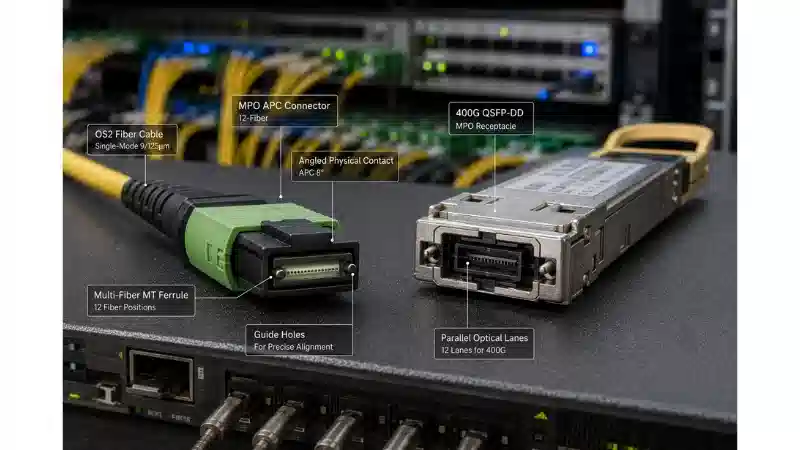
MPO connector fiber represents one of the most significant shifts in data center cabling infrastructure over the past two decades. Defined under IEC 61754-7 and TIA-604-5 (FOCIS-5) international standards, the Multi-fiber Push-On interface consolidates anywhere from 8 to 72 individual optical fibers into a single rectangular ferrule, enabling parallel transmission architectures that would be physically impossible with legacy duplex connections like LC or SC. The technology traces back to NTT's development of the MT (Mechanically Transferable) ferrule in the mid-1980s for Japanese consumer telephone services, though it wasn't until hyperscale data centers emerged in the 2000s that MPO gained its current dominance.

The Mechanical Reality of Multi-Fiber Termination
What makes MPO connector fiber particularly demanding from an engineering standpoint is the precision required across multiple fiber cores simultaneously. We're not talking about aligning two fiber ends here-we're talking about ensuring that 12, 16, 24, or more fibers achieve proper physical contact within tolerances measured in microns. The IEC PAS 61755-3-31 standard specifies critical parameters including angle of polish, fiber protrusion height, and maximum fiber height differential across all fibers in the array.
Here's where things get interesting. To achieve a target insertion loss of ≤0.5 dB per connection, total fiber core misalignment must stay below 1.6μm. That's roughly 1/50th the diameter of a human hair. The allowable stackable tolerance for fiber positions and guide pins? Around 0.8μm per ferrule. When you consider that a 12-fiber MPO has potential tolerance stack-up at every fiber position, you start to appreciate why end-face geometry matters so much more than it does with simplex connectors.

The male/female designation in MPO connector fiber systems creates endless confusion for people new to the technology. Male connectors feature two alignment pins; females have corresponding guide holes. All MPO equipment ports on switches and transceivers are male. This means any patch cord connecting to active equipment must terminate with a female connector. Getting this backwards damages fibers. I've seen entire trunk installations reworked because someone specified the wrong gender at procurement.
Why 12-Fiber Became the Default (And Why That's Changing)
The 12-fiber MPO configuration dominated early deployments for a simple reason: it aligned with 40G SR4 and early 100G SR4 transceiver architectures. Four lanes transmit, four receive, theoretically leaving four fibers unused. The waste bothered network architects, and rightfully so. When you're running thousands of these links, unused fiber represents wasted capital.
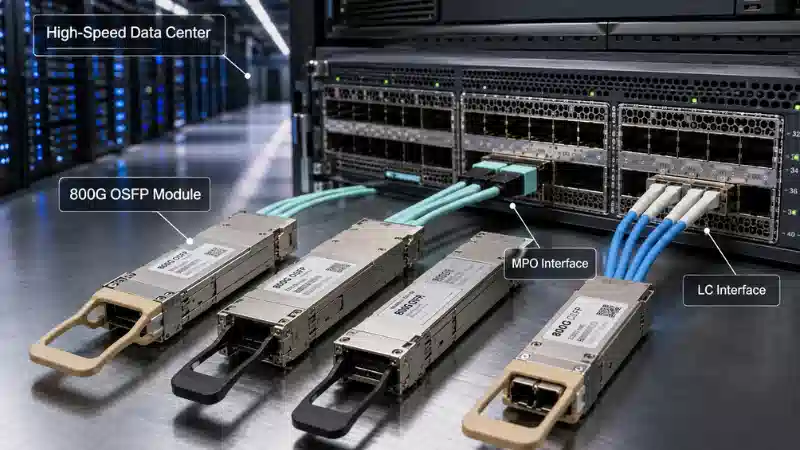
8-fiber MPO connector fiber assemblies emerged as a more efficient alternative for 40G and 100G applications. Same data rates, lower cost, reduced insertion loss. But the industry didn't stop there. 16-fiber MPOs now support 400G QSFP-DD and OSFP transceivers, while 24-fiber configurations target 800G deployments using 8 transmit and 8 receive lanes at 100 Gbps each. The density increases are staggering when you consider that 24-fiber MPOs occupy essentially the same physical footprint as their 12-fiber predecessors.
One thing that doesn't get discussed enough: higher fiber counts make geometry control significantly more difficult. The fiber height differential issue becomes substantially harder to manage with 24 fibers versus 12. Even slight height variances across the array increase the risk of incomplete cleaning and inconsistent mating. This isn't theoretical-field technicians routinely struggle with this in hyperscale environments.
MTP Versus MPO: The Branding Confusion
People throw around MTP and MPO interchangeably, which technically isn't wrong but misses important nuance. MTP is US Conec's registered trademark for their enhanced MPO connector design. Both are fully compliant with the same IEC and TIA standards. Both intermate without issues. But MTP incorporates several engineering refinements that improve optical and mechanical performance: tighter tolerances, better alignment, more consistent insertion loss characteristics.

For most data center applications, standard MPO connector fiber performs adequately. Where MTP earns its premium pricing is in ultra-high-speed systems-400G and 800G links where loss budgets are razor thin. When you're working with a total link budget of 1.5 dB and your transceiver-to-transceiver margin is maybe 0.7 dB, connector quality stops being a nice-to-have.
US Conec also offers MTP Elite connectors that reduce insertion loss by up to 50% compared to standard MTP. That sounds like marketing hyperbole until you actually test them. The elite-grade components consistently measure below 0.25 dB per connector-approaching what was considered exceptional performance for single-fiber LC connectors just a few years ago.
Polarity Management in MPO Systems
Polarity in optical networks means ensuring that each transmit fiber correctly corresponds to its receiving counterpart. With duplex LC connections, this is trivial-you swap the fibers if the link doesn't come up. MPO connector fiber makes polarity management substantially more complex because fiber positions are fixed within the ferrule. You cannot simply move a fiber if something's wrong.
TIA-568 defines three polarity methods: Type A (straight-through), Type B (cross-over), and Type C (paired flip). Type A routes fiber 1 on one end to fiber 1 on the other end with the key up/key down orientation. Type B crosses fibers so position 1 connects to position 12, position 2 to position 11, and so forth. Type C flip-flops pairs-fiber 1 to fiber 2, fiber 3 to fiber 4.
The industry has moved toward Type B for most parallel optics deployments because it simplifies transceiver-to-transceiver links. But legacy installations using Type A or mixed environments create ongoing headaches. More recently, ANSI/TIA-568.3-E introduced universal polarity methods U1 and U2 intended to streamline future installations. Whether these actually reduce confusion in practice remains to be seen.
What trips up many technicians: you cannot verify MPO polarity with a simple visual fault locator the way you can with duplex fibers. A VFL will show light passing through, but it won't confirm that the mapping is correct across all fiber positions. Proper polarity verification requires either a specialized MPO tester or methodical continuity checks using fan-out cords.
Insertion Loss Testing: More Complicated Than You'd Think
Testing MPO connector fiber presents challenges that single-fiber connectors simply don't have. A 12-fiber MPO assembly requires 12 individual insertion loss measurements, plus return loss on each channel. That's potentially 96 measurements for a single cable when you account for both directions. Automating this process isn't optional-it's necessary for any reasonable throughput.
The loss specifications themselves deserve attention. Per EIA/TIA 568, MPO connectors can have maximum insertion loss of 0.75 dB-substantially higher than the 0.3 dB typically specified for adhesive-polished simplex connectors. Elite-grade components bring this down to 0.35 dB or better. When calculating link loss budgets, these differences compound across multiple connection points.
One testing subtlety that catches people: reference method matters enormously. The three-cable reference method (launch cord, reference cord, receive cord) includes two connector interfaces in the zero reference. When you test the device under test, those connections aren't counted in your measured result. Use a different reference method, and your numbers change. Documentation must specify which reference approach was used, or the test data becomes meaningless for comparison.
Return loss specifications also vary by polish type. UPC (ultra physical contact) polish typically achieves around -50 dB return loss-adequate for most multimode applications. APC (angled physical contact) polish achieves -60 dB or better, critical for single-mode applications and DWDM systems where back-reflections cause measurable performance degradation. You cannot mate UPC and APC connectors without damaging both.
Data Center Applications: Trunk Cables and Breakout Configurations
The primary use case for MPO connector fiber in data centers is pre-terminated backbone trunk cabling. Instead of pulling individual duplex cables and terminating them on-site-a labor-intensive process with significant quality variability-you install factory-terminated MPO trunks. Deployment time drops dramatically. Cable management improves. Pathway congestion decreases.
At patch panels, these MPO trunks typically transition to LC duplex via either cassettes or hybrid fan-out patch cords. A 12-fiber trunk becomes 6 duplex LC connections. A 24-fiber trunk yields 12. The cassette approach provides cleaner rack organization; fan-out cords offer more flexibility for direct equipment connections.

For parallel optics applications-40G SR4, 100G SR4, 400G SR8-the MPO connector mates directly with the transceiver. No transition to LC. This is where the technology really shines: a single 12-fiber MPO replaces what would otherwise be 8 individual LC connectors for a 40G link. Space savings in high-density switch deployments are considerable.
Breakout applications deserve specific mention. A single 400G QSFP-DD switch port can connect to four 100G servers using an MPO-to-LC breakout cord. This maximizes expensive switch port utilization while accommodating servers that don't yet support native 400G. The economics often justify the additional cable complexity.
The 400G/800G Transition and Beyond
Current MPO connector fiber evolution is driven almost entirely by 400G and emerging 800G requirements. 400G SR8 uses 8 fibers per direction, typically deployed with 16-fiber MPOs. 800G doubles that density again. The transceiver roadmap increasingly assumes MPO-based parallel transmission as the default interconnect method.
Single-mode MPO applications are growing as well, particularly for longer-reach 400G variants like FR4 and DR4. Single-mode brings its own challenges: tighter alignment tolerances, higher connector costs, and the preference for APC polish to minimize reflections. The price premium over multimode MPO assemblies remains substantial, which limits adoption in applications where multimode reach is sufficient.
Looking further ahead, co-packaged optics and on-board optics aim to move the photonic components closer to the switch silicon. This may change interconnect requirements at the chip level, but rack-to-rack and row-to-row cabling will continue relying heavily on MPO connector fiber for the foreseeable future. The density advantages are simply too significant to abandon.
Practical Considerations: Cleaning, Inspection, and Handling
End-face contamination causes more MPO failures than any other factor. A single dust particle of 1 micron or larger can degrade signal quality measurably. Unlike simplex connectors where inspection and cleaning is straightforward, MPO connector fiber requires specialized microscopes and cleaning equipment designed for the multi-fiber ferrule format.
The cleaning protocol matters more than most people realize. Dry cleaning with lint-free wipes works for light contamination. Heavy contamination may require wet cleaning with isopropyl alcohol, though this carries risk-particles become more mobile on wet surfaces and can scratch fibers if not properly dried. Some technicians prefer cleaning cartridges designed specifically for MPO/MTP ferrules.
IEC 61300-3-35 defines specific cleanliness grading criteria for fiber end-face inspection. The standard removes subjectivity from pass/fail determinations, examining defects across core, cladding, adhesive layer, and contact zones. Following this standard for incoming inspection and post-installation verification eliminates many disputes about connector quality.
Handle MPO cables with more care than you'd give standard patch cords. The multi-fiber ferrule is inherently more fragile, and damaged guide pins or guide holes will cause alignment problems across all fibers in the connector. Keep dust caps installed until the moment of connection. Store assemblies in clean, protected environments. These basic practices prevent most field failures.

Making the Right Selection
Choosing appropriate MPO connector fiber for a specific application requires matching fiber count to transceiver requirements, selecting the correct polish type for the fiber mode, and specifying gender correctly for the cable run. Procurement errors in any of these areas result in either non-functional links or wasted inventory.
For new deployments supporting 100G and above, 8-fiber and 16-fiber MPO configurations generally offer better fiber utilization than the legacy 12-fiber format. For 400G SR8, 16-fiber is the clear choice. For 800G, 24-fiber enables the highest density, though infrastructure compatibility requires verification.
The multimode versus single-mode decision depends primarily on distance. OM4 fiber supports 100G SR4 to 100 meters-sufficient for most intra-building links. Anything longer typically requires single-mode, with the associated cost premium for connectors and transceivers.
Cost optimization in MPO connector fiber deployments comes from right-sizing components to actual requirements. Overspecifying elite-grade connectors for applications with comfortable loss budgets wastes money. Underspecifying for tight-budget 400G/800G links causes operational problems. Understanding the link loss calculation for your specific topology guides appropriate component selection.