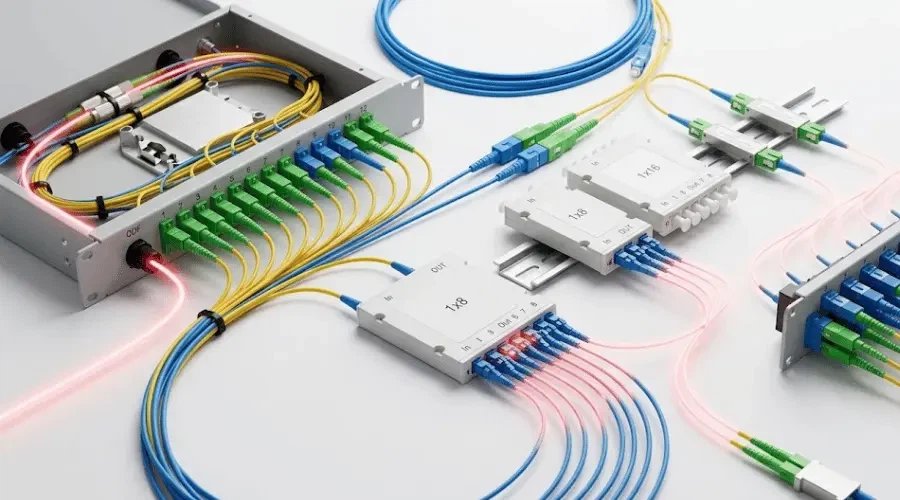
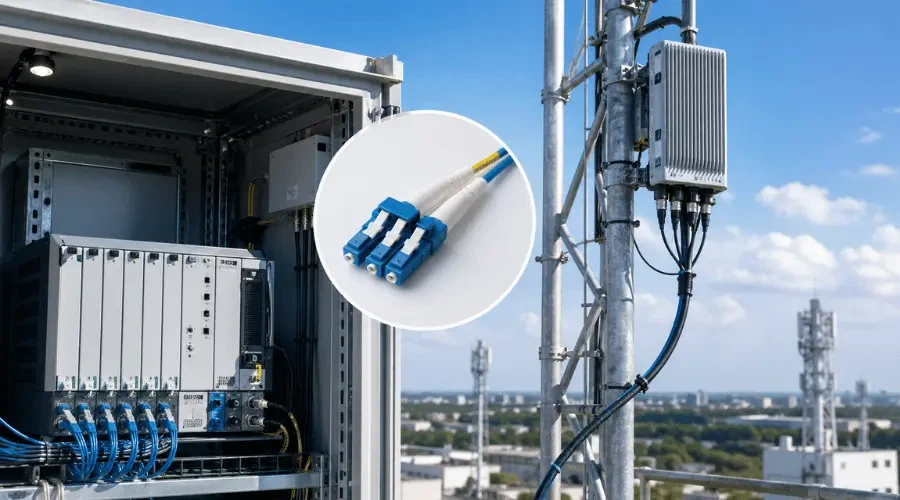
If you've spent any time crawling around data center racks or dealing with fiber infrastructure decisions, you already know the headache. Cables everywhere. Technicians grumbling about installation times. And that nagging feeling that there's gotta be a better way.
There is. And honestly? The answer's been staring at us for decades.
The Thing Nobody Tells You About Old-School Fiber
Here's what happens in most telecom setups still running traditional connectors: you've got LC, SC, maybe some ancient ST connectors if the building was wired in the 90s. Each one handles a single fiber. Sometimes two if you're fancy.
Now picture connecting two 48-port patch panels.
That's 48 individual cables. 96 fibers. Each one needing its own termination, its own inspection, its own potential failure point. I've watched installers spend entire days - plural - just running what should be straightforward backbone cabling. The labor costs alone make finance departments break into cold sweats.
And don't even get me started on the cable management afterwards. The mass of spaghetti hiding behind those rack doors? Nightmarish. Airflow gets choked. Troubleshooting becomes archaeological excavation.
Enter MPO: When Japanese Engineers Got Fed Up
The story actually goes back to the mid-1980s, which most people don't realize. NTT Corporation - the big Japanese telecom - developed what's called MT ferrule technology. They needed it for consumer telephone service, of all things. Sometimes the best industrial innovations come from solving mundane problems.
The MPO connector showed up in the early 1990s, building on that foundation.
What made it different wasn't complicated, conceptually. Instead of one fiber per connector, you pack multiple fibers into a single rectangular ferrule. Eight. Twelve. Twenty-four. Today some configurations run up to 72 fibers in one interface.
The math becomes stupid obvious. Remember those 48 cables between patch panels? With MPO-12 connectors, that drops to eight cables. MPO-24? Four.
Four cables doing the work of 48.

But Does It Actually Work Well?
This is where people get skeptical. More fibers crammed together should mean more alignment problems, right? More signal loss? More headaches?
The concern isn't crazy. Early MPO connectors had...issues. Accidental bumps could throw things out of alignment. Signal instability plagued some deployments. Engineers whispered warnings.
Then came the refinements.
US Conec introduced their MTP Elite connector in 1999 with dramatically reduced insertion loss. The technology kept evolving. Floating ferrule designs emerged that maintained fiber contact even when connector housings rotated against each other. The precision got better. The tolerances got tighter.
Modern MPO connectors now achieve insertion loss rates that rival what single-fiber connectors managed just a few years back. We're talking sub-0.35 dB for high-quality assemblies. That's borderline miraculous for multi-fiber technology.
The Density Game (And Why Data Centers Care So Much)
Here's a number that should make you pause: 864.
That's how many fibers an MTP housing can accommodate in a 1U space. For comparison? The same 1U with duplex LC connections holds maybe 144 fibers.
Six times the capacity. Same physical footprint.
For hyperscale data centers - the Facebooks and Googles and Amazons processing incomprehensible amounts of data - this isn't a nice-to-have. It's survival. Floor space costs money. Every rack unit matters. Every pathway through the cable tray represents real estate.
When you're building facilities that consume megawatts of power and move petabytes daily, the infrastructure decisions compound. MPO becomes less about convenience and more about whether your expansion strategy is even physically possible.
Parallel Optics Changed Everything

Okay, here's where it gets properly interesting.
Traditional fiber transmission works like a single highway lane. One path, one signal. Works fine until you need more speed than the technology can handle on a single fiber.
Parallel optics takes a different approach entirely. Instead of screaming louder down one fiber, you split the transmission across multiple fibers simultaneously. Four fibers transmitting at 25 Gbps each gives you 100 Gbps total. Eight fibers at 100 Gbps gets you 800 Gbps.
MPO connectors were basically built for this.
The 40GBASE-SR4 and 100GBASE-SR4 specifications use 8-fiber configurations - four transmitting, four receiving. The connector's right there waiting. 400G applications work the same way. 800G uses 16-fiber MPOs with eight lanes each direction at 100 Gbps per lane.
And 1.6 terabit? Already spec'd out using 16-fiber configurations with 200 Gbps per lane.
The connector format isn't just keeping pace. It's laying the foundation for speeds most networks haven't touched yet.
Installation: The Part Where People Actually Save Money
I mentioned labor costs earlier. Let's be specific.
Traditional terminations require individual fiber handling. Each connection needs inspection, potential re-polishing, careful documentation. A skilled technician working carefully might terminate - what - maybe 20-30 fibers per hour in optimal conditions?
MPO installations using pre-terminated trunk cables? Same technician can deploy 144 fibers in the time it previously took for a fraction of that.
The math varies by installation complexity, but estimates suggest 50-75% reductions in deployment time compared to traditional approaches. Some vendors claim even more aggressive numbers in ideal scenarios.
It's not magic. It's just...geometry. Fewer physical connections means fewer opportunities for mistakes. Plug-and-play architectures eliminate most field termination entirely. The precision happens in the factory under controlled conditions.
The Polarity Problem (Because Nothing's Perfect)
Fair warning: MPO introduces complications that don't exist with simple duplex connections.
Polarity - ensuring transmitters connect to receivers correctly - becomes genuinely tricky when you're managing 12 or 24 fibers through a single interface. The TIA-568 standard defines three different polarity methods (Type A, B, and C), each with specific cable configurations and adapter requirements.
Mix them up? Signals go nowhere. Or worse, they go somewhere wrong.
Deployment mistakes happen more frequently than manufacturers like to admit. Technicians unfamiliar with MPO polarity management can burn hours troubleshooting issues that would be immediately obvious with traditional connectors.
This isn't a dealbreaker. Good documentation, proper training, and quality test equipment handle it. But pretending the learning curve doesn't exist would be dishonest.
Single-Mode vs. Multimode: Pick Your Battlefield

MPO works for both fiber types, but the applications differ significantly.
Multimode dominates short-reach data center connections. The 100-150 meter reaches common in leaf-spine architectures suit OM4 and OM5 multimode perfectly. Most parallel optics standards assume multimode.
Single-mode MPO exists for longer reaches and emerging applications like 5G fronthaul. The tolerances are tighter, the costs higher, and the inspection requirements more stringent. APC (angled physical contact) polishing becomes important for minimizing back reflection.
If your infrastructure spans buildings or campuses, single-mode MPO deserves serious consideration. If everything lives within 100 meters? Multimode
probably wins on cost-benefit.
The Testing Reality
Here's something that catches organizations off guard: testing MPO links properly requires specialized equipment.
You can't just grab a visual fault locator and shine it through - the parallel fiber positions don't allow simple visual verification. Automated inspection scopes designed for array connectors become necessary. Cleaning gets more complex because you're dealing with 12+ fiber end faces aligned in a row.
Contamination on any single fiber in the array can degrade the entire link. The inspection standards (IEC PAS 61755-3-31) specify end-face geometry parameters including fiber protrusion heights and differential limits across the array.
Good test sets exist from the major vendors. Budget for them. Actually use them. The failure modes in untested MPO deployments get expensive fast.
When MPO Doesn't Make Sense
Not every installation benefits from MPO. Worth stating clearly.
Small office networks with dozens of connections? The economics probably don't justify it. The connector hardware costs more per termination than LC or SC. The test equipment investment makes no sense at low volumes. The polarity complexity introduces risk without corresponding reward.
Legacy environments with established duplex infrastructure face upgrade challenges too. You can't just swap connectors - the transceivers, patch panels, and backbone architecture all need alignment.
And environments requiring frequent reconfiguration at the patch level? Individual duplex connections offer flexibility that trunk-based MPO systems sacrifice.

The 5G and AI Wrinkle
Something's happening in telecom and hyperscale computing that's reshaping infrastructure assumptions.
5G deployments need fiber density that traditional connectors struggle to provide efficiently. Cell sites multiply. Fronthaul connections proliferate. The fiber counts per installation keep climbing.
AI workloads - and I'm talking serious inference clusters, not chatbots - demand bandwidth densities that push beyond what even current standards anticipated. The east-west traffic patterns in GPU-heavy computing environments create connection requirements that look nothing like traditional enterprise networking.
MPO's capacity to consolidate fiber counts into manageable interfaces positions it squarely in both paths. The cloud providers building AI infrastructure aren't choosing MPO accidentally.
Where This Goes Next
Very small form factor MPO connectors are already emerging. The SN-MT from Senko and MMC from US Conec achieve nearly triple the density of traditional 16-fiber MPOs. When 800G becomes routine and 1.6T starts appearing in production environments, these miniaturized interfaces will matter.
Co-packaged optics - moving transceivers directly onto switch ASICs - might eventually change interconnect requirements at the board level. But rack-to-rack cabling? That's MPO territory for the foreseeable future.
The connector technology that started solving telephone problems in 1980s Japan has become foundational to infrastructure supporting global digital services. Not bad for something most people have never heard of.
Making the Call
So should you choose MPO?
If you're building or upgrading data center infrastructure supporting speeds beyond 10G - probably yes. If you're deploying 40G, 100G, 400G parallel optics - definitely yes. If cable density, installation time, or scalability rank among your top concerns - the math strongly favors it.
If you're running a small office or need maximum flexibility at every patch point? Traditional connectors might serve you better.
The decision isn't universal. It's contextual. But for the environments MPO was designed to serve - high-density, high-speed, high-reliability infrastructure - the connector type has proven itself across thousands of deployments over three decades.
Sometimes the answer to "why choose this?" is simply that nothing else works as well for what you're actually trying to accomplish.
The cables don't care about marketing. They just need to connect. MPO happens to be really, really good at that.