The devices used in optical fiber communication systems can be divided into two categories: active devices and passive devices. There is a process of photoelectric energy conversion inside active devices, while those without this function are called passive devices.
Optical passive devices are energy-consuming optical devices with many types and different functions.

Passive optical devices can be divided into two categories: connection components and functional components: connection components include various optical connectors, which are used to connect optical fibers and optical fibers, components (equipment) and optical fibers, or components (equipment) and components (equipment); functional components include splitters, couplers, optical multiplexers/demultiplexers, optical attenuators, optical switches and optical isolators, etc., which are used for splitting, coupling, multiplexing, attenuation, etc. of light.
The overall requirements for passive components in optical fiber communication systems are standard specifications, low insertion loss, high reliability, good repeatability, and resistance to external influences.
fiber optic connector
There are two methods commonly used to connect optical fibers:
One requires that the connection of two optical fibers (cables) be fixed and permanent. In optical cable construction, because the length of an optical cable is generally within 3km, a fusion splicer is used to fuse and connect two optical cables.
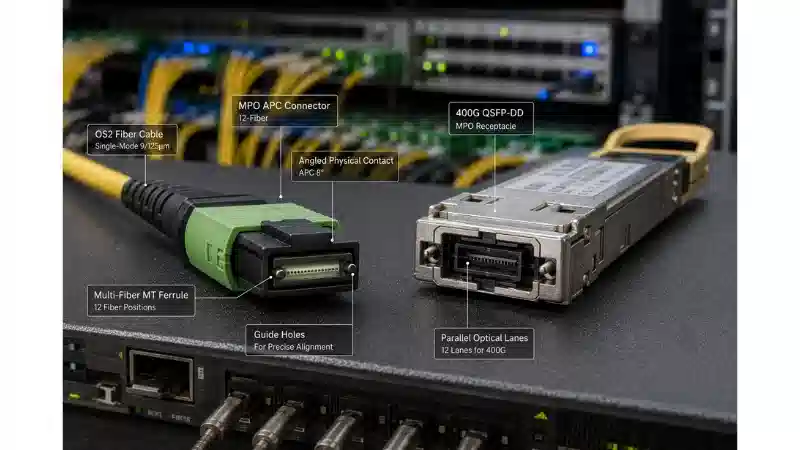
The other is the connection between the optical fiber and the optical transmitter (with pigtail), optical receiver or instrument, or the temporary connection with another optical fiber, which requires the use of optical fiber connectors. Fiber optic connectors are components prone to failure and are also the most widely used passive components.
The structure of fiber optic connector

Loss of fiber optic connectorsThe causes of connection loss can be classified into two categories: one is the inherent loss caused by optical fiber tolerances, such as mismatch in fiber core diameter, refractive index, etc., as shown in Figure 3-30a; the other is the connector plus
External losses caused by tool assembly are shown in Figure 3-30b. External losses are often dominant, with losses caused by gaps and lateral offsets accounting for a larger proportion

Optical fiber connector models and parameters
Commonly used fiber optic connector models are FC/PC, FC/APC, SC/PC, SC/APC and ST/PC.
The main performance indicators of optical fiber connectors are:
1) Insertion loss: generally below 0.5dB.
2) Repeatability: that is, the change in loss after each plugging and unplugging once or several times should generally be less than 0.1dB.
3) Interchangeability: refers to the change in loss when different pins of the same optical fiber connector are replaced. It should be less than 0.1dB.
4) Lifespan: that is, the number of plug-and-pull times that ensures that the optical fiber connector has the above loss parameters, generally it should be within a thousand timesabove.
5) Temperature performance: refers to the change in connector loss within a certain temperature range, generally between -250~+700℃
Within the range, the loss change should be less than or equal to 0.2dB.
Optical attenuator
The function of the optical attenuator is to attenuate the optical power by a predetermined amount. For example, optical receivers are very sensitive to optical power overload, and the input power must be controlled within the dynamic range of the receiver to prevent saturation; the input power of different channels in front of the optical amplifier should be balanced to prevent the input power of one or some channels from being too large, causing optical amplifier gain saturation, etc.
(1) Coupling type It changes the size of optical coupling through the offset of the input and output fiber cores, thereby achieving the purpose of changing the attenuation, as shown in Figure a.
(2) Reflective type By changing the angle of the reflector, the size of the transmitted light is controlled, as shown in Figure b.
(3) Absorption type: The attenuation piece is made of light-absorbing material to absorb and transmit light, as shown in Figure c. Optical attenuators can be divided into three types: fixed type, step variable type and continuously variable type.