Single Mode vs Multimode Fiber: Distance, Speed, and Cost Analysis
For distances under 100 meters, multimode fiber delivers 30-50% lower total link costs-but single mode becomes the economical choice when any links exceed 150 meters or when planning for 400G+ speeds. This counterintuitive finding emerges from a detailed analysis of hyperscaler data center strategies, IEEE specifications, and real-world enterprise migrations. Meta's engineering team discovered that single mode's lower cable costs and future-proofing capabilities actually delivered lower total cost of ownership than multimode for their 100G data center deployments. The critical decision factor isn't fiber or transceiver pricing in isolation-it's understanding where your total system cost crossover point lies.
The fiber optics industry is experiencing a fundamental shift. LightCounting reports that 100G-800G single mode transceivers now represent 60% of total transceiver market volume, driven by hyperscaler purchasing power that has collapsed the historical price premium. Meanwhile, multimode remains entrenched for short-reach applications, with Corning data showing 95% of deployed OM3 channels operate under 100 meters. This analysis provides procurement managers and network engineers with the technical data, cost models, and decision frameworks needed to optimize fiber selection for their specific deployment scenarios.
Why cable pricing tells only half the story
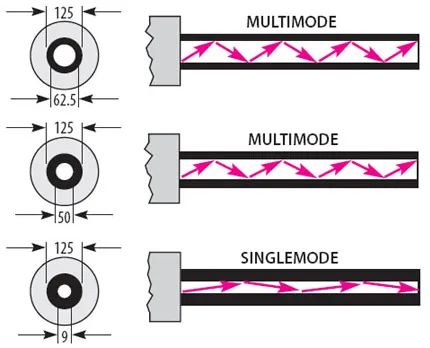
The conventional wisdom that "multimode is cheaper" inverts when examining actual market pricing. Raw fiber costs reveal a surprising reality: single mode OS2 fiber costs $0.06-0.10 per meter versus $0.25-0.32 per meter for OM4 multimode-a 60-70% premium for multimode cable. This price differential exists because multimode's graded-index core requires more complex manufacturing than single mode's step-index design.
Where multimode recovers its cost advantage is in transceiver pricing. The current market (January 2025) shows significant differences:
| Speed | Multimode (SR) | Single Mode (LR/DR) | SM Premium |
|---|---|---|---|
| SFP+ (10G) | $20-25 | $27-34 | 35-40% |
| QSFP28 (100G) | $99 | $209-399 | 110-300% |
| QSFP-DD (400G) | $219 | $549-719 | 150-230% |
For a 100G link at 50 meters, the complete calculation reveals: multimode path costs approximately $115 (optics + cable) versus $217 for single mode-a clear multimode advantage. However, at 150 meters, this gap narrows to just $74, and beyond 200 meters, multimode becomes physically impossible for 100G while single mode continues without issue.
The crossover point occurs between 200-250 meters for 100Gbps applications. Organizations must calculate their specific link length distribution before making procurement decisions.

IEEE 802.3 distance limits every engineer should know
The IEEE 802.3 standards define hard physical limits that constrain fiber selection. Understanding these specifications prevents costly deployment failures.
Multimode fiber maximum distances by grade
| Speed | OM1 | OM2 | OM3 | OM4 | OM5 |
|---|---|---|---|---|---|
| 1 Gb/s (SX) | 275m | 550m | 550m | 550m | 550m |
| 10 Gb/s (SR) | 33m | 82m | 300m | 400m | 400m |
| 25 Gb/s (SR) | N/S | N/S | 70m | 100m | 100m |
| 40 Gb/s (SR4) | N/S | N/S | 100m | 150m | 150m |
| 100 Gb/s (SR4) | N/S | N/S | 70m | 100m | 100m |
| 400 Gb/s (SR8) | N/S | N/S | 70m | 100m | 100m |
*N/S = Not Supported. OM4 can achieve 550m at 10G with optimized fiber per TIA extended specification.
Modal bandwidth (EMB) directly determines these limits. OM3's 2,000 MHz·km rating restricts 10G to 300 meters, while OM4's 4,700 MHz·km extends this to 400-550 meters. The physics cannot be circumvented-exceeding these distances causes bit errors and link failures regardless of equipment quality.
Single mode eliminates modal dispersion entirely. A single OS2 fiber plant supports speeds from 1G to 400G with transceiver changes alone:
| Application | Wavelength | Max Distance |
|---|---|---|
| 10GBASE-LR | 1310nm | 10 km |
| 100GBASE-LR4 | 4× WDM | 10 km |
| 400GBASE-FR4 | 4× WDM | 2 km |
| 400GBASE-LR8 | 8× WDM | 10 km |
This "deploy once, upgrade electronics" capability explains why Meta, Google, and AWS have standardized on single mode for spine-layer infrastructure.
Total cost of ownership reveals the true economics
A proper TCO analysis must account for installation costs, upgrade cycles, and the hidden expense of fiber replacement in occupied facilities. Real-world data demonstrates how initial savings can become long-term liabilities.
Scenario: 200-link enterprise deployment planning 10G→100G migration
Path A: Multimode OM4 (all runs under 150m)
| Cost Element | Year 1 | Year 3 | 5-Year Total |
|---|---|---|---|
| Fiber infrastructure | €3,200 | €0 | €3,200 |
| 10G transceivers | €4,000 | - | €4,000 |
| 100G upgrade | - | €19,800 | €19,800 |
| Total | €7,200 | €19,800 | €27,000 |
Path B: Single Mode OS2
| Cost Element | Year 1 | Year 3 | 5-Year Total |
|---|---|---|---|
| Fiber infrastructure | €1,280 | €0 | €1,280 |
| 10G transceivers | €5,400 | - | €5,400 |
| 100G upgrade | - | €41,800 | €41,800 |
| Total | €6,680 | €41,800 | €48,480 |
For this scenario with short, consistent runs, multimode delivers €21,480 in savings. However, this analysis assumes zero fiber replacement-a risky assumption given facility changes over multi-year horizons.
The hidden cost multiplier: fiber replacement in occupied facilities
When 15-20% of links require upgrading due to distance limitations or facility expansion, the economics reverse dramatically. Fiber replacement in occupied facilities costs €40-75 per meter-3-4× the cost of new construction installation. If just 40 of those 200 links require replacement at 120-meter average lengths:
Replacement cost: 40 × €60/m × 120m = €28,800
This single factor pushes the multimode 5-year TCO to €55,800, making single mode's €48,480 the economical choice while providing 400G+ upgrade capability.
Data center scale recommendations
- Small data centers (<500 servers): Multimode OM4 typically optimal. Shorter runs under 100m, lower transceiver counts magnify the single mode premium, and 10G-25G speeds suffice for most applications.
- Medium data centers (500-5,000 servers): Case-by-case evaluation required. Mixed distances demand analysis of specific link distribution. If any backbone links exceed 150m, single mode for spine layer with multimode for access makes economic sense.
- Large data centers (>5,000 servers): Single mode preferred. Longer distances between spine/leaf switches, 100G-400G speeds standard, and future-proofing critical. Hyperscalers have universally adopted this approach-Meta's total link cost analysis demonstrated single mode was actually cheaper at 100G when factoring all components.
Insider knowledge from network engineers in the field
Forum discussions reveal practical considerations that rarely appear in vendor documentation. These insights come from engineers troubleshooting real deployments.
Fiber contamination causes 80% of fiber issues. A single 1-micrometer dust particle on a single mode core can block 1% of light transmission (0.05dB loss). The field consensus: "You can't determine if it's clean with the naked eye. A dust particle so small you can't see it without a scope can completely block transmitted light." Never assume new connectors out of packaging are clean-always inspect, clean, and inspect again using the wet-to-dry method with proper fiber optic cleaning solution, not isopropyl alcohol.
Mode conditioning patch cables are mandatory for certain combinations. Using 1000BASE-LX/LH transceivers over OM1/OM2 fiber without mode conditioning cables risks elevated bit error rates and receiver damage. Conversely, never use mode conditioning cables with OM3/OM4-they're designed for laser-optimized fiber and will cause problems.
The OM5 reality check. Corning's December 2024 analysis states plainly: "OM5 provides no value compared to OM4 when leveraging standards-based 850nm optics" and notes "very slow adoption" in the market. OM5's benefit-supporting Short-Wavelength Division Multiplexing (SWDM) using wavelengths 850-953nm-only matters for links between 100-150 meters using BiDi or SWDM transceivers. For most deployments, the premium over OM4 is unjustified.
Bend-insensitive fiber selection matters more than specification sheets suggest. G.657.A1 and G.657.A2 fibers (10mm and 7.5mm minimum bend radius) are fully compatible with standard G.652D and should be specified for any installation involving tight corners or in-building routing. However, G.657.B variants are not fully compatible with G.652D and should only be used for short-reach applications under 1km.

Hyperscaler strategies reveal industry direction
Meta, Google, Microsoft, and AWS collectively operate infrastructure at scales that provide visibility into optimal fiber strategies years before enterprise adoption.
Meta's 100G migration decision
Meta's engineering team conducted exhaustive total link cost analysis comparing three scenarios at 100Gbps: parallel multimode, parallel single mode, and duplex single mode. Their conclusion challenged conventional wisdom: single mode total link cost (fiber + patch panels + transceivers) was lower despite higher transceiver prices. Fewer fiber strands and patch panels offset the transceiver premium. They subsequently contributed the CWDM4-OCP specification to Open Compute Project, with relaxed parameters (500m reach instead of 2km, 3.5dB link budget instead of 5dB) optimized for data center economics.
Meta now operates 24 data center campuses with 94 individual facilities totaling 48 million square feet. Their F16 topology with Minipack switches supports flexible 100G/200G/400G connectivity, with FR4 LITE optics optimized for up to 500m fiber links.
Microsoft's hollow-core fiber innovation
Microsoft has deployed 1,280 kilometers of hollow-core fiber carrying production traffic. Light travels through an air core instead of glass, achieving 33% lower latency and 45% faster transmission speeds. For latency-sensitive AI training workloads and financial applications, this technology-once considered experimental-is now production-ready for organizations willing to invest in cutting-edge infrastructure.
Their enterprise case study from Puget Sound headquarters demonstrates practical ROI: deploying their own optical network delivered ~$2 million annual savings versus leasing, with investment recovery in under two years and provisioning time reduced from months to one day.
Google's optical circuit switching approach
Google's Jupiter network delivers 13 Petabits/second bisection bandwidth using MEMS-based optical circuit switching that maps input to output fibers dynamically. This creates arbitrary logical topologies without packet routing overhead, enabling incremental network builds and seamless speed upgrades without rewiring. Their approach demonstrates that for building-scale fabrics, software-defined optical switching provides flexibility that fixed fiber topologies cannot match.
AWS's scale reveals hidden complexities
AWS operates over 9 million kilometers of fiber optic cabling-enough to stretch from Earth to Moon and back 11 times. Their largest AI data center contains 100,000+ fiber connections in a single building. At this scale, AWS moved from commodity optics to custom-specified designs, now defining their own standards for vendors rather than adopting industry-wide specifications. They use 400G-DR4+ for internal short-reach connections and 400G-LR4 for external ISP connectivity, and have put hollow-core fiber into production for latency-sensitive applications.
The 400G/800G transition and multimode's survival question
The industry is rapidly migrating to 400G, with 800G and 1.6T on the horizon. Understanding how this transition affects fiber selection is critical for procurement decisions with multi-year horizons.
400G multimode remains viable-within strict limits
IEEE 802.3cm (2020) standardized two 400G multimode options:
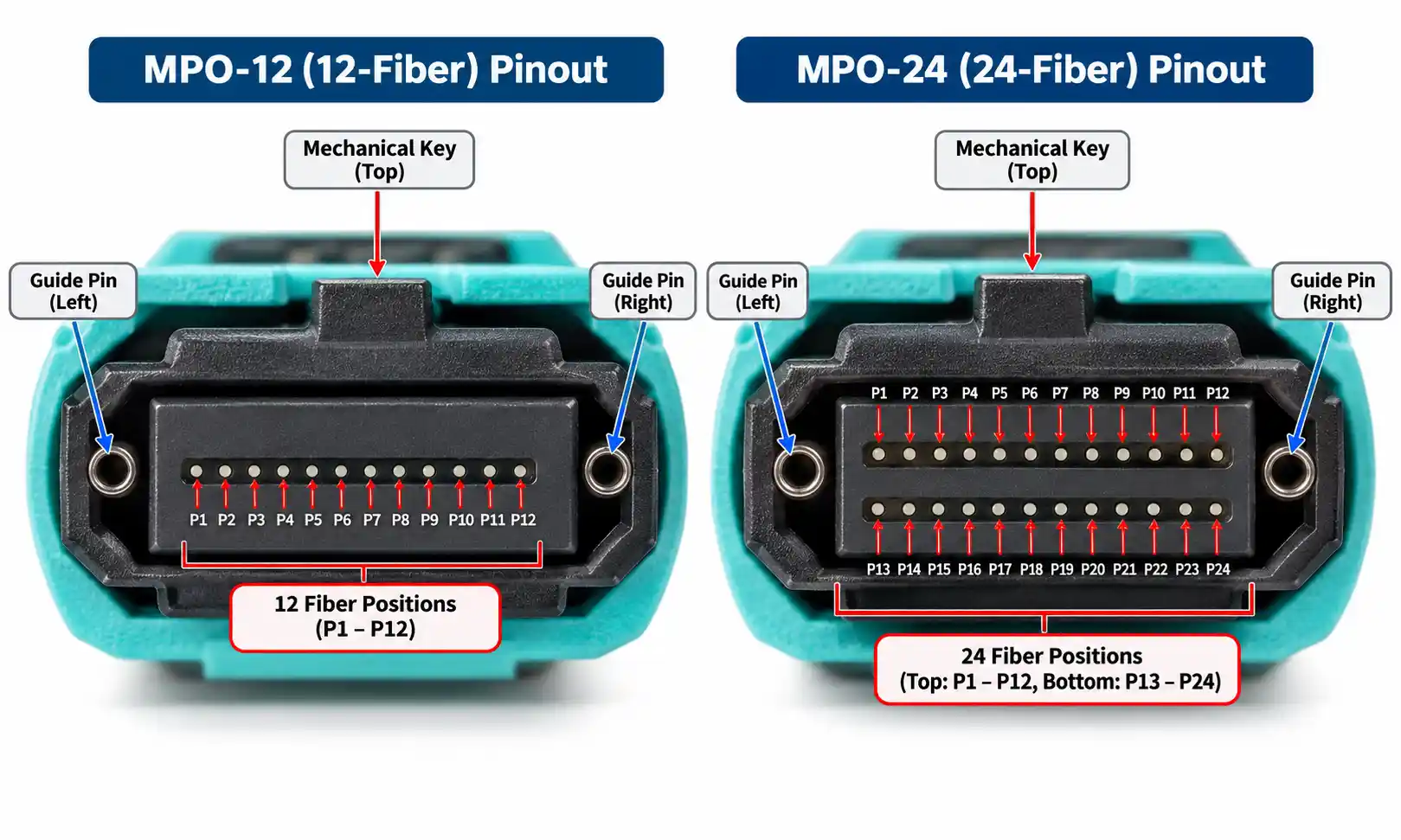
- 400GBASE-SR8: 8-fiber pairs, single wavelength (850nm), reaches 70m on OM3 and 100m on OM4/OM5
- 400GBASE-SR4.2: 4-fiber pairs, dual wavelength (850/910nm), reaches 100m on OM4 and 150m on OM5 using SWDM
For top-of-rack switches and server connections under 100 meters, these standards preserve multimode's cost advantages. The 400G SR8 transceiver at $219 versus DR4 single mode at $549 represents significant savings at scale.
Single mode dominates beyond short reach
For any 400G deployment with links exceeding 100-150 meters, single mode becomes mandatory. The 400GBASE-DR4 standard provides 500m reach on duplex single mode fiber-sufficient for most data center spine-layer connections. LightCounting data shows 40% growth in 400G/800G transceiver shipments in 2024, with 800G transceivers experiencing 100% year-over-year increases.
AI infrastructure accelerates single mode adoption
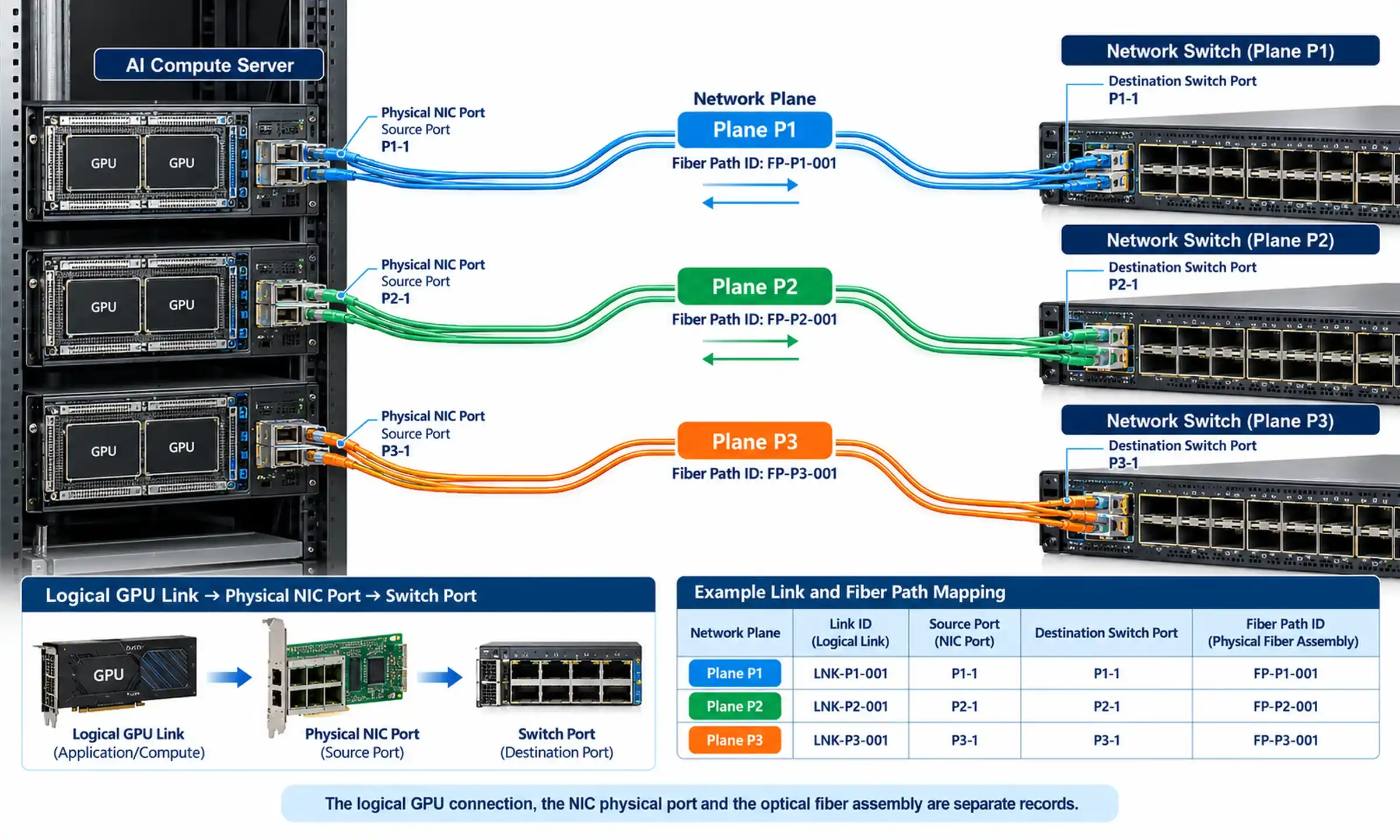
AI training clusters create unprecedented east-west traffic patterns that stress traditional network architectures. NVIDIA's NDR InfiniBand connections use 400/800G SR4/SR8 and DR4/DR8 transceivers, with each GPU requiring six pluggable transceivers consuming approximately 30W each. The bandwidth density requirements-400 Gbps per GPU connection, 3.2 Tbps per 8-GPU server-favor single mode's higher bandwidth-distance product.
Industry analyst projections suggest that by 2027, over 70% of AI data center connections will use MTP or MTP-LC hybrid systems, with single mode fiber as the standard for any connection beyond top-of-rack.
Procurement decision framework and common mistakes to avoid
Effective fiber procurement requires systematic evaluation rather than defaulting to historical choices.
Three-step selection process
Step 1: Map your distance distribution. Survey all link lengths in your planned deployment. If any links exceed 300 meters, single mode is required for those runs. If 15%+ of links fall between 100-300 meters, single mode may be more economical overall.
Step 2: Calculate total system cost, not component costs. For each candidate fiber type, sum: (cable cost per meter × average link length × link count) + (transceiver cost × link count × 2) + (estimated installation labor) + (testing/certification costs). Include a 5-year transceiver replacement budget and potential fiber replacement costs.
Step 3: Apply the future-proofing multiplier. If planning to operate the facility for 10+ years, if bandwidth requirements are expected to double within 5 years, or if the cost of business disruption from fiber replacement is high, weight single mode selections more heavily regardless of current distance requirements.
Critical procurement mistakes that increase total costs
- Calculating cable cost without transceiver costs: Transceivers often represent 60-80% of total link costs at 40G and above
- Assuming all runs will stay short: Facility reorganizations, equipment relocations, and capacity expansions regularly extend link requirements
- Specifying OM1/OM2 for any new installation: These legacy fiber grades cannot support 10G beyond 82 meters; always specify OM3 minimum, preferably OM4
- Mixing APC and UPC connectors: Green (APC) and blue (UPC) connectors are not interchangeable; mixing causes high insertion loss and physical damage
- Skipping inspection before testing: Contamination causes 80% of failures; always clean and inspect before acceptance testing
Testing and acceptance requirements
TIA-568.3-D requires Tier 1 testing (Optical Loss Test Set) for certification. Specify maximum connector loss of 0.75 dB per mated pair and maximum splice loss of 0.1 dB for fusion splices. For critical infrastructure, require Tier 2 testing (OTDR) to characterize individual events and verify splice quality. Demand bidirectional OTDR testing and documented traces for all links.
Conclusion: The right choice depends on your specific context
The single mode versus multimode decision defies universal answers. For data centers with consistent sub-100m runs, ToR deployments, and budget-constrained projects without near-term 400G requirements, multimode OM4 delivers lower total costs. For campus backbones, inter-building connections, large-scale data centers, and any deployment planning for 400G speeds, single mode OS2 provides better economics and eliminates future upgrade limitations.
Three key insights should guide procurement decisions: First, fiber cable is the smaller cost component-single mode cable is actually 60-70% cheaper than multimode, with transceivers driving the total cost difference. Second, the crossover point occurs around 200-250 meters for 100G deployments, beyond which single mode becomes both technically required and economically superior. Third, fiber replacement in occupied facilities costs 3-4× more than new installation-any risk of future re-cabling shifts the calculus toward single mode's future-proofing capability.
The industry trajectory is clear: hyperscalers have standardized on single mode for spine infrastructure, 100G-800G single mode transceivers now represent 60% of market volume, and AI data center requirements accelerate this transition. Organizations making fiber investments today should weight their decisions accordingly, recognizing that the next decade will likely see bandwidth requirements that make today's 400G look modest.