How to Choose a Fiber Optic Adapters Manufacturer?
Choosing a fiber optic adapter manufacturer comes down to three questions: Can they actually make what they claim? Will they still answer your emails six months from now? And what happens when something goes wrong?
Everything else is details.

Sleeve Material Separates the Serious Players
The alignment sleeve inside an adapter does one job: guide two ferrules into precise alignment. Get it wrong by a few microns and your insertion loss climbs. Get it very wrong and you're chasing intermittent faults for weeks.
Zirconia ceramic holds dimensional tolerance through thousands of mating cycles. The crystalline structure simply doesn't deform the way metal does. Phosphor bronze sleeves cost manufacturers maybe 40% less, and that savings gets passed along as either lower prices or higher margins. Either way, you're the one dealing with the consequences when those sleeves start developing play after a year of use.
I pulled a batch of no-name adapters from a distribution frame in Guangzhou last March. Eighteen months in service, and the bronze sleeves had worn enough to push insertion loss from around 0.18 dB to 0.43 dB. That's out of spec. The network was still functioning, but barely, and nobody had connected the gradual performance degradation to adapter wear until we started methodically testing each connection.
Ask your potential suppliers directly: what sleeve material do you use for single-mode adapters? If they hesitate or give you a non-answer about "high-quality materials," move on. Serious manufacturers know exactly what's in their products and aren't shy about it.
The Certification Question
Telcordia GR-326-CORE compliance costs real money to obtain and maintain. Testing facilities, documentation, ongoing quality audits. A manufacturer serving telecom carriers has this certification because carriers require it. A manufacturer who doesn't have it is telling you they don't sell to carriers, which raises the question: why not?
That said, I've seen plenty of GR-326 compliant adapters that still had quality issues. The certification confirms the design meets requirements; it doesn't guarantee every unit off the production line is perfect. It's necessary but not sufficient.
UL94 flammability is the one that catches people. The ratings work like this:
UL94 Flammability Scale
| Rating | Self-Extinguishing Time | Flaming Drips? | Real-World Meaning |
|---|---|---|---|
| HB | No requirement | Allowed | Bare minimum, avoid for enclosed spaces |
| V-2 | ≤30 seconds | Allowed | Better, but drips can ignite materials below |
| V-1 | ≤30 seconds | Not allowed | Acceptable for most commercial installs |
| V-0 | ≤10 seconds | Not allowed | Required for plenum, recommended for data centers |
Most adapters on the market are V-2 or don't have UL94 testing at all. If you're installing in raised floor environments or anywhere with restricted airflow, V-0 is worth specifying. The price difference is minimal; the liability difference is not.
ISO 9001, CE, RoHS... every manufacturer has these. They're the cost of doing international business. Don't let a sales rep act like ISO certification is a differentiator. It isn't.
Insertion Loss: What Datasheets Hide
Every adapter datasheet says "≤0.3 dB insertion loss." That's the maximum allowable under most industry specs. It tells you nothing about actual performance.
Quality manufacturers hit 0.10 to 0.15 dB typical on UPC connections. Budget manufacturers hover around 0.25 dB typical and occasionally ship units that just barely squeak under the 0.3 dB limit. Over a link with multiple connection points, those differences compound.

When evaluating suppliers, ask for production lot test data, not just datasheet specs. Any manufacturer with real quality control has this data readily available. If they can't or won't provide it, that's your answer.
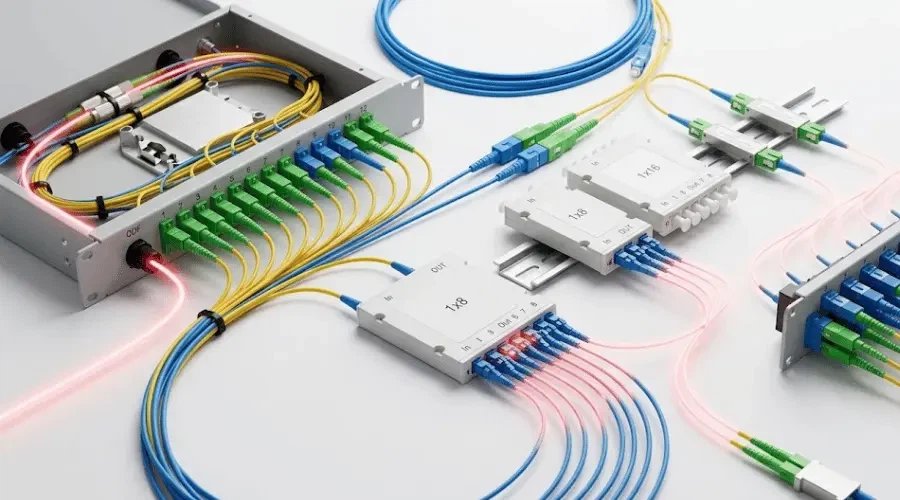
One thing I've learned the hard way: the APC/UPC mismatch problem is more common than it should be. Green housing means APC (8-degree angled end face). Blue means UPC (flat perpendicular polish). Mate them together and you'll damage both ferrules permanently. This seems obvious, but I've seen mixed orders go out because someone in purchasing didn't understand the color coding. Make sure your supplier's ordering system flags incompatible combinations, and double-check specs before approving large POs.

The Money Part
Here's where procurement teams consistently get it wrong.
A budget LC duplex adapter costs around $0.85. A quality adapter from an established manufacturer runs $1.60 to $2.20. The math looks obvious until you factor in what happens when adapters fail.
Budget suppliers run defect rates somewhere between 2% and 5%. The good manufacturers sit around 0.3% to 0.8%. When a connection fails in production, you're not just replacing a dollar part. You're dispatching a technician, which costs $80 or more just to roll the truck, plus diagnostic time, plus the paperwork, plus the hit to your credibility with the client.
Work it out on a thousand-unit order:
Budget
Material Cost: $850
Est. Failures: 30-40 units
Service Costs: $2,800
Total Exposure: $3,650
Quality
Material Cost: $1,900
Est. Failures: 5-8 units
Service Costs: $500
Total Exposure: $2,400
The premium adapters cost 35% less when you account for field failures. This math convinced our operations manager to stop overriding engineering specs with "equivalent" substitutions from cheaper vendors. Maybe it'll convince yours.
China Sourcing in 2025
The tariff situation changed the calculus on Chinese suppliers.
Section 301 duties on fiber optic components run as high as 100% in some HTS categories. The de minimis exemption that used to let small shipments through duty-free went away in May. So a $1.50 adapter from a Shenzhen manufacturer might cost $3.20 landed after duties and freight, compared to maybe $5.50 from a domestic source.
Still cheaper, but not by the margin it used to be. And the gap closes further when you factor in:
- Customs delays (budget an extra week minimum, more if there's any paperwork issues)
- Minimum order quantities (Chinese factories often want 500+ units to justify a production run)
- Communication friction (time zones, language barriers, different assumptions about what "quality" means)
- Payment terms (wire transfer upfront is standard; good luck getting net-30)
For volumes under 2,000 units or so, I'd seriously consider domestic or regional distributors even at higher unit cost. The logistics headaches eat your savings. At higher volumes, direct China sourcing still makes sense if you've qualified the supplier properly.
Connectors: Stop Overthinking This

LC for anything going in a data center. SC for FTTH and outside plant. FC if you're doing test and measurement or need vibration resistance. MPO/MTP for parallel optics trunks.
That's it. That's the decision tree.
I see RFQs that go into elaborate detail about connector selection when the application already determines the answer. LC won because it packs twice the density of SC in the same panel space. When rack space costs $300/month per U, density wins. SC survives in field applications because technicians like the larger form factor when they're working in a handhole at 2am with a headlamp.
The only connector decision that actually requires thought is MPO/MTP for high-speed links. Quality variance between manufacturers is much higher on MPO than single-fiber connectors because the tolerances are tighter and the assembly is more complex. Budget MPO adapters cause more field problems than all other connector types combined, in my experience. This is not the place to save money.
Finding a Manufacturer You Can Actually Work With
Production capacity claims are meaningless. Every supplier says they can handle your volume. What matters is whether they'll prioritize your order when things get busy.
Questions that actually reveal something:
Lead times:
What's your ship time for standard in-stock items? (Should be 24-48 hours.) What about custom configurations? (Should be specific, not "depends.") Do you offer penalty clauses for late delivery on time-critical orders?
MOQ flexibility:
Can you do sample quantities of 20-50 pieces for qualification? What's your minimum for production orders? (This tells you whether they're set up for enterprise buyers or only interested in high-volume distribution.)
Technical support:
Can I talk to an engineer, or just sales? What's your process when we have a quality issue? (If the answer involves "submit a ticket," think carefully.)
Communication:
How fast did they respond to your initial inquiry? If it took five days to get a quote, imagine how long a warranty claim will take.
I've had exactly one supplier in ten years proactively call me when they discovered a quality issue with a batch they'd shipped. One. That company gets all our adapter business now. The rest wait until you find the problem yourself, then argue about whose fault it is.
Sample Testing Before You Commit
Get samples. Test them yourself. This is non-negotiable.
Use an inspection scope to check end face quality and sleeve finish. Look for contamination, scratches, chips on the ferrule edge. Connect test jumpers through the adapter and measure insertion loss with a power meter. Disconnect and reconnect several times; the readings should stay consistent within 0.02 dB or so.
Manufacturers who resist sending samples or want to charge retail price for qualification units are telling you something about their confidence in their own product. The good ones expect testing and build sample costs into their customer acquisition budget.
The whole qualification process takes maybe two hours per supplier. It's saved us from at least three sourcing disasters that would have taken months to unwind.
Wrapping Up
The adapter market is growing fast. Projections have it roughly doubling from current levels over the next decade as data center construction and FTTH deployment continue expanding. That growth attracts manufacturers across the entire quality spectrum, and brand recognition doesn't correlate with quality the way it used to.
Focus on the fundamentals: ceramic sleeves, verifiable test data, responsive communication. Calculate total cost including probable defects, not just unit price. Qualify before you commit volume.
And find someone who answers the phone when something goes wrong. That relationship is worth more than a few cents per adapter.