What is the Most Commonly Used Fiber Connector?
LC connectors hold roughly 35% of the global market according to Grand View Research's 2024 data (grandviewresearch.com). SC comes second. MPO/MTP is growing fast in data center backbone applications.
But that ranking shifts depending on which segment you're looking at. Hyperscale data centers are almost exclusively LC because of SFP transceiver standardization. Telecom outside plant still runs heavily on SC. Industrial and military applications use connectors most people have never heard of.
The procurement question isn't which connector is most popular-it's which one costs you the least while meeting your actual requirements.

LC vs SC: The Real Cost Difference
We get requests all the time where the engineer has spec'd LC across the board for a telecom access build. When we ask why, the answer is usually something like "that's the standard now" or "we use LC everywhere else."
LC became dominant in data centers because of density. The 1.25mm ferrule is half the size of SC's 2.5mm, which means 144 duplex ports per 1U panel versus 72 for SC. In a facility running hundreds of thousands of connections, that density advantage translates into millions saved on floor space and cooling.
In an outdoor cabinet with 24 ports? The density argument disappears entirely.
Here's what the numbers actually look like on a mid-size deployment:
| Connector | Unit Cost (5k-10k qty) | 8,000 Units Total | Installation Notes |
|---|---|---|---|
| LC UPC | $2.50-4.00 | $20,000-32,000 | Requires more precision, slower in cold weather |
| SC UPC | $1.50-3.00 | $12,000-24,000 | Easier handling with gloves, faster field work |
| LC APC | $3.50-5.50 | $28,000-44,000 | Required for PON/CATV only |
| SC APC | $2.50-4.50 | $20,000-36,000 | Same applications, lower cost |
The spread between LC and SC runs 25-40% depending on volume and supplier. On 8,000 terminations, you're looking at $8,000-12,000 difference just on connectors-before accounting for the labor differential from SC's easier field handling.
We quoted a regional ISP last year where switching from LC to SC saved them somewhere around $50k on a 12,000-drop FTTH expansion. They'd originally spec'd LC because their data center used it. Six months into deployment, their field supervisor was asking about SC replacements anyway because technicians kept fumbling LC connections in Minnesota winter conditions.

MPO for High-Speed Backbone: When the Math Flips
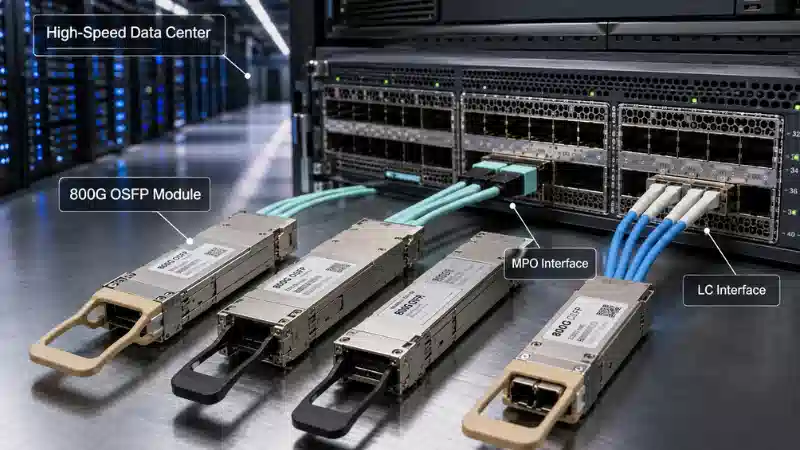
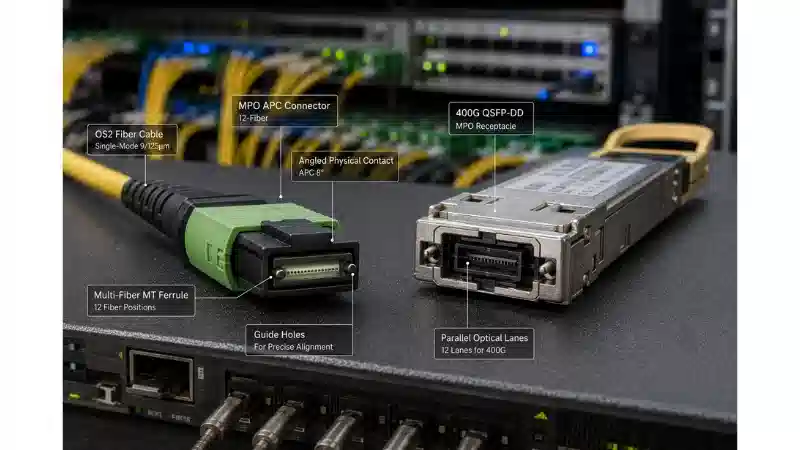
Above 40G, the calculation changes completely. MPO/MTP connectors pack 12 or 24 fibers into a single interface, enabling the parallel optics that 100G/400G transceivers require.
Per-unit cost looks bad-$50-80 for an MPO-12 versus $3-4 for LC duplex. But the installation economics reverse that:
| Factor | Field-Terminated LC (12 fibers) | Pre-Terminated MPO-12 |
|---|---|---|
| Material cost | ~$40 | ~$65 |
| Installation time | 3-6 hours | 10 minutes |
| Labor @ $75/hr | $225-450 | $12 |
| Test time | 45 min per end | Factory certified |
| Field error rate | 5-10% | <1% |
| Total installed cost | $300-550 | $80-100 |
Corning's published data from EDGE Rapid Connect deployments shows 70% installation time reduction and error rates dropping from around 8% to under 1% (corning.com). The rework costs from field errors alone often exceed the MPO premium.
For backbone runs that stay static, MPO wins. For patch positions with frequent moves/adds/changes, discrete LC connections still make sense because you're not paying for re-termination on reconfiguration.
The Technical Details That Actually Matter
Most comparison articles spend pages explaining what LC and SC stand for (Lucent Connector and Subscriber Connector, if you care). That's not useful for procurement decisions. What matters:
Ferrule grading
is something most buyers never ask about. Zirconia ceramic ferrules have bore diameters ranging from 124μm to 127μm to match variations in fiber cladding. Orbray, who pioneered ceramic ferrule manufacturing in 1987, maintains tolerances under 1 micrometer-but that precision only helps if the ferrule grade matches your fiber (orbray.com). Cheap connectors use one grade for everything. The result is 0.05-0.1dB additional insertion loss per connection that compounds across long links.
APC vs UPC
isn't a quality difference-it's an application requirement. APC (green, 8° angled end face) is mandatory for PON, CATV, and RF-over-fiber because the angled polish directs reflected light into the cladding rather than back toward the source. UPC (blue, perpendicular end face) works fine for standard Ethernet.
The critical rule: never mate APC to UPC. The angular mismatch creates an air gap that pushes insertion loss above 4dB and physically damages both ferrules. I've seen a 50G link chase phantom errors for two days before someone noticed a blue jumper plugged into a green bulkhead. Every connector and adapter in your infrastructure should be one type or the other, enforced through your BOM specs.
FC keying standards still trip people up on legacy systems. FC/APC exists in two incompatible key widths: 2.0mm (reduced, single scribe mark) and 2.14mm (NTT, double scribe mark). They look identical but don't mate correctly. If you're maintaining older telecom infrastructure with FC connectors, verify which standard your existing equipment uses before ordering replacements.

What Shows Up in Field Failures
The PLCTalk forums have a recurring thread type that goes something like: "fiber link between buildings went down, my media converters are marked multimode but the building run is single-mode, can I use multimode jumpers on single-mode cable?"
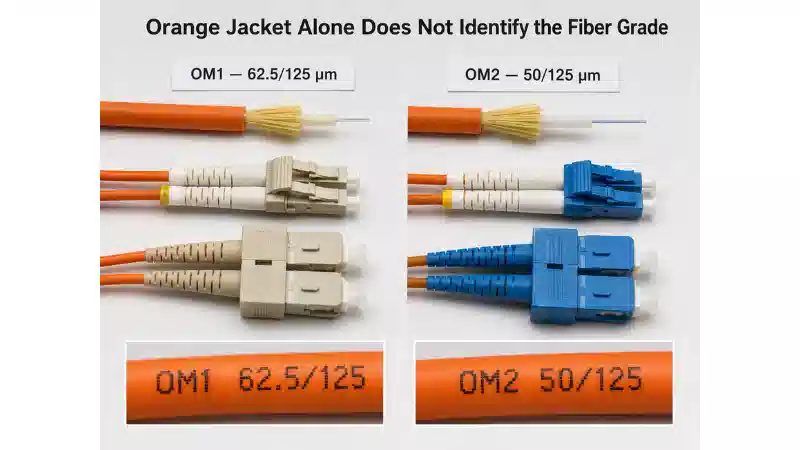
No. 62.5/125μm (OM1) and 50/125μm (OM3/OM4) multimode fiber requires multimode transceivers and jumpers. Single-mode requires single-mode everything. Mixing them doesn't create "extra loss"-it creates complete signal failure or intermittent drops that are nearly impossible to troubleshoot systematically.
This happens because someone orders "fiber patch cables" without specifying mode, or a technician grabs whatever's in the truck. Color coding helps (yellow = single-mode, orange = OM1/OM2, aqua = OM3/OM4) but isn't foolproof. Your receiving inspection process needs to verify mode compatibility explicitly.
Contamination is the other constant. Industry estimates put dirty connectors as the cause of 85-90% of fiber network faults. You can't assess cleanliness visually-a fingerprint that looks clean to the eye will fail under a fiber scope. Every connection should be inspected and cleaned before mating, which means your field kits need to include inspection equipment and IPA cleaning supplies, and your technicians need to actually use them.
Supplier Qualification Questions
Generic datasheets all claim similar specs because everyone copies from TIA and IEC standards. The questions that reveal manufacturing depth:
What insertion loss do you guarantee-typical value or maximum? What's your process Cpk on that parameter? (If they don't know what Cpk means, that's informative.)
Do your MPO assemblies ship with individual channel test data, or just worst-case values for the assembly?
For APC connectors, are you testing end-face angle and radius per IEC 61755-3-1, or just checking insertion loss? (Geometry problems can pass IL testing but cause issues under thermal cycling or repeated mating.)
What's your actual lead time right now for SC/APC in quantity 5,000? For MPO-24 APC in quantity 200? (The gap between quoted and actual lead time tells you about inventory versus manufacture-to-order.)
Summary
LC is most commonly used because data centers drove that standardization through SFP transceiver interfaces. SC remains more cost-effective for telecom access, FTTH drops, and any deployment where density isn't the primary constraint. MPO/MTP has become the default for 40G+ backbone infrastructure where installation labor costs dominate material costs.
The connector that's "most commonly used" globally isn't necessarily optimal for your specific application. Run the math on your actual deployment volumes, labor rates, and density requirements before defaulting to whatever seems standard.
For specific pricing on connector assemblies or structured cabling projects, contact our technical sales team at focc-fiber.com. We handle everything from small patch cable orders to complete data center cabling specs, and we'll tell you straight if your requirements are outside our wheelhouse.