Does passing an E2A cable jacket abrasion test mean the cable markings also pass E2B? No. IEC E2A evaluates the abrasion resistance of the optical fibre cable sheath, while E2B evaluates the markings on its surface. A cable can satisfy the specified sheath requirement without having demonstrated that its printed identification remains legible after a separate marking abrasion test. For project approval, the distinction matters as much as the word "PASS" on a report: the method, sample, conditions and acceptance criteria must all match the property being assessed.
What Changed in IEC 60794-1-102:2026?
Published on 22 September 2026, IEC 60794-1-102:2026 establishes abrasion test procedures for optical fibre cables under Method E2. It distinguishes Method E2A for cable sheaths from Method E2B for cable markings, including text, graphic markers and continuous coloured lines. It replaces Method E2 previously contained in IEC 60794-1-21:2015. E2A and E2B are not newly invented tests; they have been brought into a separate standard with updated requirements.
The IEC identifies three significant changes in the 2026 edition: sample surface cleaning requirements, the number of tests to be performed for Method E2B, and additional details to be reported. A test record prepared against an earlier edition should therefore be checked for the relevant differences rather than treated as automatically equivalent or automatically invalid.
The standard provides a test method; the relevant product specification or project requirement determines how the result is used for a particular cable. The exact apparatus settings, required test count and acceptance conditions should be checked against the applicable edition of the full standard and the specified cable requirements. Neither a test equipment catalogue nor a general-purpose cable guide is a substitute for those documents.
What Does an IEC E2A Cable Jacket Abrasion Test Prove?
Method E2A subjects the outer cable sheath to a defined abrasion procedure. The result concerns how that sheath performs against the specified test requirements. It does not describe the durability of the cable's printed legend, identify a universal maximum pulling distance or establish resistance to every form of installation damage.
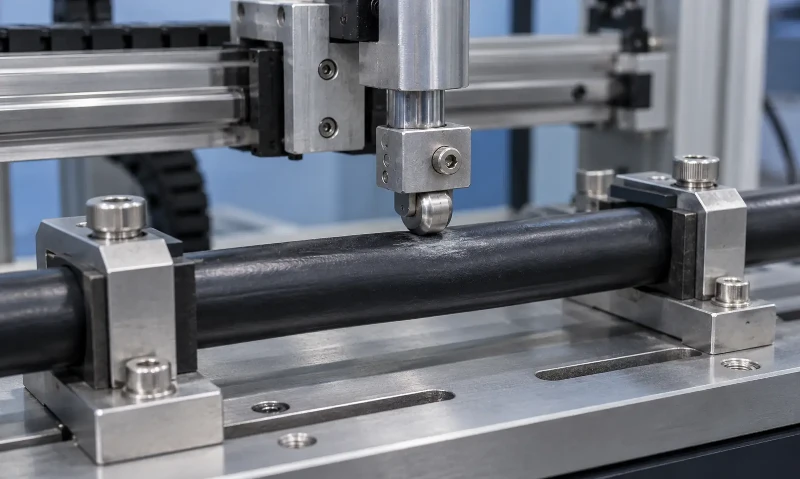
A report stating "IEC E2A: PASS" is useful only when the reviewer can identify the cable specimen, the standard edition, the applied test conditions and the criterion used to reach that conclusion. For instance, a report on one jacket formulation cannot automatically be assigned to another cable with a different sheath material or construction.
Consider an outdoor GYXTW cable with a polyethylene outer sheath. The cable's steel-tape reinforcement and its PE sheath perform different functions. An E2A result, if available for the applicable configuration, concerns the outer sheath's abrasion performance; it does not establish the performance of the armour, the water-blocking system or the surface marking. These properties should not be combined into a single unsupported claim about overall cable durability.
Similarly, the test should not be described as proof that water cannot penetrate the cable or that optical attenuation will remain unchanged in any installation. Those are separate questions requiring evidence appropriate to the condition being assessed.
How Does IEC E2B Evaluate Cable Marking Abrasion?
E2B deals with identification applied to the outer surface: printed text, graphic information and continuous coloured lines. The relevant issue is whether the markings meet the specified abrasion requirement after testing. The information may include product identification, a cable designation or a length reference, but understanding cable type and identification codes is a different task from proving that the markings resist abrasion.
The distinction is important in field records. A perfectly readable designation before installation says nothing on its own about how that marking performs under an E2B procedure. Equally, an E2B result does not establish the mechanical integrity of the underlying sheath.
E2B Method 1: Scraping-Test Configuration
IEC E2B includes a Method 1 configuration using a specified abrasive-contact arrangement. Its purpose is to assess marking resistance under the conditions set out for that method. Markings produced through different processes, including raised, indented or surface-applied identification, should not be assigned to Method 1 on the basis of appearance alone. The applicable method must be confirmed against the standard and the cable marking specification.
A complete record should state that Method 1 was used and identify the relevant conditions, specimen and acceptance requirement. Without those details, a reader cannot tell whether the result is applicable to the intended marking.
E2B Method 2: Wool-Felt Abrasion Configuration
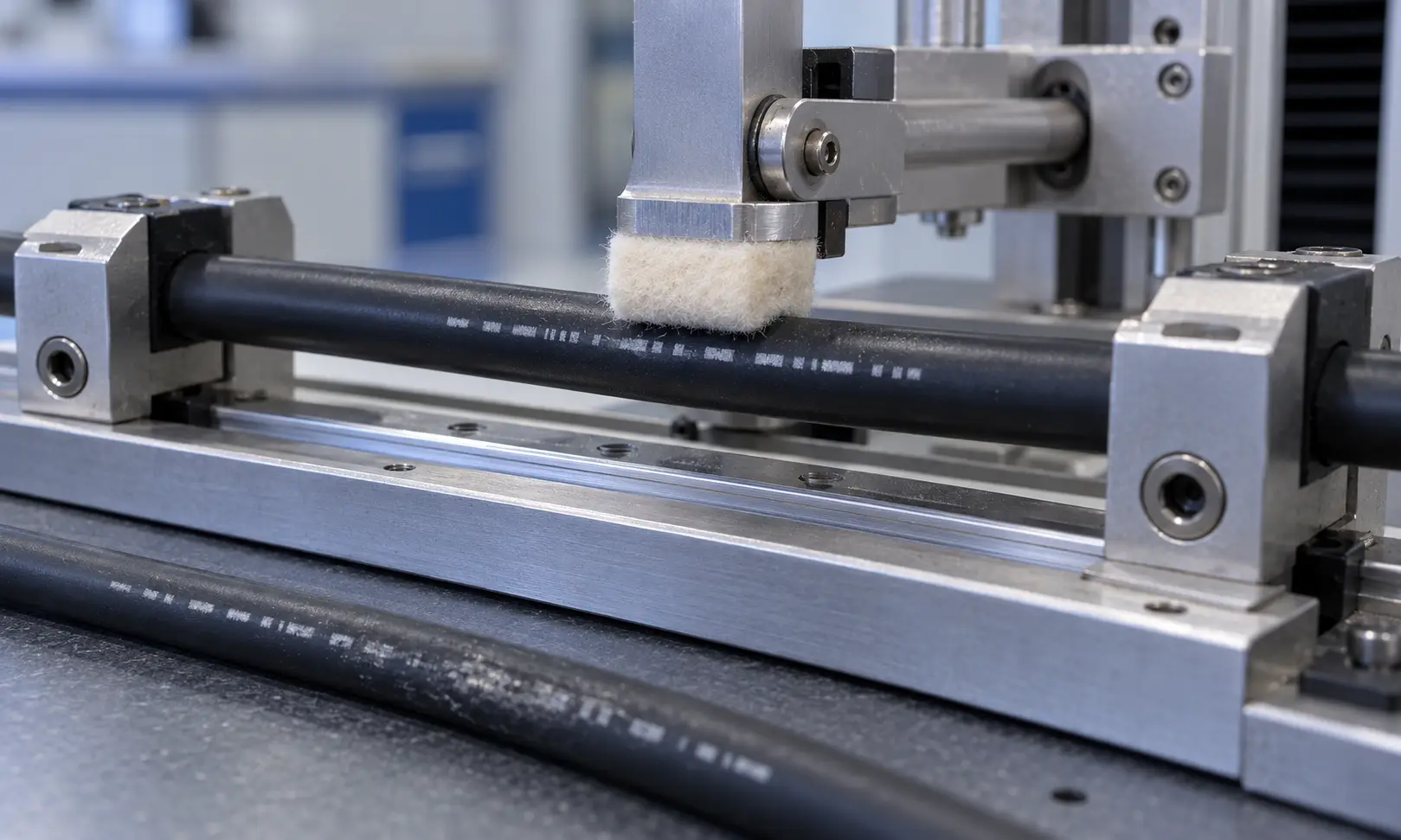
Method 2 uses a different abrading arrangement involving wool felt. It is relevant when this procedure is specified for the marking under assessment. Its contact conditions are not interchangeable with those of Method 1, and a reported cycle count has no reliable meaning without the associated method and test conditions.
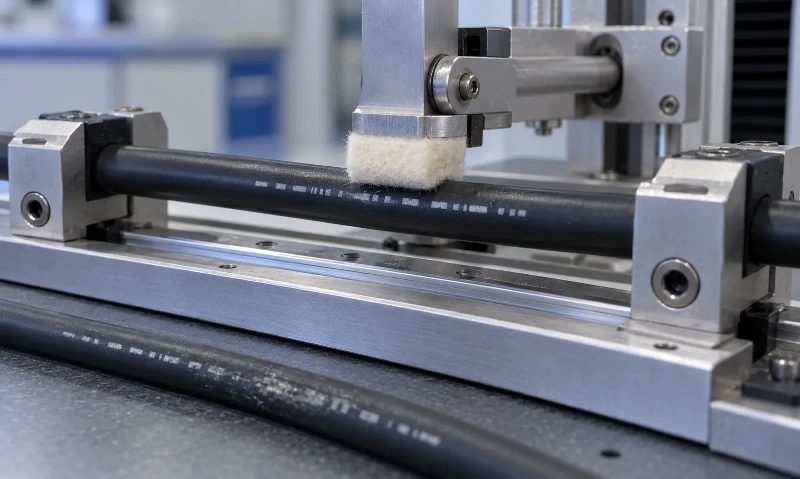
For printed identification, it is particularly useful to record the marking process and the tested surface. An inkjet marking on one jacket formulation should not be assumed to behave identically on another formulation. Nor should a Method 2 pass be presented as a stronger or weaker result than a Method 1 pass merely because the apparatus or number of cycles differs.
IEC E2A vs E2B: What Each Result Actually Proves
| Test | Property Evaluated | Evidence Needed | What a Pass Supports | What It Does Not Establish |
|---|---|---|---|---|
| E2A | Outer cable sheath abrasion resistance | Identified sheath specimen, test conditions, acceptance criteria and observations | The tested sheath meets the specified abrasion requirement under the recorded conditions | Marking legibility, water penetration resistance or overall field service life |
| E2B Method 1 | Cable marking abrasion resistance | Marking type, Method 1 configuration, conditions and post-test observations | The tested marking meets the applicable Method 1 requirement | Sheath abrasion resistance or equivalence with a Method 2 result |
| E2B Method 2 | Cable marking abrasion resistance | Marking type, wool-felt method, conditions and post-test observations | The tested marking meets the applicable Method 2 requirement | Sheath abrasion resistance or equivalence with a Method 1 result |
The table is not a substitute for the acceptance clauses of IEC 60794-1-102:2026. Its purpose is to keep the decision tied to the property actually tested. A single abrasion result cannot be stretched to cover every mechanical or environmental requirement in a cable specification.
Why Can a Jacket Pass While Its Markings Fail?
Sheath abrasion and marking abrasion are different physical questions. Sheath performance depends on the cable construction, jacket material and prescribed mechanical contact. Marking performance is also influenced by how the identification is produced, surface preparation, adhesion and the specified abrading contact. A material can satisfy one requirement without satisfying the other.
Suppose the outer sheath of a cable remains within the E2A acceptance condition, but its printed legend no longer meets the applicable E2B legibility criterion. That would not be a contradiction. It would mean the tested sheath and tested marking produced different outcomes under different procedures. The reverse is also possible: a marking may satisfy its specified test while the sheath lacks sufficient evidence for E2A approval.
This matters when identifying installed links, maintaining route records or checking replacement stock. An unreadable legend may complicate traceability even if the cable itself has no visible structural failure. It should not, however, be described as equivalent to loss of optical service or water ingress without separate evidence.
Can Two Fiber Optic Cable Abrasion Test Reports Be Compared?
Two reports marked "PASS" are not necessarily comparable. First confirm whether both reports evaluate the same property. Then check whether the specimens, methods, conditions and acceptance requirements support the specific comparison being made.
Consider two hypothetical reports submitted for an outdoor cable project. The examples below are illustrative; they are not test results from FOCC Fiber or any named supplier.
| Report Field | Report A | Report B |
|---|---|---|
| Cable | Outdoor optical cable, specimen A | Outdoor optical cable, specimen B |
| Reported method | IEC E2A | IEC E2B Method 2 |
| Tested property | Outer sheath abrasion resistance | Surface marking abrasion resistance |
| Reported conclusion | PASS | PASS |
| What is still unknown | Whether the markings satisfy E2B | Whether the sheath satisfies E2A |
Neither report is inherently better. They answer different questions. To approve a project that specifies both sheath and marking abrasion performance, the reviewer needs applicable evidence for both properties on the relevant cable configurations.
Even two E2B reports require closer examination. If one evaluates a surface-applied legend and the other examines a different marking process, comparing their reported cycle counts or simply ranking their PASS statements would be misleading. A fair comparison requires the same defined performance requirement, a suitable method for each marking and traceable evidence of the resulting condition.
Product identification must also match. An abrasion report for a particular jacket and marking configuration should not be assumed to cover every variation of an FTTH outdoor drop cable, especially if the jacket composition, surface treatment or marking process has changed.
What Should a Cable Abrasion Test Report Include?
A useful test report connects the result to a defined cable specimen and procedure. The standard edition, selected method, relevant apparatus settings and acceptance conditions matter because "PASS" without context cannot support a meaningful engineering comparison.
For 2026-edition records, pay particular attention to the sample cleaning requirements, E2B test count and reporting details introduced in the updated standard. The exact required fields and procedural values should be checked against the applicable full IEC text. The following matrix is a practical document-review aid, not an invented list of universal IEC numerical limits.
| Review Item | Evidence to Look For | Why It Matters | If Missing |
|---|---|---|---|
| Cable and specimen identity | Manufacturer, cable model, construction, specimen reference and report date | Confirms that the result belongs to the proposed cable | Request traceable identification |
| Standard edition | Applicable IEC number, year and any project-specific reference | Identifies the technical requirements against which the test was conducted | Clarify the edition |
| Test method | E2A or E2B, including Method 1 or Method 2 as applicable | Shows which property and procedure were evaluated | Request method identification |
| Marking specification | Marking process, area or legend tested, where relevant | Links E2B evidence to the actual product identification | Confirm marking applicability |
| Sample preparation | Preparation and cleaning information required by the applicable method | Allows procedural compliance to be reviewed | Request the preparation record |
| Test conditions | Abrading contact, force, stroke or movement conditions and required test count, as applicable | Establishes the conditions under which the result was obtained | Request missing conditions |
| Acceptance basis | Relevant specification, acceptance criterion and any permitted deviations | Explains what "PASS" actually means | Do not infer compliance |
| Observations and disposition | Post-test sheath or marking condition, result, deviations and reviewer decision | Distinguishes observed performance from a summary verdict | Request a complete result record |
Insufficient evidence is not the same as a failed cable. If the report omits the applied method or acceptance criterion, the result may be unusable for the intended decision even though no valid test failure has been demonstrated. Similarly, if the laboratory did not follow an essential required procedure, the result may need to be treated as invalid rather than automatically recording a product failure.
A practical review should therefore distinguish four outcomes: a valid pass against the required criterion; a valid failure against that criterion; insufficient evidence to determine compliance; and a test result that cannot be relied upon because the procedure was invalid. The necessary action may be acceptance, clarification, supplementary assessment or retesting, depending on the identified gap.
Can an Older IEC E2 Test Report Still Be Used?
Yes, in some cases. A report prepared under an earlier edition is not automatically invalid simply because IEC 60794-1-102:2026 has been published. The IEC identifies the new document as replacing Method E2 in IEC 60794-1-21:2015, but project acceptance still depends on the edition specified in the contract, the test actually performed and whether the available evidence supports the applicable requirements.
Start by checking the original method and specimen details. Compare the recorded preparation, E2B test count and report information with the requirements of the edition now being requested. If the contract calls for the 2026 edition and the older report does not provide enough evidence for that edition, the reviewer may need additional records, a documented technical assessment or a new test. It is not sound to declare every historical report obsolete, nor to accept one automatically on the strength of an old PASS statement.
The same principle applies when comparing reports from different laboratories: an apparent difference in cycle count or apparatus arrangement must be interpreted in relation to the method, edition and acceptance basis, not treated as a simple ranking of product quality.
What Does an Abrasion Test Not Prove?
Neither E2A nor E2B replaces separate evidence for ultraviolet ageing, water penetration, fire performance, tensile strength, crushing resistance or the cable's expected service life. Each assessment addresses a different property under specified conditions. A laboratory abrasion pass also cannot guarantee that the cable will withstand every edge, surface or handling event encountered during installation.
The distinction is especially important when reviewing cable jackets. The fire rating of a fibre optic cable jacket concerns a different set of performance and installation requirements from abrasion resistance. A jacket's fire classification should not be inferred from its abrasion result, and vice versa.
Where a project calls for multiple mechanical or environmental properties, the evidence package should address each specified property. Adding more test names to one abrasion report does not fill gaps in unrelated performance data.
Confirming Jacket and Marking Test Requirements for a Cable Order
For a cable order, begin with the actual configuration rather than a general request for a "durable jacket." Identify the jacket material, cable outside diameter, intended environment, marking process and any lettering or continuous colour identification that the project requires. Then state whether E2A, E2B or both are needed, together with the applicable standard edition and acceptance basis.
FOCC Fiber supplies a range of fibre optic cable configurations for different network applications. The appropriate technical discussion is about the specific cable proposed for the project and the testing documents available for that configuration; no abrasion test status should be assumed without a corresponding record.
For a useful technical enquiry, provide the following information:
- Required cable model, fibre type and fibre count.
- Jacket material, outside diameter and any specified construction details.
- Marking method, identification content and legibility requirements.
- Installation environment and any project-specific handling conditions.
- Required E2A or E2B method and applicable IEC edition.
- Specified acceptance criteria and requested test records.
- Estimated quantity, cable lengths and any relevant customization requirements.
With this information, the proposed cable and the available evidence can be checked against the actual project requirement. Send FOCC Fiber your cable specification and abrasion test requirements to discuss the relevant configuration, documentation and quotation. A clear specification improves the quality of that review; it does not, by itself, guarantee a passing test result.