For the shortest qualified links inside a rack, passive DAC is usually the first option because it keeps cost, cable-side power, and complexity low. AOC becomes useful when the route needs a lighter optical cable but can remain a fixed end-to-end assembly. Separate optical transceivers and fiber are usually the better fit when the link must pass through structured cabling, cover longer distances, support patch panels, or allow the optics and fiber to be replaced independently.
There is no single distance where every network should switch from DAC to AOC or from AOC to pluggable optics. Port speed, electrical lane rate, host design, FEC, breakout mode, cable construction, and vendor qualification can all change the usable reach. The right choice starts with the actual link rather than a generic cable-length chart.
DAC vs AOC vs Optical Transceiver at a Glance
| Factor | Passive DAC | Active Copper | AOC | Optical Transceiver + Fiber |
|---|---|---|---|---|
| Signal medium | Twinax copper | Twinax copper | Optical fiber | Optical fiber |
| Signal conditioning inside the cable | None in the high-speed signal path | Yes, depending on ACC/LACC/AEC design | Integrated optical conversion at both ends | Handled by removable optical modules |
| Reach | Short and rate-dependent | Short to intermediate and product-dependent | Product-dependent | PMD-dependent, from short reach to long reach |
| Cable-side power | Lowest | Higher than passive DAC | Active power required at both ends | Module power depends on the selected optics |
| Cable bulk | Highest at comparable high-speed links | Generally higher than optical fiber | Low | Low |
| Structured cabling | Poor fit | Poor fit | Limited because it is a fixed assembly | Best fit |
| Service model | Replace the cable assembly | Replace the cable assembly | Replace the cable assembly | Module and fiber can be serviced separately |
| Typical starting point | Shortest in-rack links | When passive copper reach is insufficient | Fixed optical links where low cable bulk matters | Structured, modular, or longer-reach links |
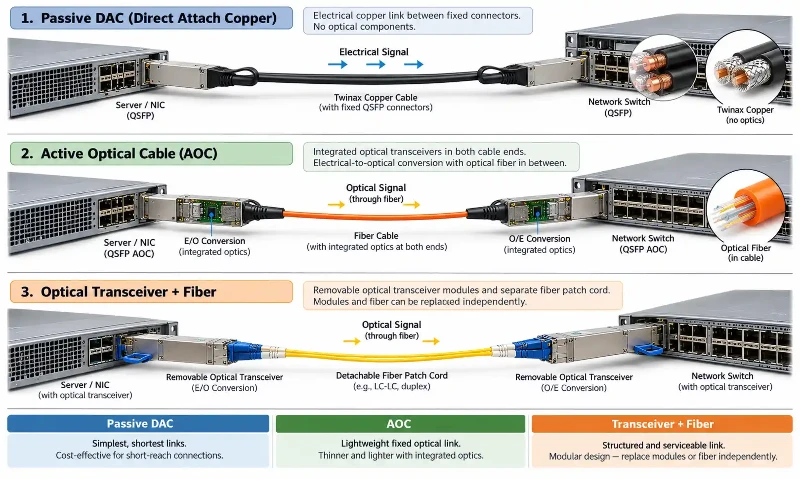
How the Four Link Architectures Differ
Passive DAC
A passive direct attach copper cable carries the high-speed electrical signal over twinax copper between fixed connector ends such as SFP, QSFP, QSFP-DD, or OSFP. It does not contain active equalization or retiming in the high-speed signal path, so the host SerDes, PCB traces, connector interfaces, and cable all share the electrical channel budget.
This simplicity is why passive DAC remains attractive for very short server-to-switch and switch-to-switch links. A 100G QSFP28 passive DAC, for example, represents the basic architecture well: the cable is the complete electrical link between the two ports rather than a separate transceiver plus transmission medium.
Active Copper: ACC, LACC, and AEC
Active copper adds electronics when passive twinax no longer provides enough electrical margin. The terminology is not perfectly uniform across vendors, so the internal architecture should be checked rather than inferred from the product name alone.
- ACC or linear active copper commonly uses analog equalization or linear amplification to compensate for channel loss without converting the link to optics.
- AEC commonly uses more active signal processing, which can include retiming or DSP-based functions depending on the implementation.
These cables fill the gap between passive DAC and optical links, especially when the route is still short but the lane rate or host channel makes passive copper impractical.
Active Optical Cable
An AOC integrates the optical engines and fiber into one factory-assembled cable. The host still sees a pluggable electrical interface, but the signal is converted to light inside the cable ends and carried over fiber between them.
AOC is an architecture, not a guarantee of one fiber type or laser technology. Many short-reach products use multimode fiber and VCSEL-based optics, while other implementations can use single-mode fiber. NVIDIA's Layer 1 data center guidance, for example, defines AOC as an integrated cable that may use multimode or single-mode fiber.
Optical Transceiver + Passive Fiber
With pluggable optics, the transceiver and fiber cable are separate parts. That separation allows the PMD, wavelength, connector interface, fiber type, and reach to be selected for the actual link. The same fiber optic transceiver category can therefore include short-reach multimode modules as well as single-mode modules intended for much longer distances.
The fiber itself can also be selected independently. Short-reach multimode links may use OM4 multimode patch cords, while longer-reach single-mode systems may use OS2 single-mode patch cords. The transceiver specification determines which medium is valid.
Distance Depends on Speed, Lane Rate, and the Host Platform
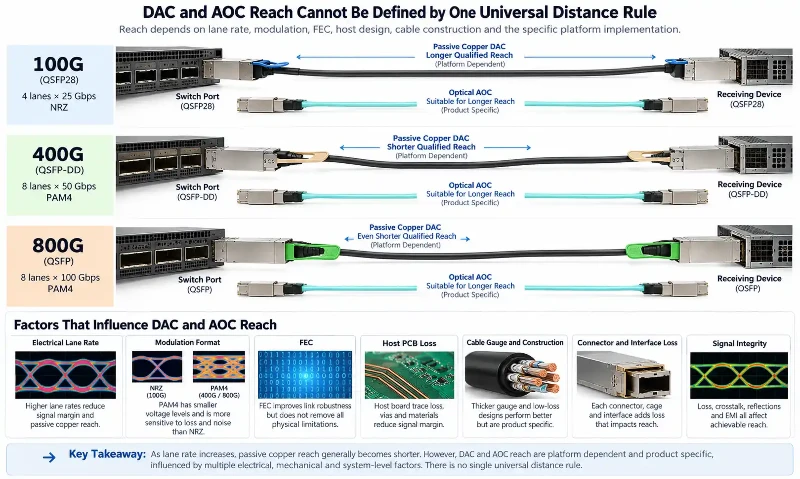
Statements such as "DAC works to 7 meters" or "AOC is always 100 meters" are too broad for modern data center links. Electrical reach changes with lane rate, modulation, cable gauge, insertion loss, host PCB loss, connector loss, equalization, FEC, and the qualification limits of the switch or NIC.
Higher aggregate port speed does not automatically mean the same electrical lane architecture. A 100G port built from four 25G NRZ lanes presents a different copper-channel problem from a 400G or 800G interface built around higher-rate PAM4 lanes. As signaling rate rises, the loss margin available to passive copper generally becomes tighter.
A current vendor portfolio illustrates why rate-specific data matters. NVIDIA lists different maximum DAC and linear-active-copper reaches across its 400G and 800G product families rather than one universal copper limit. Its current interconnect specifications list, for example, different DAC limits for 800G/400G OSFP and 400G QSFP-DD systems.
The practical rule is simple: use the reach stated for the exact port speed, cable type, and host platform being deployed. Do not carry a distance number from one generation into another.
Power and Thermal Trade-Offs
Passive DAC normally has the lowest incremental cable power because there is no active signal conditioning or optical conversion in the high-speed path. Active copper adds electronics, while AOCs and pluggable optical modules must power optical transmitters, receivers, and any associated signal-processing circuitry.
That does not justify one universal wattage for each category. A 40G AOC, a 100G AOC, an 800G AEC, and an 800G optical module can have very different power profiles. Even products with the same form factor can use different DSP, retiming, or linear-drive architectures.
For a few ports, the difference may be minor. At high port counts, a few additional watts per port can materially affect front-panel thermal density and the power budget of the switch. Procurement should therefore check the actual module or cable specification against the supported port power class and cooling design.
Latency: Do Not Reduce the Decision to Copper vs Fiber
Passive DAC adds no cable-side active retiming or optical conversion, which makes it the simplest signal path. Active copper, AOC, and pluggable optics may add equalization, retiming, CDR, or DSP functions depending on the product architecture.
That distinction is more useful than saying "copper has zero latency" or assigning a fixed delay to every optical link. Propagation delay through short copper and fiber runs is of the same general order, while active electronics vary by implementation. Some AOCs and optical modules include retiming; others use lower-processing or linear architectures.
For latency-sensitive systems, compare the actual cable or module specification and the complete end-to-end path rather than assuming every active optical link adds the same processing delay.
Cable Density, Bend Management, and Airflow
Copper cable bulk becomes increasingly important as port density rises. High-speed twinax can be thicker, heavier, and stiffer than optical fiber, which makes large cable bundles harder to route around switch faces, vertical managers, and rack pathways.
AOC and passive fiber are usually lighter and easier to route, but fiber still has bend-radius limits. A tight bend can increase optical loss or damage the cable. The correct bend radius must come from the cable manufacturer's specification rather than a generic diameter rule.
NVIDIA's data center cabling guide highlights longer reach and smaller diameter as optical-fiber advantages while also noting the additional cost and active electronics involved.
For dense racks, cable choice should therefore include:
- Available side and vertical routing space
- Connector-head clearance
- Required bend radius
- Cable bundle size and weight
- Airflow around switch and NIC ports
- Whether the route will remain fixed or change frequently
AOC vs Optical Transceiver + Fiber
AOC and separate pluggable optics both move data over fiber, but they create different operating models.
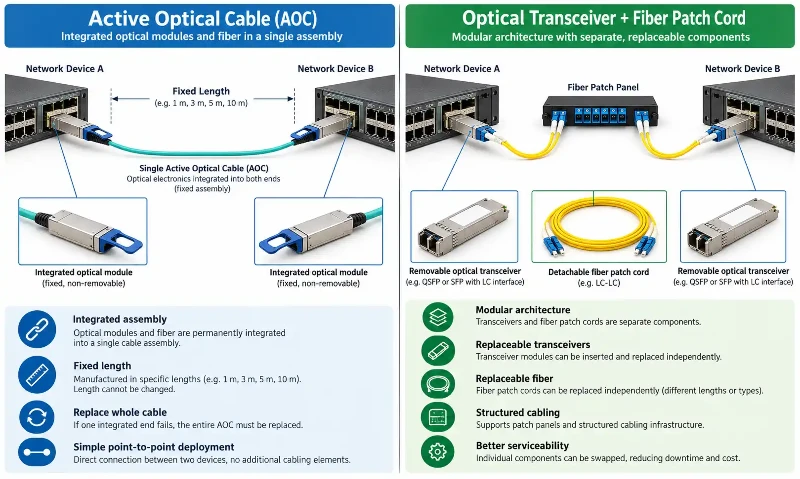
| Decision Point | AOC | Optical Transceiver + Fiber |
|---|---|---|
| Construction | Optics and fiber permanently integrated | Removable optics plus separate passive fiber |
| Length | Fixed at purchase | Fiber length can be changed independently |
| Patch panels | Less suited to structured patching | Well suited to patch panels and cross-connects |
| Failure replacement | Normally replace the complete assembly | Replace module or cable independently |
| Inventory | Spare assemblies by length and coding | Modules and patch cords stocked separately |
| Fiber reuse during upgrades | Limited by integrated cable ends | Possible if the new PMD supports the installed fiber plant |
| Best fit | Fixed point-to-point optical links | Structured cabling and modular infrastructure |
AOC can be attractive when the route is fixed, the required length is known, and reducing cable bulk is more important than separating the serviceable parts. Pluggable optics are stronger when the link passes through patch panels, the fiber route must remain in place through hardware changes, or operations teams want to replace the module and cable independently.
That modularity does not guarantee that an old fiber plant will support every future speed. Reuse still depends on the new PMD's fiber type, connector interface, polarity, reach, insertion-loss limit, and other channel requirements.
Maintenance and Failure Domains
DAC, active copper, and AOC are fixed assemblies. If a cable body or an integrated end fails, the normal service action is to replace the complete cable. For a short, easily accessible in-rack link, that can be fast and simple. For a long AOC routed through dense trays, replacing the entire assembly can be more disruptive.
Pluggable optics separate the failure domains. A failed module can be replaced without disturbing the passive fiber route, and a damaged patch cord can be replaced without discarding the optics. That becomes more important in structured cabling where the passive plant may pass through multiple cabinets or patching locations.
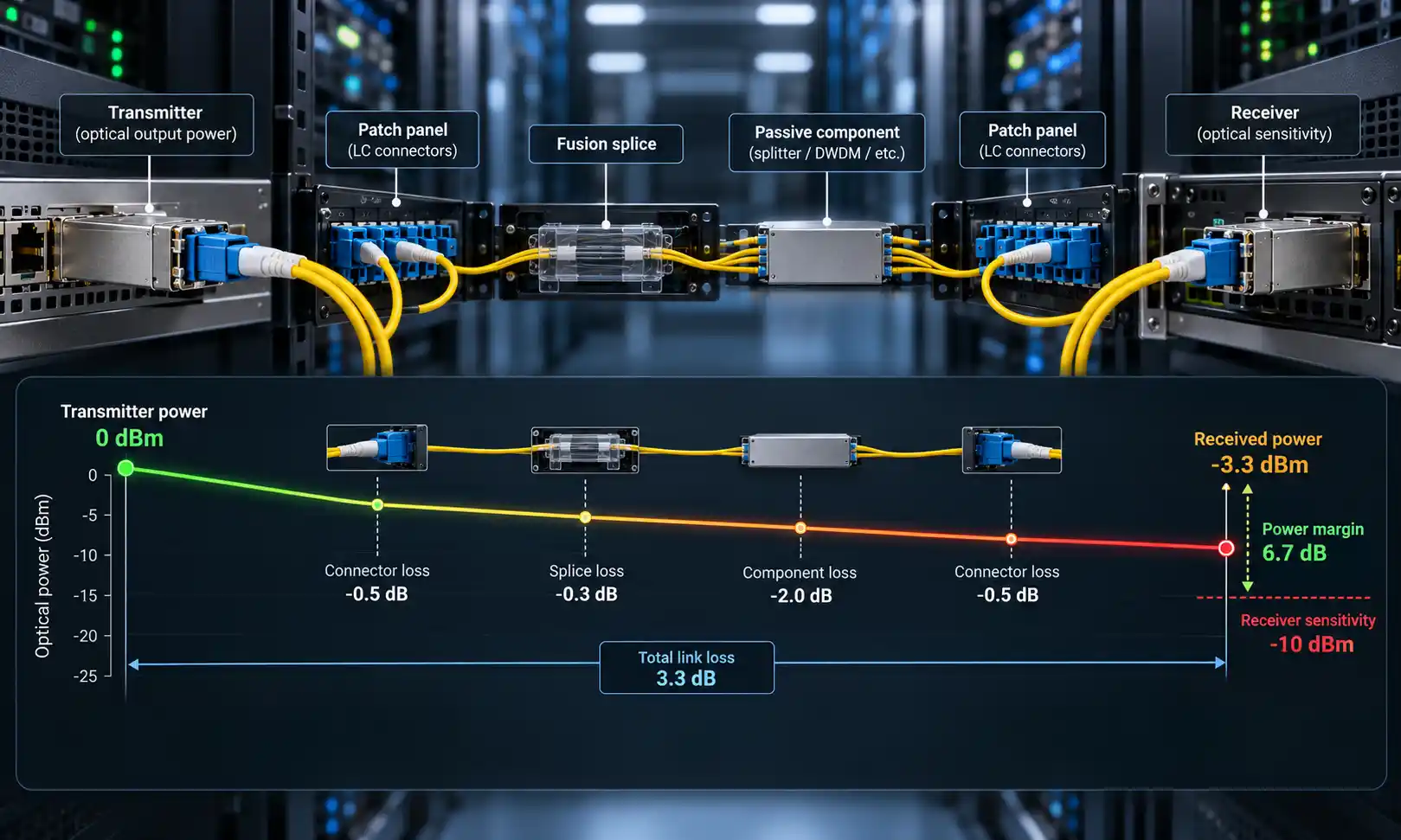
There is a trade-off: every additional removable optical interface creates another connector that must be kept clean and within the channel loss budget. Modular systems improve serviceability, but they also require disciplined connector inspection, cleaning, labeling, and link documentation.
Same Form Factor Does Not Mean the Same Link
An SFP, QSFP, QSFP-DD, or OSFP mechanical interface does not guarantee that every cable or module with the same shell will work in the port. Compatibility is determined by the electrical and protocol requirements behind the cage.
Before treating a DAC, AOC, or optical module as interchangeable, verify:
- Port speed and supported operating modes
- Electrical lane count and lane rate
- NRZ or PAM4 signaling where relevant
- Required FEC mode
- Breakout support and lane mapping
- EEPROM or vendor coding requirements
- Switch or NIC firmware support
- Power class and thermal limits
- For optics, PMD, wavelength, fiber type, connector, and reach
For example, two QSFP28 devices may share the same form factor while representing very different optical links. A 100GBASE-SR4 QSFP28 uses a short-reach multimode parallel-optics interface, while a 100G QSFP28 LR4 is designed around a very different single-mode optical path.
Breakout Links: The Cable Does Not Configure the Port
Breakout cabling allows one higher-speed port to connect to several lower-speed ports, such as a 100G QSFP28 port operating as four 25G lanes. DAC, AOC, and optical breakout assemblies can all be used in supported architectures.
The cable itself does not put the switch into breakout mode. The host must support the required split, and the port must be configured for the correct lane map, branch speed, and FEC behavior. A mechanically compatible breakout cable cannot create a breakout mode that the switch ASIC, firmware, or NIC does not support.
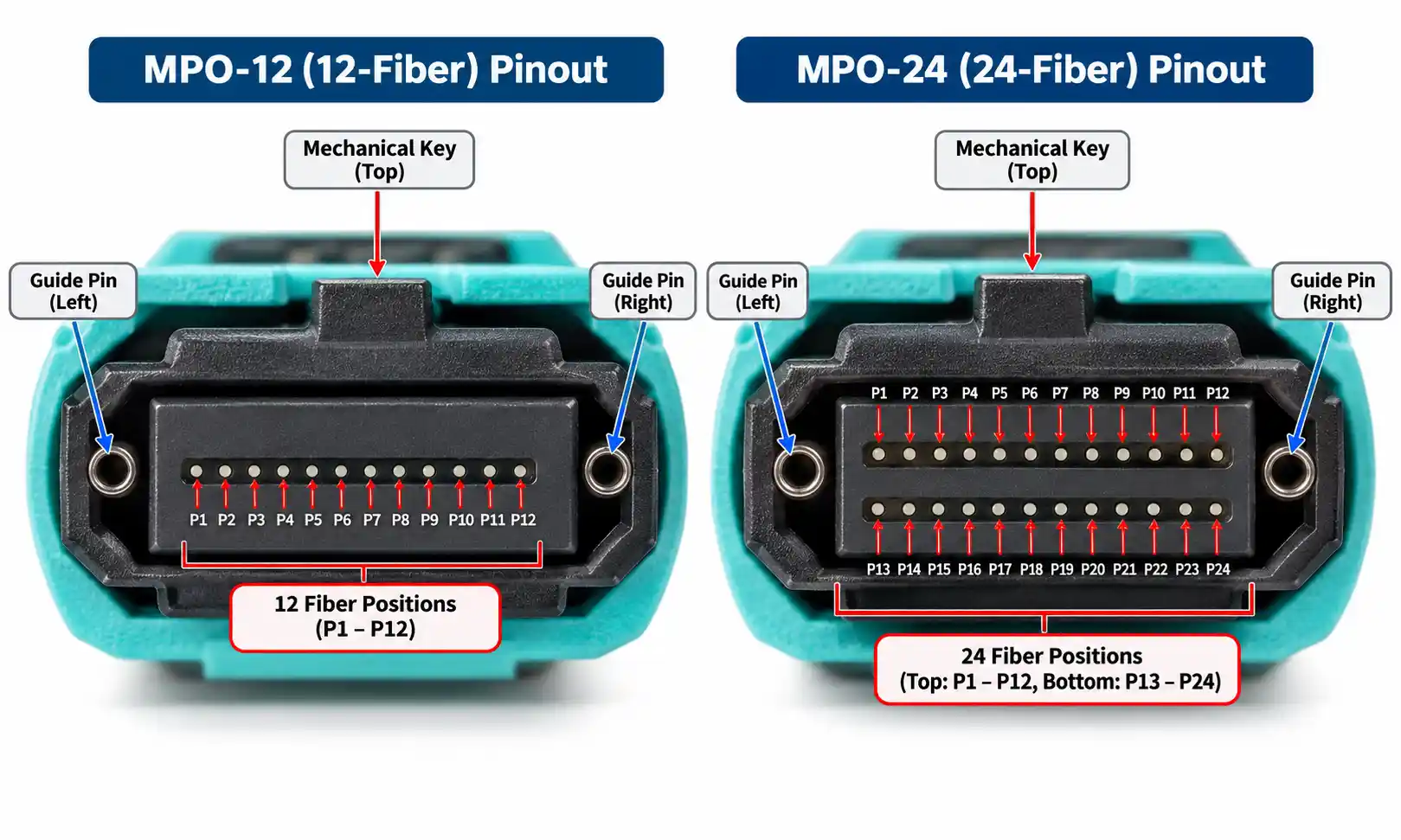
For short server connections within a rack, a passive breakout DAC can be an efficient option. When the same split must cross a longer fixed route, AOC or an optical breakout architecture may be more practical. Structured parallel-optics systems can also use MPO/MTP trunk cabling where the PMD, polarity, connector count, and loss budget support it.
Where ACC, LACC, and AEC Fit
Active electrical cables are useful when passive DAC is attractive operationally but cannot meet the required electrical reach. They preserve a copper-based connection while adding signal conditioning.
The internal design matters. Linear active copper can extend reach using analog equalization with relatively simple electronics, while AEC implementations may use retiming or DSP to recover a higher-loss electrical channel. These designs have different power, latency, host-channel, and interoperability characteristics, so "active copper" should not be treated as one fixed specification.
NVIDIA's current interconnect portfolio, for example, separates passive DAC and LACC and publishes different reach limits for each product family rather than treating them as one cable category.
What Changes at 400G and 800G?
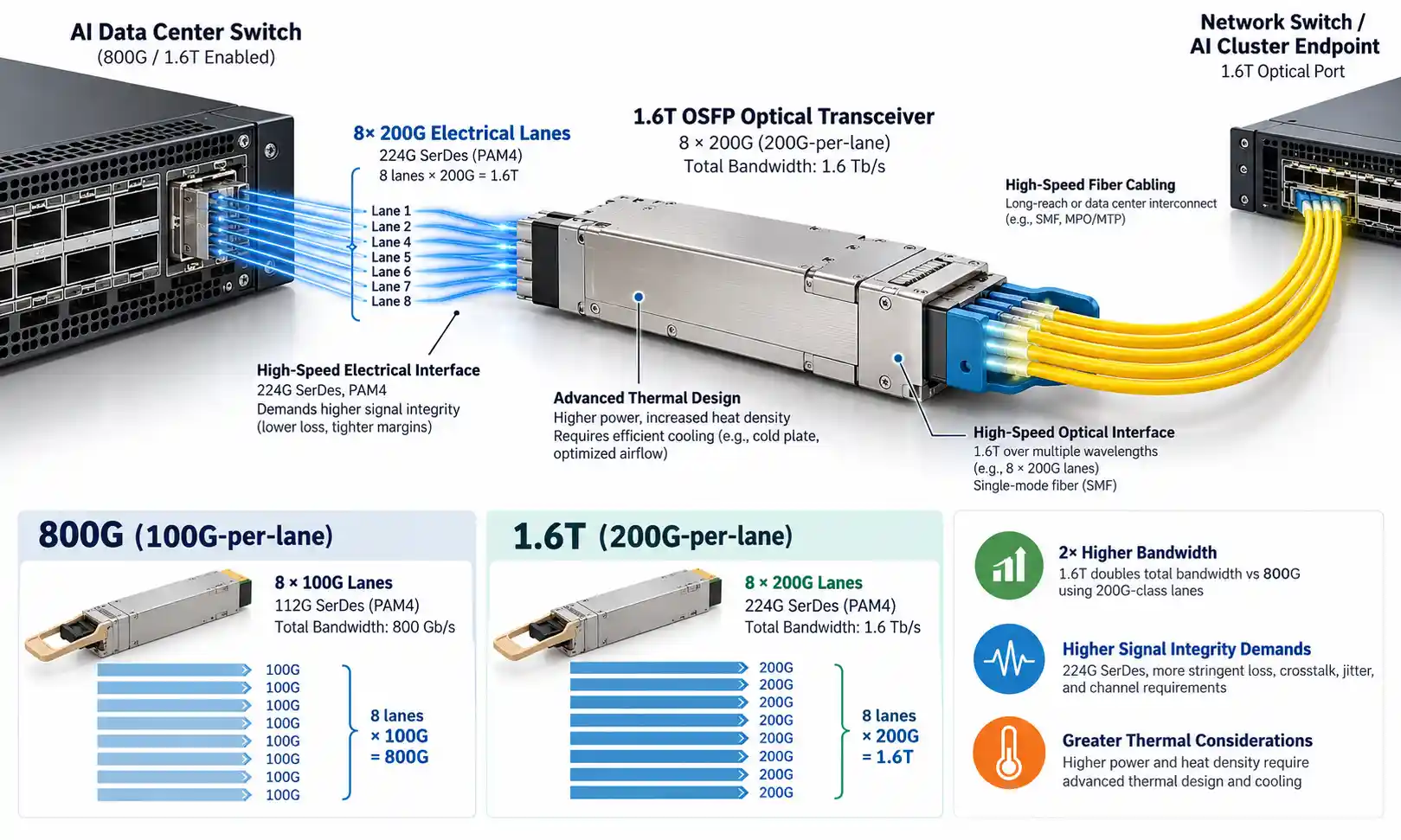
At 400G and 800G, the basic decision framework is the same, but the electrical margin becomes more restrictive. Higher per-lane signaling rates increase sensitivity to insertion loss, reflections, channel quality, and host design. That tends to reduce the practical reach of passive copper and increases the value of active copper or optical links as distance grows.
This does not mean 400G or 800G automatically requires fiber. Very short qualified DAC links remain valid in current high-speed platforms. IEEE's 802.3df 400 Gb/s and 800 Gb/s Ethernet work includes both electrical and optical physical-layer options, reflecting the fact that cable choice still depends on the deployment rather than speed alone.
For dense AI and HPC fabrics, three pressures become more important at these rates:
- Electrical reach: passive copper has less margin as lane rates increase.
- Physical density: large copper bundles are harder to route at scale.
- Thermal density: active copper and optical modules can add meaningful port-side power.
The result is not "800G equals optics." A short in-rack 800G link, a five-meter rack-to-rack link, and a 500-meter fabric link require different answers.
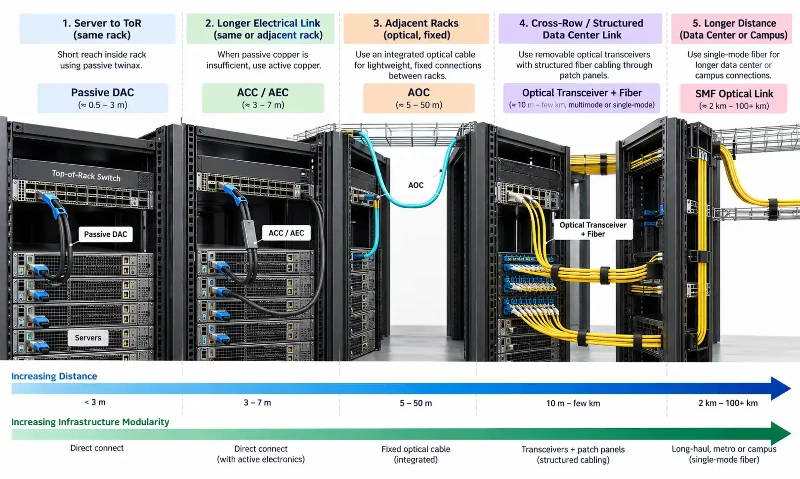
Which Option Fits Each Data Center Scenario?
| Scenario | Good Starting Point | Why |
|---|---|---|
| Server to ToR switch in the same rack | Passive DAC | Lowest complexity when the qualified copper reach is sufficient |
| Same rack but passive copper margin is insufficient | ACC/LACC/AEC | Extends the electrical link without moving directly to optics |
| Adjacent racks, fixed route, cable bulk is a concern | AOC | Light optical cable with integrated ends and simple deployment |
| Cross-row or structured cabling | Optical transceiver + fiber | Supports patch panels, cross-connects, and independent service |
| Parallel-optics structured backbone | Optical transceiver + MPO/MTP cabling | Supports high-density modular fiber architecture when the PMD requires it |
| Longer single-mode data center or campus link | Single-mode optical transceiver + OS2 fiber | Supports PMDs designed for longer reach |
This table is a starting point, not a substitute for the host and cable specification. The same physical distance can lead to different answers at different lane rates or on different switch platforms.
CAPEX and OPEX: Compare the Whole Link
Passive DAC often has the lowest upfront cost for short links because it avoids optical engines and separate fiber components. AOC can simplify a fixed optical connection because the optics and cable arrive as one assembly. Separate transceivers and fiber usually require more components, but that modularity can reduce the scope of future replacements.
Do not assume that AOC is always cheaper than two optical modules plus fiber, or that modular optics always have the lowest long-term cost. Pricing varies by speed, reach, vendor qualification, volume, and interface type.
For total cost of ownership, compare:
- Initial cable or module cost
- Power at both ends of the link
- Spare inventory strategy
- Labor to replace failed assemblies
- Disruption caused by rerouting long fixed cables
- Whether passive fiber can remain in place during upgrades
- Patch-panel and structured-cabling requirements
Selection Checklist
Before ordering a DAC, AOC, active copper cable, or optical module, record the following for each link:
- Port type: SFP+, SFP28, QSFP28, QSFP-DD, OSFP, or another interface
- Required speed: including any breakout mode
- Actual route length: not straight-line rack distance
- Host qualification: supported cable/module type and maximum length
- FEC and lane mode: required at both ends
- Cable pathway: rack, row, overhead tray, underfloor, or structured patching
- Density limits: cable bulk, bend space, and airflow
- Service model: fixed assembly or independently replaceable parts
- Optical requirements: PMD, wavelength, fiber type, connector, and loss budget
- Upgrade plan: whether the passive cabling should remain reusable
FAQ: DAC vs AOC vs Optical Transceiver
Is DAC better than AOC?
Neither is universally better. Passive DAC is usually the first choice for the shortest qualified links because it is simple and low power. AOC is more attractive when the route needs a lighter optical cable and the integrated fixed assembly fits the maintenance plan.
When should I use AOC instead of DAC?
Consider AOC when the required route exceeds the qualified passive-copper reach, cable bulk is becoming difficult to manage, or the link needs the routing flexibility of fiber but does not require a modular structured-cabling design.
Is AOC the same as an optical transceiver and fiber patch cord?
No. An AOC permanently integrates the optical ends and fiber into one assembly. A pluggable optical link uses separate transceivers and passive fiber, allowing the parts to be replaced or changed independently.
Can DAC and AOC use the same switch port?
They can share the same physical cage only when the switch supports the required cable type, speed, lane configuration, FEC, coding, and power characteristics. Mechanical fit alone is not enough.
How far can a DAC cable run?
There is no universal DAC distance. Reach depends on data rate, electrical lane rate, cable construction, host PCB loss, equalization, FEC, and vendor qualification. Use the maximum supported length for the exact switch, NIC, and cable part number.
Is DAC always lower latency than AOC?
Passive DAC has no cable-side active signal processing, which gives it the simplest path. The actual latency difference depends on whether the AOC or active copper design uses retiming, CDR, DSP, or other processing. Use product-specific data when latency is a design constraint.
Can I reuse installed fiber when upgrading transceivers?
Sometimes. The existing fiber can remain only if the new PMD supports its fiber type, connector interface, polarity, reach, and channel loss. A modular fiber plant improves the possibility of reuse but does not guarantee it.
Should I use DAC, AOC, or fiber for rack-to-rack links?
Start with the actual distance and supported host configuration. Passive DAC can still work for very short qualified rack-to-rack links. Active copper can extend that range. AOC is useful for fixed optical runs, while separate transceivers and fiber are generally better when the link is part of a structured or frequently serviced cabling system.
Final Takeaway
Choose the interconnect by the link, not by a fixed distance rule. Passive DAC is the simplest starting point for the shortest qualified connections. Active copper fills part of the gap when electrical reach is the limiting factor. AOC provides a compact fixed optical assembly. Separate optical transceivers and fiber provide the strongest fit for structured cabling, longer reach, and independent maintenance.
At 400G and 800G, the same logic still applies, but lane rate, signal integrity, power, cable density, and host qualification become more important. Verify the exact platform and cable specification before turning any general comparison into a procurement rule.