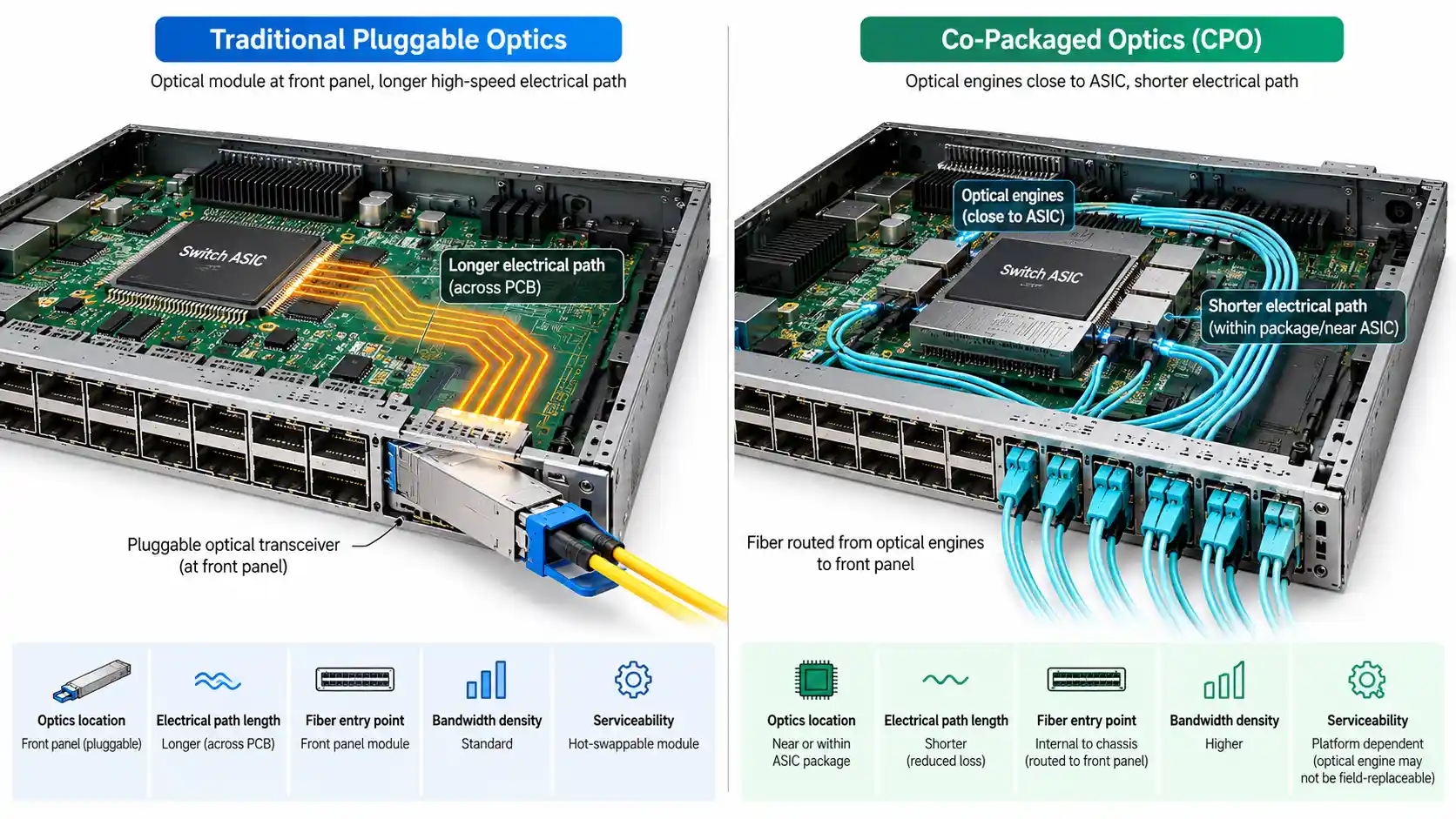
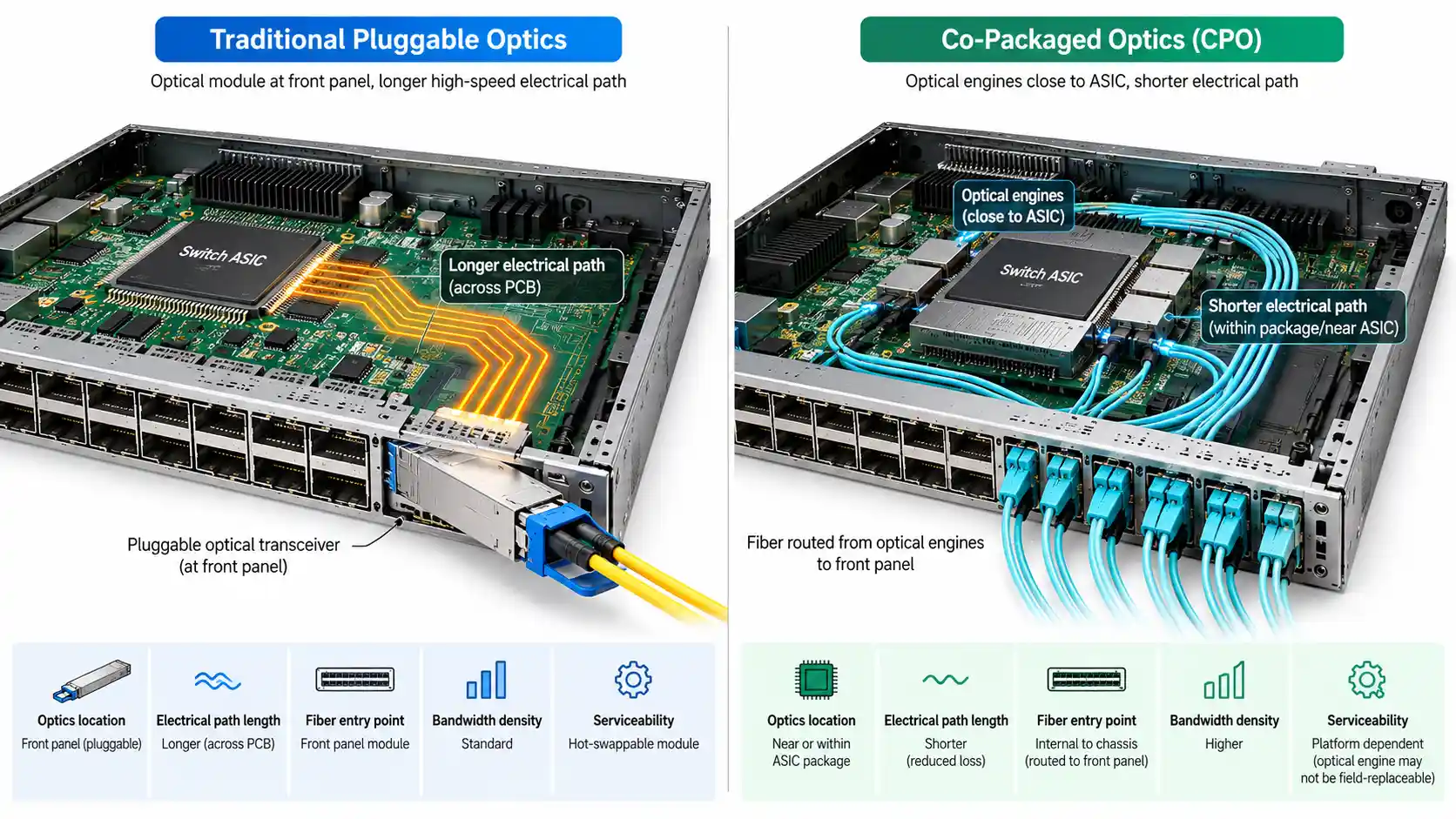
Co-packaged optics and pluggable optics solve the same basic problem in different places. Pluggable optics keep the optical module at the switch faceplate, preserving a familiar hot-swappable service model. CPO moves the optical engine much closer to the switch ASIC, reducing the high-speed electrical path that becomes harder to drive efficiently as SerDes rates rise.
For AI and HPC networks, that difference affects more than switch power. It changes where fiber enters the system, how front-panel density is managed, what can be replaced in the field, and how operators think about cleaning, loss budgets, spare parts, and maintenance. CPO can improve bandwidth density and reduce electrical interconnect loss, but it does not remove fiber cabling or automatically make pluggable optics obsolete.
CPO vs Pluggable Optics: The Architecture Difference
The easiest way to compare these architectures is to ask one question: where does electrical-to-optical conversion happen relative to the host ASIC?
Traditional DSP-Based Pluggable Optics
In a conventional pluggable design, the switch ASIC sends high-speed electrical signals across the printed circuit board to a removable module at the faceplate. The module contains the optical transmitter and receiver together with the electronics needed to recover and condition the electrical signal.
This architecture remains operationally attractive because the module is a clear field-replaceable unit. A failed optic can normally be removed without replacing the switch or line card. For many enterprise, cloud, and data-center interconnect applications, this service model is still one of the strongest reasons to use pluggable optical transceivers.
Linear Pluggable Optics
Linear pluggable optics keep the optical module at the front panel but reduce or remove some signal-processing functions inside the module. The goal is to cut module power while preserving the familiar pluggable form factor.
This is an important distinction: LPO is not CPO. LPO changes how the front-panel module handles electrical signal conditioning; CPO changes the physical relationship between the optical engine and the host ASIC.
Near-Package Optics
Near-package optics move the optical engine away from the faceplate and closer to the host ASIC, shortening the electrical path without fully integrating the optics into the same package as the switch silicon. It sits between traditional pluggables and full co-packaging in terms of integration.
Co-Packaged Optics
CPO places optical engines within the same package environment as, or in very close proximity to, the switch ASIC. Broadcom describes its CPO platform as heterogeneous integration of optics and silicon on a packaged substrate, with the goal of reducing path loss and power associated with long high-speed electrical interconnects. Its current CPO platform overview also shows that CPO can be implemented as part of both scale-up and scale-out networking systems.
The architecture is therefore not defined by one universal mechanical layout. Different vendors may use different packaging, fiber-attach, laser-source, and connector strategies while still following the same basic principle: move the optics closer to the switching silicon so less of the highest-speed signal has to cross the PCB electrically.
Why AI Networks Are Pushing Optics Closer to the ASIC
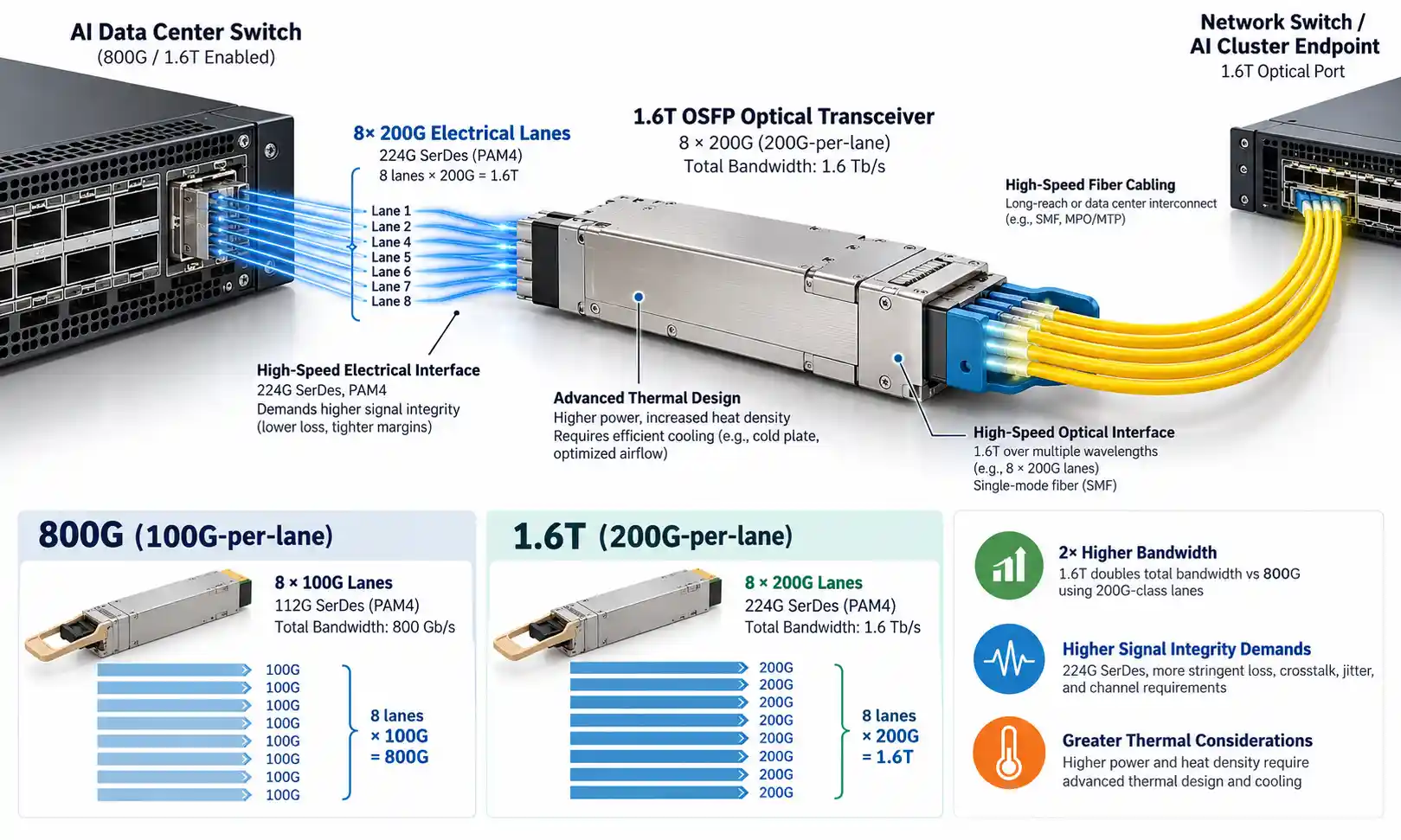
As lane rates rise, PCB channels become more difficult to drive. Skin effect, dielectric loss, crosstalk, package loss, and equalization requirements all increase the cost and power needed to move electrical signals between the ASIC and a front-panel module.
That problem matters more in AI clusters because high-radix switches aggregate enormous bandwidth into a limited chassis area. At the same time, the network shares the same facility power and cooling envelope as GPUs and other compute hardware.
CPO addresses this by shortening the electrical path and moving more of the high-speed interconnect into the optical domain. Broadcom's current CPO switch portfolio includes 200G-SerDes-based systems, while NVIDIA's current silicon photonics networking platform also uses co-packaged optics with 200G SerDes for AI-scale Ethernet and InfiniBand systems.
Those vendor implementations show why CPO is receiving attention, but their published power or reliability gains should not be treated as fixed values for every architecture. System boundaries, cooling assumptions, laser placement, reach, switch design, and traffic model can all change the comparison.
CPO vs Pluggable Optics: What Actually Changes?
| Design Area | Co-Packaged Optics | Pluggable Optics |
|---|---|---|
| Optics location | Integrated with or placed very close to the switch ASIC | Removable module at the faceplate |
| High-speed electrical path | Shorter | Longer PCB path from ASIC to front panel |
| Bandwidth density | Can move more optical I/O closer to the package edge | Constrained by faceplate cages and module pitch |
| Power strategy | Reduces dependence on long electrical channels and associated signal conditioning | Depends on module DSP, retimers, host channel quality, and reach |
| Thermal design | Shifts more thermal complexity toward the package and system cooling design | Heat is distributed across replaceable front-panel modules |
| Field replaceability | Depends on optical-engine, connector, and external-laser architecture | Individual transceivers are normally hot-swappable |
| Fiber entry point | Fiber must reach optical engines inside or near the package | Fiber terminates at front-panel modules |
| Best fit today | Very high-bandwidth AI/HPC systems where power and density justify tighter integration | Broad range of enterprise, cloud, DCI, storage, and AI scale-out applications |
Does CPO Eliminate Fiber Cabling?
No. CPO changes where electrical-to-optical conversion happens; it does not remove the optical path between systems.
Fiber still has to connect switch ports, racks, clusters, patching fields, and other network endpoints. In a CPO platform, the cabling problem can actually become more sensitive because fibers may need to enter the chassis and reach optical engines that sit much closer to the switch package.
That makes the design of fiber cable assemblies, routing paths, connector interfaces, service loops, cleaning access, and bend control part of the CPO system design rather than a separate afterthought.
Internal Fiber Routing Becomes More Important
In a pluggable system, most service access happens at the faceplate. In CPO, some fiber paths can extend deeper into the chassis. The actual routing depends on the platform, but the engineering questions are consistent:
- Can the internal fiber path maintain the minimum bend radius specified for the cable assembly?
- Can technicians reach serviceable connection points without disturbing adjacent fibers?
- Does the route avoid fans, cold plates, sharp edges, and moving hardware?
- Can the chassis maintain fiber organization as port count increases?
These questions matter because the connector and cable architecture is now more closely coupled to the switch mechanical design.
Connector Density Moves Up the Priority List
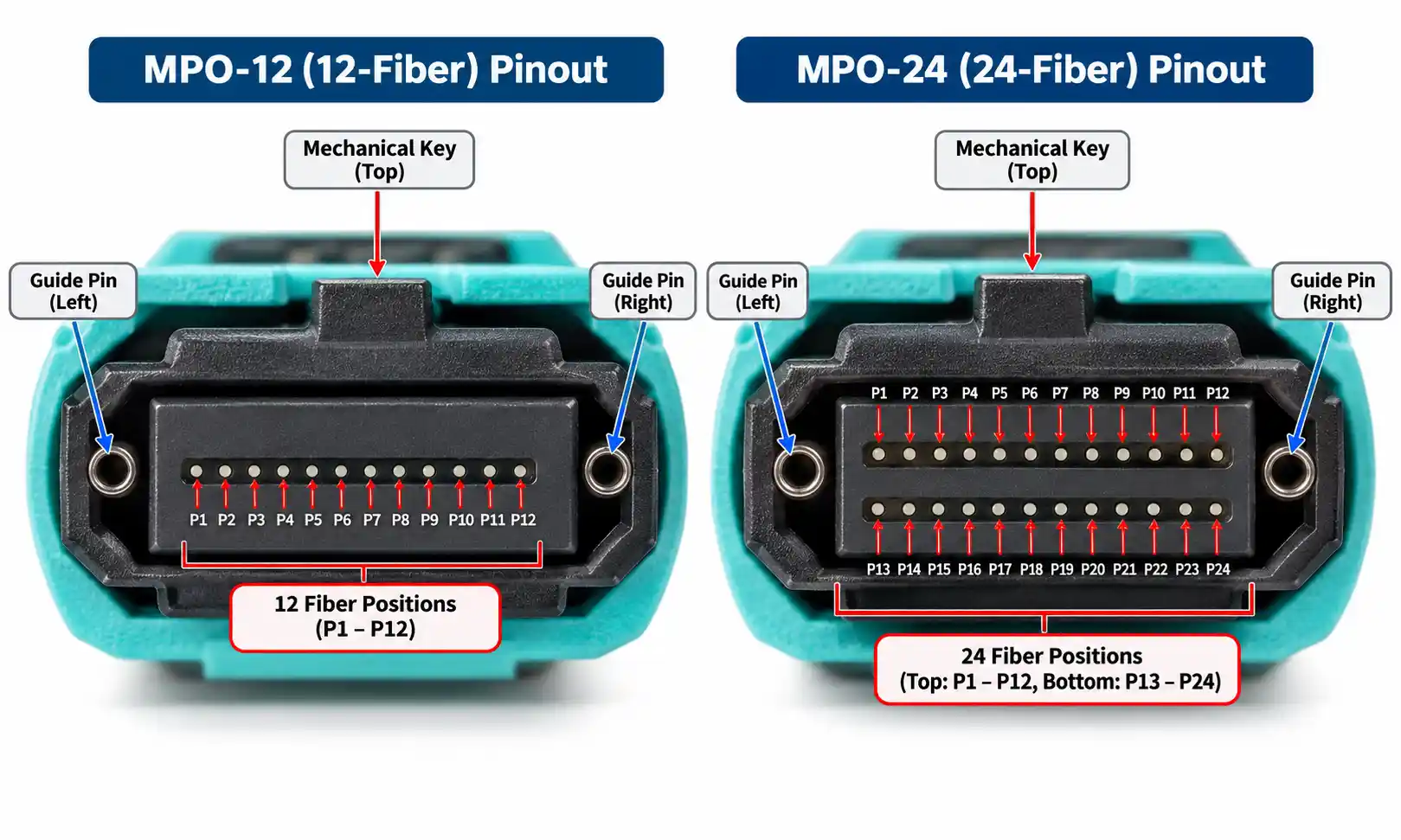
High-radix CPO systems need a large amount of optical I/O in a limited front-panel area. That creates demand for compact multi-fiber and very-small-form-factor connector systems, but there is no single connector that defines all CPO implementations.
Depending on the platform, the external fiber plant may use conventional duplex interfaces, multi-fiber connectors, detachable fiber assemblies, or newer high-density connector formats. Existing MPO/MTP cable assemblies remain relevant where the switch or structured cabling design uses parallel or high-count fiber interfaces, but they should not be assumed to be the connector for every CPO system.
Insertion Loss and Reflectance Still Matter
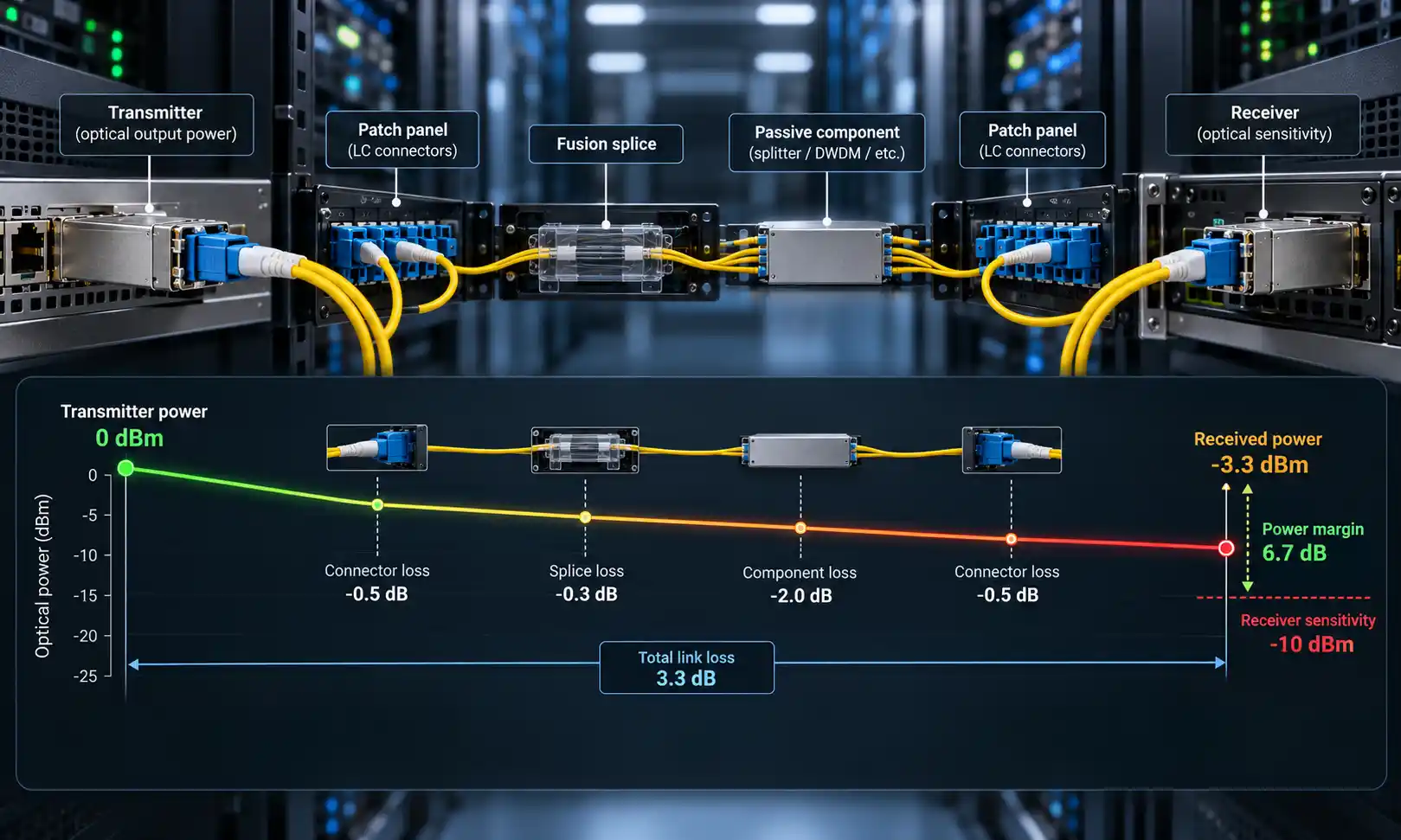
Every connector, adapter, splice, cassette, and internal optical interface consumes part of the link budget. Moving the optical engine closer to the ASIC does not remove those passive losses.
For CPO designs, engineers need to consider the complete optical path from the optical engine through internal fiber, chassis interface, structured cabling, and the far-end receiver. If multiple fiber optic connectors and adapters are present, their specified insertion loss and return-loss performance should be included in the channel calculation rather than replaced with one generic connector allowance.
Adapters and Blind-Mate Interfaces Need Service Access
CPO platforms may use detachable or blind-mate optical interfaces to make dense internal fiber practical. These interfaces can improve assembly and serviceability, but they also make alignment, contamination control, and mechanical access important design factors.
Where a chassis uses removable optical interfaces, the mating system should be evaluated together with the external fiber optic adapters and patching architecture so maintenance does not depend on inaccessible connection points.
External Laser Sources Change the Service Model
One of the most important CPO design choices is where the laser sits. The OIF's Co-Packaging Framework notes that silicon-photonics optical engines can use either integrated or external laser sources. With an external laser source, the laser can be placed in a replaceable front-panel module while continuous-wave light is delivered to the co-packaged optical engine.
This matters because the laser is no longer automatically tied to the same field-replaceable unit as the switch ASIC. OIF specifically identifies improved serviceability and thermal separation as potential benefits of external laser architectures, while also noting the additional optical loss that the laser-delivery path introduces.
Some CPO systems therefore use polarization-maintaining fiber components or other controlled optical paths to deliver light from an external laser source into the package. The exact requirement depends on the optical-engine and laser architecture rather than on CPO as a category.
Serviceability: CPO Changes the Failure Domain
Pluggable optics have a straightforward operational advantage: the transceiver is a small, standardized field-replaceable unit. If the module fails, technicians can normally replace that module without disturbing the rest of the switch.
CPO changes that model, but it does not always mean that the entire chassis must be replaced. The service boundary depends on the platform.
NVIDIA, for example, places lasers in accessible external laser-source modules and uses detachable fiber interfaces in its silicon-photonics switches. Broadcom also uses pluggable laser sources in current CPO systems. These designs are attempts to keep high-failure or service-sensitive components replaceable even though the optical engine itself is much more tightly integrated with the switching silicon.
The practical question for operators is therefore not simply "Is CPO serviceable?" It is:
- Which optical components are field replaceable?
- Can external lasers be replaced independently?
- Can fiber assemblies be disconnected without removing the line card?
- What happens if an internal optical engine fails?
- What spare-unit strategy does the platform require?
CPO Can Increase Platform Dependency
A standard pluggable ecosystem gives operators broad freedom to source compatible modules separately from the switch platform. CPO integrates the optics more tightly with the silicon and mechanical system, so the sourcing model can become more platform-specific.
That does not mean every CPO design creates the same level of vendor dependency. Interoperable external laser sources, standardized management interfaces, detachable optical connectors, and common fiber interfaces can all reduce that dependency. The OIF CMIS 5.3 specification, for example, includes monitoring provisions for CPO subsystems and external laser inputs.
For procurement teams, the relevant questions are lifecycle support, spare-unit availability, connector compatibility, monitoring support, and whether optical components can be sourced or serviced independently from the switch platform.
Who Should Care About CPO Now?
Hyperscale AI and HPC Networks
CPO deserves immediate architectural attention where switch radix, 200G-class SerDes, power density, and cluster size make front-panel pluggable architectures difficult to scale. Broadcom is already offering CPO switch platforms and NVIDIA has announced CPO-based Spectrum-X and Quantum-X systems, so this is no longer only a laboratory concept.
For these deployments, network architects should evaluate CPO at the same time as switch cooling, structured fiber routes, connector density, external laser service access, and rack-level maintenance procedures.
Existing 400G and 800G Data Centers
Most existing enterprise and cloud networks do not need to redesign around CPO simply because the technology exists. Pluggable optics remain mature, easy to replace, widely interoperable, and well understood by operations teams.
For these environments, CPO is better treated as a roadmap consideration. Teams can prepare by improving fiber density, documenting insertion-loss budgets, standardizing high-quality patching, and avoiding cabling choices that make future chassis-level changes unnecessarily difficult.
CPO vs Pluggable Optics: A Practical Decision Checklist
- Bandwidth density: Is front-panel module density limiting the switch design?
- Power: Is electrical-channel and pluggable-module power materially limiting rack scale?
- Cooling: Can the platform support the thermal design required by tightly integrated optics?
- Serviceability: Which optical components remain field replaceable?
- Fiber routing: Can the chassis support dense internal fiber without violating bend, access, or cleaning requirements?
- Connector architecture: Are the external and internal optical interfaces defined and supportable?
- Link budget: Have all internal and external optical losses been included?
- Lifecycle: Is the platform's spare, repair, and vendor-support model acceptable?
Final Takeaway
CPO and pluggable optics should not be treated as a simple old-versus-new technology choice. Pluggable optics keep the optical module at the faceplate and preserve a mature hot-swappable service model. CPO shortens the highest-speed electrical path by integrating the optics much more closely with the switch ASIC, improving the scaling options for very high-bandwidth systems.
The trade-off is tighter coupling between switching silicon, optical engines, cooling, connectors, and the fiber plant. For AI data centers, the key question is therefore not whether CPO eliminates fiber cabling. It is how the fiber cabling architecture must change when optical conversion moves from a removable front-panel module into the switch platform itself.