Narrow-linewidth lasers are driving the upgrade of optical communications; how can fiber optic links be optimized in sync?
As narrow-linewidth lasers continue to drive upgrades in optical communication, their role in coherent systems is becoming increasingly critical. In practical terms, a narrow-linewidth tunable laser serves as an ultra-stable carrier for coherent transmission, where sub-MHz linewidth and integrated wavelength and power control are especially important for higher-order modulation formats such as 16QAM and 64QAM. Research presented at OFC 2023 further highlighted that 800G systems are highly sensitive to local oscillator phase noise. The engineering implication is straightforward: once the spectral purity of both the transmitter and local oscillator improves, connector reflections, end-face contamination, polarization-dependent loss (PDL), and additional insertion loss in the fiber link are more likely to translate into extra phase recovery burden for the DSP and higher OSNR cost.
For this reason, synchronized link optimization should be carried out across four layers: the source port, passive filtering nodes, transmission fiber, and receiver port. At both the transmitter and receiver interfaces, APC physical contact end faces should be prioritized to reduce back reflection. For long-haul coherent backbone links, G.654.E low-attenuation, large-effective-area fiber should be evaluated first in order to gain higher OSNR margin and reduce the need for additional amplification or regeneration sites. At DWDM nodes, filter insertion loss, isolation, and temperature drift should be tightly controlled under the constraints of the G.694.1 grid. Finally, link acceptance should go beyond simple continuity testing. It should also include insertion loss at both 1310 nm and 1550 nm, along with OTDR and ORL records. A practical engineering conclusion often cited in ORL analysis is that if each connector pair reflects at around -47 dB, a link may support roughly six connector pairs, while improving reflection performance to around -49 dB can extend that to about ten pairs. This shows clearly that optimizing reflection at a single connection point can scale into a meaningful increase in the total number of connection interfaces the system can tolerate.
Key Parameter Table
| Solution | Insertion Loss per Pair (dB) | Return Loss (dB) | Mechanical Durability (Cycles) | Typical Application Scenarios |
|---|---|---|---|---|
| Professional LC/UPC Patch Cord | ≤0.25 | ≥45 | 500 | Existing equipment ports, general interconnection |
| Professional LC/APC Patch Cord | ≤0.25 | ≥60 | 500 | Transmitter/receiver ports, DWDM nodes |
| Low-loss MPO/APC Trunk Cable | ≤0.25 for random mating, average value approx. 0.12 | ≥60 | 500 | High-density trunk lines, machine room backbone li |
What Requirements Do 400G/800G Coherent Networks Place on Fiber Links?
With the transition to 400G and 800G coherent transmission, fiber link design can no longer be judged simply by whether the link works. As modulation formats, spectral efficiency, and DSP compensation capabilities continue to advance, the tolerance window of the passive optical link actually becomes narrower. From a procurement and engineering perspective, the focus should not be limited to a single component specification. What matters is the overall performance of the entire fiber link in terms of insertion loss, reflection control, end-face quality, mechanical consistency, and long-term maintainability.
- The first parameters to evaluate are insertion loss (IL) and return loss (RL). These remain the two most fundamental performance indicators of fiber optic connectors. Internal reference materials also make this clear: for fiber connectors, the key optical performance parameters are insertion loss and return loss, while MPO/MTP products further involve different optical requirements for multimode, single-mode PC, and single-mode APC configurations. For 400G/800G coherent links, insertion loss is not only a matter of link budget, but also directly affects OSNR margin. Return loss, meanwhile, is closely related to reflection noise and laser stability, especially at DWDM nodes, transmitter interfaces, and receiver interfaces. For that reason, procurement for coherent systems should not stop at "standard compliant" products. It should prioritize professional-grade patch cords and trunk assemblies designed for low insertion loss and low reflection.
- end-face cleanliness and 3D end-face geometry control must be treated as a front-end requirement rather than a post-failure corrective action. MPO/MTP product materials already outline a complete 3D control framework, including fiber height, fiber differential height, roughness, and curvature, while also showing that single-mode APC connectors require stricter return loss performance than ordinary PC end faces. In practical terms, this means that for high-order coherent transmission, buyers should not only ask whether the connector is APC, but also whether interferometric 3D inspection is performed, whether 3D reports can be provided, whether the product undergoes full inspection or sampling inspection, and whether IL/RL test records are available before shipment. Many link failures are not caused by raw material quality, but by contamination, scratches, geometric deviation, or inconsistent assembly.
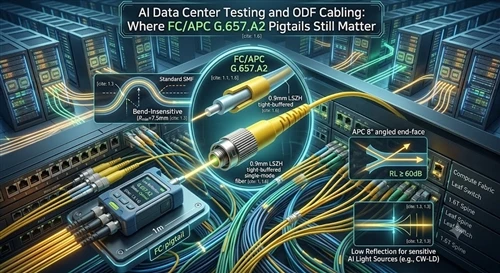
- bend radius and fiber type matching have become increasingly important in high-density cabling environments. Equipment-side routing in coherent systems often involves tighter spaces, where patch cords, distribution units, and backbone cables are more susceptible to localized bending. Existing training materials already show clear differences in bend performance among G652D, G657A1, and G657A2 fibers under small-radius routing conditions. In compact cabling scenarios, G657A1 and G657A2 are generally more suitable because they offer better bend resistance. This means procurement specifications should not simply say "single-mode patch cord" or "LC-LC cable." The fiber type, installation position, and minimum bend performance requirement should be clearly defined. At equipment fronts, inside ODFs, and in cabinet-side routing areas, bend-insensitive single-mode solutions are often the more reliable choice.
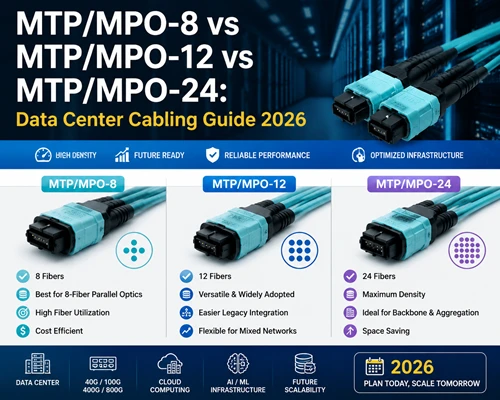
- polarity management and port density are especially important in 400G/800G systems. In architectures using MPO/MTP trunks, high-density panels, and modular cabling, polarity errors are no longer just a minor field issue. They can directly delay acceptance, complicate expansion, and increase operational risk. MPO/MTP product documentation clearly distinguishes male and female connectors, single-mode APC versus multimode PC, low-loss versus standard-loss, and different fiber-count structures. This means buyers must define interface requirements precisely rather than using a generic description such as "MPO cable." For 400G/800G applications, procurement specifications should at minimum state fiber count, polarity, end-face type, connector gender, tolerance requirements, application position such as trunk or equipment side, and whether pre-terminated testing is required.
- label management and maintainability may not look like optical parameters, but they are critical in real engineering practice. Coherent system links often involve transmitters, receivers, WDM equipment, patch panels, intermediate nodes, and test ports. Without a consistent labeling structure, fault location and maintenance costs rise quickly. For high-density fiber projects, it is advisable to define cable labeling rules, port numbering logic, polarity identification, length marking, and test-number traceability during the procurement stage. This improves not only initial deployment efficiency, but also future expansion, replacement, and inspection workflows.
- test documentation has become part of the procurement requirement itself. High-end coherent links should not be accepted on the basis of simple continuity alone. Internal production and training references already show a more complete inspection flow, including end-face inspection, 3D geometry testing, IL/RL measurement, final end-face check, and packaging control. A more professional procurement requirement should therefore ask whether the supplier can provide test reports for each batch or for each critical assembly, whether the documents include IL, RL, and end-face inspection records, whether MPO/MTP products include multi-fiber test results, and whether project acceptance can be supported with 1310/1550 nm dual-window loss records as well as OTDR and ORL verification where necessary.
- a procurement perspective, the requirements that 400G/800G coherent communication places on fiber links can be summarized in one sentence: every connection point in the link must be upgraded from a basic interconnect into an engineering-grade connection unit that is low-loss, low-reflection, verifiable, and traceable.
FOCC's supply capacity
To support coherent transmission, DWDM deployment, high-density data center cabling, and telecom network upgrades, FOCC provides a broad portfolio of fiber connectivity products and structured cabling solutions. Our supply scope includes fiber optic patch cords, MPO/MTP assemblies, FTTA CPRI patch cords, fiber adapters, patch panels, ODF, MDF, DDF, cabinets, and one-stop fiber cabling solutions for a wide range of network environments.
For buyers and engineering teams, the value of the supply chain is not only in product availability, but in whether the supplier can match the right configuration to the actual application scenario. In high-speed optical networks, different systems place different demands on connector type, fiber type, insertion loss, return loss, polarity, cable jacket, and testing standards. A solution intended for 400G/800G optical module testing may differ significantly from one designed for DWDM transmission, telecom backbone upgrades, or high-density rack cabling in a data center.
If you are selecting supporting fiber optic components for 400G/800G optical module testing, DWDM transmission, high-density data center cabling, or telecom link upgrades, you can provide FOCC with your basic project requirements, such as optical module type, connector interface, fiber type, fiber count, length, polarity, jacket specification, and testing requirements. Based on these details, we can help match a connection solution that is practical for volume production and aligned with your deployment needs.
FAQ
1. Why do narrow-linewidth lasers make fiber link quality more important?
Narrow-linewidth lasers improve spectral purity and phase stability in coherent transmission systems, but they also make the link more sensitive to connector reflection, end-face contamination, polarization-related effects, and unnecessary insertion loss. As optical source performance improves, passive link quality has a more direct impact on OSNR margin, DSP workload, and overall transmission stability.
2. Are standard LC/UPC patch cords sufficient for 400G/800G coherent systems?
In some general interconnect positions, professional LC/UPC patch cords may still be used. However, for transmitter ports, receiver ports, and DWDM nodes where back reflection is more critical, LC/APC patch cords are often the better choice because they provide higher return loss performance and help reduce reflected optical power.
3. Why are insertion loss and return loss both critical in coherent optical links?
Insertion loss directly affects link budget and OSNR margin, while return loss affects reflection control and source stability. In coherent systems, both parameters matter because excessive loss reduces usable signal strength, while excessive reflection can increase system noise and degrade overall transmission performance.