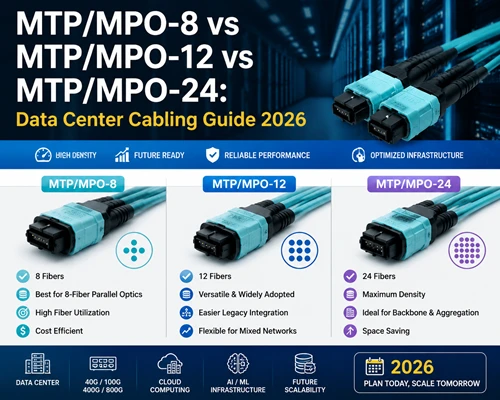
As data centers move from 40G and 100G to 400G, 800G and future higher-speed networks, high-density fiber cabling has become a critical part of network design. MTP/MPO cabling is widely used because it supports multiple fibers in a single connector, helping data centers save space, simplify installation and prepare for bandwidth upgrades.
However, many network engineers and buyers face the same question:
Should I choose MTP/MPO-8, MTP/MPO-12 or MTP/MPO-24 for my data center cabling?
The answer depends on your transceiver type, fiber utilization, migration plan, patching architecture, polarity design and long-term upgrade strategy.
This guide explains the differences between MTP/MPO-8, MTP/MPO-12 and MTP/MPO-24, and helps you choose the right cabling system for modern data center applications.
1. What Is an MTP/MPO Connector?
MPO stands for Multi-fiber Push-On. It is a multi-fiber connector commonly used in high-density fiber optic cabling.
MTP is a high-performance version of the MPO-style connector. The term MTP is a registered trademark of US Conec. In many data center projects, people use "MTP/MPO" together when discussing multi-fiber cabling, but technically they are not exactly the same.
In practical purchasing, MTP/MPO cables are commonly used for:
- Data center backbone cabling
- High-density patching
- 40G / 100G / 400G / 800G optical links
- Parallel optics applications
- Breakout cabling
- Pre-terminated fiber systems
- Migration from duplex LC to high-speed parallel fiber links
2. What Do MTP/MPO-8, MTP/MPO-12 and MTP/MPO-24 Mean?
The number refers to the fiber count inside one MTP/MPO connector.
| Type | Fiber Count | Common Description |
|---|---|---|
| MTP/MPO-8 | 8 fibers | 8-fiber MTP/MPO connector or 8-fiber base system |
| MTP/MPO-12 | 12 fibers | 12-fiber MTP/MPO connector or 12-fiber base system |
| MTP/MPO-24 | 24 fibers | 24-fiber MTP/MPO connector or 24-fiber base system |
Each system can be used in data centers, but they are not always interchangeable. The best choice depends on how your optical modules transmit and receive signals.
3. Quick Comparison: MTP/MPO-8 vs MTP/MPO-12 vs MTP/MPO-24
| Item | MTP/MPO-8 | MTP/MPO-12 | MTP/MPO-24 |
|---|---|---|---|
| Fiber count | 8 fibers | 12 fibers | 24 fibers |
| Fiber utilization | High for 4-channel parallel optics | Some unused fibers in certain 8-fiber applications | High density, but planning is more complex |
| Common use | 40G SR4, 100G SR4, 400G DR4/FR4-related cabling depending on module design | Traditional data center backbone, 40G/100G migration, cassette systems | High-density backbone, 100G/400G aggregation, space-saving cabling |
| Main advantage | Efficient for 8-fiber parallel applications | Widely deployed, mature ecosystem | Very high density |
| Main challenge | Less common in legacy 12-fiber infrastructure | May waste 4 fibers in 8-fiber parallel links | Higher polarity and management complexity |
| Best for | New high-speed data center designs focused on fiber efficiency | Mixed legacy and modern cabling environments |
Large-scale high-density backbone cabling |
4. Which One Is Better for 40G, 100G, 400G and 800G?
There is no single best MTP/MPO option for every data center. The correct choice depends on the optical module, transmission distance, fiber type and network architecture.
The most important rule is:
Always choose the MTP/MPO cabling system according to the actual transceiver interface and project design.
4.1 MTP/MPO Cabling for 40G
Many 40G SR4 optical modules use 4 transmit lanes and 4 receive lanes. This means that 8 fibers are typically used for the link.
For this reason, MTP/MPO-8 can provide good fiber utilization in many 40G SR4 applications.
MTP/MPO-12 is also widely used for 40G networks because many existing data centers already use 12-fiber trunks and cassettes. However, in an 8-fiber parallel application, some fibers in a 12-fiber connector may remain unused.
| Option | Suitability for 40G |
|---|---|
| MTP/MPO-8 | Efficient for many 40G SR4 applications |
| MTP/MPO-12 | Common in existing data centers, but may leave unused fibers |
| MTP/MPO-24 | More often used as backbone or aggregation cabling |
4.2 MTP/MPO Cabling for 100G
100G optical modules have multiple interface types. Some use parallel fiber, while others use duplex LC.
For example:
100G SR4 usually uses parallel multimode fiber.
100G PSM4 usually uses parallel single-mode fiber.
100G CWDM4 / LR4 usually uses duplex single-mode fiber.
Therefore, not every 100G module needs MTP/MPO cabling.
| 100G Module Type | Typical Cabling Consideration |
|---|---|
| 100G SR4 | Often uses parallel multimode fiber |
| 100G PSM4 | Often uses parallel single-mode fiber |
| 100G CWDM4 | Usually duplex single-mode fiber |
| 100G LR4 | Usually duplex single-mode fiber |
For 100G SR4 or PSM4 applications, MTP/MPO-8 can be efficient because many such links use 8 fibers. MTP/MPO-12 can also be used in legacy or mixed environments, but fiber utilization should be checked.
4.3 MTP/MPO Cabling for 400G
400G cabling is more complex because 400G modules can use different optical designs.
Some 400G modules use parallel optics, while others use duplex single-mode cabling.
Possible examples include:
400G DR4
400G XDR4
400G PSM4-type designs
400G SR8
400G FR4
400G LR4
Different interfaces may require different fiber counts and connector types.
| 400G Application | Cabling Consideration |
|---|---|
| 400G DR4 / PSM4-type | May require parallel single-mode fiber |
| 400G SR8-type | May require higher fiber count parallel multimode cabling |
| 400G FR4 / LR4-type | Usually uses duplex single-mode fiber |
| 400G breakout applications | Need to confirm breakout mapping and fiber count |
For 400G projects, MTP/MPO-8, MTP/MPO-12 and MTP/MPO-24 may all appear in the cabling system, but they are used differently.
For example:
MTP/MPO-8 may be used for efficient parallel links.
MTP/MPO-12 may be used in existing structured cabling.
MTP/MPO-24 may be used as high-density backbone cabling.
FAQ
Q1: Is MTP/MPO-8 better than MTP/MPO-12?
Not always. MTP/MPO-8 can provide better fiber utilization for many 8-fiber parallel optics applications. However, MTP/MPO-12 is more common in many existing data centers and may be easier to integrate with legacy infrastructure.
Q2: Why does MTP/MPO-12 sometimes waste fibers?
Some parallel optics applications use 8 fibers: 4 for transmit and 4 for receive. In a 12-fiber connector, the remaining 4 fibers may not be used in that specific application.
Q3: When should I use MTP/MPO-24?
MTP/MPO-24 is suitable for high-density backbone cabling, aggregation areas and large-scale structured cabling systems where space saving and high fiber count are important.
Q4: Can MTP/MPO-12 be used for 400G?
It depends on the 400G optical module type. Some 400G modules use parallel fiber, while others use duplex LC or other connectors. Always check the transceiver datasheet before selecting cabling.
Q5: Is MTP the same as MPO?
No. MPO is the generic multi-fiber connector type. MTP is a branded, high-performance version of the MPO-style connector. In purchasing and engineering discussions, "MTP/MPO" is often used together, but the terms are not identical.
Q6: Should I choose single-mode or multimode MTP/MPO cables?
Choose multimode, such as OM3/OM4/OM5, for many short-distance data center links. Choose OS2 single-mode for longer-distance links or single-mode parallel optics. The final choice should match your transceiver specification and link budget.