For this reason, APC-polished connectors are widely deployed in FTTH, GPON, XGS-PON, CATV, and wavelength division multiplexing (WDM) networks. Among the available APC connector formats, the E2000/APC connector has gained recognition for combining low-reflection optical performance with enhanced connector protection and long-term reliability.
Understanding Return Loss in Fiber Optic Networks
Return loss is one of the most important optical parameters in a fiber optic link. It describes how much reflected optical power travels back toward the transmitter after encountering a connection point, splice, or discontinuity within the network.
In practical deployments, excessive back reflection can introduce noise, affect laser stability, reduce receiver sensitivity, and negatively impact overall network performance. The impact becomes more noticeable in systems that use optical splitters, long transmission distances, or high-power optical sources.
Applications such as GPON, XGS-PON, CATV transmission, and DWDM networks typically place greater emphasis on reflection control because signal quality must remain stable across multiple passive and active network components.
As a result, connector end-face geometry plays a critical role in determining network performance.
Why APC Connectors Are Used in Reflection-Sensitive Applications
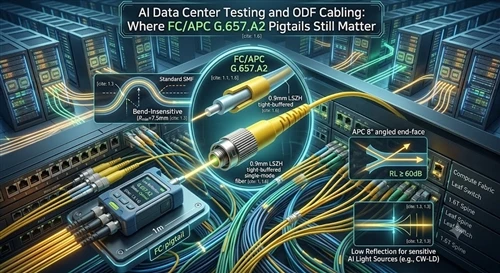
APC stands for Angled Physical Contact. Unlike UPC connectors, which use a flat polished contact surface, APC connectors feature an 8-degree angled ferrule end face.
This angled geometry redirects reflected light away from the fiber core rather than allowing it to travel directly back toward the optical source. By reducing the amount of reflected optical energy that returns into the system, APC connectors help support more stable signal transmission.
For this reason, APC connectivity has become the preferred choice in many optical access and transmission networks. It is frequently specified in FTTH deployments, passive optical networks, CATV infrastructure, and wavelength division multiplexing systems where optical reflection must be minimized.
Although actual return loss performance depends on connector quality, polishing accuracy, cleanliness, and installation conditions, APC connectors are generally selected whenever low-reflection connectivity is a design requirement.
What Makes the E2000 Connector Different?
While APC polishing addresses optical reflection, the connector housing itself also influences network reliability.
The E2000 connector is distinguished by its integrated protective shutter. When the connector is disconnected, the shutter automatically covers the ferrule end face, helping protect it from dust, airborne contaminants, and accidental contact.
In real-world telecom environments, connector contamination remains one of the most common causes of optical loss and troubleshooting events. Even microscopic particles can affect insertion loss and return loss performance.
By reducing direct exposure of the ferrule surface, the E2000 design helps maintain connector cleanliness throughout installation, maintenance, and network expansion activities.
This feature is particularly valuable in high-density optical distribution frames, telecom central offices, FTTH distribution cabinets, and other environments where connectors may be repeatedly handled during network operations.
Why E2000/APC Connectors Are Preferred in High Return Loss Networks
The combination of APC polishing and E2000 mechanical protection creates a connector solution that addresses both optical and operational challenges.
From an optical perspective, APC polishing helps reduce reflected light and supports stable transmission performance in reflection-sensitive applications.
From a maintenance perspective, the integrated shutter helps protect the ferrule from contamination, reducing the likelihood of performance degradation caused by dirty connector end faces.
For network operators and system integrators, this combination can contribute to improved link stability, lower maintenance effort, and more predictable long-term network performance.
As optical networks continue to expand and become more densely interconnected, connector protection and reflection control become increasingly important factors in network design.
The Role of G657.A2 Fiber in Modern Access Networks
Connector performance is only one part of the overall optical link. Fiber selection also affects installation flexibility and long-term reliability.
Many E2000/APC pigtails are manufactured using G657.A2 bend-insensitive singlemode fiber. This fiber type is specifically designed for environments where routing space is limited and tight bends are unavoidable.
Compared with conventional singlemode fiber, G657.A2 fiber is better suited to FTTH distribution boxes, optical terminal enclosures, wall-mounted cabinets, and high-density patching environments.
The ability to maintain optical performance under tighter bending conditions simplifies installation and helps reduce the risk of bend-related attenuation.
For this reason, G657.A2 fiber has become a common choice throughout modern fiber access infrastructure.
Typical Applications for E2000/APC Fiber Pigtails
E2000/APC fiber pigtails are widely used in carrier networks, fiber access systems, and optical distribution infrastructure.
Typical deployment scenarios include FTTH subscriber access networks, GPON and XGS-PON systems, CATV optical transmission platforms, DWDM transport networks, optical distribution frames, and telecom equipment rooms.
Because these environments often require low-reflection connectivity and reliable long-term operation, E2000/APC connectivity remains a preferred option for many network designers and infrastructure contractors.
Choosing the Right E2000/APC Fiber Pigtail
When selecting an E2000/APC pigtail, buyers should evaluate more than connector type alone.
Factors such as fiber specification, cable diameter, jacket material, environmental conditions, installation space, and required test documentation should all be considered during the procurement process.
For indoor deployments, LSZH jackets are often preferred because they support low-smoke installation requirements. For FTTH and high-density cabling projects, G657.A2 fiber typically provides greater routing flexibility than conventional singlemode fiber.
Project-specific insertion loss requirements, return loss expectations, and compliance standards should always be verified against supplier documentation and test reports before deployment.
Frequently Asked Questions (FAQ)
Q1: What is the difference between E2000/APC and E2000/UPC connectors?
The primary difference lies in the connector end-face polish. E2000/APC connectors use an 8° angled physical contact polish that helps reduce back reflection by directing reflected light away from the fiber core. E2000/UPC connectors use a flat ultra-physical contact polish and are generally used in standard single-mode optical networks where reflection requirements are less stringent.
Q2: Why are APC connectors preferred in FTTH and PON networks?
FTTH, GPON, and XGS-PON networks often require strict control of optical reflections because reflected signals can affect transmitter performance and receiver sensitivity. APC connectors are commonly used in these networks because their angled end face helps minimize back reflection and improve signal stability.
Q3: What are the advantages of E2000 connectors compared with SC or LC connectors?
One of the key advantages of the E2000 connector is its integrated automatic protective shutter. The shutter automatically covers the ferrule end face when the connector is disconnected, helping reduce contamination risks. This feature is particularly valuable in telecom facilities, optical distribution frames (ODFs), and other environments where connector cleanliness is critical.
Q4: Can E2000/APC connectors be connected to E2000/UPC adapters?
No. APC and UPC connectors should not be directly mated because their end-face geometries are different. Mixing APC and UPC interfaces may result in increased insertion loss, degraded return loss, and potential connector damage.