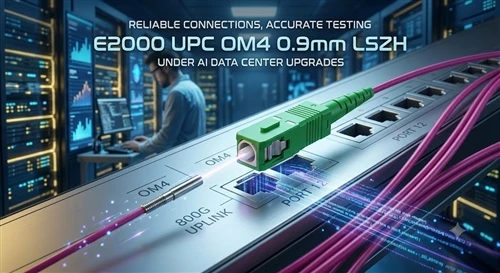
With the explosion of Artificial Intelligence (AI) computing architectures, data center internal bandwidth is evolving toward 800G and even 1.6T Ethernet at an unprecedented pace. In this race for speed and efficiency, not only have high-performance core switches, GPU clusters, and high-speed optical modules become the center of attention, but the physical fiber optic connectivity-acting as the underlying nerve endings-is also facing ultimate reliability challenges.
In dense, high-density patching environments and under rigorous physical link testing, a tiny pigtail often determines the success or failure of the entire link. This article will delve into the core value of the E2000 UPC OM4 Simplex LSZH 1M 0.9mm fiber pigtail and analyze how it builds a solid security barrier for next-generation data centers in short-distance connections and high-standard testing.
High-Speed Network Trends: Why Short Patch Cords Deserve Critical Attention
Increased Requirements for Link Loss and Testing Reliability in AI Data Centers
In the transmission era of 400G/800G and higher bitrates, the power budget left by high-speed optical modules for the physical fiber link is extremely compressed. This means that an additional loss of even ≤ 0.1 dB can cause the signal Bit Error Rate (BER) to skyrocket or even trigger frequent link flaps. As a transitional bridge between equipment ports and backbone fiber cables, the insertion loss stability and testing accuracy of short patch cords and pigtails directly affect the availability of the entire network.
End-Face Contamination, Insertion Loss, and Cabling Chaos Impact Link Stability
In actual data center operations, over 80% of fiber optic failures can be attributed to end-face contamination. Tiny dust particles not only directly increase insertion loss (IL) but also cause light reflection, deteriorating return loss (RL). Furthermore, in high-density cabinets with thousands of fibers, the absence of clear color coding and reasonable cable diameter planning can easily result in chaotic "spiderweb" cabling, drastically increasing the risk of network technicians accidentally unplugging or damaging fibers.
Product Overview: E2000 UPC OM4 Simplex LSZH 1M 0.9mm Fiber Pigtail
Key Specifications Table
To enable system integrators, technical procurement teams, and O&M experts to evaluate system compatibility at a glance, the structured
technical specifications of this high-performance pigtail are summarized below:
| Property | Specifications | Standards / Remarks |
| Connector Type (Connector A) |
E2000 (LSH) |
Compliant with IEC 61754-15 standard |
| Polish Type |
UPC (Ultra Physical Contact) |
Ultra-fine machine polishing |
| Fiber Type |
Multimode OM4 50/125 µm |
Laser-optimized multimode fiber |
| Fiber Count |
Simplex (1 Core) |
1 Core |
| Cable Diameter |
0.9 mm |
Tight Buffer |
| Jacket Material |
LSZH (Low Smoke Zero Halogen) |
Compliant with flame-retardant & eco-friendly requirements |
| Jacket Color |
Magenta / Erika Violet |
International standard OM4 identification color |
| Length |
1 Meter (1M) |
Custom lengths available upon request |
| Insertion Loss (IL) |
≤ 0.20 dB (Typical); ≤ 0.25 dB (Max) |
IEC 61300-3-4 |
| Return Loss (RL) |
≥ 35 dB |
IEC 61300-3-6 |
| Wavelength |
850 nm / 1300 nm |
VCSEL laser optimized |
| Operating Temperature |
-20°C to +70°C |
Engineered for harsh server environments |
Which Parameters Need Confirmation Before Procurement?
When procuring, you should look beyond the basic length (e.g., 1 meter) and strictly verify core physical parameters: First, ensure whether the fiber core specification (OM4 50/125 µm laser-optimized multimode fiber) perfectly matches your existing multimode fiber system to avoid massive insertion loss caused by mismatched core diameters; second, verify that the connector type (E2000/UPC) and optical performance indicators meet telecom-grade standards (such as typical insertion loss ≤ 0.20 dB).
Application Value of E2000 UPC Connectors

End-Face Protection and Connection Stability
The reason the E2000 (LSH) connector is highly favored in high-standard scenarios lies in its unique mechanical design. It features an integrated spring-loaded metal dust shutter that automatically closes when the connector is unplugged. This not only provides 100% isolation from external dust and environmental contamination but, more importantly, instantly blocks high-power laser emissions, preventing operators from accidental eye damage caused by high-power laser exposure.
Ideal for Patch Panels, Test Instruments, and Equipment Port Connections
The high physical stability and excellent repeatability of the E2000 make it an ideal choice for connections between Optical Distribution Frames (ODFs), precision optical test instruments, and high-density equipment ports. In frequent plug-and-unplug laboratory testing environments or high-density patching environments, it eliminates the need to manually attach dust caps every time, significantly boosting testing and O&M efficiency while eliminating end-face loss caused by secondary contamination from the dust caps themselves.
Which Short-Distance Applications Suit OM4 Multimode Fiber?
Data Center Cabinet Short Patching
Although single-mode fiber dominates long-distance and large-capacity communications, OM4 multimode fiber is widely used within short-distance transmissions under 500 meters (especially inter-cabinet and inter-device interconnections within data centers) due to the significantly lower overall deployment cost of multimode optical modules. The 1-meter OM4 pigtail is specifically engineered for high-density fusion splicing and short patch links inside cabinets, perfectly supporting the ultra-high bandwidth transmission demands of 10G/40G/100G networks.
OM4 Multimode Link Testing and Maintenance
When performing acceptance or maintenance testing on multimode fiber cabling links (such as using an OTDR or an optical power meter), you must select a multimode test pigtail that completely matches the fiber under test. Mixing single-mode pigtails for measurement will yield severely skewed or completely incorrect results. This pigtail serves as a standard component for building high-quality OM4 link testing reference links.
Laboratory and R&D Environments
In R&D and testing laboratories for VCSEL lasers and related multimode high-speed network equipment, OM4 fiber possesses an Effective Modal Bandwidth (EMB) of 4700 MHz·km at the 850 nm wavelength. This ensures exceptionally stable laser injection efficiency and excellent signal integrity, making it the ideal medium for various extreme bitrate stress tests.
Advantages and Precautions of the 0.9mm Thin Diameter Structure
Space-Saving Design Ideal for High-Density Cabling
Compared to common 2.0mm or 3.0mm outer diameter optical cables, the 0.9mm tight-buffered thin diameter structure is extremely lightweight and flexible. Within cramped fiber termination boxes and high-density ODF patch panels, the 0.9mm pigtail offers excellent stripping and terminating capabilities, which is highly beneficial for rapid fusion splicing and clean cable radius routing.
Avoiding Over-Stretching, Squeezing, and Small-Radius Bending
It must be noted that 0.9mm cables lack outer aramid strength members and heavy armored protection, resulting in relatively lower tensile strength during installation and use. Slight crushing, stretching, or excessive bending can cause micro-bend or macro-bend losses in the fiber, causing light energy to leak into the cladding and increase attenuation. Generally, the bending radius during installation and non-static states should be no less than 30 times the cable's outer diameter (and no less than 20 times when static). Avoid pulling 0.9mm thin lines forcefully or bundling them too tightly with cable ties.
Why is the LSZH Jacket Ideal for Indoor Cabling?
The Safety Significance of Low Smoke Zero Halogen Materials
LSZH (Low Smoke Zero Halogen) is a mandatory safety requirement for modern indoor and enclosed server room cabling. When exposed to external fire or high temperatures, the LSZH material jacket releases only a minimal amount of faint smoke and absolutely zero toxic, acidic halogen gases (such as chlorine or bromine). This not only guarantees the evacuation safety of O&M personnel inside the server room but also effectively prevents acidic corrosive gases from causing secondary destructive chemical damage to precision electronic equipment and server chips.
Flame-Retardant and Low-Smoke Standards Must Rely on Test Reports
Premium LSZH pigtails must undergo rigorous verification by authoritative organizations before leaving the factory. When purchasing, buyers should explicitly request third-party certifications and test reports from suppliers that comply with international standards such as IEC 60332-1 (Vertical flame test for a single insulated wire or cable), RoHS directive, and European CPR (Construction Products Regulation) flame-retardant ratings to ensure true compliance under extreme fire scenarios.
How the Magenta Outer Jacket Enhances Link Management Efficiency
Rapid Link Identification
According to international color coding standards, Magenta (or Erika Violet) is the officially designated identification color for OM4 laser-optimized multimode fiber. Seeing magenta on the rack allows O&M personnel to instantly identify that the link carries high-speed multimode networks such as 10G, 40G, or 100G.
Reducing the Risk of Accidental Unplugging/Mis-plugging
In crowded data center patch panels where various cables intertwine, a uniform and conspicuous magenta jacket creates a strong visual contrast. This allows technicians to instantly lock onto the designated OM4 link during routine patch changes or troubleshooting, avoiding the accidental unplugging of adjacent single-mode (typically blue or yellow) or OM3 (typically aqua) links, fundamentally lowering human-induced O&M incidents.
Color-Coding Specifications Should Align with Project Requirements
Although international standards recommend using magenta for OM4 identification , certain specific projects or legacy machine room upgrades may utilize custom color management rules. Before bulk procurement, it is recommended to double-check against the overall network design blueprint of the project to ensure consistency across the data center's visual management system.
Procurement Checklist for E2000 UPC OM4 Simplex Fiber Pigtails

To ensure that the purchased fiber optic products fully satisfy the high standards of EEAT (Experience, Expertise, Authoritativeness, Trustworthiness) during large-scale procurement or project bidding, it is recommended to refer to the following three-dimensional checklist:
1. Connectors, Length, Outer Diameter, Jacket, and Color
- Connector Verification: Confirm that Side A is a standard E2000 (LSH) connector with a UPC (ultra-fine machine polished) end-face.
- Physical Geometry: Ensure the length is precisely 1 meter (or supports flexible customization based on project needs).
- Outer Diameter Spec: Verify it is a 0.9mm tight-buffered configuration, ideal for high-density routing and management.
- Jacket Attributes: Must feature LSZH flame-retardant material, and the exterior color must be magenta, compliant with OM4 standards.
2. Insertion Loss, Return Loss, End-Face Inspection, and Test Reports
- Optical Metrics: Typical insertion loss ≤ 0.20 dB, maximum insertion loss not exceeding ≤ 0.25 dB (compliant with IEC 61300-3-4) ; return loss ≥ 35 dB (compliant with IEC 61300-3-6).
- Factory Quality Control: Every single pigtail must undergo 3D interferometer geometric end-face testing (strictly measuring Radius of Curvature, Apex Offset, and Fiber Height) and a comprehensive 100% inspection under a 400x electronic microscope to ensure a scratch-free and contamination-free end-face.
- Data Traceability: The product must come with a unique serialized test data label and report attached to the packaging, ensuring 100% optical performance traceability.
3. Standards, Certifications, Packaging, and Labeling
- Systems & Compliance: The manufacturer should hold an ISO9001 quality management system certification , and products must fully pass CE, RoHS environmental protection, and CPR flame-retardant certifications.
- Commercial Packaging: Packed in individual anti-static sealed bags to prevent secondary contamination during transportation and storage.
- Batch Management: The packaging bag must be printed with a barcode that supports production batch and serialized item tracking, facilitating seamless inventory management and quality sourcing during bulk procurement.
Conclusion: In the Era of High-Speed Networks, Reliable Short Connections Are Equally Crucial
The upgrading of AI data centers has pushed network speeds to physical limits, and every single minute component of the physical layer serves as a critical milestone for high network availability. A 1-meter long, 0.9mm thick E2000 UPC OM4 simplex pigtail may seem trivial within a massive high-speed network architecture , but with its top-tier low-loss metrics , flawless built-in shutter physical protection , exceptional LSZH environmental safety , and high color-coding visibility, it plays a pivotal role in short-distance interconnections and precision link testing.
As a source manufacturer, we firmly believe that only by pursuing excellence in the quality of every short connection and never overlooking a single end-face detail can we truly build an enduring, unshakeable "optical highway" for million-level and ten-million-level AI computing clusters.