As artificial intelligence, large language models, and AI computing infrastructure continue to accelerate worldwide, the optical communications industry is entering a new cycle of network infrastructure upgrades. Discussions at the 2026 China Optical Network Symposium highlighted growing industry attention toward technologies such as 50G-PON, ROADM-based all-optical networks, hollow-core fiber, next-generation optical fibers, Tbit-class transmission systems, and AI-enabled fiber sensing technologies.
Industry experts generally agree that AI workloads are placing unprecedented demands on bandwidth, latency, scalability, energy efficiency, and network reliability. As a result, optical networks are evolving from traditional connectivity infrastructure into the fundamental transport layer for distributed computing and AI services.
To support AI data center interconnection, cloud-network convergence, enterprise private networks, and future intelligent services, next-generation optical networks must simultaneously deliver ultra-high bandwidth, low latency, intelligent resource scheduling, high reliability, and sustainable energy efficiency.
50G-PON Accelerates the Deployment of 10-Gigabit Optical Networks
In the access network segment, 50G-PON has emerged as a key technology for enabling large-scale deployment of 10-Gigabit optical broadband services.
Compared with widely deployed GPON and 10G-PON technologies, 50G-PON offers significantly higher bandwidth capabilities for residential broadband, enterprise connectivity, campus networks, cloud services, industrial internet applications, AI-powered devices, and future digital households.
According to information presented during the conference, the China Telecom Research Institute and industry partners have successfully advanced interoperability verification for third-generation coexistence 50G-PON OLT and ONU platforms. This milestone helps address one of the major challenges associated with large-scale commercial deployment.
However, successful commercialization depends not only on individual device performance but also on ecosystem maturity across OLTs, ONUs, ODN infrastructure, optical transceivers, network management systems, and operational platforms.
The deployment pace of 50G-PON will continue to depend on factors including operator investment strategies, terminal equipment costs, compatibility with existing networks, and ongoing standards development. Equipment specifications such as port density, optical budgets, transmitter power, receiver sensitivity, energy consumption, and interoperability performance should always be verified through manufacturer documentation and operator validation reports.
Hollow-Core Fiber Draws Attention for Low-Latency Applications
Beyond access network evolution, hollow-core fiber (HCF) has become one of the most discussed technologies within the optical communications sector.
Unlike conventional silica-based fibers, hollow-core fiber guides light primarily through an air-filled core. This architecture offers the potential for lower latency, reduced nonlinear effects, and improved performance in specific high-speed transmission environments.
In AI data centers and computing networks, communication latency directly affects cluster efficiency. During distributed AI training, multi-node inference, storage synchronization, and computing resource orchestration, accumulated network delay can significantly impact overall system performance.
For this reason, hollow-core fiber is attracting increasing interest from operators, equipment vendors, hyperscale data centers, and research organizations.
Current industry assessments suggest that hollow-core fiber may provide the greatest value in short- to medium-distance deployments, including:
- AI data center interconnects (DCI)
- Campus-scale computing networks
- Financial low-latency trading networks
- Scientific research infrastructures
- High-performance computing environments
Nevertheless, several technical challenges remain under evaluation, including attenuation optimization, mode coupling control, polarization mode dispersion, gas absorption effects, and long-term field reliability.
As a result, hollow-core fiber should not currently be viewed as a direct replacement for conventional single-mode fibers such as G.652.D or G.657 series fibers. Network planners should evaluate deployment scenarios based on transmission distance, latency requirements, optical loss budgets, connector compatibility, installation conditions, and lifecycle performance expectations.
ROADM and All-Optical Networks Enable Flexible AI Resource Scheduling
At the backbone and metro network layers, ROADM (Reconfigurable Optical Add-Drop Multiplexer) based all-optical networking is increasingly recognized as a critical enabler of AI-era computing infrastructure.
ROADM architectures allow wavelength-level traffic management and dynamic resource allocation, supporting high-capacity transmission, automated service provisioning, and rapid network restoration.
As demand for geographically distributed AI computing resources grows, optical networks are no longer expected to provide bandwidth alone. Instead, they are becoming intelligent transport platforms capable of automated provisioning, service awareness, self-healing, and adaptive optimization.
Capabilities such as:
- Wavelength-level traffic engineering
- WSON architectures
- Mesh networking
- Deterministic recovery mechanisms
- Automated optical operations
- Intelligent network orchestration
are becoming key evaluation criteria for next-generation optical transport networks.
For optical communications vendors, this trend also signals a shift in content strategy. Technical materials and product documentation should move beyond simply highlighting transmission speed and distance specifications. Customers increasingly need guidance on how optical fibers, transceivers, WDM systems, ROADM platforms, OTN equipment, and management software work together within complete network architectures.
Next-Generation Fiber and AI-Powered Fiber Sensing Enter the Spotlight
The symposium also highlighted growing interest in advanced optical fibers and AI-driven fiber sensing technologies.
Future optical fibers may serve not only as transmission media but also as distributed sensing platforms capable of monitoring network conditions, environmental changes, infrastructure integrity, and operational status in real time.
Within future intelligent all-optical networks, fibers and optical modules could become the network's distributed sensory system, enabling:
- Real-time link monitoring
- Environmental sensing
- Fault localization
- Predictive maintenance
- Network health analytics
Enhanced physical-layer visibility would allow operators and data center managers to identify connector contamination, fiber bends, optical power fluctuations, aging components, and potential failures before they impact service performance.
However, AI-powered fiber sensing remains an emerging field requiring coordination across optical components, monitoring systems, AI algorithms, data platforms, and operational processes. Practical deployment effectiveness will depend on specific application scenarios, while key metrics such as sensing accuracy, response speed, deployment cost, and interoperability require further industry validation.
Industry Impact: Optical Fiber Content Must Evolve from Product Specifications to Application Decisions
The rise of 50G-PON, hollow-core fiber, ROADM, and intelligent all-optical networking reflects a broader industry transformation.
Customers are no longer focused solely on technical specifications. Instead, they increasingly evaluate whether a technology can solve real business challenges and support long-term operational objectives.
For optical fiber manufacturers, network equipment vendors, and solution providers, future content strategies should focus on:
1. 50G-PON Deployment and Selection Guides
Explain OLTs, ONUs, ODN architectures, optical modules, splitter ratios, optical budgets, and coexistence with legacy networks.
2. Hollow-Core Fiber Application Analysis
Compare hollow-core fiber with conventional G.652.D and G.657.A1/A2 fibers while discussing latency advantages and deployment limitations.
3. AI Data Center Cabling Solutions
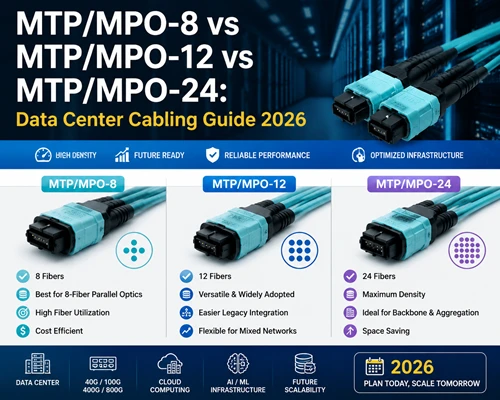
Provide practical guidance covering 800G and 1.6T optical modules, MPO/MTP connectivity, high-density fiber management, low-loss cabling, and liquid-cooled environments.
4. ROADM and WDM Networking Fundamentals
Help enterprise customers understand the value of wavelength-level traffic management, cloud-network integration, and all-optical service delivery.
5. Fiber Sensing and Intelligent Operations
Focus on predictive maintenance, fault detection, network observability, and operational reliability improvements.
Conclusion
Artificial intelligence is driving optical networks beyond simple high-speed transmission toward intelligent computing infrastructure.
While 50G-PON accelerates the evolution of 10-Gigabit access networks, hollow-core fiber explores the boundaries of ultra-low-latency connectivity. ROADM and all-optical networking improve AI resource orchestration, while advanced fiber technologies and AI-powered sensing create new opportunities for intelligent operations and maintenance.
Looking ahead, competitive differentiation in optical communications will depend not only on individual product performance but also on system interoperability, application-specific optimization, reliability validation, standards compliance, and long-term operational value.
For network operators, enterprises, and infrastructure investors, purchasing decisions should therefore move beyond simple comparisons of price and specifications toward comprehensive evaluations of deployment scenarios, network architecture requirements, scalability, lifecycle costs, and future expansion potential.