When selecting fiber optic patch cords or pigtails for telecom networks, optical test systems, CATV links, FTTH projects, or legacy equipment interfaces, connector polish type is not a small detail. The difference between an FC APC connector and an FC UPC connector directly affects insertion loss, fiber return loss, signal stability, and long-term network reliability.
What Is an FC Fiber Connector?
FC stands for Ferrule Connector. It uses a threaded metal coupling structure to provide stable mechanical engagement between two optical interfaces. Compared with push-pull connectors such as SC or LC, the FC connector offers stronger vibration resistance and is still widely used in telecom equipment, optical distribution frames, test instruments, laboratory systems, industrial communication links, and some legacy transmission networks.
The FC connector itself refers to the mechanical interface. The terms APC and UPC refer to the ferrule end-face polishing method. Therefore, the key question is not only "Should I use FC?" but also "Should I choose an FC APC connector or an FC UPC connector?"
What Is an FC APC Connector?
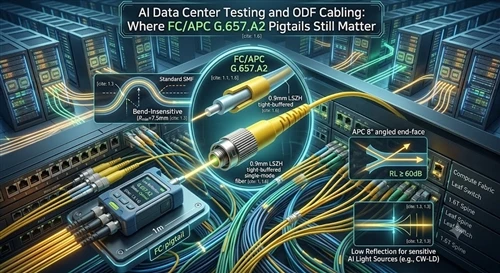
An FC APC connector uses an Angled Physical Contact polish. The ferrule end face is typically polished at an 8-degree angle. This angled surface reduces the amount of reflected light that travels back toward the laser source.
In optical networks, reflected light can interfere with the transmitter, increase noise, and reduce signal stability. APC polishing helps direct reflected light into the cladding instead of back into the fiber core. For this reason, FC APC is commonly selected when low reflection is critical.
Typical characteristics of an FC APC connector include:
- End-face polish: 8-degree angled physical contact
- Typical color code: green
- Return loss performance: usually higher than UPC
- Main advantage: excellent back-reflection control
- Main application: FTTH, CATV, PON, WDM, high-power optical links, and analog transmission systems
What Is an FC UPC Connector?
An FC UPC connector uses Ultra Physical Contact polishing. Its ferrule end face is not angled but is polished into a precise convex surface to improve physical contact between two fiber cores.
UPC polishing provides low insertion loss and stable performance for many digital transmission applications. However, because the end face is not angled, reflected light can return more directly toward the source compared with APC.
Typical characteristics of an FC UPC connector include:
- End-face polish: non-angled ultra physical contact
- Typical color code: blue
- Return loss performance: good, but lower than APC
- Main advantage: low insertion loss and cost-effective deployment
- Main application: digital transmission systems, test equipment, data communication links, and general telecom connections
FC APC vs FC UPC: Key Technical Differences
The main difference between FC APC vs FC UPC is return loss performance. Both connector types can provide low insertion loss when manufactured and tested correctly, but APC is designed for better reflection control.
| Parameter | FC APC Connector | FC UPC Connector |
|---|---|---|
| Polish type | Angled Physical Contact | Ultra Physical Contact |
| End-face angle | Typically 8 degrees | Non-angled convex polish |
| Common color | Green | Blue |
| Insertion loss | Low | Low |
| Fiber return loss | Better, commonly used for high-RL requirements | Good, but lower than APC |
| Back reflection | Very low | Higher than APC |
| Compatibility | Must mate with APC only | Must mate with UPC only |
| Typical use | FTTH, CATV, PON, WDM, RF over fiber | Digital telecom, test systems, general optical links |
From a practical engineering view, UPC is usually sufficient when the system is not highly sensitive to reflection. APC is preferred when fiber return loss must be tightly controlled.
Why Fiber Return Loss Matters
Fiber return loss measures how much optical power is reflected back toward the source. A higher return loss value means lower reflection and better optical stability.
In a simple digital link, moderate reflection may not immediately cause failure. However, in reflection-sensitive systems, poor return loss can lead to unstable laser output, increased noise, higher bit error rate, reduced OSNR, and degraded transmission quality.
This is especially important in systems such as CATV, RF over fiber, PON networks, WDM transmission, long-distance singlemode links, and high-power optical equipment. In these scenarios, an FC APC connector is often the safer choice because it minimizes back reflection more effectively than an FC UPC connector.
Insertion Loss: Is FC APC Always Higher Than FC UPC?
Insertion loss refers to the optical power loss caused when a connector, adapter, splice, or other passive component is inserted into the link.
In many cases, a high-quality FC UPC connector can achieve very low insertion loss. A high-quality FC APC connector can also provide low insertion loss, but APC polishing is more demanding because the angled geometry must be precisely controlled.
The difference should not be judged only by polish type. Actual performance depends on ferrule concentricity, polishing process, end-face cleanliness, adapter sleeve quality, fiber core alignment, and factory testing.
For procurement, it is more reliable to ask for actual test data instead of only asking whether the connector is APC or UPC.
Recommended quality checks include:
- 100% insertion loss testing
- Return loss testing for singlemode APC and UPC assemblies
- End-face inspection under microscope
- Geometry control for apex offset, radius of curvature, fiber height, and polishing angle
- Lot-level test reports for OEM or project orders
APC vs UPC Fiber Connector: Application-Based Selection
When comparing an APC vs UPC fiber connector, the right choice depends on the application rather than only the connector price.
Choose an FC APC connector when the link requires strong reflection control. Typical scenarios include FTTH access networks, GPON/XG-PON/XGS-PON systems, CATV transmission, RF overlay, WDM networks, long-haul singlemode links, high-power laser systems, and optical sensing applications.
Choose an FC UPC connector when the network is mainly digital, reflection tolerance is higher, and cost-performance balance is more important. Typical scenarios include general telecom equipment, optical test benches, legacy FC interfaces, data communication links, and short-to-medium distance digital transmission.
Compatibility Warning: Do Not Mate FC APC with FC UPC
One of the most common installation errors is mating APC and UPC connectors together. Although both may use an FC threaded body, their ferrule end-face geometry is different.
An FC APC connector must be connected to another APC interface. An FC UPC connector must be connected to another UPC interface.
Mating APC with UPC can cause high insertion loss, poor fiber return loss, unstable transmission, and possible end-face damage. In field deployment, connector color coding should be strictly followed: green for APC and blue for UPC.
How to Choose Between FC APC vs FC UPC

For buyers, engineers, and system integrators, the decision can be simplified as follows.
Choose FC APC if your project focuses on low reflection, high return loss, analog optical transmission, FTTH/PON, CATV, WDM, RF over fiber, or long-distance singlemode links.
Choose FC UPC if your project focuses on low insertion loss, standard digital transmission, optical test equipment, general telecom cabling, or cost-sensitive legacy FC systems.
In other words, FC APC vs FC UPC is not only a connector selection question. It is a link-performance decision based on reflection tolerance, optical budget, equipment interface, and future maintenance risk.
Procurement Checklist for FC APC and FC UPC Patch Cords
Before ordering FC APC or FC UPC patch cords, buyers should confirm the following specifications:
Connector type: FC APC or FC UPC
Fiber type: G.652.D, G.657.A1, G.657.A2, OM3, OM4, or other fiber grade
Cable structure: simplex, duplex, armored, pigtail, or custom assembly
Cable diameter: 0.9 mm, 2.0 mm, 3.0 mm, or customized diameter
Jacket material: PVC, LSZH, OFNR, OFNP, PE, TPU, or other jacket type
Cable length: standard or customized
Insertion loss requirement
Return loss requirement
End-face inspection standard
Packaging, labeling, and test report requirements
For project-based orders, it is better to specify both insertion loss and fiber return loss in the purchase documentation. This reduces quality disputes and ensures the delivered connectors match the real optical link requirements.
Common Mistakes When Choosing FC APC and FC UPC
The first mistake is selecting by price only. A cheaper connector with poor polishing quality may introduce unstable loss, poor return loss, and long-term maintenance costs.
The second mistake is ignoring connector compatibility. APC and UPC interfaces should never be mixed, even if the connector body looks similar.
The third mistake is focusing only on insertion loss. In reflection-sensitive networks, return loss may be more important than a small difference in insertion loss.
The fourth mistake is not checking the equipment port type. Before ordering FC patch cords, confirm whether the device interface is APC or UPC. The connector must match the active equipment, adapter, ODF, and existing patching environment.
FAQ: FC APC vs FC UPC
Is FC APC better than FC UPC?
Not always. FC APC is better for low-reflection applications because it provides superior fiber return loss. FC UPC is still a practical and cost-effective choice for many digital optical links where reflection is not a major concern.
Can I connect an FC APC connector to an FC UPC connector?
No. FC APC and FC UPC connectors should not be mated together. Their end-face geometry is different, and cross-mating can cause high insertion loss, poor return loss, and possible connector damage.
Which connector has better return loss?
The FC APC connector usually has better return loss because its 8-degree angled polish reduces back reflection more effectively than UPC polishing.
Which connector has lower insertion loss?
Both FC APC and FC UPC connectors can achieve low insertion loss if they are manufactured and tested properly. In many standard digital links, FC UPC is widely used because it offers stable low-loss performance and good cost efficiency.
Which connector should I choose for FTTH or PON networks?
For FTTH, PON, CATV, and WDM systems, FC APC is usually preferred because these networks often require better reflection control and higher return loss performance.
Conclusion
The difference between FC APC vs FC UPC is mainly about reflection control. An FC APC connector is the better option for networks that require low back reflection and high fiber return loss, such as FTTH, CATV, PON, WDM, and analog optical transmission. An FC UPC connector is a cost-effective solution for standard digital transmission, optical testing, and general telecom applications where reflection sensitivity is lower.
For reliable network deployment, buyers should not only compare APC vs UPC fiber connector types, but also verify insertion loss, return loss, polishing quality, end-face cleanliness, and factory test reports. The correct connector choice helps reduce link instability, maintenance risk, and long-term project cost.