In the era of information explosion and increasing demand for high-speed data transmission, optical fiber has become the "nervous system" of the digital world. With ongoing technological evolution, traditional solid-core fiber is facing new challenges, while hollow-core fiber (HCF), with its innovative structure, is redefining the boundaries of optical communication. This article provides a comprehensive analysis of hollow-core fiber and modern optical communication, covering principles, classification, key performance indicators, and application prospects, along with FOCC™ product solutions for practical implementation.
1. Optical Fiber Basics and Evolution
Optical fiber is an optical transmission medium made of high-purity silica glass, drawn into fibers through precision manufacturing processes. Its core diameter ranges from a few micrometers to tens of micrometers, with a typical outer diameter of 125 μm. Light propagates in the fiber by total internal reflection due to the refractive index difference between the core and cladding, achieving low-loss long-distance transmission. Based on transmission modes, optical fibers are primarily categorized into single-mode fiber (SMF) and multi-mode fiber (MMF).
- Single-Mode Fiber (SMF): Core diameter around 8–10 μm, suitable for long-distance communication and high-bandwidth applications, typically operating at 1310nm and 1550nm wavelengths.
- Multi-Mode Fiber (MMF): Larger core diameter (50–62.5 μm), supporting multiple light modes, suitable for short-distance LANs and data center cabling.
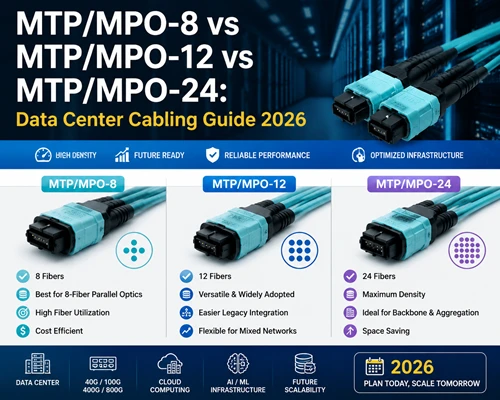
FOCC™ offers high-performance fiber optic patch cords and MPO/MTP modules supporting OM3/OM4 multimode and G.652/G.657 single-mode fibers, meeting the needs of data centers, high-speed backbone networks, and FTTH deployments.
2. Hollow-Core Fiber Principles and Structure
Traditional optical fibers are limited by the absorption, scattering, and nonlinear effects of glass, which constrain transmission capacity and power. Hollow-core fiber (HCF) reduces light interaction with glass by designing the core as an air channel, achieving low-loss and low-latency light transmission.
Main types include:
- Photonic Bandgap Fiber (PBGF):Uses periodic air-hole structures to form a photonic crystal. The photonic bandgap confines light within the air core, enabling high-power, low-loss transmission.
- Hollow-Core Anti-Resonant Fiber (HC-ARF):Utilizes thin-walled glass capillaries in the cladding to reflect light into the air core via anti-resonance. Nested anti-resonant structures provide wider low-loss bandwidth and simpler designs, becoming a key development direction.
Hollow-core fibers' core advantage lies in air's low nonlinear coefficient and near-unity refractive index, allowing light speed to increase by approximately 31%, significantly reducing latency-a crucial factor for high-frequency trading and supercomputing.
3. Key Optical Performance Metrics
Hollow-core fibers excel in the following areas:
Transmission Loss: Achievable experimental losses in the 1.55 μm communication window and 2 μm mid-infrared range are lower than traditional fibers.
Nonlinear Effects: Air-core minimizes self-phase modulation, four-wave mixing, and other nonlinearities, suitable for high-power pulse transmission.
Latency: Reduced refractive index lowers propagation delay, critical for financial and real-time computing applications.
Dispersion: Structure can be engineered to optimize dispersion curves, meeting requirements for high-speed pulses and DWDM systems.
FOCC™ hollow-core fiber and high-density cabling products undergo strict optical testing, including insertion loss, return loss, and wavelength sensitivity, ensuring reliable performance.
4. Application Scenarios and Value
The unique characteristics of hollow-core fiber enable transformative applications:
Next-Generation Optical Communication:
- Data center interconnects and backbone networks with low latency and high capacity.
- High-frequency trading and financial systems requiring millisecond-level latency reduction.
Ultra-High Power Optical Transmission:
- Industrial and research laser systems, supporting high-power pulses without signal distortion.
Long-Distance and Ultra-Long-Haul Communication:
- Telecom backbone deployment reduces the need for repeaters and lowers overall energy consumption.
FOCC™ provides end-to-end solutions, including fiber patch cords, MPO/MTP modules, cabinets, and ODF panels, enabling efficient deployment and management of single-mode, hollow-core, and multimode fiber systems.
5. Standards and Industry Compliance
The development of hollow-core and traditional optical fibers adheres to rigorous international standards:
- Fiber Standards: ITU-T G.652/G.657, IEC 60793 series.
- Cables and Connectors: IEC 61754 (connectors), TIA/EIA-568 (cabling systems).
- Testing Methods: OTDR, insertion/return loss, dispersion, and nonlinear coefficient measurements.
FOCC™ implements ISO9001 quality management and ISO14001 environmental management systems in manufacturing and testing, ensuring reliability and environmental compliance.
6.FAQ
1. What is hollow-core fiber and how does it differ from traditional optical fiber?
Hollow-core fiber (HCF) is an optical fiber where light propagates through an air-filled core instead of solid glass. This reduces absorption, scattering, and nonlinear effects compared to traditional solid-core fibers, enabling lower loss, lower latency, and higher power transmission.
2. How does FOCC™ support hollow-core fiber deployment?
FOCC™ provides end-to-end solutions including hollow-core and conventional fiber patch cords, MPO/MTP modules, cabinets, and ODF panels. Their products undergo strict optical testing, ensuring reliable insertion loss, return loss, and wavelength performance.
3. What standards govern hollow-core and traditional optical fibers?
Key standards include ITU-T G.652/G.657, IEC 60793 (fiber specifications), IEC 61754 (connectors), and TIA/EIA-568 (cabling systems). FOCC™ products comply with ISO9001 (quality management) and ISO14001 (environmental management) standards.
4. Why is hollow-core fiber important for next-generation optical networks?
Due to its low loss, low latency, and high-power capacity, hollow-core fiber enables higher data throughput, precise timing, and long-distance transmission, supporting the increasing demands of AI, 5G, and high-performance computing networks.