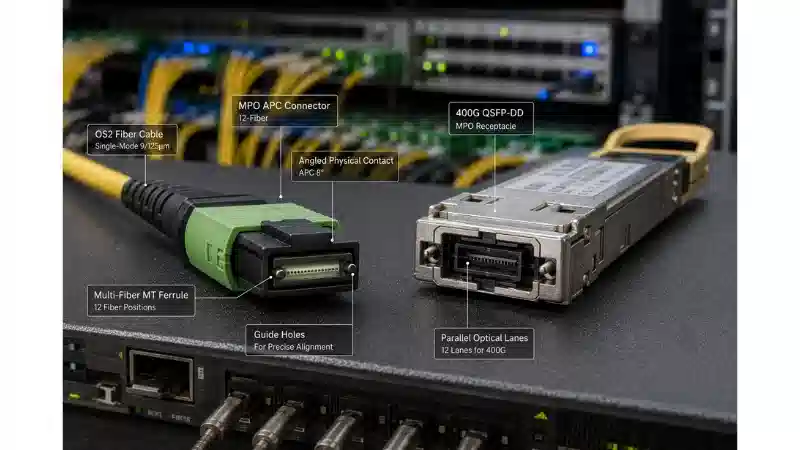
Network infrastructure evolution reveals a fundamental shift. Traditional single-fiber terminations demanded skilled technicians spending days on installations that now complete in hours. Recent deployment studies demonstrate 3,456 fibers can be fully installed in one 8-hour workday with mtp fibre connector technology, while conventional splicing requires 24-30 working hours for identical fiber counts. The transformation isn't incremental-it represents a 70-75% reduction in deployment timelines. Understanding the mtp fibre connector means recognizing how multi-fiber termination technology directly addresses the three pressure points modern networks face: exponential bandwidth growth, physical space constraints, and operational cost optimization.

The Economic Foundation of MTP Adoption
MTP housings accommodate 864 fibers in spaces where duplex connections manage only 144 fibers-a sixfold capacity increase without expanding physical footprint. This density differential creates measurable financial advantages across deployment lifecycles. Organizations operating under capital expenditure constraints discover that mtp fiber connector infrastructure reduces per-port costs while simultaneously decreasing the cooling expenses associated with cable congestion.
The total cost of ownership calculation extends beyond initial hardware procurement. Labor represents the dominant expense in fiber deployments, and factory-terminated MTP cables eliminate field termination entirely. A mid-sized data center operator recently documented their transition: installing 2,880 fiber connections using traditional LC connectors consumed 240 technician hours at $95/hour. The same installation with MTP trunk cables required 32 hours. The labor differential alone-$22,800 versus $3,040-funded their entire MTP infrastructure investment while accelerating time-to-production by three weeks.
Pre-terminated systems also minimize the quality variability inherent in field terminations. Each mtp fibre connector arrives from manufacturing facilities with documented insertion loss specifications, typically below 0.35 dB for standard variants. MTP Elite connectors demonstrate insertion loss around 0.10 dB, reducing signal loss by approximately 50% compared to standard MTP implementations. Consistent optical performance translates to predictable network behavior-networks operate within designed parameters rather than requiring post-installation troubleshooting cycles.
Real-world deployment pattern: A legal services firm supporting distributed offices needed to double their fiber capacity within existing conduit infrastructure. Their existing 144-fiber backbone consumed available pathway space. Switching to MTP enabled a 576-fiber installation using the same physical pathways. The project avoided costly building modifications that initial assessments estimated at $180,000 for new conduit runs.
Three Engineering Pillars Behind MTP Performance
Floating Ferrule Architecture
The floating ferrule design enables mated ferrules to maintain physical contact even while connector housings rotate relative to each other. Early MPO implementations suffered from signal instability-accidental cable bumps disrupted ferrule contact, causing momentary signal drops that parallel optics systems couldn't tolerate. The floating mechanism isolates mechanical stress at the housing level, preventing force transfer to the optical interface.
This architectural choice becomes significant in operational environments where cables experience handling. Data center technicians routinely access equipment racks, and cable management systems flex during routine maintenance. The floating ferrule maintains optical continuity throughout these normal operational stresses, eliminating the transient errors that plagued earlier multi-fiber systems.
Elliptical Guide Pin Geometry
Standard cylindrical guide pins create wear patterns during insertion cycles. The mtp fibre connector employs elliptical guide pin tips that minimize guide hole wear and debris generation across repeated mating operations. The elliptical profile creates a smoother entry path, distributing contact forces more evenly.
Durability testing demonstrates mtp fibre connector systems withstand over 1,000 mating cycles without meaningful performance degradation. For organizations managing dynamic environments-networks that undergo frequent reconfiguration-this durability specification becomes a practical requirement rather than a technical curiosity. A financial services company operating a trading floor with quarterly layout changes reports their MTP infrastructure has supported 47 reconfigurations over six years without requiring connector replacement.
Material Science Improvements
The transition to polyphenylene sulfide (PPS) thermoplastic ferrules reduced moisture absorption vulnerabilities that affected earlier thermosetting materials. Moisture absorption causes dimensional instability-ferrules expand microscopically, altering the precise alignments that multi-fiber systems demand. PPS maintains dimensional stability across humidity ranges typical in telecommunications environments.
Metal pin clamps replaced plastic variants in MTP designs, addressing mechanical failure modes observed during field deployments. The metal clamps provide consistent retention force across temperature variations and don't exhibit the stress fractures that plastic clamps developed during thermal cycling.
Parallel Optics: Why MTP Became Essential
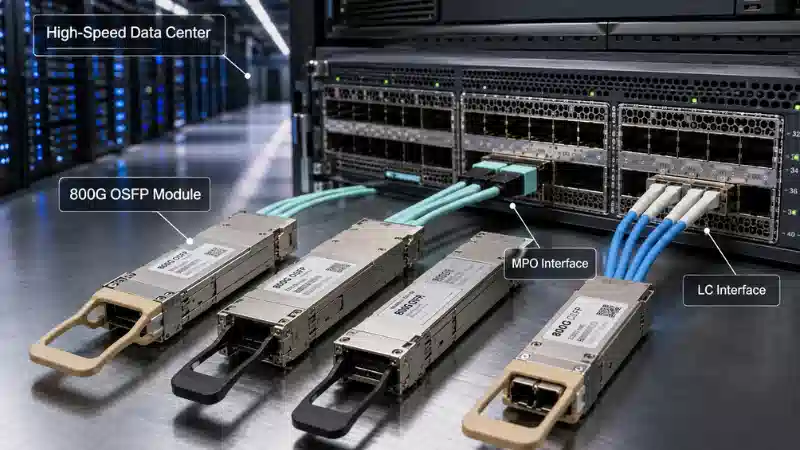
Current 40GBASE-SR4 and 100GBASE-SR4 applications employ 8 fibers with 4 transmitting and 4 receiving, while 800 Gig implementations utilize 16-fiber configurations. The parallel optics architecture depends on simultaneous multi-fiber connections-transceivers cannot function with individual fiber pairs connected sequentially.
A network engineer designing a campus backbone faces this reality: a 100G link between buildings requires 8 fiber paths. Using traditional duplex connectors means managing 4 physical cable connections per link, with polarity requirements that introduce configuration complexity. Each connection point creates insertion loss that accumulates across the link budget. The mtp fibre connector consolidates those 8 fibers into a single mating operation, reducing insertion points from 4 to 1 and simplifying polarity management through standardized cabling methods.
The scalability pathway illustrates MTP's strategic positioning. Emerging 1.6 Terabit applications leverage 16-fiber MPOs with 8 transmit and 8 receive paths operating at 200 Gbps per lane. Organizations deploying mtp fibre connector infrastructure today build compatibility with transmission technologies that will dominate the 2026-2030 upgrade cycle. Infrastructure investments made now won't require complete replacement when transceivers advance to next-generation speeds.
Deployment case: A cloud services provider supporting enterprise clients operates three regional data centers. Their initial 40G deployment in 2019 utilized 12-fiber MTP trunk cables with 8 active fibers and 4 unused positions. The 2024 migration to 400G parallel optics repurposed the same physical MTP infrastructure-they activated the previously unused fiber positions and upgraded transceivers. The existing cable plant supported the 10x bandwidth increase without physical infrastructure modifications.
Operational Simplicity Through Standardization
TIA-568 defines three polarity methods for MTP systems-Type A, Type B, and Type C. These standards eliminate the guesswork that characterized early multi-fiber deployments. Type B polarity, for instance, employs a "key-up to key-down" orientation that creates a crossover connection ensuring transmit fibers align with receive fibers on opposing ends.
Organizations benefit most when they select a single polarity method and apply it consistently across their infrastructure. A regional healthcare network initially deployed mixed polarity types across their facilities, creating documentation nightmares during troubleshooting. Their standardization initiative converted all infrastructure to Type B polarity. Troubleshooting times for fiber link issues dropped from an average of 2.8 hours to 22 minutes-technicians no longer needed to verify polarity configurations before testing.
The mtp fibre connector incorporates removable housing designs that enable gender transitions and ferrule rework without complete cable replacement. This field-configurability addresses the practical challenge of managing large inventories. Rather than stocking male and female variants of every cable length, organizations maintain smaller inventories and reconfigure connectors as deployment requirements dictate. A managed service provider reports their MTP cable inventory decreased 40% after implementing field-configurable practices, reducing capital tied up in spare parts while improving deployment flexibility.
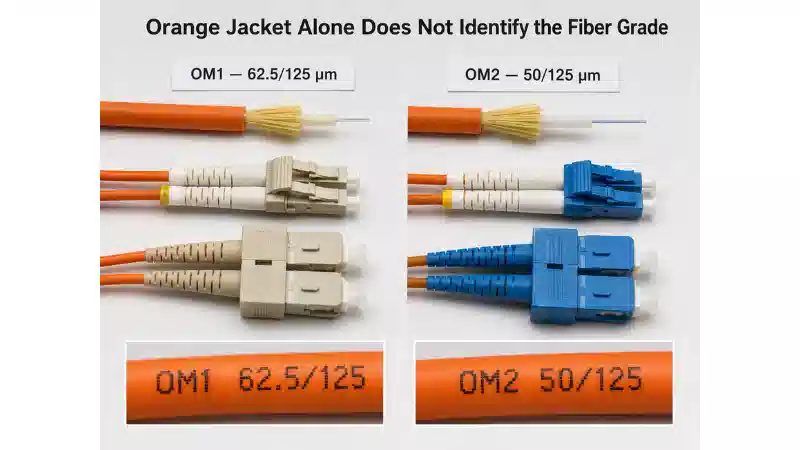
Color coding provides visual verification that prevents costly mistakes. Industry standards assign specific jacket colors to fiber types-aqua indicates OM3/OM4 multimode, yellow denotes single-mode. Boot colors on MTP connectors follow similar conventions. Installers working in dimly lit equipment rooms rely on these visual cues to verify they're connecting compatible fiber types without requiring detailed documentation lookup for every connection.
Real-World Constraints and Practical Solutions
MTP technology demands cleanliness standards that exceed single-fiber requirements. Contamination on even one fiber within the MTP array can migrate to mating connectors, affecting multiple fiber paths simultaneously. Organizations must implement systematic cleaning protocols-inspect, clean, reinspect-as non-negotiable procedures.
A telecommunications carrier documented their learning curve: initial mtp fibre connector deployments experienced 12% link failure rates traced to contamination. After implementing mandatory inspection procedures using video microscopes and establishing cleaning certification requirements for technicians, failure rates dropped to 0.8%. The procedural changes required modest equipment investment-$3,200 for inspection scopes and cleaning supplies-but eliminated field visits that were costing $850 per incident.
Polarity errors represent another practical challenge. Unlike duplex connectors where transmit/receive relationships are obvious, MTP arrays contain 12 or 24 fibers with specific position assignments. Connecting incompatible polarity types creates non-functional links that require systematic troubleshooting to identify. Effective organizations employ physical labeling systems-colored tags, standardized cable numbering schemes-that make polarity visible to installation teams. One enterprise data center requires QR codes on all MTP cables linking to a configuration database, enabling technicians to verify polarity compatibility by scanning codes before making connections.
The termination skill gap affects MTP adoption differently than traditional fibers. While field termination is possible with specialized equipment, it requires precision that many organizations find impractical. Most successful deployments specify factory-terminated solutions and maintain adequate spare cable inventory rather than attempting field repairs. A professional services firm compared their historical fiber repair costs-$180 average per field termination including labor and materials-against the cost of stocking $8,000 in MTP spare cables. The spare cable approach eliminated 93% of emergency field termination calls over two years while providing faster repair times.

Deployment Patterns Across Organization Types
High-Growth SaaS Companies
Cloud-native organizations face infrastructure demands that scale unpredictably. A development platform provider experienced 340% user growth over 18 months, necessitating continuous data center expansion. Their MTP strategy emphasized modular infrastructure that could grow incrementally. Rather than provisioning fixed fiber counts between zones, they deployed high-count MTP trunk cables (144 fibers) with initial 20% utilization. As compute clusters expanded, they activated additional fiber pairs through breakout modules without installing new trunk infrastructure.
The financial advantage emerged during their Series C expansion-they added 480 server racks without new inter-zone fiber installations. Existing MTP trunks had sufficient dark fiber to support the expansion by simply adding breakout cassettes at distribution points. The infrastructure supported 3x growth while avoiding the 6-week lead time new fiber installations would have required during their peak growth phase.
Professional Services Firms
Legal and consulting organizations operate distributed offices with periodic technology refresh cycles. An international law firm with 23 offices needed infrastructure supporting both current 10G networking and future 25G/100G capabilities. Their MTP deployment focused on longevity rather than immediate utilization. Each office received MTP trunk cables sized for 10-year bandwidth projections even though initial connections used 30% of available capacity.
Their 2020 infrastructure investment supported 2024 upgrades to 25G server connectivity without physical cable changes. They retrofitted cassettes and transceivers while the underlying MTP cable plant remained unchanged. The approach transformed infrastructure from a recurring expense requiring refresh every 3-4 years to a one-time investment supporting extended technology lifecycles. Their infrastructure CapEx decreased 60% over the 2020-2025 period compared to previous refresh cycles.
Regional Data Center Operators
Multi-tenant facilities face unique challenges-they provision fiber connectivity for diverse customer requirements while managing limited physical pathways. A colocation provider managing 12 facilities adopted MTP as their standard cross-connect medium. Customer connectivity uses standard LC or SC interfaces at equipment, but all backbone infrastructure between zones utilizes MTP.
This architecture enables flexible service provisioning. When customers order new cross-connects, technicians provision services by patching MTP trunk cables to breakout cassettes near customer cabinets. The same MTP infrastructure supports 1G customers (using 1 fiber pair from a 12-fiber MTP), 10G customers (1 fiber pair), 40G customers (4 fiber pairs), and 100G customers (4 fiber pairs). The provider maintains standardized inventory rather than custom cable types for each service tier, reducing operational complexity while accelerating service delivery times from 48 hours to same-day for most requests.
Integration with Emerging Technologies
Network architectures increasingly employ disaggregation-separating compute, storage, and networking into specialized resources connected through high-speed fabrics. These architectures depend on dense fiber connectivity between resource pools. Disaggregated storage systems, for example, connect storage arrays to compute nodes using RDMA over Converged Ethernet (RoCE), requiring multiple 25G or 100G links per connection.
A research computing facility supporting scientific workloads implemented disaggregated infrastructure connecting 160 compute nodes to centralized storage via 100G fabric. The installation required 640 fiber pairs-impractical with traditional cabling. MTP trunk cables created structured pathways from compute zones to storage areas, with breakout cassettes providing the final connections to equipment. The installation completed in three days; estimates for traditional duplex fiber installations projected 18-22 days for equivalent connectivity.
Artificial intelligence workloads demonstrate similar patterns. Training clusters require high-bandwidth, low-latency connectivity between GPU nodes. A machine learning company operates clusters with 64 nodes, each requiring 8x100G connectivity to the cluster fabric-512 total 100G ports. MTP infrastructure provides the physical layer supporting that connectivity density in equipment rooms measuring 400 square feet. Equivalent capacity using duplex connectors would require approximately 960 square feet of equipment rack space just for fiber management.
Strategic Infrastructure Planning
Forward compatibility represents MTP's often-overlooked advantage. The mtp fibre connector format scales across emerging parallel optics applications including 400 Gb Ethernet implementations running across 32, 16, and 8 fiber configurations. Organizations installing MTP infrastructure position themselves for technology transitions that preserve capital investments.
Consider the upgrade pathway: a campus network deployed in 2021 with 40G backbone links using 12-fiber MTP cables. The 2025 upgrade to 400G requires new transceivers and potentially different fiber types (migrating from OM4 to single-mode for longer reaches), but the MTP connector interface remains constant. The campus installed new MTP cables while reusing all cassettes, patch panels, and cable management infrastructure. Material costs for the upgrade totaled 35% of original installation expenses, while labor requirements represented only 20% of initial deployment-most infrastructure remained in place during the technology refresh.
The sustainability aspect merits attention. Traditional fiber installations generate substantial waste during technology transitions-obsolete cable types, incompatible connectors, outdated infrastructure all require disposal. MTP's longevity reduces this waste stream. The same physical MTP infrastructure supports multiple generations of transmission technology, minimizing the environmental impact of network upgrades while reducing the total materials consumed across equipment lifecycles.
Decision Framework for MTP Adoption
Organizations should evaluate five factors when considering MTP implementation:
Fiber density requirements: Deployments requiring more than 144 fibers between two points strongly favor MTP economics. Below that threshold, traditional duplex connectors may prove adequate depending on other factors.
Technology roadmap: Organizations planning bandwidth increases within 3-5 years should evaluate whether MTP provides upgrade flexibility. If the roadmap includes migrations to 40G, 100G, or 400G parallel optics, MTP infrastructure offers future-proof characteristics that reduce long-term costs.
Installation timeline constraints: Projects with compressed deployment schedules benefit from MTP's rapid installation characteristics. When time-to-production matters-new facility openings, merger integrations, capacity expansions-MTP's installation speed advantage becomes strategic.
Operational complexity: Organizations with limited fiber expertise may find MTP's standardized approaches reduce complexity despite the technology's sophistication. Pre-terminated systems eliminate the skill requirements for field termination while polarity standards reduce configuration errors.
Space constraints: Physical space limitations-congested pathways, limited rack space, small equipment rooms-favor MTP's density advantages. Organizations paying premium rates for facility space ($/square foot) often discover MTP infrastructure generates measurable space cost savings.
Frequently Asked Questions
How does MTP differ from standard MPO connectors?
MTP represents US Conec's enhanced MPO implementation featuring floating ferrule design, elliptical guide pins, and metal pin clamps. While both conform to industry standards enabling interoperability, the mtp fibre connector incorporates engineering refinements addressing durability and performance characteristics.
Can existing duplex fiber infrastructure integrate with MTP systems?
Breakout cables and cassettes enable bidirectional integration. MTP trunk cables connect to distribution cassettes providing standard LC or SC interfaces for equipment connectivity. This architecture preserves existing equipment investments while gaining MTP's backbone advantages.
What fiber counts are available in MTP configurations?
Common data center implementations employ 8-fiber, 12-fiber, 16-fiber, and 24-fiber configurations, with specialty applications supporting counts up to 72 fibers. Selection depends on application requirements and future expansion planning.
Does MTP technology work with both single-mode and multimode fiber?
MTP connectors support both fiber types. The connector interface remains identical while the fiber type determines transmission distance and bandwidth characteristics. Organizations specify appropriate fiber types based on link distances and application requirements.
How do organizations handle MTP polarity management?
Industry standards define three polarity methods-Type A, Type B, and Type C-providing systematic approaches to ensuring transmit-receive alignment. Most organizations select one method and apply it consistently, simplifying deployments and troubleshooting.
What maintenance do MTP connectors require?
Systematic inspection and cleaning protocols represent primary maintenance requirements. Organizations implement three-step procedures: inspect for contamination, clean when necessary, reinspect to verify cleanliness. Protective caps should remain in place when connectors aren't actively mated.
Key Takeaways
MTP technology reduces fiber installation time by 70-75% compared to traditional splicing methods through factory-terminated solutions
Density advantages enable 6x capacity increases within identical physical spaces, addressing both space constraints and infrastructure costs
Floating ferrule architecture and elliptical guide pins provide durability exceeding 1,000 mating cycles while maintaining consistent optical performance
Parallel optics applications from 40G through emerging 1.6T implementations depend on MTP's multi-fiber architecture for practical deployment
Standardized polarity methods and color coding systems reduce deployment complexity while minimizing configuration errors
Strategic deployment enables technology upgrades that preserve cable plant investments across multiple equipment generations
Pre-terminated MTP systems eliminate field termination skill requirements while providing consistent performance specifications