I've been around data centers long enough to know that picking the wrong patch cable can turn a Tuesday afternoon into a three-day nightmare. MPO cables aren't complicated once you get the hang of them, but there's a catch-the market's flooded with options, and not all of them are worth your money.
We won't tell you everything is "cutting-edge" or "revolutionary." Some cables perform better for specific applications. That's just reality.
The Basics Nobody Bothers Explaining
MPO stands for Multi-fiber Push On. MTP is basically MPO's fancier cousin-same footprint, better tolerances, made by US Conec. People use these terms interchangeably and honestly, for most applications, you can too. The purists will disagree. Let them.
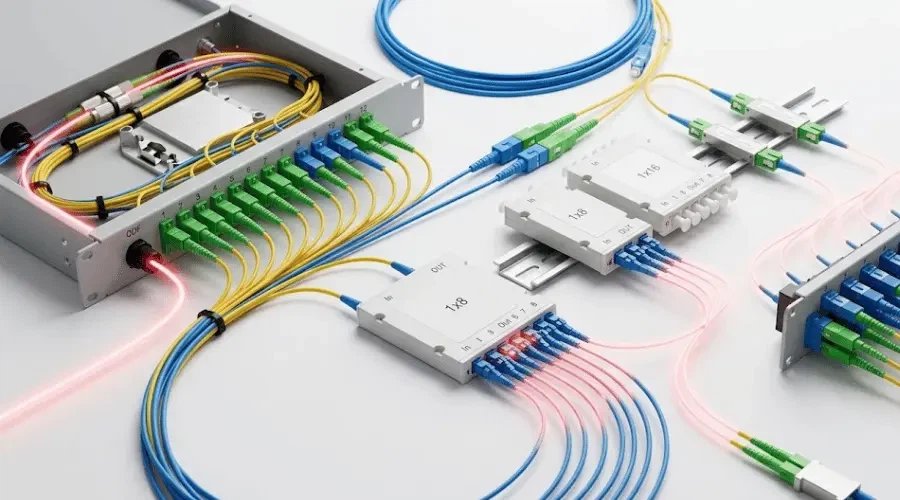
What matters is this: these connectors pack 8, 12, or 24 fibers into a single interface about the size of a thumbnail. That's the whole point. Density. Speed of deployment. Less stuff to manage.
Fiber Count Isn't Just a Number
Here's where things get interesting. The 12-fiber configuration has been the workhorse forever. It works with 40G QSFP+ transceivers. It's everywhere. But if you're building something new-say, for 400G or beyond-the 8-fiber base starts making more sense.
Why? Because 400G-SR8 uses 8 fibers. 200G-SR4 uses 4 fibers. The industry's been locked into this 12-fiber paradigm for years, and now there's waste. You've got fiber pairs sitting there doing nothing. Some people don't care. Accountants usually do.
The 24-Fiber Trunk Argument
Trunk cables with 24 fibers (that's two 12-fiber assemblies in one jacket) are popular for backbone runs. Makes sense-fewer cable pulls, cleaner pathways. But I've seen installations where the second set of 12 fibers never got used because the growth projections were... optimistic. Plan your capacity honestly.

Polarity: The Thing That Breaks Deployments
Polarity management is where I see installations fall apart. There are three methods-Type A, Type B, and Type C. Each handles the transmit/receive flip differently.
|
Type |
Connector Arrangement |
Best For |
|
Type A |
Key up to key up, straight |
Duplex LC breakouts |
|
Type B |
Key up to key down, reversed |
Direct MPO-to-MPO links |
|
Type C |
Key up to key up, pairs flipped |
Less common, legacy systems |
Type B is what most 40G and 100G equipment expects. Just go with Type B unless you have a specific reason not to. I'm serious-it'll save you hours of troubleshooting.
Male vs Female: Check Twice

请替换当前内容 Architectural design & planning cepteur sint occaecat cupidatat proident, taken possession of my entire soul, like these sweet mornings of spring which I enjoy with my whole...Architectural design & planning cepteur sint occaecat cupidatat proident, taken possession od my entire soul, like these sweet mornings of spring which I enjoy with my whole
Lorem ipsum dolor sit ament, consectetur adipisicing elit,sed do eiusmod tempor incididunt labore et dolore magna aliqua. it enim ad minim veniam.
MPO connectors have pins (male) or don't (female). Most transceivers are male. So your patch cables should be female. Pin alignment is how the connector achieves low insertion loss-if you mate two males together, you're going to have a bad time. And bent pins. Mostly bent pins.
Multimode vs Single Mode: Distance Decides
This one's actually straightforward. Single mode (OS2) goes far-kilometers. Multimode (OM3/OM4/OM5) stays in the building. For data center interconnects within the same campus, multimode still makes sense. The transceivers are cheaper, and you're not running fiber across town.
OM4 has become the default multimode choice. It handles 100G out to 150 meters at 850nm. OM5 adds support for SWDM wavelengths, but honestly, adoption's been slow. OM3 still works fine if your runs are under 100 meters and your budget's tight.

Insertion Loss-Where Cheap Cables Fail
This is the spec that separates decent MPO cables from garbage. Standard connectors run about 0.5-0.7 dB per mated pair. Low-loss versions hit 0.35 dB or better. Ultra low-loss can go below 0.25 dB.
Does it matter? Depends. If you're running one short patch, probably not. But chain a few connectors together in a structured cabling system and those losses add up fast. 400G transceivers are less forgiving than 10G-the optical budgets are tighter. Pay for the good stuff if you're planning for tomorrow's speeds.
Quick Reference: Loss Classes
|
Grade |
Insertion Loss |
Use Case |
|
Standard |
≤0.7 dB |
Basic 10G/40G links |
|
Low Loss |
≤0.35 dB |
100G deployments |
|
Ultra Low Loss |
≤0.25 dB |
400G/800G, multi-hop |
Jacket Ratings: Code Compliance Matters
OFNP (plenum) cables can go in air-handling spaces. OFNR (riser) cables work in vertical runs between floors. LSZH (low smoke zero halogen) is required in some regions, especially Europe. PVC is the cheap option for controlled environments.
Don't overthink this. Check your local codes, check what's above your ceiling tiles, and spec accordingly. The fire marshal doesn't care about your deployment timeline.
Real Talk: Which Cable for What
AI and GPU clusters:
These things are hungry for bandwidth. 800G is where it's going. Use OM4 or OM5 with ultra low-loss connectors. 8-fiber or 16-fiber base depending on transceiver choice. Don't cheap out-the whole point of the cluster is throughput.
Standard enterprise data center:
12-fiber OM4, Type B polarity, low-loss grade. This covers 40G/100G comfortably. You'll be fine for years.
Colocation and carrier-neutral facilities:
Single mode OS2 if you're doing meet-me-room connections. Customers expect it, and distances can get weird in those buildings.
Campus backbone:
Single mode for anything over 300 meters. Under that, multimode works but single mode future-proofs better. I've seen too many rip-and-replace projects where someone tried to stretch multimode beyond its limits.
Things I Wish Someone Told Me Earlier
Always test cables before installation. Always. The factory test reports are nice but things happen during shipping.
Keep your ferrule end faces clean. One speck of dust at these densities causes problems. IPA wipes and inspection scopes aren't optional.
Label everything. Both ends. Include polarity type, fiber count, and cable ID. Future you will be grateful.
Stock spare patch cables. Not many-just enough. MPO lead times can be long for custom lengths.
The bend radius on these cables matters. 7.5mm minimum typically. Don't kink them in cable trays.
Bottom Line
There's no single "best" MPO cable. There's the right cable for your network. Figure out your speed requirements, distance constraints, and growth plans. Match polarity to your equipment. Buy quality connectors because fiber optics is unforgiving of sloppiness.
And if you're still unsure after reading this? Call a vendor you trust, tell them exactly what you're building, and ask for recommendations. The good ones won't oversell you.
- - -
For technical specifications and product availability, please contact us.