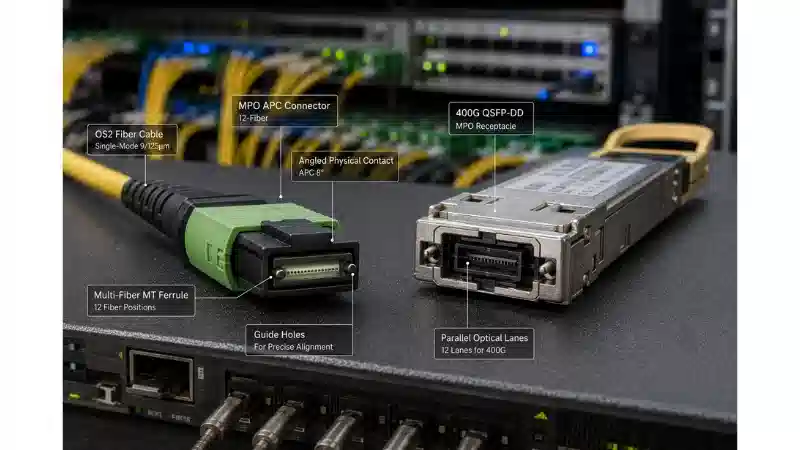
If you've been staring at fiber optic catalogs lately, you've probably noticed MPO breakout cables popping up everywhere. And for good reason-these things are kind of the unsung heroes of modern data center cabling. But here's the thing: not every situation calls for a breakout cable. Sometimes a trunk cable makes more sense. Sometimes you don't need MPO at all.
So let me walk you through when you actually need a breakout cable versus when you're better off with something else.

The Basic Idea Behind Breakout Cables
An MPO breakout cable (some people call them fanout cables or harness cables-same thing, different name) takes that big multi-fiber MPO connector on one end and splits it into individual duplex connectors on the other. Usually LC connectors, sometimes SC, occasionally FC or ST if you're working with older equipment.
Think of it like this: you have a garden hose that branches into multiple smaller hoses at the end. One high-capacity connection fans out into several smaller ones.
The magic number here is typically 8 fibers or 12 fibers, though you'll see 16-fiber and 24-fiber versions too. An 8-fiber MPO to 4xLC breakout is probably the most common configuration out there right now.
Scenario 1: The 40G to 10G Migration Sweet Spot
This is honestly where breakout cables shine the brightest.
You've got a switch with 40G QSFP+ ports. But your servers? They're still running 10G SFP+ connections. What do you do?
An 8-fiber MPO-LC breakout cable solves this beautifully. One 40G QSFP+ SR4 transceiver connects to the MPO end, and then you get four separate 10G connections at the LC end. Each pair of fibers carries one 10G channel (one fiber transmit, one fiber receive).
Same story with 100G to 25G. A 100G QSFP28 SR4 transceiver can break out to four 25G SFP28 connections using the exact same cable type. No joke-the same physical cable works for both scenarios. The transceivers are doing the heavy lifting on the speed side.
When this makes sense:
You're running a leaf-spine architecture and your spine switches have 40G/100G uplinks but leaf switches or servers have 10G/25G ports
Budget constraints mean you can't upgrade everything at once
You want to maximize port utilization on expensive high-speed switches

Scenario 2: High-Density Cabling Without the Headache
Here's where it gets interesting.
In a traditional setup, if you wanted to connect 12 servers to a switch, you'd run 12 individual fiber patch cables. That's 12 cables snaking through your cable management. 12 potential points of failure. 12 opportunities for someone to accidentally unplug the wrong thing.
With an MPO trunk cable running to a patch panel and breakout cables at the server end, you've got one clean backbone connection handling what used to be a cable jungle. The breakout happens right where you need it-at the rack level.
I've seen data centers where they reduced their cable volume by something like 70% just by switching to MPO-based structured cabling with breakouts at the endpoints.
When to Use Breakout Cables vs. Trunk Cables
This confuses people all the time, so let me be clear.
Use a trunk cable when: you're connecting two points that both have MPO interfaces. Switch to switch. Patch panel to patch panel. 100G port to 100G port. Same connector type on both ends. Simple.
Use a breakout cable when: one end has an MPO interface (like a high-speed transceiver or MPO patch panel port) and the other end needs individual connections (like servers with standard LC duplex ports).
There's also a third option that doesn't get talked about enough: MPO conversion cables. These have MPO connectors on both ends but with different fiber counts. Like a 24-fiber MPO splitting into three 8-fiber MPO legs. Useful for aggregation scenarios.
The 400G Era is Changing Things
Quick note on where this is all heading.
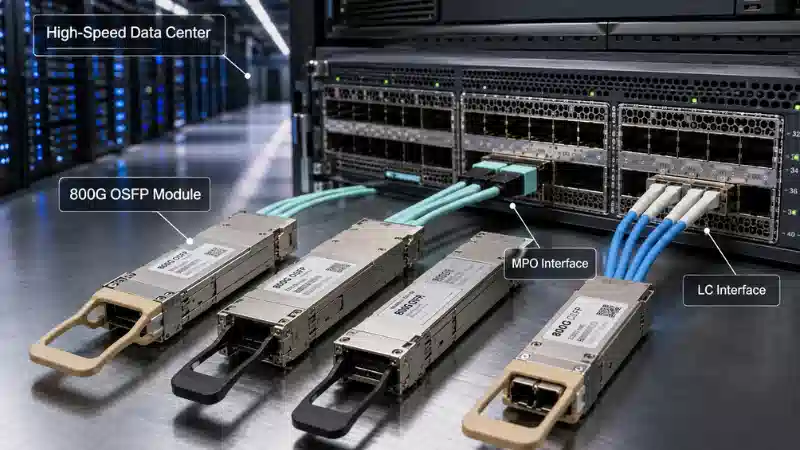
400G transceivers are becoming more common, and they're pushing the breakout cable game further. A 400G DR4 optic can break out to four 100G DR connections. An 800G DR8 can fan out to eight 100G channels.
The 16-fiber MPO connector (sometimes called MPO-16) is becoming the new standard for 400G applications. If you're planning infrastructure for the next few years, keep this in mind. The 8-fiber and 12-fiber breakouts aren't going away, but 16-fiber configurations are where the growth is happening.
Polarity Considerations (Yes, This Matters)
I'm not going to pretend polarity is exciting. But if you get it wrong, your link won't work.
MPO breakout cables need to maintain proper polarity so the transmit signals reach the correct receive ports. With breakout cables, the situation gets a bit tricky because you're going from a multi-fiber connector to multiple duplex connections.
Type B polarity is generally recommended for parallel optics deployments. Each vendor has their own guidance, and honestly, the safest approach is to stick with one polarity method throughout your entire data center. Mixing polarity types is asking for trouble during troubleshooting.
Most manufacturers now provide clear documentation on which polarity type their breakout cables support. If they don't, ask before ordering.

The Direct-Connect vs. Structured Cabling Question
You've got two basic deployment options with breakout cables.
Direct connection: The breakout cable runs directly from your switch's QSFP port to your servers' SFP ports. Simple, straightforward, good for smaller deployments or when equipment is relatively close together.
Structured cabling: The breakout cable is one piece of a larger system. An MPO trunk cable runs from your switch to a patch panel. The breakout cable connects the patch panel to your servers. This adds a connection point but gives you flexibility for moves, adds, and changes.
For enterprise data centers, structured cabling almost always wins out. For smaller deployments or lab environments, direct connection is often more practical.
Real Talk: When NOT to Use Breakout Cables
Not every high-speed connection needs a breakout.
If both ends of your link are 40G or 100G with MPO interfaces, use a trunk cable instead
If you're doing short-distance connections within a single rack and only need a few fibers, standard duplex patch cords might be simpler and cheaper
If your equipment uses BiDi (bidirectional) optics that send and receive on a single fiber, breakout cables don't apply
Also, breakout cables tend to cost more per port than equivalent individual patch cords. The value comes from the cable management benefits, not raw cost savings.
Insertion Loss and Performance
This gets overlooked too often.
Every connector in your optical path adds insertion loss. An MPO connector typically adds 0.25dB to 0.5dB of loss, depending on quality. The LC connectors at the breakout end add their own loss too.
For multimode 40G/100G SR4 applications, you've got about 1.5dB to 1.9dB of total loss budget to work with. That sounds like plenty, but it can get eaten up fast if you have multiple connections in your path or if your connectors are dirty.
This is why low-loss MPO connectors matter more for parallel optics than they do for traditional duplex applications. Cheap MPO connectors can push you right up against your loss limits.
Fiber Type Selection
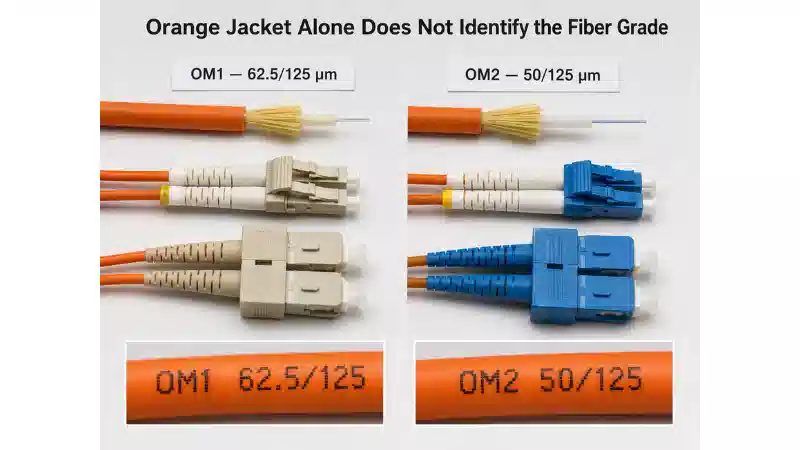
Most breakout cables ship in OM3 or OM4 multimode for 40G/100G SR4 applications. OM5 (the lime green stuff) adds extended wavelength capability for SWDM applications but costs more.
For longer reaches, single-mode OS2 breakout cables support PSM4 and DR4 transceivers. These are less common but becoming more important as data centers move toward 400G.
Match your cable to your transceivers. An OM4 breakout cable won't do you any good with single-mode PSM4 optics.

Cleaning and Inspection
Can't skip this part.
MPO connectors have multiple fiber end faces in one connector. A single dirty fiber can tank your entire link's performance. And because MPO connectors mate multiple fibers simultaneously, contamination spreads easily between connectors.
Before every connection, inspect. If dirty, clean and re-inspect. This isn't just good practice-it's mandatory if you want reliable performance.
The cleaning process for MPO is more involved than for standard LC/SC connectors. You need specialized cleaning tools designed for multi-fiber end faces. Don't try to improvise with regular fiber cleaning supplies.
Wrapping Up
MPO breakout cables occupy a specific niche in data center cabling. They bridge the gap between high-speed parallel optics and traditional duplex equipment. They're essential for speed-migration scenarios and high-density deployments.
But they're not a universal solution. Understanding when to use them-and when to reach for something else-separates a clean, efficient cabling design from an expensive mess.
If you're planning a 40G/100G deployment with mixed equipment speeds, breakout cables should be on your radar. If you're doing same-speed connections throughout, trunks are probably your better bet. And if you're just connecting a couple servers in a lab, don't overthink it-standard patch cords are fine.
The right cable for the right job. That's really all there is to it.