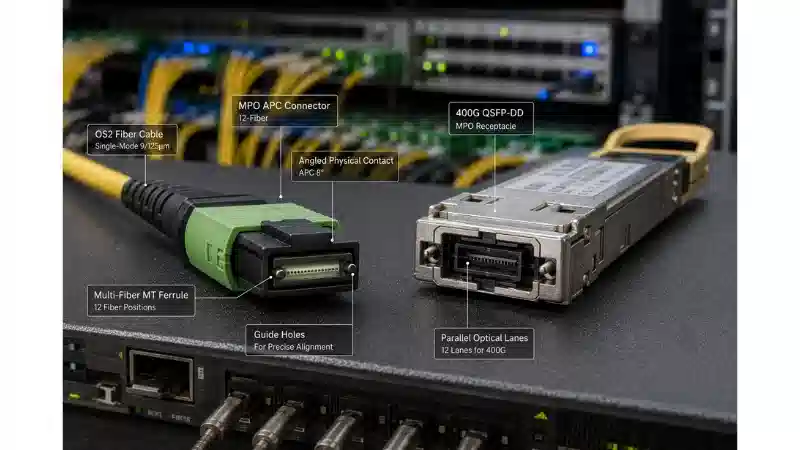
In the rapidly evolving world of fiber optic technology, the MDC connector stands out as a pivotal innovation designed to meet the demands of high-density data transmission. The MDC connector, short for Miniature Duplex Connector, is a very small form factor (VSFF) duplex optical connector that has revolutionized how we approach fiber cabling in data centers and telecommunications networks. Developed by US Conec, the MDC connector utilizes proven 1.25mm ferrule technology, similar to that found in traditional LC connectors, but in a much more compact design. This allows the MDC connector to achieve up to three times the fiber density compared to its predecessors, making the MDC connector an essential component for modern high-speed applications.
To understand the MDC connector fully, it's important to delve into its origins. The MDC connector was introduced to address the growing need for smaller, more efficient connectors in environments where space is at a premium. As data rates climb to 400G and beyond, the MDC connector provides a solution that supports port breakout architectures in transceivers like QSFP and SFP. The MDC connector's design focuses on ease of use, with features like the DirectConec™ push-pull boot, which enables effortless insertion and removal even in densely packed panels. This makes the MDC connector particularly appealing for data center operators who need to maximize rack space without compromising performance.

The core of the MDC connector lies in its technical specifications. The MDC connector is engineered for both single-mode and multimode fiber cables up to 2.0mm in diameter. With a ferrule diameter of 1.25mm, the MDC connector ensures low insertion loss, typically around 0.15 dB, meeting IEC Grade B standards for attenuation. The MDC connector supports UPC (Ultra Physical Contact) and APC (Angled Physical Contact) polishing, with the APC variant featuring an opposing 8°-8° angled ferrule design that minimizes reflectance in high-density duplex setups. Compliance with standards like Telcordia GR-326 and TIA-568 further solidifies the MDC connector's reliability, as it exceeds requirements for mechanical and environmental testing, including proof and twist-with-axial-load (TWAL) tests.
One of the standout features of the MDC connector is its polarity management. Unlike older connectors, the MDC connector allows for simple polarity reversal without exposing or twisting the delicate fibers. By pulling the boot from the housing, rotating it 180 degrees, and reattaching, users can switch polarity effortlessly. Visual indicators, such as polarity marks and the MDC logo, notify users of the change, ensuring the MDC connector maintains system integrity. This user-friendly aspect makes the MDC connector ideal for field technicians who often face polarity issues during installations.
In terms of density, the MDC connector truly shines. Traditional LC duplex connectors allow for about 144 fibers in a 1U rack space, but the MDC connector triples this to 432 fibers (216 duplex ports). This is achieved through the MDC connector's smaller footprint-measuring just 3.9mm in pitch compared to the LC's 6.25mm-allowing three MDC connectors to fit where one LC would. Adapters for the MDC connector come in 2-port, 3-port, and 4-port configurations, fitting directly into standard LC panel cutouts for seamless upgrades. The MDC connector's low-profile design not only increases density but also reduces capital and operational expenses by minimizing hardware needs.
To illustrate the specifications of the MDC connector, consider the following table:
| Specification | Details |
|---|---|
| Ferrule Diameter | 1.25mm |
| Cable Diameter | Up to 2.0mm OD |
| Insertion Loss | 0.12 dB mean, 0.25 dB max (IEC Grade B) |
| Polishing Options | UPC or APC (8°-8° for APC) |
| Density in 1U | 432 fibers (216 duplex ports) |
| Compliance | Telcordia GR-326, TIA-568 |
| Fiber Types | Single-mode, Multimode |
This table highlights why the MDC connector is a go-to choice for high-performance applications. The MDC connector's ability to handle emerging transceiver multi-source agreements (MSAs) further enhances its utility, supporting four MDC connectors in a QSFP footprint and two in an SFP footprint.
Comparing the MDC connector to other popular connectors like the LC reveals significant advantages. The MDC connector offers superior density and ease of handling, making it a natural evolution in fiber optics. For instance, while the LC connector has been a standard for years, the MDC connector's push-pull boot prevents buckling in tight spaces, a common issue with LC designs. The MDC connector also maintains the same low-loss performance but in a form factor that's nearly half the size.

Here's a comparison table between the MDC connector and the LC connector:
| Feature | MDC Connector | LC Connector |
|---|---|---|
| Size/Pitch | 3.9mm | 6.25mm |
| Density (1U Fibers) | 432 | 144 |
| Polarity Reversal | Boot rotation, no fiber exposure | Requires disassembly |
| Insertion/Extraction | Push-pull boot for dense access | Standard latch, prone to issues in density |
| Ferrule Technology | 1.25mm, Grade B | 1.25mm, similar |
| Applications | High-density data centers, 400G+ breakouts | General duplex fiber |
This comparison underscores the MDC connector's edge in modern infrastructures. The MDC connector not only saves space but also simplifies maintenance, reducing downtime in critical environments.
The applications of the MDC connector are vast and varied. In data centers, the MDC connector is used for high-density patching, enabling more connections per rack unit. For telecommunications, the MDC connector supports carrier-grade performance in dense setups, ideal for 5G and beyond. The MDC connector is also integral to port breakout solutions, where transceivers require multiple duplex links from a single port. Companies like Corning have integrated the MDC connector into their EDGE solutions, allowing for transceiver-level breakouts and universal wiring to manage polarity efficiently. This makes the MDC connector a key player in reducing complexity during moves, adds, and changes (MACs).
Beyond data centers, the MDC connector finds use in enterprise networks, cloud computing facilities, and even emerging on-board optic architectures. The MDC connector's rugged build ensures it withstands harsh conditions, exceeding GR-326 requirements for vibration, thermal cycling, and humidity. For aggregation, clips and consolidated connectors group multiple MDC connectors, streamlining cable management.
Installation of the MDC connector requires specialized tools, but its design simplifies the process. Termination involves standard 1.25mm ferrule polishing, with equipment like cleaners, inspection scopes, and interferometers available for the MDC connector. Field technicians appreciate the MDC connector's intuitive polarity flip, which can be done without tools. Maintenance involves regular cleaning to prevent dust buildup, as the MDC connector's small size makes it susceptible to contaminants.
To further explore applications, here's a table outlining common uses of the MDC connector:
| Application Area | Benefits of MDC Connector | Examples |
|---|---|---|
| Data Centers | 3x density, low loss | Rack patching, transceiver breakouts |
| Telecommunications | Carrier-grade reliability | 5G base stations, fiber to the home |
| Enterprise Networks | Space efficiency, easy MACs | Office cabling, cloud interconnects |
| High-Speed Computing | Supports 400G+ | AI data processing, hyperscale facilities |
This table demonstrates the versatility of the MDC connector across industries.
While the MDC connector offers numerous benefits, it's not without challenges. One common issue in the industry is ensuring proper polarity during initial setup, as mismatches can lead to signal loss. Another is contamination in high-density environments, where the small size of the MDC connector makes cleaning critical. Compatibility with legacy systems can also pose problems when upgrading from LC to MDC connector setups.
Industry Common Problems and Solutions
Polarity Mismatch: In fiber optic installations using the MDC connector, polarity errors can occur if the transmit (Tx) and receive (Rx) fibers are swapped, leading to no signal or high attenuation. Solution: Utilize the MDC connector's built-in polarity reversal feature by rotating the boot 180 degrees without exposing fibers. Always verify with visual indicators and test equipment like OTDRs. Training technicians on standard polarity (Tx on top) and using color-coded labels can prevent issues. For complex setups, implement universal wiring schemes as in Corning's EDGE solutions, reducing risks during MACs. This approach ensures quick fixes, minimizing downtime to under 5 minutes per connector.
Contamination and Dust Buildup: The compact design of the MDC connector makes it prone to dust and debris, causing increased insertion loss or intermittent connections in data centers. Solution: Regular maintenance with specialized cleaning tools like the MDC cleaner from Fujikura or US Conec's inspection scopes is essential. Use dry cleaning methods first, followed by wet if needed, and always cap unused ports. Implementing cleanroom protocols during installation and periodic audits with interferometry can maintain performance. For high-density panels, automated cleaning robots or anti-dust adapters enhance longevity, ensuring the MDC connector operates at optimal 0.15 dB loss levels.
Density-Related Cable Management: Overcrowding in racks with the MDC connector can lead to cable bends exceeding minimum radii, causing signal degradation. Solution: Employ aggregation clips and consolidated connectors to group MDC connector cables neatly. Use 2.0mm duplex cables with flexible boots to maintain bend radii. Design panels with sufficient depth and use cable trays for routing. Simulation software for layout planning prevents issues upfront. This structured approach not only preserves the MDC connector's integrity but also facilitates easier access for maintenance, reducing operational costs by up to 20%.
In conclusion, the MDC connector represents a significant advancement in fiber optic connectivity, offering unmatched density, performance, and ease of use. As networks continue to demand more from less space, the MDC connector will undoubtedly play a central role. Whether in data centers or telecom infrastructures, adopting the MDC connector ensures future-proofing against escalating data needs.
Notes
[1] VSFF: Very Small Form Factor - A category of connectors designed for ultra-high density.
[2] Ferrule: The ceramic or metal tube that holds the fiber end in a connector.
[3] QSFP: Quad Small Form-factor Pluggable - A transceiver module for high-speed data.
[4] APC: Angled Physical Contact - Polishing technique to reduce back reflection.
[5] OTDR: Optical Time-Domain Reflectometer - Tool for testing fiber optic cables.
[6] MACs: Moves, Adds, and Changes - Common operations in network management.