In today's era of rapid information development, whether it's massive data transmission in data centers or network access in countless households, everything depends on a seemingly inconspicuous yet critically important component-the patch cord (jumper wire). As the core platform for manufacturing this key component, the patch cord production line carries the vital mission of building communication infrastructure. This article will start from the basic concepts of patch cords and provide an in-depth analysis of the complete picture of patch cord production lines, presenting readers with a comprehensive knowledge system.
Basic Concepts and Classification of Patch Cords
What is a Patch Cord
A patch cord, also known as a jumper wire, is a cable assembly used for short-distance device connections. Its essence is installing standardized connectors at both ends of a cable, enabling quick and flexible communication connections between devices. The term "patch" originates from early telephone exchange systems, where operators used short cables to connect different jacks on switchboards, as if "patching" the system-this flexible, rapid connection method continues to this day.
The core value of patch cords lies in their plug-and-play characteristics. Unlike permanent wiring that requires on-site fusion splicing or termination, patch cords can be replaced and adjusted at any time according to needs, providing great convenience for network configuration and troubleshooting.
Main Types of Patch Cords
Based on transmission media and application scenarios, patch cords are mainly divided into the following categories:
Fiber optic patch cords are the most important connection components in optical communication systems. Their structure is similar to coaxial cables, with a glass core in the center for light propagation. In multimode fiber, the core diameter is approximately 50 to 65 micrometers, similar to the thickness of human hair, while single-mode fiber has a core diameter of only 8 to 10 micrometers. The core is surrounded by glass cladding with a lower refractive index, keeping light confined within the core, with the outermost layer being a plastic protective jacket. Fiber optic patch cords are widely used in communication equipment rooms, fiber-to-the-home applications, local area networks, fiber optic sensors, and other fields.
Network patch cords are key components in network cabling systems for connecting computers, switches, routers, and other devices. Common specifications include Category 5e, Category 6, Category 6A, and Category 7, with four twisted pairs inside. Network patch cords are usually short, used for connections between equipment and patch panels in equipment rooms, serving as fundamental elements in data center cabling.
PCB jumpers are a concept in electronic manufacturing, referring to wires or components used to connect circuits on printed circuit boards. When PCB routing cannot achieve connectivity between two points through copper traces, jumper wires are needed to complete the electrical connection.
1.3 Detailed Classification of Fiber Optic Patch Cords
The classification system for fiber optic patch cords is quite complex and can be divided into multiple types from different dimensions:
By fiber mode, single-mode fiber patch cords are usually yellow and suitable for long-distance transmission; multimode fiber patch cords include OM1 and OM2 in orange, and OM3 and OM4 in aqua, mainly used for short-distance high-speed transmission.
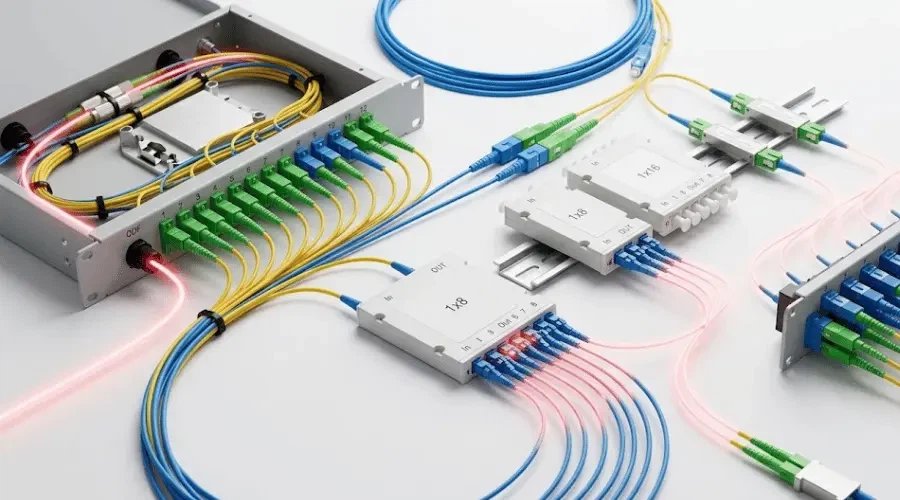
By connector type, FC connectors use metal ferrules and screw fastening, mostly used in fiber distribution frames; SC connectors have rectangular shells with push-pull latch designs, widely used on routers and switches; ST connectors have circular shells and are commonly used in fiber distribution frames; LC connectors are compact with modular jack designs, being the mainstream choice in current data centers; MPO/MTP connectors support multi-fiber high-density connections and are widely used in 40G/100G high-speed networks.
By end-face polishing method, PC type uses flat contact polishing, APC type uses 8-degree angled polishing, and UPC type uses ultra physical contact polishing. Different polishing methods determine optical performance indicators such as return loss.
Definition and Composition of Patch Cord Production Lines
Definition of Patch Cord Production Lines
A patch cord production line refers to an industrial production system that processes raw materials into finished patch cords with standard connectors. It integrates multiple technologies including mechanical processing, precision assembly, optical inspection, and automation control, connecting cables with connectors through a series of processes and ensuring products meet relevant performance standards.
From a systems engineering perspective, a patch cord production line is a typical discrete manufacturing system where products must go through processing and inspection at multiple workstations to be completed. Depending on the level of automation, production lines can be classified into manual, semi-automatic, and fully automatic forms.
Core Components of Production Lines
A complete patch cord production line typically consists of the following subsystems:
Material preparation system is responsible for storage, supply, and preprocessing of raw materials. This includes cable pay-off racks, tension control devices, length measuring devices, etc. Raw materials are usually supplied in large reels and need to be cut to specific lengths according to order requirements.
Processing and assembly system is the core of the production line, completing the transformation from raw materials to semi-finished products. This includes cutting equipment, stripping equipment, glue injection equipment, crimping equipment, curing equipment, polishing equipment, etc. These devices are arranged according to the process sequence, forming a complete processing flow.
Inspection and testing system ensures product quality meets standard requirements. This includes end-face geometry inspection, optical performance testing, visual inspection, and other steps. The precision and reliability of inspection equipment directly affect product yield rates.
Logistics and conveying system enables workpiece flow between workstations. This can use manual transfer, conveyor belts, robotic arms, and other methods. Production lines with higher automation typically feature automated logistics systems.
Control and management system coordinates the operation of the entire production line. This usually employs PLC programmable controllers as lower-level control, combined with upper-level computer software to achieve production scheduling, data collection, quality traceability, and other functions.
Fiber Optic Patch Cord Production Process
Process Overview
Fiber optic patch cord production is a precision manufacturing process with extremely high requirements for process control. The complete production process includes: cable cutting, wear component assembly, glue dispensing, fiber insertion, heat curing, de-gluing, polishing, end-face inspection, overall assembly, performance testing, quality sampling, and packaging for shipment.
This process reflects the three core tasks of fiber optic patch cord production: reliable assembly of cables and connectors, precision polishing of end faces, and strict quality inspection. Each task requires professional equipment and precise process control.
Detailed Process Analysis
First Process: Cable Cutting
Cable cutting is the starting point of production, cutting rolled cables into specified lengths according to order requirements, with a certain allowance reserved for subsequent processing. Cutting accuracy directly affects the length consistency of finished products. Modern production lines typically use fully automatic cable cutting machines that can automatically memorize cutting lengths, perform electric cutting, and feature cable collection devices that wind cut cables into coils for subsequent handling and packaging. Advanced cutting machines can simultaneously process 12-color cables at once, greatly improving production efficiency.
Second Process: Component Threading and Fiber Stripping
Various components are pre-threaded onto the fiber in sequence, including rubber boots, heat shrink tubing, support tubes, springs, etc. Attention must be paid to correct orientation during threading. Subsequently, fiber strippers are used to remove the outer jacket from both ends of the cable, exposing the internal fiber. Extra care must be taken during stripping not to damage the fiber core, otherwise optical performance will degrade or fiber breakage may occur.
Third Process: Glue Dispensing and Injection
This is a critical process requiring injection of special adhesive into the connector ferrule's tail section. Commonly used adhesives like 353 glue need to be mixed in specific ratios, with bubble formation minimized during mixing. Modern production often uses professional glue dispensing machines that can precisely control dispensing time, quantity, and force, ensuring glue volume consistency.
Fourth Process: Fiber Insertion
The stripped fiber is manually or automatically threaded into the glue-filled ferrule, with the fiber end-face slightly protruding beyond the ferrule end-face. This process has high skill requirements for operators, who must achieve precise positioning without damaging the fiber.
Fifth Process: Heat Curing
Ferrules with inserted fibers are placed in curing ovens for baking until the adhesive is completely cured. Professional fiber curing ovens use high-precision temperature control systems and can cure multiple connectors simultaneously, such as 64 connectors at once. Control of curing temperature and time significantly affects bonding strength.
Sixth Process: Polishing
This is the core process determining the optical performance of fiber optic patch cords. After curing, fiber end-faces must undergo multiple polishing steps to achieve required geometric shapes and surface quality. Polishing is typically divided into coarse grinding, medium grinding, fine grinding, and polishing stages, using polishing films of different grit sizes to progressively improve end-face quality.
The polishing machine is the core equipment for this process. Advanced polishing machines feature four-corner pressure designs, control polishing programs through integrated circuit modules and touch buttons, and display polishing counts simultaneously, making process quality easier to control. High-end polishing machines use rigid fixture systems with precision and repeatability far superior to floating fixture systems.
Seventh Process: End-Face Inspection
After polishing, detailed inspection of end-faces is required, including geometric shape inspection and visual inspection. Geometric shape inspection uses interferometers to measure radius of curvature, apex offset, fiber height, and other parameters. Visual inspection uses video fiber microscopes to observe whether end-faces have scratches, contamination, or other defects.
Eighth Process: Assembly
Other patch cord components are assembled manually or through automation to complete final assembly. Some components need ultrasonic cleaning in pure water before assembly to remove surface dust, followed by drying in precision dryers before use. Cleanliness directly affects fiber connection performance.
Ninth Process: Performance Testing
Insertion loss and return loss testers are used to measure core optical parameters of fiber optic patch cords. Telecom-grade products typically require insertion loss less than or equal to 0.3dB and return loss greater than or equal to 50dB. For products with higher requirements, complete 3D interferometric testing is also needed to check three key geometric parameters: apex offset, radius of curvature, and fiber height.
Tenth Process: Quality Sampling and Packaging
Quality management personnel perform sampling re-inspection of tested qualified products to control batch quality. Qualified products complete final packaging and prepare for shipment.
Network Patch Cord Production Process
The production process for network patch cords is relatively simple, mainly including the following steps:
First is wire cutting, cutting twisted pair cables to required lengths. Then stripping, using wire strippers to remove about 2 centimeters of outer jacket from twisted pair cables, being careful not to damage the wire cores. Next is wire arranging, arranging the four pairs of wires in color order according to 568A or 568B standards. Then crimping, inserting arranged wire cores into RJ45 crystal plugs and using crimping tools to crimp and secure. Finally testing, using network patch cord testers to check electrical connections and wire sequence correctness.
Core Equipment for Patch Cord Production Lines
Cutting Equipment
Fully automatic fiber cable cutting machines are the starting equipment of production lines, featuring length measurement, cutting, and winding functions. They can cut indoor fiber of different specifications to required lengths and automatically wind cables into coils. Advanced cutting machines have features such as automatic cutting length memory, electric cutting, adjustable cutting time, and settable cutting length, with cable collection devices that can adjust coil diameter, size, and quantity.
For network patch cord production, wire cutting machines need to handle twisted pair cables of different specifications and be equipped with automatic stripping functions.
Glue Injection and Crimping Equipment
Glue injection machines are used to precisely inject adhesive into connector ferrules. Professional glue dispensing equipment can adjust dispensing time, quantity, force, and retraction time, using imported glue control valves to ensure dispensing accuracy and consistency.
Crimping equipment is used to mechanically secure fibers to connectors, available in manual and automatic types. Automatic crimping machines can achieve continuous production, improving efficiency and consistency.
Curing Equipment
Fiber curing ovens are equipment specifically designed for curing fiber connector adhesives. They can handle various connector types, including FC, SC, LC, MU, MTRJ, ST, MPO, etc. High-precision temperature control systems ensure curing temperature stability. Large-capacity curing ovens can cure dozens of connectors at once, improving production efficiency.
Polishing Equipment
Fiber polishing machines are among the most technically sophisticated equipment in production lines. Advanced polishing machines use rigid fixture system designs with precision and repeatability superior to traditional floating fixture systems. Polishing programs are controlled through integrated circuit modules, displaying polishing counts for easier process quality control.
Polishing fixtures are important tooling used with polishing machines, with different connector types requiring corresponding fixtures. High-quality fixtures ensure polishing consistency, meeting or exceeding GR-326 geometric requirements, achieving low back reflection without scratching ferrule end-faces.
Inspection Equipment
Inspection equipment is key to ensuring product quality. Main types include:
Insertion loss and return loss testers measure core optical parameters of fiber optic patch cords and are essential testing equipment for production lines.
Interferometers measure end-face geometric shapes, including radius of curvature, apex offset, fiber height, and other parameters. Cost-effective interferometers are increasingly being adopted by factories.
Video fiber microscopes observe the visual quality of fiber end-faces, providing clear images with simple operation. Variable magnification microscopes integrate multiple magnification levels such as 400x, 200x, and 80x, allowing clear and convenient observation of fiber end-faces and ferrule end-face conditions.
Network patch cord testers check electrical connections and wire sequences of network patch cords. During testing, corresponding indicator lights flash sequentially to indicate correct crimping.
Auxiliary Equipment
Production lines also require various auxiliary equipment, including heat shrink machines for shrinking protective tubing; marking machines for product identification; ultrasonic cleaners for cleaning components; dryers for drying cleaned components; and packaging equipment for final product packaging.
Quality Control and Industry Standards
Key Quality Indicators
Fiber optic patch cord quality is mainly measured by the following indicators:
Insertion loss is the power loss when optical signals pass through connectors, measured in decibels (dB). Telecom-grade products require insertion loss less than or equal to 0.3dB, with high-end products requiring even lower values.
Return loss is the ratio of reflected optical power to incident optical power, reflecting the reflection characteristics of connector end-faces. Single-mode products typically require return loss greater than or equal to 45dB or 50dB, with APC types achieving over 60dB.
End-face geometric parameters include radius of curvature, apex offset, fiber height, etc. These parameters determine the physical contact state when two connectors are mated.
Mechanical performance includes tensile strength, bending performance, insertion/extraction durability, etc., ensuring patch cord reliability during use.
Environmental adaptability includes temperature cycling, humidity, vibration, and other tests, verifying product stability under various environmental conditions.
Major Industry Standards
Major standards that fiber optic patch cord production must follow include:
GR-326-CORE is the generic requirements standard for single-mode fiber optic connectors and patch cord assemblies developed by Telcordia in the United States, widely adopted globally. This standard has detailed specifications for connector optical performance, geometric parameters, mechanical performance, environmental performance, and other aspects.
IEC 61300 series are fiber optic connector standards developed by the International Electrotechnical Commission, including multiple sections on test methods and performance requirements. Products must meet corresponding test characteristic requirements to enter international markets.
TIA/EIA-568 is the structured cabling standard developed by the Telecommunications Industry Association and Electronic Industries Alliance of the United States, with clear specifications for network patch cord wire sequences and performance. 568A and 568B are two standard wire sequences.
5.3 Quality Control Systems
Establishing a comprehensive quality control system is the foundation for ensuring product quality, mainly including:
Incoming inspection performs sampling inspection on raw materials to ensure cables, connectors, etc. meet specification requirements.
Process control establishes inspection points at key processes, monitors process parameters, and promptly identifies and corrects deviations.
Final inspection performs 100% optical performance testing on every finished product to ensure shipped products are qualified.
Sampling re-inspection allows quality management personnel to perform sampling review of qualified products to control batch quality.
Traceability system records production information for each product, facilitating traceability and analysis of quality issues.
Automated Production Line Design
Basic Concepts of Automated Production Lines
An automated production line is a production system that connects a group of automatic machines and auxiliary equipment in process sequence through workpiece transfer systems and control systems, automatically completing all or part of the product manufacturing process. Automatic production lines operate automatically according to prescribed programs or instructions without human intervention, with goals of achieving "stable, accurate, and fast" production.
The automation level for patch cord production can be selected based on production volume requirements and investment budgets. Small-batch, multi-variety production is suitable for semi-automatic production lines, while large-batch standardized production is suitable for fully automatic production lines.
Production Line Planning Elements
Planning a patch cord automated production line requires considering the following elements:
- Product variety determines the flexibility requirements of the production line. Automated production lines are suitable for single-variety, high-volume product production, with fewer product varieties recommended, as this involves tooling and fixtures that make multi-product compatibility difficult. Product changeover may involve tooling and fixture replacement.
- Capacity requirements are fundamental parameters for production line design, with appropriate production processes and equipment configurations selected based on capacity requirements.
- Production processes once determined require configuring appropriate numbers of equipment for each process based on processing time to achieve line balance.
- Equipment specifications must match product requirements, meeting both precision requirements and cost-effectiveness considerations.
- Layout design must consider smooth logistics, convenient operation, economical floor space, and other factors.
Production Takt Time and Balance Rate
Production takt time is a core parameter for automated production lines, determined by the slowest process in the entire workflow. This requires that each process have roughly the same takt time, but in practice deviations always exist-this deviation is the production line balance rate.
The formula for calculating production line balance rate is: sum of all workstation times divided by bottleneck process time, then divided by number of processes. If all processes have the same production takt time, the balance rate is 100%. If one process is slower, the efficiency of the entire production line decreases.
To achieve the same takt time for each process, different processes typically need different numbers of equipment. For example, if Process A takes 2 minutes with one machine and Process B takes 4 minutes with one machine, Process B can be configured with 2 machines, so both processes have matching takt times without resource waste.
Composition of Automation Systems
A modern patch cord automated production line typically includes the following automation elements:
- Controllers are the decision-making mechanisms that issue commands, completing coordination and commanding operations of the entire system. Common controllers used in automated factories include PLC programmable controllers, industrial computers, etc.
- Sensors are used to monitor and control various parameters in production processes, keeping equipment operating in normal or optimal states. Without numerous excellent sensors, modern production would lose its foundation.
- Servo systems provide precise motion control, including servo motors and drives, used to achieve various precision positioning actions.
- Robots and manipulators achieve automatic handling and loading/unloading of workpieces between workstations, being key to improving automation levels.
- Frequency converters control AC motors by changing motor power supply frequency, achieving energy conservation and speed regulation purposes.
- Human-machine interfaces provide windows for operators to interact with equipment, enabling parameter setting, status monitoring, fault diagnosis, and other operations.
- SCADA systems, or data acquisition and monitoring systems, can automatically collect process data and equipment parameters from production lines and provide large-screen display interfaces, showing real-time production line operating status.
Industry Applications and Market Prospects
Application Fields
Patch cord products have very broad application fields:
Data centers are the largest application market for fiber optic patch cords. With the development of cloud computing, big data, artificial intelligence, and other technologies, data center construction continues to grow, and demand for high-performance fiber optic patch cords continues to expand. In particular, demand for MPO/MTP pre-terminated fiber optic patch cords in 40G/100G high-speed networks is strong.
Communication networks including telecom backbone networks, metropolitan area networks, and access networks are traditional application fields for patch cords. Continued advancement of fiber-to-the-home has driven substantial patch cord demand.
Enterprise networks including office buildings, industrial parks, commercial buildings, and other structured cabling systems require large quantities of network patch cords and fiber optic patch cords.
Broadcasting systems where digital transformation and fiber upgrades of cable television networks have created considerable patch cord markets.
Industrial automation fields where fiber optic patch cords are typically used for interconnection of industrial control equipment, with high requirements for product reliability and environmental adaptability.
Smart city infrastructure construction where fiber optic patch cords are widely used in street lights, traffic signals, surveillance systems, etc.
Technology Development Trends
High density
High density is an important trend adapting to data center needs. Applications of MPO/MTP and other multi-fiber high-density connectors are becoming increasingly widespread, placing higher demands on production processes.
High speed
High speed as 400G and even higher-rate networks are deployed, optical performance requirements for patch cords continue to increase, requiring more precise production processes to ensure quality.
Intelligence
Intelligence with production lines increasingly adopting industrial robots, machine vision, artificial intelligence, and other technologies to achieve higher levels of automation and intelligence.
Green manufacturing
Green manufacturing with applications of low-smoke halogen-free materials, energy conservation and emission reduction in production processes, and waste recycling becoming industry focus areas.
Industry Landscape
The global patch cord industry has formed a relatively complete industrial chain:
Upstream consists of raw material suppliers providing optical fiber, optical cables, connectors, adhesives, and other raw materials.
Midstream consists of patch cord manufacturers, including internationally renowned brands and numerous domestic enterprises. China has become the world's largest patch cord production base, with products exported worldwide.
Downstream consists of various application customers, including telecom operators, data center operators, system integrators, engineering contractors, etc.
Equipment suppliers provide various professional equipment for patch cord production, from simple hand tools to complex automated production lines, forming a specialized market segment.
Production Management Practices
Production Planning Management
Patch cord production typically adopts make-to-order production mode, requiring establishment of efficient production planning management systems:
Order management receives customer orders, conducts order reviews, confirms product specifications, quantities, delivery requirements, etc., and evaluates production capacity.
Material planning calculates material requirements based on order needs, arranges procurement and inventory management, ensuring production materials arrive on time.
Production scheduling comprehensively considers order priority, capacity constraints, material supply, and other factors to develop reasonable production schedules.
Progress tracking monitors production progress in real-time, promptly identifies and resolves problems, and ensures on-time delivery.
Shop Floor Management
Good shop floor management is the foundation for ensuring product quality and production efficiency:
Environmental control for fiber optic patch cord production has certain cleanliness requirements, especially for polishing and assembly processes, requiring control of dust and static electricity.
5S management through continuous improvement of sorting, setting in order, shining, standardizing, and sustaining, establishes a clean and orderly production environment.
Equipment maintenance establishes preventive maintenance systems, regularly maintaining and calibrating equipment to ensure equipment remains in good condition.
Personnel training requires operators to undergo systematic training before working at their posts, especially for key processes such as polishing and testing, which have high skill requirements.
Cost Control
Cost control in patch cord production needs to focus on the following aspects:
Material costs are the main cost component, reduced through optimized procurement, waste reduction, improved yields, and other methods.
Labor costs are reduced through improved automation levels, optimized process flows, enhanced employee skills, and other methods to increase per-capita output.
Equipment costs are reduced through improved equipment utilization, extended equipment life, reasonable capacity configuration, and other methods to lower per-unit equipment allocation costs.
Quality costs include prevention costs, appraisal costs, internal failure costs, and external failure costs, with overall quality costs reduced by improving first-pass yield rates.
Conclusion
A patch cord production line is a comprehensive manufacturing system integrating precision mechanics, optical inspection, automation control, and quality management. Deeply understanding patch cord production lines requires mastering knowledge in multiple areas including product knowledge, process technology, equipment principles, quality standards, and production management.
With the continued development of information and communication technology, demand for patch cord products will continue to grow, and performance requirements will continue to increase. This brings broad market opportunities to patch cord manufacturing enterprises while also presenting challenges for technology upgrades and management improvements. Only through continuous learning and innovation can companies remain competitive in fierce market competition.
We hope this systematic introduction helps readers establish a comprehensive understanding of patch cord production lines and provides reference for learning and work in related fields. Whether newcomers to the industry or practitioners seeking deeper understanding, valuable information and inspiration can be found here.