Patchcord Production Line: Buyer's Guide
A 1-meter SC simplex jumper goes for $2 from some suppliers, $12 from others. Same connector type, same cable spec on paper. What's the difference? Everything that doesn't show up on a spec sheet.
That price gap traces back to production decisions-fiber grade, aramid quality, ferrule sourcing, polishing equipment, testing protocol. If you're evaluating suppliers or thinking about setting up your own line, understanding these cost drivers matters. Not because cheaper is always worse (sometimes it's just more efficient), but because you need to know what you're actually buying.

Why Prices Vary So Much
Raw materials account for 45-55% of production cost. That's where most cost-cutting happens, and it's mostly invisible to buyers.
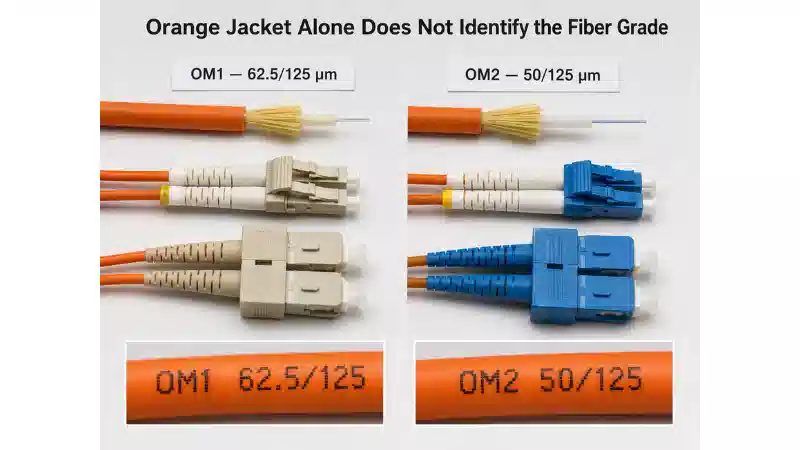
Fiber core grade is the big one. A-grade cores from major producers versus C or D-grade that some factories substitute. Without an interferometer to check-and plenty of smaller operations don't have one-you can't tell until installation. Then you get excessive loss, short transmission reach, inconsistent core diameter that makes splicing a nightmare. I've seen OM3-300 labeled as OM4. Happens more than the industry likes to admit.

Aramid fiber (Kevlar is just DuPont's brand name for it) is supposed to protect the fiber from tensile stress during pulls. Real aramid costs money. Polyester yarn costs maybe one-tenth as much and does almost nothing. Some suppliers use it anyway. Quick way to check: hit the exposed strands with a lighter. Polyester melts and burns, aramid doesn't. We've had cables come in claiming aramid that failed that test.
Ferrule quality affects optical alignment directly. Good ferrules spec 1.0μm concentricity. Cheap ones run 1.5μm and then get "adjusted" during testing-rotated until they happen to line up with the reference. Passes the measurement, fails in the field when mated randomly. Some places even use recycled ferrules that have already been through one polish cycle. The protrusion length is wrong, insertion loss goes up, and you're stuck figuring out why your network has problems six months later.
The jacket material question is less about cost and more about compliance. LSZH costs more than PVC but building codes increasingly require it for indoor runs. Some suppliers quote LSZH and ship PVC. You can't tell by looking.
Production Line Economics
The automation decision isn't complicated once you know your numbers. Below about 20,000 connectors a month, semi-automatic polishing with manual assembly usually makes more sense than full automation. Above 100,000 monthly, full automation pays for itself. In between, it depends on your labor costs and how stable your product mix is.
Komax has published guidance that automation becomes economically justified above 250,000 cable ends annually (komax.com). That tracks with what we've seen. The equipment cost jump from semi-auto to full automation is substantial-often $300K or more-and it only makes sense at volume.
Here's the math that actually matters for the automation decision:
| Setup | Per-Connector Cost Breakdown | Monthly Break-Even vs. Manual |
|---|---|---|
| Hand polishing | $0.50 labor + $0.02 consumables = $0.52 | - |
| Semi-auto (assuming $150K investment) | $0.08 labor + $0.11 equipment + $0.02 consumables = $0.21 | ~8,000 units |
| Full automation (assuming $500K investment) | $0.02 labor + $0.15 equipment + $0.02 consumables = $0.19 | ~25,000 units |
That $0.31 per-connector difference between hand polishing and semi-auto adds up fast. At 50,000 monthly volume, it's $15,500/month in savings. The equipment pays itself off in under a year. But at 5,000 monthly volume, you're saving $1,550/month against a $150K outlay. That's an eight-year payback. Doesn't make sense.
Labor rates shift this calculation a lot. The numbers above assume $15/hour. At $8/hour, manual stays viable longer. At $25/hour, even moderate volumes justify automation.
Process Details That Actually Matter
I'm not going to walk through all twelve production steps. Most of them are straightforward if you have decent equipment and trained operators. But three areas cause the majority of quality problems.
Epoxy curing is where a lot of connectors get ruined before they even reach polishing. EPO-TEK 353ND mixed 10:1, cured at 150°C for about a minute. You can tell it's done when the color shifts from yellowish-green to amber. Undercure causes pullout failures. Overcure makes it brittle. Multimode is especially touchy-thermal shock cracks the core. Some operations step-cure (start at 80°C, ramp up) to prevent this, but that requires programmable ovens. Budget lines skip it and accept the yield hit.
The final polish step gets skipped more than it should. Diamond polishing generates enough heat to alter the refractive index of the top 20-30μm of the fiber face. CMP slurry removes that damaged layer. Skip it and you'll pass visual inspection-the endface looks fine-but random-mating IL tests show elevated loss. Not every connector, just enough to create field problems.

Also: don't clean with alcohol after CMP. Causes permanent spotting. Took us 200 scrapped connectors to figure that one out.
Rubber pad durometer is boring but matters. Pads are spec'd at Shore 50-65. They harden with use. At Shore 70+ you get geometry variation-radius of curvature and fiber height start drifting. Monthly checks catch it. Most cost-focused operations check quarterly if at all, and wonder why their yield fluctuates.
Quality Specs and What They Mean for Market Access
IEC 61753-1 Grade B (mean IL ≤0.12dB, max ≤0.25dB) has become the effective minimum for telecom and data center work. Grade C (mean ≤0.25dB) is fine for enterprise and campus. Grade D is residential.
If your production can't hit Grade B consistently, you're locked out of the contracts that actually pay well. The equipment and process control to go from Grade C to Grade B capability costs maybe 40-60% more. Not a trivial difference, but the market access difference is bigger.
The geometry specs in GR-326 (radius of curvature, fiber height, apex offset) matter because they predict random-mating performance. A connector that looks great against the supplier's master jumper might measure 0.35dB against your installed plant because the geometry is marginal. This is why 3D interferometry data matters and why some suppliers don't want to provide it.
One thing the 2022 IEC revision changed: optical performance now takes precedence over visual inspection. A connector with minor scratches in Zone B can ship if IL/RL meets spec. Worth knowing when you're evaluating supplier reject rate claims.
Evaluating Suppliers
Ask about materials. Fiber grade, aramid source, ferrule supplier. Vague answers or annoyance at the question is information.
Ask about testing. 100% or sample? Master jumper only or random mating? Do they have 3D interferometry and will they share data?
Ask about yield. Capacity claims don't mean much. A line making 10,000/day at 8% rejects delivers less usable product than one making 6,000/day at 2%. And those rejects go somewhere-sometimes to less demanding customers, sometimes relabeled as house brand for a different market.
Ask about equipment vintage. This one gets overlooked. 2015-era polishing machines on original firmware don't produce the same results as current equipment with adaptive pressure control. The difference shows up in geometry consistency.
If they won't let you visit the facility, that's also information.

The Demand Picture
This matters for timing decisions. Corning has stated publicly that AI data centers need roughly 10x the fiber of traditional builds (corning.com). U.S. FTTH deployment hit a record last year-10.3 million homes passed, bringing total coverage to 88 million households. The BEAD program is $42 billion mandating fiber-first. MPO/MTP segment is growing at double-digit rates.
Equipment lead times normalized after the 2022-2023 mess. Standard stuff is 6-8 weeks now. MPO fixtures still run 10-14 weeks. If you're adding capacity, start the procurement process early.
Bottom Line
The $2 jumper and the $12 jumper look the same. The difference is in material grade, process control, and testing rigor-none of which appear on a datasheet. Understanding where production costs actually come from lets you evaluate suppliers on what matters instead of just comparing quoted prices.
Whether you're sourcing or building, the questions are the same: what fiber grade, what aramid, what ferrule concentricity, what testing protocol, what yield rate. Suppliers who answer clearly are telling you something. Suppliers who don't are also telling you something.

In today's era of rapid information development, whether it's massive data transmission in data centers or network access in countless households, everything depends on a seemingly inconspicuous yet critically important component-the patch cord (jumper wire). As the core platform for manufacturing this key component, the patch cord production line carries the vital mission of building communication infrastructure. This article will start from the basic concepts of patch cords and provide an in-depth analysis of the complete picture of patch cord production lines, presenting readers with a comprehensive knowledge system.