If you've spent any time poking around data center cabling or just tried to order fiber patch cables online, you've probably run into these two names: LC and MPO. And honestly? The first time I saw an MPO connector in person, I thought someone had welded a bunch of fibers together wrong. It looked weird. Bulky. Nothing like the neat little LC plugs I was used to.
But here's the thing-they're not competitors in the way people think. More like cousins with very different jobs.
The LC connector: everyone's favorite
LC stands for Lucent Connector. Lucent Technologies developed it back in the day, and it stuck around because it just... works. Small footprint. 1.25mm ferrule. Push-pull mechanism that doesn't require you to twist or screw anything. You click it in, you're done.
Most people encounter LC first. It's everywhere-corporate networks, telecom rooms, small data centers, SFP transceivers. The duplex version (two LC connectors joined together) handles your standard transmit-and-receive setup without any drama.
What makes LC so popular isn't some technical miracle. It's practical stuff. The thing is tiny compared to older connectors like SC or ST. You can pack more ports into a panel. That matters when rack space costs money.
MPO means Multi-fiber Push-On. Or Multi-fiber Push-On/Pull-Off if you want the full name nobody actually uses.
Here's where it gets interesting.
An MPO connector doesn't carry one or two fibers. It carries 8, 12, 24-sometimes up to 72 fibers in a single plug. One rectangular connector. Multiple fibers lined up inside a precision ferrule. The idea is density. Raw, aggressive density.
Why would anyone want this? Because modern data centers are insane. 40 gig links. 100 gig links. 400 gig and beyond. At those speeds, you need parallel optics-multiple fibers transmitting simultaneously. Running individual LC cables for each fiber would be a cable management nightmare. Trust me. I've seen the "before" photos from data centers that tried.

Size matters (but not how you'd think)

LC ferrule: 1.25mm diameter.
MPO: rectangular ferrule housing multiple fibers in a linear array.
You'd assume bigger = better capacity, and technically yes. But MPO connectors aren't "big" in the way older connectors were big. They're compact for what they do. An MPO-12 takes roughly the same panel space as one SC connector-but it's moving twelve times the fiber.
The engineering behind this is genuinely clever. Precision guide pins. Floating ferrule designs in premium versions (that's where the MTP trademark from US Conec comes in). These things need micron-level alignment across multiple fibers simultaneously. Get the alignment wrong, and you're staring at insertion loss numbers that'll make you cry.
When you'd actually use each one
LC dominates in:
Enterprise networks where 10G is the standard
Smaller installations that don't need massive fiber counts
Legacy systems-tons of existing infrastructure uses LC
Pretty much any SFP or SFP+ transceiver setup
MPO shows up when:
You're building 40G/100G/400G links in a data center
Pre-terminated trunk cables make sense for your deployment
Space is so tight that running dozens of individual cables isn't feasible
You're connecting QSFP transceivers
But here's a nuance most guides skip over: MPO and LC often work together. Data centers commonly use MPO trunk cables for backbone runs, then break them out to LC at patch panels via cassettes or fanout cords. The MPO-12 to 6xLC-duplex conversion is practically an industry standard.
So it's not LC versus MPO. It's LC and MPO, depending on where you are in the cable plant.
The polarity headache
I should probably mention polarity because it trips people up constantly.
With LC, polarity is straightforward. You've got two fibers-transmit and receive. Flip the connector orientation or use a crossover cable. Done.
MPO? Good luck.
When you have 12 fibers in a connector and they need to line up correctly at both ends-with transmit matching to receive on every single pair-things get complicated fast. TIA-568 defines three polarity methods (A, B, and C) for structured cabling. Each requires specific cable configurations. Mix them up and your link either doesn't work or has fibers talking to nobody.
The white dot on MPO connectors marking position 1 exists for this exact reason. Keys. Pin orientation. Male versus female connectors. There's a whole system to keep things organized, and it works, but there's definitely a learning curve.

Performance: what the specs don't tell you
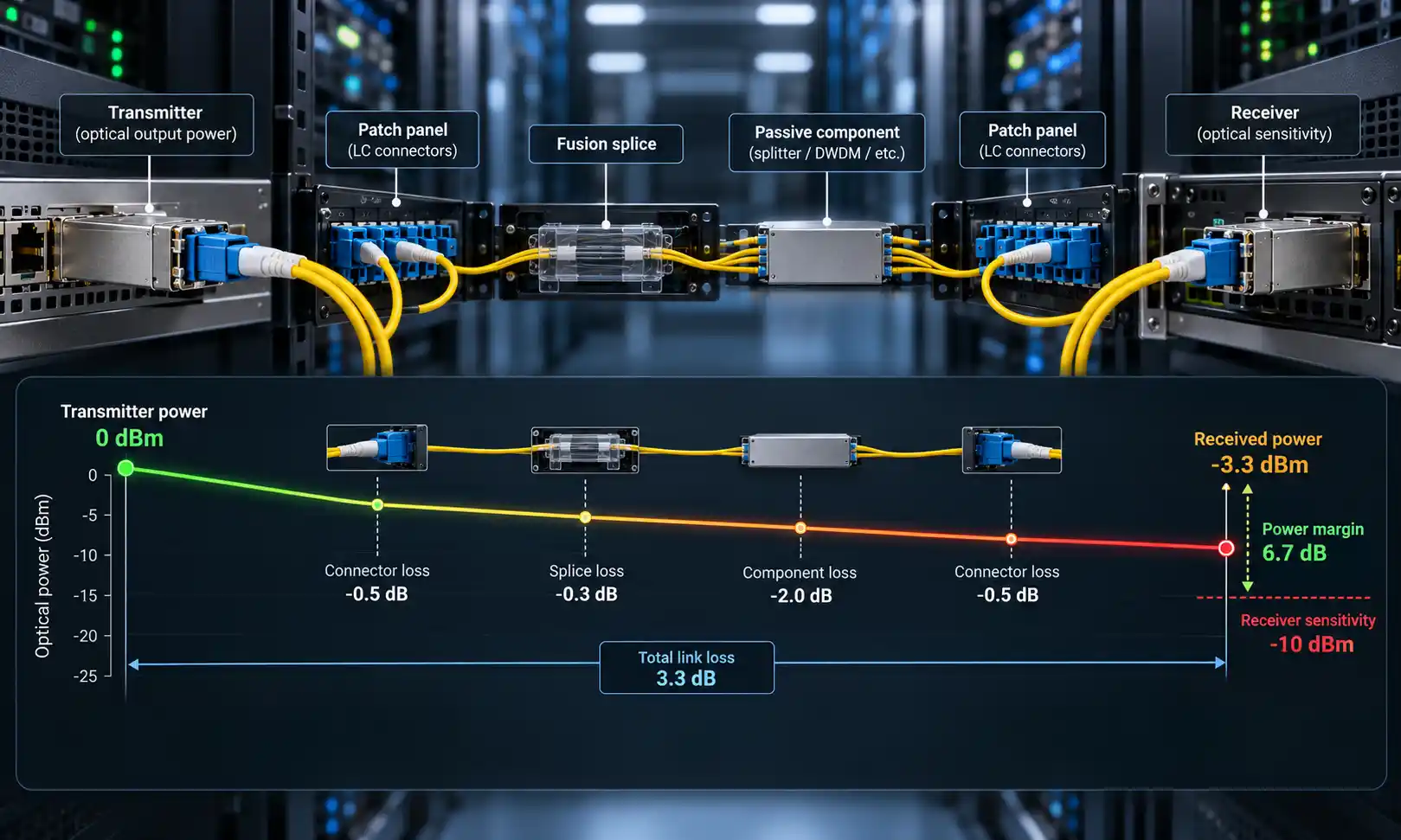
Both LC and MPO have excellent performance when manufactured correctly. Typical insertion loss specs hover around 0.1-0.15 dB for quality LC connectors, maybe 0.25-0.35 dB for MPO (per fiber).
Here's what nobody advertises: MPO connectors are harder to keep clean.
That rectangular ferrule with 12 or 24 fiber ends? Every single one needs to be contamination-free. One spec of dust on one fiber can degrade your entire link. And because the surface area is larger and the geometry more complex, standard fiber cleaning tools sometimes aren't enough.
I've heard technicians say MPO connectors are "high maintenance" and honestly that's fair. LC has a single fiber end to clean. MPO has... a lot more surface area for things to go wrong.
Premium MTP connectors address some of this with better ferrule materials and tighter tolerances, but they cost more. Sometimes significantly more.
Cost and availability
LC connectors are cheap. Like, surprisingly cheap for precision optical components. Competition drove prices down years ago. You can get decent LC patch cords for a few dollars each.
MPO trunk cables? Different story. The connectors themselves are more expensive. The precision requirements are higher. And you're paying for multiple fiber terminations in one assembly. A quality 24-fiber MPO trunk cable costs real money.
But-and this is the counterargument data center architects make-the installation labor for one MPO trunk versus twelve separate LC cables has to factor in. Time is money. Plug-and-play pre-terminated systems exist specifically because of this math.

The future (or whatever we're calling it now)
LC isn't going anywhere. There's too much installed base. Too many devices with SFP ports. It'll remain the workhorse connector for single-channel applications.
MPO is growing. 400G deployments use 8-fiber and 16-fiber MPO. Newer very-small-form-factor connectors (like the SN-MT and MMC) are basically evolved MPO concepts with higher density. AI data centers with their insane bandwidth requirements are driving demand for even more parallel fibers.
The connector landscape keeps evolving. But for most practical purposes today, knowing when to reach for LC versus MPO-or both-covers 95% of scenarios.
Quick reference
LC connector
Single fiber (or duplex pair)
1.25mm ferrule
Push-pull latch
Universal in enterprise and telecom
Works with SFP/SFP+ modules
Cheap and everywhere
MPO connector
8 to 72 fibers in one plug
Rectangular MT ferrule
Push-on coupling
Data center backbone and parallel optics
Works with QSFP/QSFP-DD modules
Higher cost, higher complexity
Nobody writes love letters about fiber connectors. But if they did, LC would be the reliable partner who's always there, and MPO would be the ambitious one who shows up when the stakes are high.
Use whichever one makes sense for your situation. Or both. Usually both.