An MTP single-mode breakout converts high-density multi-fiber connections into individual duplex connections by splitting one MTP connector containing 8, 12, or 24 fibers into multiple LC or SC duplex ports. This design uses OS2 9/125μm single-mode fiber to support long-distance transmission up to 40 kilometers while maintaining signal quality across the breakout.

The Architecture Behind MTP Breakout Cables
The fundamental structure of an mtp single-mode breakout cable consists of two distinct termination points. One end features a single MTP (Multi-fiber Termination Push-on) connector housing multiple fibers within a compact ferrule, while the opposite end fans out into individual duplex connectors. This architecture solves a critical data center challenge: how to interface high-density parallel optic equipment with traditional duplex fiber infrastructure.
Connector Configuration
The MTP connector side typically comes in female or male configurations. Female connectors lack guide pins and mate with male connectors containing two precision guide pins that ensure accurate fiber alignment. MTP connectors can contain 8, 12, or 24 fibers, with 12-fiber configurations being most common for 40G and 100G applications. The connector features a push-pull tab mechanism for single-handed installation and removal, reducing installation time in dense rack environments.
On the breakout side, each fiber pair terminates in standard duplex LC or SC connectors. A 12-fiber MTP connector breaks out into six duplex LC connections, while an 8-fiber version provides four duplex channels. These duplex connectors follow industry-standard footprints, ensuring compatibility with existing switch ports, transceivers, and patch panels.
OS2 Single-Mode Fiber Specifications
The mtp single-mode breakout uses OS2-rated fiber with a core diameter of 9 micrometers and cladding diameter of 125 micrometers (9/125μm). OS2 single-mode fiber supports transmission distances from 5-10 kilometers at 1310nm wavelength and 30-40 kilometers at 1550nm wavelength for 10 Gigabit Ethernet. This long-distance capability makes single-mode breakouts essential for campus networks, metropolitan area networks, and inter-building connections where multimode fiber's distance limitations become prohibitive.
The cable construction typically includes a 2.0mm or 3.0mm trunk diameter with individual 0.9mm or 2.0mm microduct legs on the breakout side. Yellow jacket coloring denotes single-mode fiber, following industry color coding standards that help technicians quickly identify cable types during installation and maintenance.
Polarity Management in Single-Mode Breakouts
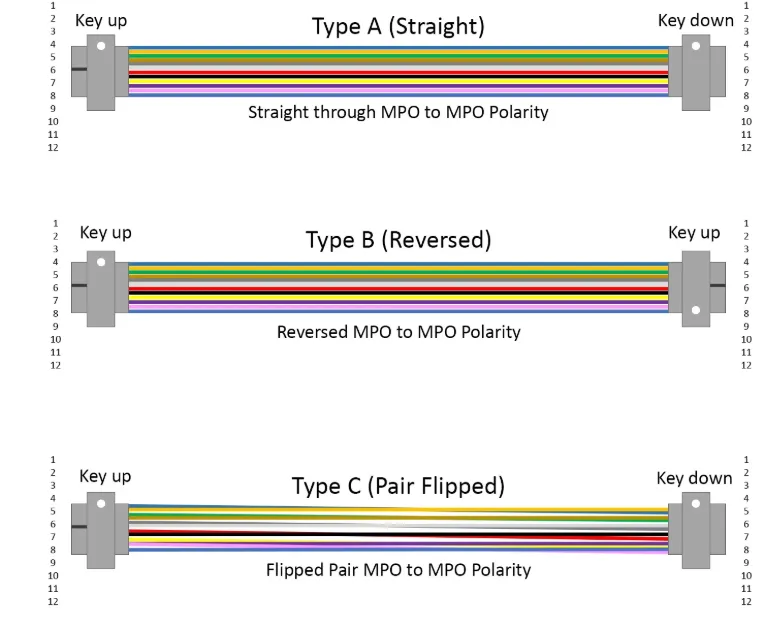
Polarity defines the fiber pathway from transmit (Tx) to receive (Rx) ports across the network. Without proper polarity, transmitted signals cannot reach their intended receivers, causing communication failures. MTP breakout cables implement polarity through three standardized configurations defined by TIA-568 standards.
Type A Polarity
Type A cables use a key-up connector on one end and a key-down connector on the other end, maintaining a straight-through connection where fiber position 1 connects to position 1 at the opposite end. The key refers to a physical protrusion on the MTP connector that determines orientation during mating.
In Type A breakout cables, the fiber mapping remains sequential. Position 1 and 2 on the MTP connector break out to the first LC duplex pair, positions 3 and 4 to the second LC duplex, and so forth. This straightforward mapping simplifies troubleshooting but requires specific patch cord types (A-B crossover cords) at equipment connections to achieve proper Tx-to-Rx alignment.
Type B Polarity
Type B cables use key-up connectors on both ends with reversed fiber positions-fiber at position 1 on one end mates with position 12 at the opposite end. This reversed configuration is particularly popular for 40G QSFP+ and 100G QSFP28 direct connections because it naturally provides the required polarity flip.
Type B breakout cables work seamlessly with 40GBASE-SR4 PSM4 transceivers for converting 40G ports into four 10G connections or 100G ports into four 25G connections. The reversed polarity eliminates the need for specialized patch cords at both ends-standard straight-through A-B patch cords work correctly throughout the channel.
Type C Polarity
Type C cables flip adjacent fiber pairs. Position 1 shifts to position 2 at the opposite end, position 2 shifts to position 1, and this pair-flipping continues throughout the connector. While less common in single-mode applications, Type C provides flexibility in certain cassette-based architectures where pair-flipping simplifies the overall polarity scheme.
The critical rule: never mix polarity types within a single channel. Doing so causes signal misalignment and communication failures.

Polish Types: UPC and APC
Single-mode MTP breakout cables use two ferrule polish types that dramatically affect optical performance. The polish type determines how light behaves at fiber connections and which applications the cable supports.
UPC Polish Characteristics
UPC (Ultra Physical Contact) connectors feature fiber endfaces polished with no angle, though they have a slight curvature for better core alignment, achieving return loss of approximately -50dB or better. The polishing process creates a dome-shaped endface that minimizes air gaps when two connectors mate.
UPC connectors use blue color coding on single-mode cables. They work well for most data center applications where moderate return loss suffices. UPC polish finds widespread use in digital TV, telephony, and data systems. The manufacturing process for UPC polish is less complex than APC, typically resulting in lower cable costs.
APC Polish Advantages
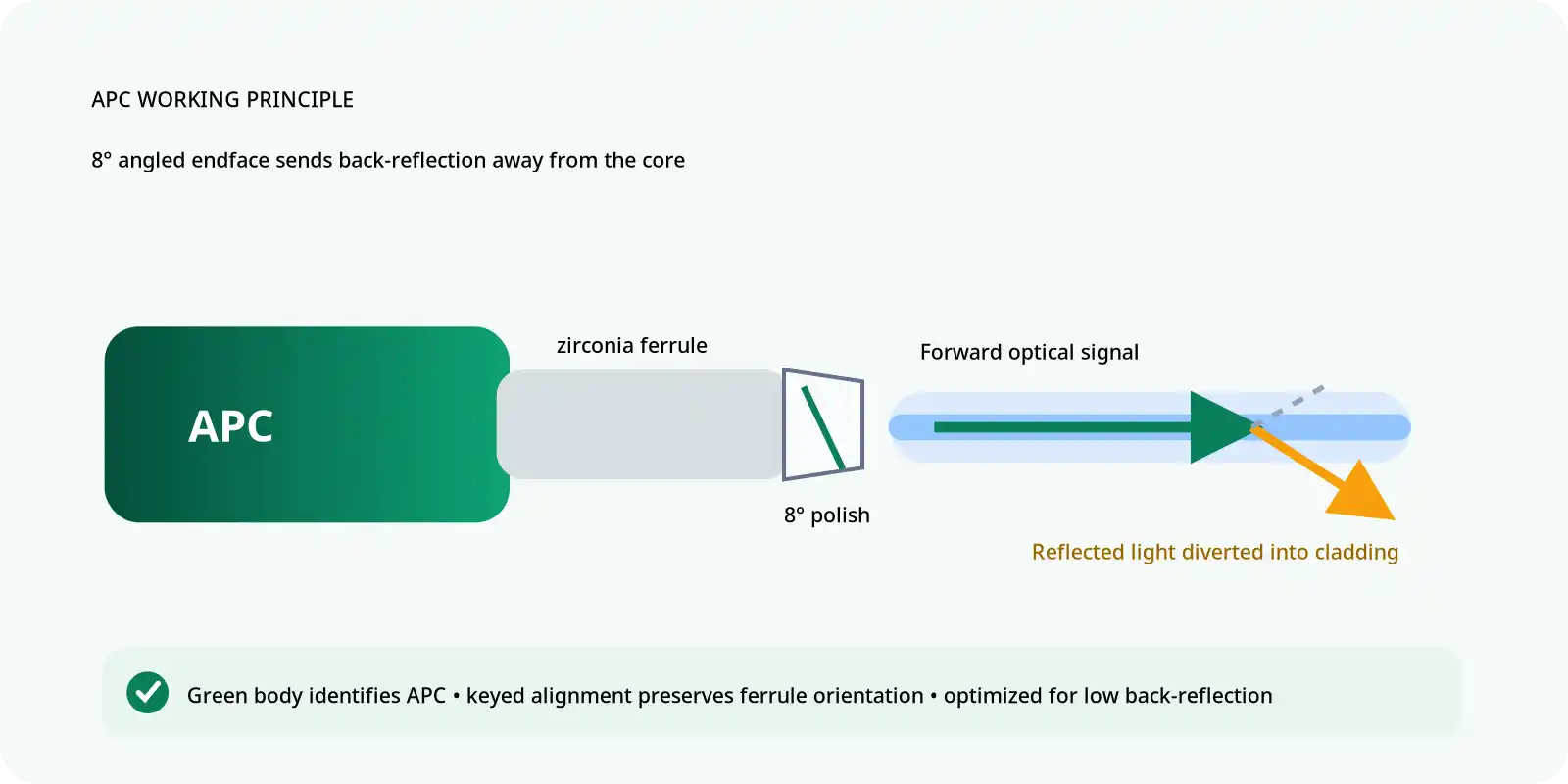
APC (Angled Physical Contact) connectors feature fiber endfaces polished at an 8-degree angle, achieving superior return loss of -60dB or better. This angle directs reflected light into the fiber cladding rather than back toward the light source, dramatically reducing back reflection.
APC connectors use green color coding to distinguish them from UPC versions, preventing dangerous mismatches. The angled polish makes APC connectors essential for applications sensitive to return loss, including RF video overlay systems, passive optical networks (PON), and high-wavelength WDM systems operating above 1550nm.
Critical Warning: Never mate UPC and APC connectors. Mating UPC to APC causes poor performance because fiber cores cannot properly touch, and can permanently damage both connectors and potentially destroy expensive transceiver equipment.
Applications in Data Center Infrastructure
MTP single-mode breakout cables solve specific connectivity challenges that arise in modern data center architectures. Understanding these applications helps network designers choose appropriate cable configurations.
40G to 10G Migration
MTP-LC breakout cables bridge gaps between older 10G equipment and newer 40G systems, allowing four 10G SFP+ transceivers to connect through a single 40GBASE-SR4 QSFP+ port. This conversion extends the useful life of 10G infrastructure while enabling gradual migration to higher-speed networking.
The breakout occurs at the switch side, where one 40G port fans out to four separate 10G connections. Each 10G connection uses a standard duplex LC interface, maintaining compatibility with existing 10G switches, servers, and storage arrays. This approach eliminates the need for expensive media converters or complete equipment replacement.
100G to 25G Conversion
Similar principles apply to 100G environments. A single 100GBASE-PSM4 QSFP28 transceiver connects through an 8-fiber MTP breakout to four 25G SFP28 LR transceivers, splitting 100G bandwidth across four 25G channels. This conversion pattern supports mixed-speed environments where some servers operate at 25G while core switches provide 100G uplinks.
The PSM4 (Parallel Single-Mode 4-lane) technology requires single-mode fiber and typically uses 1310nm wavelength. Each 25G lane transmits independently, providing flexibility for load balancing and redundancy configurations.
Structured Cabling Between Patch Panels
MTP breakout assemblies enable rapid deployment of high-density, multi-port patch field connectivity for Storage Area Network (SAN) applications and between Main Distribution Frames (MDFs) and Intermediate Distribution Frames (IDFs). Rather than running individual duplex fibers between floors or buildings, technicians deploy MTP trunk cables for the backbone and use breakout cables at distribution points.
This structured approach reduces pathway congestion. A single 12-fiber MTP trunk replaces six duplex fiber runs, cutting installation time and improving cable management. MTP-LC harness designs replace the combination of fiber cables and fiber cassettes, simplifying network upgrades and conserving cabling space.
Technical Specifications and Performance
Understanding the performance characteristics of mtp single-mode breakout cables ensures proper system design and helps predict link budgets.
Insertion Loss
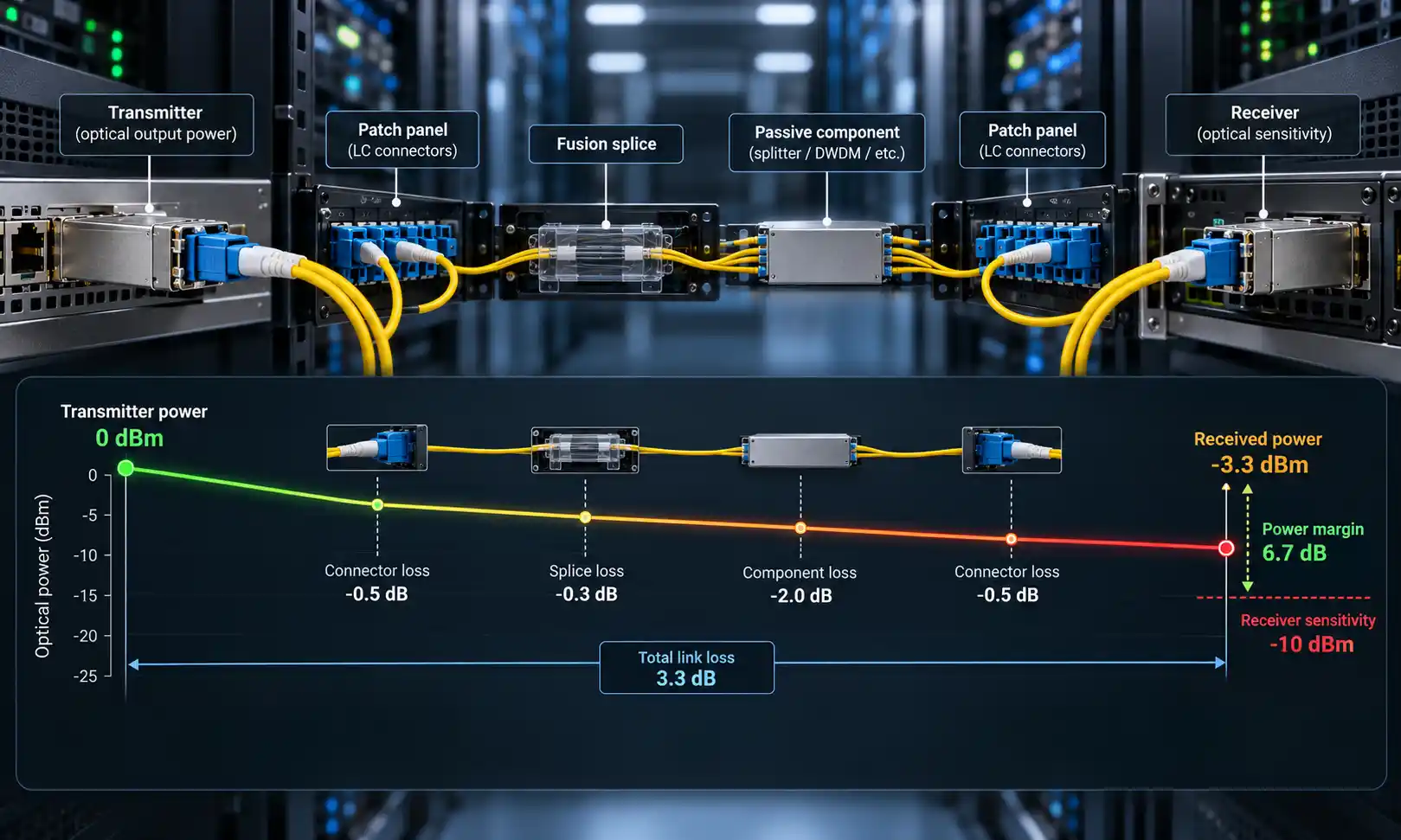
Industry-standard MTP breakout cables achieve insertion loss of ≤0.2 dB per connector pair. Total channel insertion loss depends on the number of connection points. A typical MTP breakout with one MTP connector and six LC duplex connectors contributes approximately 0.4-0.6 dB total insertion loss.
Premium cables using US Conec MTP Elite connectors achieve even lower insertion loss. Elite low-loss connectors reach 0.35 dB maximum insertion loss. This improvement matters in long-distance applications approaching maximum transmission distances where every tenth of a decibel counts.
Return Loss Performance
UPC single-mode connectors deliver return loss better than -55 dB, while APC versions exceed -60 dB. Higher return loss values (more negative) indicate better performance with less light reflecting back toward the source.
Applications using coherent modulation schemes, such as 100G DP-QPSK or 400G 16-QAM, demand excellent return loss performance. Back reflection interferes with these sensitive modulation formats, causing bit errors and reducing maximum transmission distances. APC polish becomes mandatory in these scenarios.
Jacket Ratings and Fire Safety
Single-mode breakout cables come in three primary jacket ratings that determine installation environments:
OFNR (Riser): PVC jacket suitable for vertical runs between floors in non-plenum spaces. OFNR jackets meet UL 1666 riser flame test requirements.
OFNP (Plenum): Low-smoke, flame-retardant jacket certified for air-handling spaces. OFNP jackets meet UL 910 regulations and remain compatible with both unrated and OFNR-rated applications. Building codes often mandate plenum-rated cables in raised floors and suspended ceilings.
LSZH (Low Smoke Zero Halogen): Halogen-free construction for environments where toxic fume production during fires poses unacceptable risks. Common in European installations and submarine applications.
Installation Best Practices
Proper installation techniques extend cable life and ensure optimal performance. MTP connectors require more careful handling than traditional duplex connectors due to their multi-fiber nature and precision alignment requirements.
Connector Cleaning Protocols
Clean endfaces are non-negotiable. A single dust particle or oil smudge across any fiber in an MTP connector corrupts that channel and potentially adjacent channels. Clean end-face is the main requirement for reliability and high-performance connections.
Use approved cleaning methods: one-click cleaners designed for MTP connectors, or lint-free wipes with 99.9% isopropyl alcohol. Always clean both mated sides-the cable connector and the adapter or transceiver port. Inspect endfaces with a fiber microscope after cleaning to verify complete contamination removal. Even connectors with protective dust caps require cleaning before first use, as manufacturing residues may remain.
Bend Radius Management
Single-mode fiber tolerates less bending than multimode fiber due to its smaller core diameter. Maintain minimum bend radius of 30mm (1.2 inches) during installation and 15mm (0.6 inches) for installed cables. Tighter bends cause increased attenuation and potential fiber breakage.
Bend-insensitive fiber adds a "trench" layer with lower refractive index around the core, reflecting weakly guided modes back into the core when stress would normally couple them into the cladding, allowing smaller bending radiuses without significant light loss. Cables using Corning ClearCurve or equivalent bend-insensitive fiber provide installation flexibility, particularly valuable in tight cabinet spaces.
Polarity Verification
Before energizing links, verify polarity using a visual fault locator (VFL) or optical time-domain reflectometer (OTDR). Incorrect polarity won't damage equipment but prevents communication. Simple verification: connect a VFL to one LC port on the breakout and verify light emerges from the correct position on the MTP connector.
More sophisticated verification uses a polarity tester that illuminates all fibers simultaneously and displays their positions at the opposite end. This method catches reversed pairs and other wiring errors before they cause operational problems.
Comparison: Breakout Cables vs. Trunk Cables with Cassettes
Network designers often face the choice between using MTP Breakout Cable assemblies or deploying MTP trunk cables with cassette modules. Each approach offers distinct advantages depending on application requirements.
Direct Breakout Approach
Breakout cables provide the simplest connection method. MTP breakout cables use MTP connectors on one end and duplex connectors on the other end, enabling direct connection without intermediate cassettes. This direct approach reduces connection points, lowering total channel insertion loss and eliminating potential failure points.
Breakout cables excel in applications requiring rate splitting-converting one high-speed port into multiple lower-speed connections. The fixed breakout configuration simplifies inventory management since each cable serves a specific conversion purpose.
Cassette-Based Architecture
MTP trunk cables feature MTP connectors on both ends and connect patch panel cassettes that have multiple duplex connectors at the front, establishing permanent links between equipment. Cassette systems offer superior flexibility since changing the cassette type alters the breakout configuration without replacing trunk cables.
Cassette architectures support higher port densities in limited rack space. A single rack unit can house 96 LC ports using MTP-to-LC cassettes, compared to approximately 24-48 ports using traditional patch panels. This density advantage becomes critical in large-scale deployments where rack space costs significant money.
The choice often comes down to flexibility versus simplicity. Cassette systems enable easier modifications as network requirements evolve. Breakout cables provide lower insertion loss and simpler installation for fixed configurations.
Frequently Asked Questions
What's the difference between MTP and MPO connectors?
MPO is the generic connector name while MTP is a registered trademark from US Conec with enhanced design features, but both types are backwards compatible and work interchangeably with MTP/MPO cassettes and patch panels. MTP connectors include removable housings for field reworking and typically deliver better optical performance due to tighter manufacturing tolerances. When specifying cables, either term is generally acceptable, though MTP often indicates premium-grade components.
Can I use single-mode breakout cables for multimode applications?
No. Single-mode and multimode fibers have different core diameters (9μm vs. 50μm or 62.5μm) and operate at different wavelengths. Transceivers designed for multimode operation expect larger core diameter and won't couple light efficiently into single-mode fiber. Additionally, APC polish is primarily used for single-mode applications, while multimode typically uses UPC polish. Always match fiber mode (single-mode or multimode) when extending or modifying network infrastructure.
How do I identify the polarity type of an existing cable?
Examine the key positions on both MTP connectors. Type A cables have key-up on one end and key-down on the other. Type B cables have key-up on both ends. If documentation is unavailable, test with a visual fault locator: illuminate position 1 at one end and observe which position lights up at the other end. Position 1-to-1 indicates Type A; position 1-to-12 indicates Type B. Many manufacturers also print polarity type on the cable jacket or include labels on the connectors.
What breakout length should I choose?
Breakout length refers to the individual fiber legs on the duplex connector side. Common options include 0.5m, 1m, 1.5m, and 3m. Choose based on the physical distance between the MTP connection point and equipment ports. In tight cabinet spaces, 0.5m legs prevent excess cable clutter. For patch panels mounted several rack units away from active equipment, 1.5m or 3m legs provide necessary reach. Longer legs offer flexibility but increase cable management challenges. Consider using staggered breakout lengths when connecting multiple ports-this spaces out the duplex connectors and reduces congestion at switch faceplates.
MTP single-mode breakout technology represents a elegant solution to data center density challenges. By concentrating multiple fiber pairs into a single compact connector, these cables reduce pathway congestion while maintaining the flexibility to interface with traditional duplex equipment. Proper attention to polarity management, polish types, and installation practices ensures these cables deliver years of reliable high-speed connectivity across campus and metropolitan networks.