This guide is intended for defense network planners, system integrators, procurement engineers, and buyers evaluating rugged fiber optic cable assemblies for military and aerospace environments.
Modern defense networks carry video feeds, radar data, command-and-control traffic, and encrypted communications across battlefields, ships, aircraft, and fixed installations. A military fiber optic cable must do more than transmit light. It must survive mud, sand, salt fog, repeated deployment, vibration, and field handling - and still deliver reliable performance at mission-critical moments.
This guide explains what sets military fiber optic cables apart from commercial fiber, covers the main cable types and connector options, walks through real defense applications, and provides a practical framework for choosing the right cable assembly for your mission profile.
What Is a Military Fiber Optic Cable?

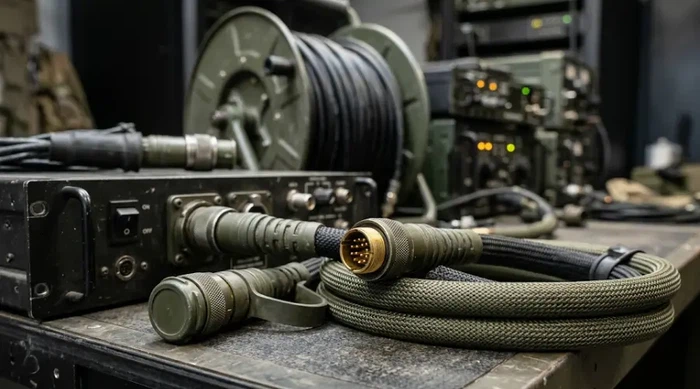
A military fiber optic cable is a ruggedized optical cable engineered for defense, aerospace, naval, vehicle, and tactical communication environments. Like all fiber optic cables, it transmits data as light through optical fiber. The distinction lies in the level of mechanical protection, environmental resistance, connector robustness, and deployment readiness built into every layer of the cable.
Standard commercial fiber networks serve buildings, data centers, and telecom routes under controlled conditions. Military fiber systems face a different reality: field personnel dragging cable across rough ground, connectors mated in rain or dust, cables routed through tight vehicle compartments, or assemblies wound onto tactical reels and redeployed after each mission. The cable construction, jacket material, strength members, connectors, and testing requirements must reflect those actual operating conditions.
In practice, a military-grade fiber optic cable may serve as a fixed installation cable in a command center, a tactical deployable cable on a battlefield, an armored cable along a perimeter, a shipboard cable inside a naval vessel, or a custom fiber optic cable assembly built around a specific platform requirement.
Why Defense Networks Choose Fiber Over Copper
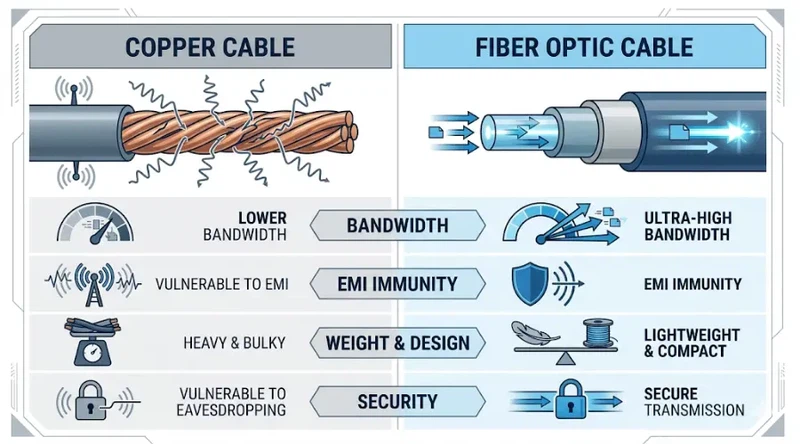
Four characteristics make fiber optic cable the preferred transmission medium for military communications.
High bandwidth over long distances.
Fiber supports the data throughput required for real-time video, radar processing, sensor fusion, and secure digital links - often over distances where copper would need repeaters or suffer unacceptable signal degradation. The Fiber Optic Association notes that single-mode fiber in particular can carry signals over many kilometers with minimal attenuation.
Electromagnetic interference immunity.
Defense environments are electrically hostile. Radios, radar transmitters, electronic warfare systems, generators, and vehicle power systems produce EMI that can disrupt copper-based data links. Glass fiber is inherently immune to electromagnetic interference, making it far more reliable in these environments.
Weight reduction.
Fiber optic cable weighs significantly less than equivalent copper cable. For aircraft, UAVs, tactical kits, ground vehicles, and man-portable communication systems, every kilogram saved improves mobility, payload capacity, and operational range.
Physical-layer security characteristics.
Optical fiber does not radiate a signal the way copper conductors do, and tapping a fiber link without causing detectable signal loss is technically difficult. While network security always depends on encryption, access control, and system design, fiber provides a stronger physical transmission layer. The U.S. Department of Defense has long recognized these properties in its communications infrastructure guidelines.
Core Components of a Military Fiber Optic System
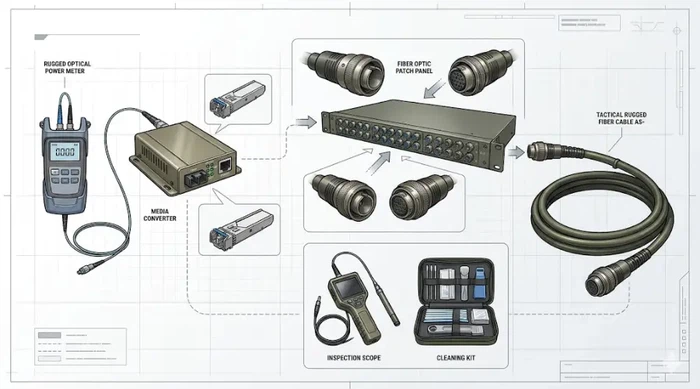
A complete military fiber optic solution involves more than just cable. A reliable system typically includes cables, connectors, pre-terminated assemblies, patch panels, media converters, transceivers, test equipment, and cable management accessories. Each component must be selected to work together under the same environmental and operational conditions.
Cables and Cable Assemblies
The cable forms the physical backbone of the link. It may contain single-mode fiber, multimode fiber, or a hybrid configuration combining both. Depending on the application, the cable may use tight-buffered fibers, aramid yarn reinforcement, metallic or non-metallic armor, rugged outer jackets, or water-blocking materials.
A cable assembly is a finished cable with connectors factory-installed at one or both ends. For defense programs, pre-terminated assemblies reduce field installation time and eliminate the variability of field termination - especially when the assembly has been factory-tested to documented optical and mechanical standards.
Engineering note: If your team needs to deploy and retrieve the same cable assembly repeatedly, specify reel-compatible construction, reinforced strain relief at the connectors, and a jacket material that resists abrasion from repeated winding. A cable that performs well optically but fails after three deployments because the jacket delaminates or the connector strain relief cracks is not fit for tactical use.
Military Fiber Optic Connectors
Connectors are the most vulnerable point in a fiber optic link. Dust, scratches, poor alignment, moisture ingress, and repeated mating cycles all degrade performance. Military fiber optic connectors typically feature rugged housings, environmental sealing, integrated strain relief, and designs rated for field conditions.
The two main categories - expanded beam and physical contact - involve fundamentally different tradeoffs. Connector choice should be driven by deployment scenario, contamination risk, mating frequency, and link budget, not by habit or familiarity alone.
Patch Panels and Cable Management
In command centers, shelters, vehicles, and shipboard communication rooms, patch panels and termination enclosures organize fiber connections and protect splice points. For temporary field deployments, tactical reels and deployment backpacks enable fast cable laydown and retrieval.
Good cable management reduces damage during operation, simplifies troubleshooting, and extends cable service life. For tactical systems, retrieval and storage procedures matter as much as installation procedures.
Transceivers and Media Converters
Most defense systems need fiber links to interface with Ethernet switches, routers, radios, cameras, sensors, or legacy copper-based equipment. Fiber optic transceivers and media converters bridge these interfaces.
When selecting transceivers, confirm wavelength compatibility, data rate, connector interface, operating temperature range, power input, form factor, and interoperability with the network architecture before ordering. Mismatched transceivers are one of the most common causes of link failures during system integration.
Inspection, Cleaning, and Test Equipment
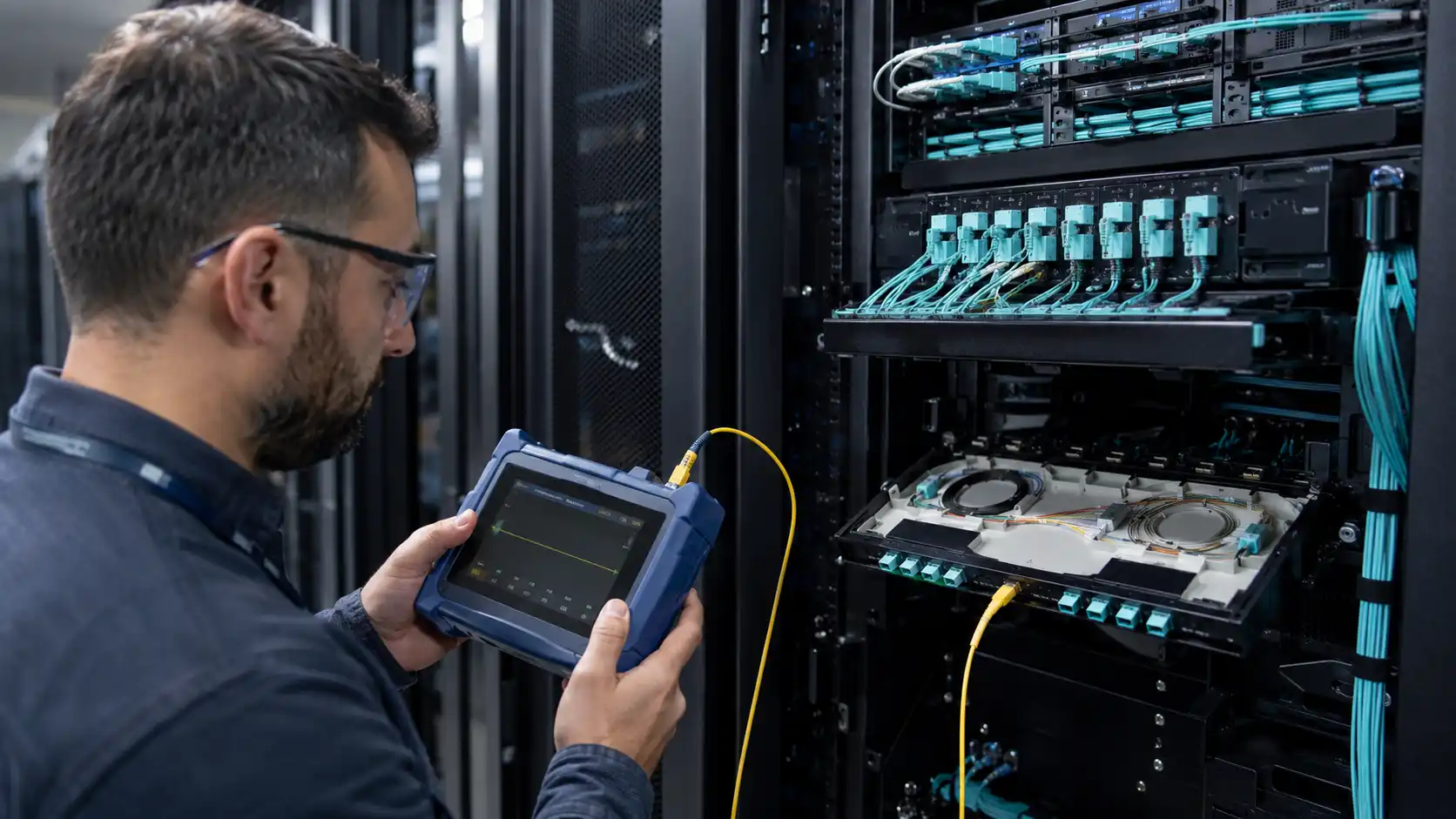
A reliable fiber link depends on clean connector end faces and verified optical performance. Inspection scopes, cleaning kits, optical power meters, light sources, visual fault locators, and OTDR equipment are essential for installation acceptance, periodic maintenance, and post-deployment verification.
For mission-critical systems, testing should be built into the workflow - not treated as a troubleshooting step after something fails. The right inspection and test tools can mean the difference between finding a contaminated connector in two minutes and spending two hours tracing a link fault.
Types of Military Fiber Optic Cable
Different defense applications require different cable designs. The table below provides a high-level comparison of the three main cable categories used in military environments.
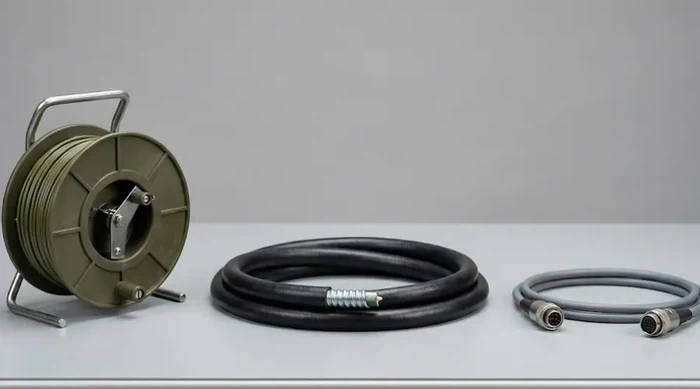
| Feature | Tactical Fiber Cable | Armored Fiber Cable | Shipboard / Aerospace Fiber Cable |
|---|---|---|---|
| Primary use | Rapid field deployment and retrieval | Fixed or semi-permanent installations with mechanical hazards | Naval, aircraft, UAV, and vehicle platforms |
| Key strengths | Flexible, lightweight, fast to deploy | High crush, abrasion, and rodent resistance | Compact, vibration-resistant, platform-qualified |
| Key limitations | Less mechanical protection than armored cable | Heavier and less flexible | Requires platform-specific qualification and documentation |
| Typical connector | Expanded beam or ruggedized physical contact | Standard or ruggedized physical contact | MIL-DTL-38999-style or platform-specific |
| Deployment style | Reel, backpack, or hand-deployed | Buried, duct, or surface-mounted | Routed through compartments, raceways, or conduit |
Tactical Fiber Optic Cable
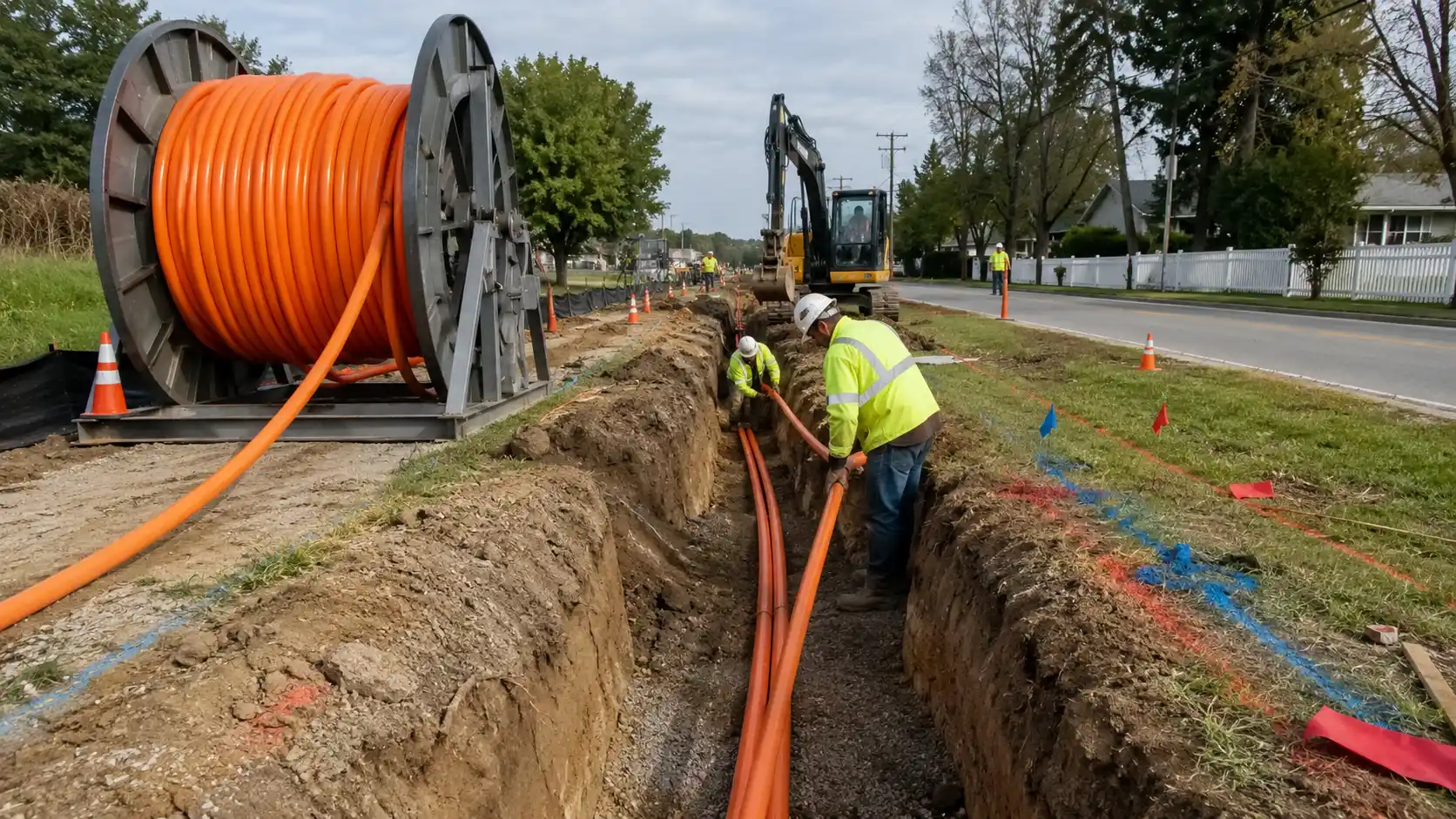
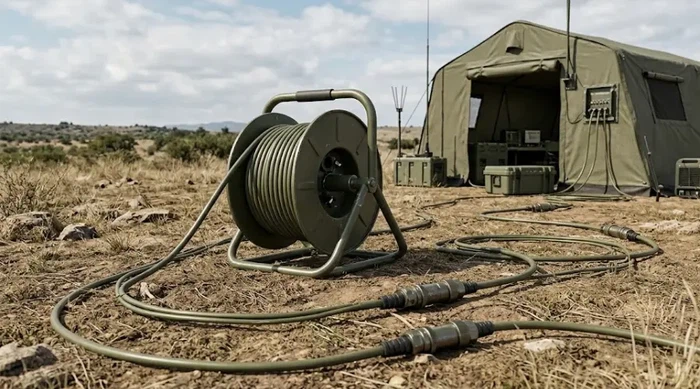
Tactical fiber cable is designed for fast deployment and retrieval - often by soldiers working in field conditions with limited time and no splice equipment. It connects command posts, mobile shelters, sensor nodes, temporary towers, surveillance systems, and field network nodes.
A well-designed tactical cable should unspool cleanly from a reel, lie flat on uneven ground, resist crushing under foot traffic or vehicle crossings, and survive rewinding without kinking. For a temporary field command post, deployment speed and connector contamination control usually matter more than cable appearance or jacket color.
Armored Fiber Optic Cable
Armored fiber cable adds a layer of physical protection - typically steel tape, steel wire, or corrugated armor - to guard against crushing, abrasion, rodent damage, and rough handling. It is used where the cable route passes through areas with mechanical hazards, in buried installations, or in semi-permanent outdoor runs at military facilities.
The tradeoff is weight and flexibility. An armored outdoor cable assembly that protects against backhoe strikes may be too stiff for tight routing in a vehicle or too heavy for a two-person field team to carry. Match the protection level to the actual threat, not the worst-case assumption.
Shipboard and Aerospace Fiber Cable
Naval vessels, aircraft, UAVs, ground vehicles, and autonomous platforms impose constraints that go beyond mechanical protection. These environments involve tight routing spaces, exposure to fuels and hydraulic fluids, salt atmosphere, constant vibration, mechanical shock, and strict weight budgets.
For shipboard applications, cables qualified under MIL-PRF-85045 must pass tests for fluid immersion, thermal shock, smoke generation, flame propagation, toxicity, salt water blocking, and other environmental factors. Cable diameter, jacket material, flame rating, bend radius, and connector retention force can be just as critical as optical performance in these applications.
Single-Mode vs Multimode Fiber for Defense Applications
Choosing between single-mode and multimode fiber is one of the first decisions in any military fiber optic system design. The table below summarizes the key differences relevant to defense buyers.
| Parameter | Single-Mode Fiber | Multimode Fiber |
|---|---|---|
| Core diameter | ~9 µm | 50 µm or 62.5 µm |
| Typical wavelengths | 1310 nm and 1550 nm | 850 nm and 1300 nm |
| Maximum distance | Tens of kilometers without repeaters | Hundreds of meters to ~2 km depending on data rate |
| Bandwidth capacity | Effectively unlimited for current systems | Limited by modal dispersion; varies by OM class |
| Light source | Laser or laser diode | VCSEL or LED |
| Transceiver cost | Higher per unit | Lower per unit |
| Best for | Long-haul backbone links, high-speed trunks, future scalability | Short-distance links where compatible equipment is already in place |
Use single-mode fiber for long-distance backbone links, high-bandwidth trunks, and systems that need headroom for future data rate upgrades. Use multimode fiber for shorter runs where existing transceivers and infrastructure support it, and the link distance falls within multimode range.
Do not mix single-mode and multimode fiber within the same link unless the system is specifically designed for hybrid operation. The Fiber Optic Association's reference on fiber types provides detailed guidance on fiber classifications and their intended uses.
COTS vs Custom Cable Assemblies
Commercial off-the-shelf assemblies work when requirements are standard, timelines are tight, and the deployment environment is controlled. When the project calls for specific fiber counts, custom lengths, particular connector combinations, non-standard jacket materials, special labeling, or unique reel configurations, a custom assembly is the better path.
For defense buyers, "custom" does not mean expensive or complicated. It means the assembly is built around the actual mission profile - rather than forcing the system to work around what happens to be in stock. A properly specified custom assembly often reduces integration problems and field failures compared with adapting a generic product.
Military Fiber Optic Connector Options
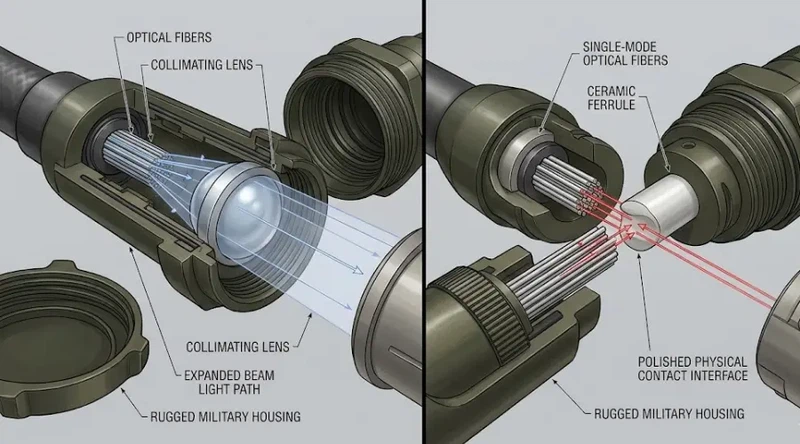
Connector choice directly affects link reliability, maintenance burden, and total lifecycle cost. The two main categories serve different operational needs.
| Feature | Expanded Beam Connectors | Physical Contact Connectors |
|---|---|---|
| Operating principle | Lenses expand and collimate the beam across an air gap | Polished fiber end faces pressed into direct contact |
| Contamination tolerance | Higher - less sensitive to small particles | Lower - particles on end face directly affect signal |
| Mating cycle durability | Better suited to frequent field mating | Excellent if properly maintained; sensitive to repeated dirty mating |
| Insertion loss | Typically higher than well-maintained PC connectors | Lower when clean and properly polished |
| Best environment | Outdoor, dusty, wet, tactical, or high-use field connections | Protected equipment rooms, fixed installations, controlled environments |
| Cleaning requirements | Less critical between matings | Essential - inspect and clean before every mating in field conditions |
Expanded Beam Connectors
Use expanded beam connectors when repeated field mating and contamination risk are more important than achieving the lowest possible insertion loss. They tolerate dust, moisture, and alignment variation better than physical contact designs because the expanded beam is less affected by small particles on the lens surface. The tradeoff is higher insertion loss, which must be accounted for in the link budget.
Physical Contact Connectors
Physical contact connectors such as LC, SC, ST, and FC provide excellent optical performance when the end faces are properly polished, cleaned, and maintained. They are the standard choice for equipment rooms, rack-mounted systems, and protected installations.
In field environments, cleaning discipline determines success. A contaminated physical contact connector degrades performance immediately. Carry cleaning tools, use protective dust caps, and inspect end faces before mating - every time.
MIL-DTL-38999-Style Circular Connectors
The MIL-DTL-38999 connector family is widely used in aerospace and military applications for electrical interconnection. Fiber optic variants of these circular connectors use specialized inserts to carry optical contacts within the same ruggedized shell format. This allows fiber optic links to use the same proven connector housings, environmental sealing, and mounting hardware as existing electrical systems on aircraft, vehicles, and shipboard platforms.
Not all MIL-DTL-38999 connectors carry fiber - the designation refers to the connector shell standard. When specifying fiber optic circular connectors, confirm the insert type, fiber contact configuration, and optical performance specifications separately.
Common Defense Applications
Tactical Battlefield Communications
Tactical fiber links connect command posts, mobile shelters, sensor arrays, surveillance cameras, temporary communication towers, and field network nodes. The operational priorities are fast deployment by small teams, rugged handling on unprepared ground, low weight for man-portable systems, and reliable performance from the moment the link goes live.
Typical configuration: A temporary tactical command post might use a 2-fiber or 4-fiber tactical cable deployed from a reel, terminated with expanded beam connectors, running 500 meters to a sensor node. The cable runs across open ground and must survive foot and light vehicle traffic. The team deploys and retrieves the cable daily. In this scenario, reel handling characteristics, connector contamination resistance, and cable crush resistance matter more than maximum bandwidth or minimum insertion loss.
Command and Control Centers
Fixed command facilities use structured fiber optic cabling for secure data links, video distribution, server interconnection, and mission system networking. In these environments, cable management, patch panels, documentation, redundancy, and long-term maintainability are the primary concerns.
Physical contact connectors (LC and SC types) are standard within protected equipment rooms. Clean-room handling practices, proper labeling, and documented test records support ongoing network management.
Naval and Shipboard Networks
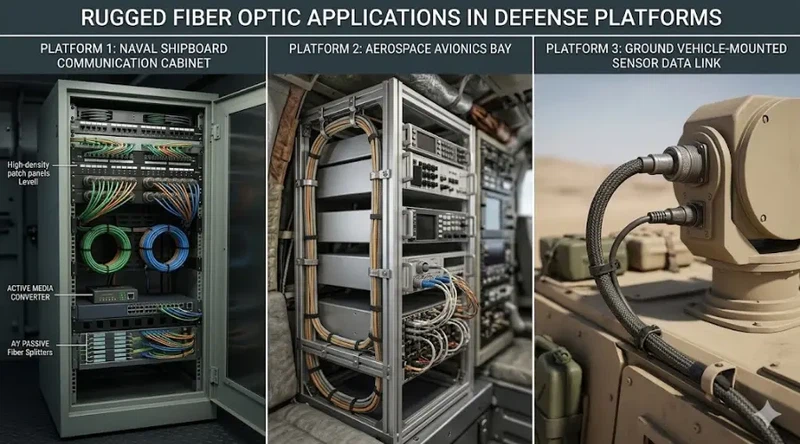
Shipboard fiber optic networks must tolerate vibration, limited routing space, moisture, salt atmosphere, fluid exposure, and platform-specific installation requirements. Cables qualified under MIL-PRF-85045 must meet stringent tests for flame propagation, smoke generation, toxicity, fluid immersion, and thermal shock as outlined in the specification's slash sheets for shipboard and submarine applications.
Fiber's EMI immunity and weight advantage over copper are particularly valuable in naval environments where electromagnetic compatibility and topside weight management are constant concerns.
Aerospace, UAV, and Vehicle Systems
Aircraft, UAVs, armored vehicles, and autonomous platforms use fiber for sensor links, camera feeds, mission computer interconnection, data buses, and communication backhauls. Cable weight, bend radius, vibration resistance, connector retention force, and qualification documentation are major selection factors.
For vehicle-mounted sensor links, a compact armored fiber assembly with MIL-DTL-38999-style connectors may be routed through tight conduits alongside power and signal cables. The fiber must tolerate the vibration profile of the platform without connector disengagement or optical performance degradation.
Sensors, Surveillance, and Perimeter Security
Fiber optic cable supports IP cameras, radar systems, perimeter intrusion detection sensors, acoustic sensing arrays, and distributed monitoring networks at military installations. Long transmission distances and EMI immunity make fiber the practical choice for connecting remote sensors back to central monitoring facilities without signal degradation or interference from nearby electrical systems.
How to Choose the Right Military Fiber Optic Cable
Selecting the right cable starts with the mission environment, not the product catalog. The following decision framework walks through the key steps.
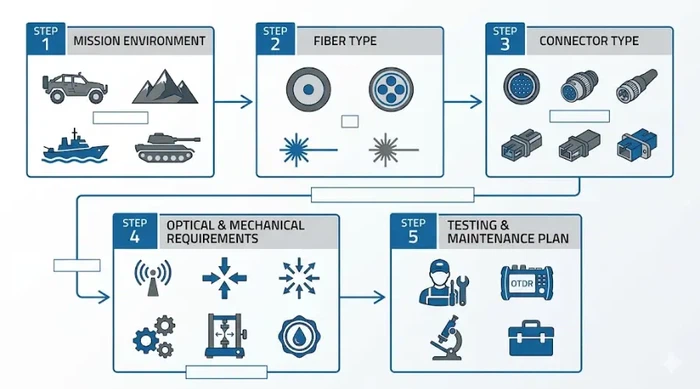
Step 1: Define the Mission Environment
Before evaluating any cable, answer these questions:
Will the cable be permanently installed, semi-permanent, or repeatedly deployed and retrieved? Will it be exposed to mud, sand, fuel, salt fog, moisture, UV radiation, or chemical agents? Will it face vehicle crossings, foot traffic, vibration, pulling loads, or impact? Will personnel deploy it by hand under time pressure? Will it operate indoors, outdoors, shipboard, airborne, underground, or vehicle-mounted?
The answers determine whether you need a lightweight tactical cable, an armored outdoor cable, or a platform-qualified shipboard or aerospace cable.
Step 2: Choose the Fiber Type
Use single-mode fiber for backbone links over several hundred meters, high-speed trunks, and systems where future bandwidth scaling matters. Use multimode fiber for shorter equipment-to-equipment links where existing transceivers and infrastructure are multimode-compatible.
Step 3: Match the Connector to the Deployment Scenario
For outdoor, dusty, wet, or frequently mated connections, select expanded beam or ruggedized connectors rated for field use. For protected equipment rooms and permanent patch panels, standard physical contact connectors (LC, SC) deliver lower insertion loss and are widely compatible.
Consider insertion loss budget, cleaning requirements, mating cycle rating, environmental sealing, strain relief, and compatibility with existing platform fiber optic adapters and infrastructure.
Step 4: Confirm Optical and Mechanical Requirements
Key parameters to specify include: fiber count, cable length (with tolerance), insertion loss, return loss, operating wavelength, minimum bend radius, tensile strength, crush resistance, jacket material, operating temperature range, flame rating, fluid and moisture resistance, connector type on each end, and reel or packaging format.
For programs requiring military specification compliance, request documentation showing conformance to the applicable standard. MIL-PRF-85045 is the primary U.S. military performance specification for fiber optic cables, covering designs for shipboard, ground tactical, airborne, and space applications. Testing under this specification includes environmental exposures such as temperature cycling, humidity, thermal shock, fluid immersion, fungus resistance, and life aging.
Step 5: Plan for Testing, Cleaning, and Field Maintenance
A fiber link can fail because of a contaminated connector end face, an excessive bend in the cable route, a damaged jacket exposing the fiber, poor strain relief at a connector transition, or an untested splice. For tactical systems, the ability to inspect, clean, test, and replace assemblies in the field should be part of the procurement plan - not an afterthought.
The best cable assembly is the one that works reliably throughout the mission lifecycle, not just the one that passes acceptance testing on day one.
Quick Selection Reference
| Use Case | Recommended Cable Type | Recommended Connector | Key Buying Concern |
|---|---|---|---|
| Temporary field command post | Tactical fiber on reel | Expanded beam | Deployment speed, contamination resistance, reel compatibility |
| Fixed command center | Indoor structured cable | LC / SC physical contact | Cable management, documentation, patch panel density |
| Shipboard backbone | MIL-PRF-85045 qualified | MIL-DTL-38999-style or shipboard-rated | Flame/smoke/toxicity compliance, fluid resistance |
| Aircraft or UAV sensor link | Lightweight aerospace cable | MIL-DTL-38999-style circular | Weight, vibration resistance, connector retention |
| Perimeter security network | Armored outdoor cable | Ruggedized physical contact | Crush resistance, UV and moisture protection, long runs |
| Vehicle-mounted data link | Compact armored assembly | MIL-DTL-38999-style or ruggedized | Bend radius, vibration, routing space |
Installation and Maintenance Best Practices
Respect Minimum Bend Radius
Do not route fiber cable around sharp corners, through too-tight conduit bends, or across edges that force the cable below its rated bend radius. Excessive bending increases signal loss and can permanently damage the fiber. Check the manufacturer's rated minimum bend radius for both installed and during-installation conditions - they are usually different.
Keep Connectors Clean
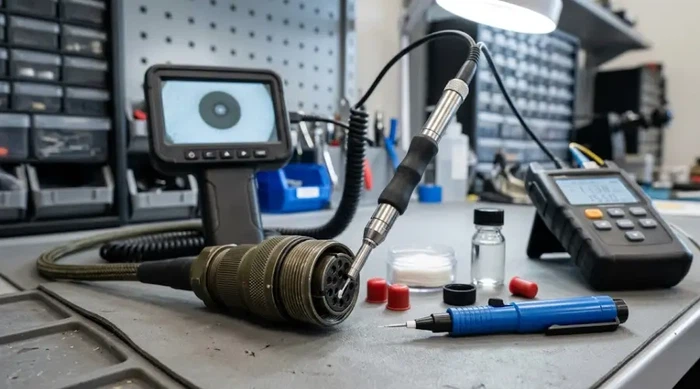
Connector contamination is the most common cause of fiber optic link failures. According to industry guidelines from the FOA and connector manufacturers, even a single particle on a connector end face can cause measurable signal loss. Keep dust caps on unused connectors at all times, inspect end faces with a fiber scope, and clean connectors before mating. For field teams, carry a compact cleaning kit as standard equipment.
Label Every Cable
Label both ends of each cable assembly with fiber count, link ID, direction, destination, and any special handling notes. Clear labeling reduces troubleshooting time from hours to minutes and prevents accidental disconnection of critical links during reconfiguration.
Test Before and After Deployment
For critical links, test cable assemblies before deployment to establish a baseline, after installation to confirm performance, and after retrieval if the cable will be reused. Record results to detect gradual degradation over time.
Store Tactical Cable Properly
Improper winding, kinking, and rough storage shorten service life. Use the appropriate reels, backpacks, or transit cases to protect cable assemblies between deployments. Train field personnel on correct winding technique - this is one of the simplest ways to prevent connector damage and jacket failure.
Common Mistakes to Avoid
Using Commercial Cable in Harsh Environments
A standard indoor fiber patch cable may work in a lab or equipment room, but it will not survive field deployment. Standard PVC jackets crack in cold, indoor connectors flood in rain, and non-reinforced cables break under the mechanical stress of tactical handling. Match the cable to the environment.
Ignoring Connector Contamination
Even the best cable assembly will underperform if the connector end face is dirty. Cleaning is not a remedial action - it is a standard operating procedure. Budget for inspection scopes and cleaning supplies as part of every fiber optic procurement.
Mixing Incompatible Fiber Types
Single-mode and multimode fibers are not interchangeable. Connecting a single-mode transceiver to a multimode fiber (or vice versa) will result in excessive loss or a non-functional link. Before ordering cable or transceivers, confirm fiber type, wavelength, connector interface, and link budget end to end.
Underestimating Deployment and Retrieval
A cable that meets every optical specification may still fail operationally if it is too heavy for a two-person team, too stiff to deploy from a reel in cold weather, or too fragile to survive rewinding over rough ground. Evaluate the cable under realistic handling conditions, not just on a test bench.
Purchasing Without Documentation
For defense programs, documentation is not optional. Request test data, material certificates, compliance documentation (including MIL-PRF-85045 qualification where applicable), and assembly drawings. Undocumented cable assemblies create risk during system acceptance, audit, and sustainment.
Military Fiber Optic Cable Selection Checklist
Before requesting a quote or selecting a supplier, prepare the following information. Providing these details early helps the supplier recommend a cable assembly built around your actual operating requirements.
Application: tactical, naval, aerospace, vehicle, command center, or infrastructure. Installation type: fixed, temporary, mobile, or repeatedly deployed. Required length (including length tolerance). Fiber count. Fiber type: single-mode, multimode, or hybrid. Connector type on each end (including polish and gender). Insertion loss budget or maximum allowable insertion loss. Jacket material and color. Armor or strength member requirements. Operating temperature range. Environmental exposure: moisture, fuel, salt fog, UV, chemicals. Reel, backpack, or packaging requirements. Labeling and documentation requirements. Testing requirements (insertion loss, return loss, visual inspection, OTDR). Applicable military specifications. Quantity and delivery schedule.
FAQs About Military Fiber Optic Cable
What is a military fiber optic cable?
A military fiber optic cable is a rugged optical cable designed for defense environments including tactical field communications, command centers, vehicles, aircraft, ships, and secure infrastructure. It provides reliable data transmission while withstanding environmental and mechanical stress that would damage standard commercial fiber cable.
Why is fiber optic cable preferred for military communications?
Fiber supports high bandwidth and long transmission distances with minimal signal loss. It is immune to electromagnetic interference, weighs less than copper, and offers stronger physical-layer security characteristics. These properties make it particularly valuable in defense environments where radios, radar, and power systems generate heavy EMI.
What is the difference between tactical fiber cable and armored fiber cable?
Tactical fiber cable is optimized for rapid deployment and retrieval using flexible, lightweight construction suited to field handling. Armored fiber cable provides stronger mechanical protection against crushing, abrasion, and physical damage through metallic or non-metallic armor layers, but at the cost of added weight and reduced flexibility.
Should I choose single-mode or multimode fiber for a defense application?
Choose single-mode fiber for long-distance links, high-speed backbone connections, and systems where future bandwidth scaling is important. Choose multimode fiber for shorter equipment-to-equipment links where compatible multimode transceivers are already in place and the link distance falls within multimode specifications.
What are expanded beam fiber optic connectors?
Expanded beam connectors use lenses to expand and align the optical signal across an air gap between the mated connector halves. This design tolerates dust, dirt, and repeated mating better than standard physical contact connectors, making expanded beam connectors a common choice for tactical, outdoor, and high-use field environments.
What is MIL-PRF-85045?
MIL-PRF-85045 is a U.S. military performance specification covering fiber optic cables for defense applications. It defines requirements and qualification tests for cables used in shipboard, ground tactical, airborne, and space environments. Individual slash sheets within the specification address specific cable configurations, fiber counts, and application classes.
What information should I provide when requesting a military fiber optic cable quote?
Provide the application environment, installation type, cable length, fiber count, fiber type, connector type on each end, jacket and armor requirements, operating temperature range, environmental exposures, testing and documentation requirements, applicable military specifications, quantity, and delivery schedule. The more detail you share upfront, the better the supplier can match the assembly to your mission.
Conclusion
A military fiber optic cable is not a tougher version of a standard patch cord. It is a purpose-built component within a defense communication system that must balance optical performance, mechanical ruggedness, connector reliability, deployment speed, field maintainability, and documentation compliance.
For fixed command centers, the priorities are structured cabling, clean patch panels, and long-term network reliability. For tactical field networks, the priorities are rapid deployment, contamination-resistant connectors, reel-compatible construction, and ease of cleaning. For naval, aerospace, and vehicle platforms, the priorities are weight, vibration resistance, space constraints, platform qualification, and environmental compliance.
Start with the mission environment. Then select the fiber type, cable construction, connector format, and testing plan that fit the operational reality. When in doubt, share your application requirements with a qualified fiber optic cable supplier and request a configuration built around the mission - not the datasheet.
For assistance with custom fiber optic cable assemblies, connector selection, or defense-grade fiber solutions, contact our engineering team to discuss your project requirements.