Background of MPO
Multi-fiber push-in (MPO) connectors (often also known as MTP connectors, as MTP is a registered MPO connector brand from other well-known companies) are gaining popularity due to the numerous advantages they offer to high-speed network operators, owners, and installation companies. They are used to connect the fastest links, providing customers with the most sensitive services and data, enabling high-speed interconnection, and creating redundancy. More and more telecommunications companies are also reconfiguring their central offices into data centers (CORDs) and deploying MPO cabling with 12 or 24 fibers. In fact, MPO is rapidly becoming the connector of choice.
MT ferrules are made of high-precision polymer or ceramic materials and accommodate multiple optical fibers (commonly 12/24/48 cores) through a micro-aperture array. A mechanical guiding structure enables simultaneous alignment of multiple channels, ensuring low-loss transmission of optical signals between fibers. Their core value lies in high-density integration-for example, a single 24-core MPO can replace 24 single-core LC connectors, saving 90% of rack space.
MPO Components
MPO fiber optic connectors include optical fiber, sheath, coupling assembly, metal ring, pins, dust cap, etc. The pin portion comes in male and female versions. Male connectors have two pins, while female connectors do not.
Color Coding
MPO connectors can be color-coded to help easily distinguish different types and specifications. MPO connectors are suitable for both single-mode and multi-mode multi-fiber cables. Single-mode multi-fiber cables have a yellow sheath and are typically equipped with angled physical contact (APC) connectors. Since yellow represents OS1 or OS2 specifications, it is important to carefully read the cable specifications.
Some MPO termination cable providers use Erika purple sheaths on OM4 cables to visually distinguish them from the aquamarine OM3 cables.

Connector Types

Each jacket contains multiple optical fibers, which are color-coded according to a common standard. The most common connector type is the MPO-12, which has 12 fibers per row. Higher density connectors are also available, consisting of multiple rows of 12 fibers (e.g., 24, 36, 48). CORD increasingly uses the MPO-24. The MPO-16, consisting of 16 fibers per row, is also available. Additionally, the MPO-32 consists of two rows of 16 fibers each.
The three standardized fiber polarity types shown in the diagram are: Type A (commonly known as straight-through), Type B (commonly known as inverted), and Type C (commonly known as twisted pair).
Male and Female Connectors
Unlike all-male single-fiber connectors, MPO connectors can be either male (with ferrules) or female (with corresponding guide holes). Pairing only male connectors with female connectors is the first step to avoid damage (male to male) and ensure continuity. Aligning the ferrules ensures the fibers face each other perfectly.

Connector Key
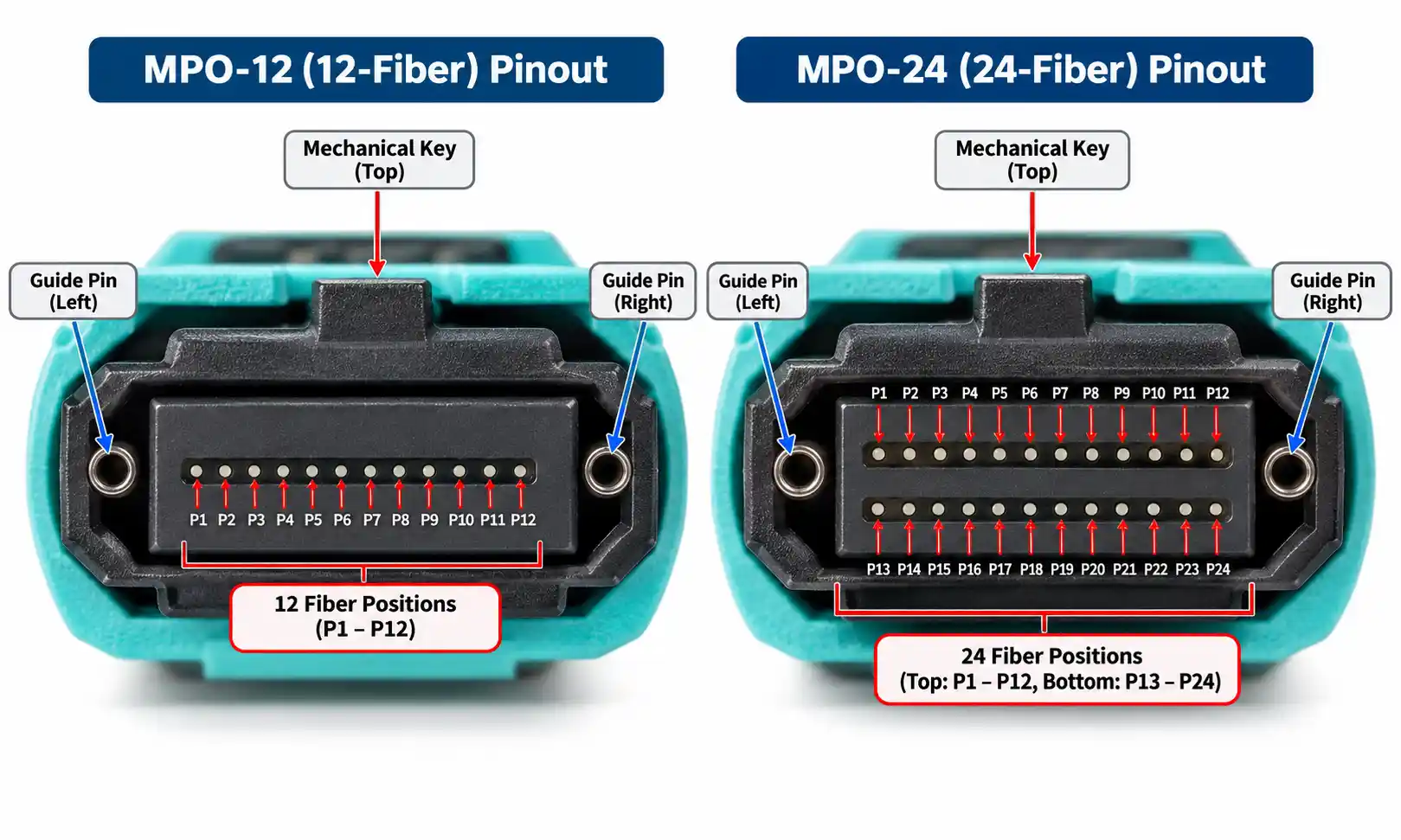
MPO connectors have a key on one side of the connector body. When the connector key is facing up (referred to as "key up"), the fiber positions within the connector are arranged from left to right, from position 1 (P1) to position 12 (P12). For MPO connectors with multiple rows, the numbers are also arranged from top to bottom, i.e., the first row is P1 to P12, the second row is P13 to P24.
The connector key for MPOs with 8, 12, or 24 fibers is located in the center. For MPOs with 16 or 32 fibers, the key is located offset to the left.
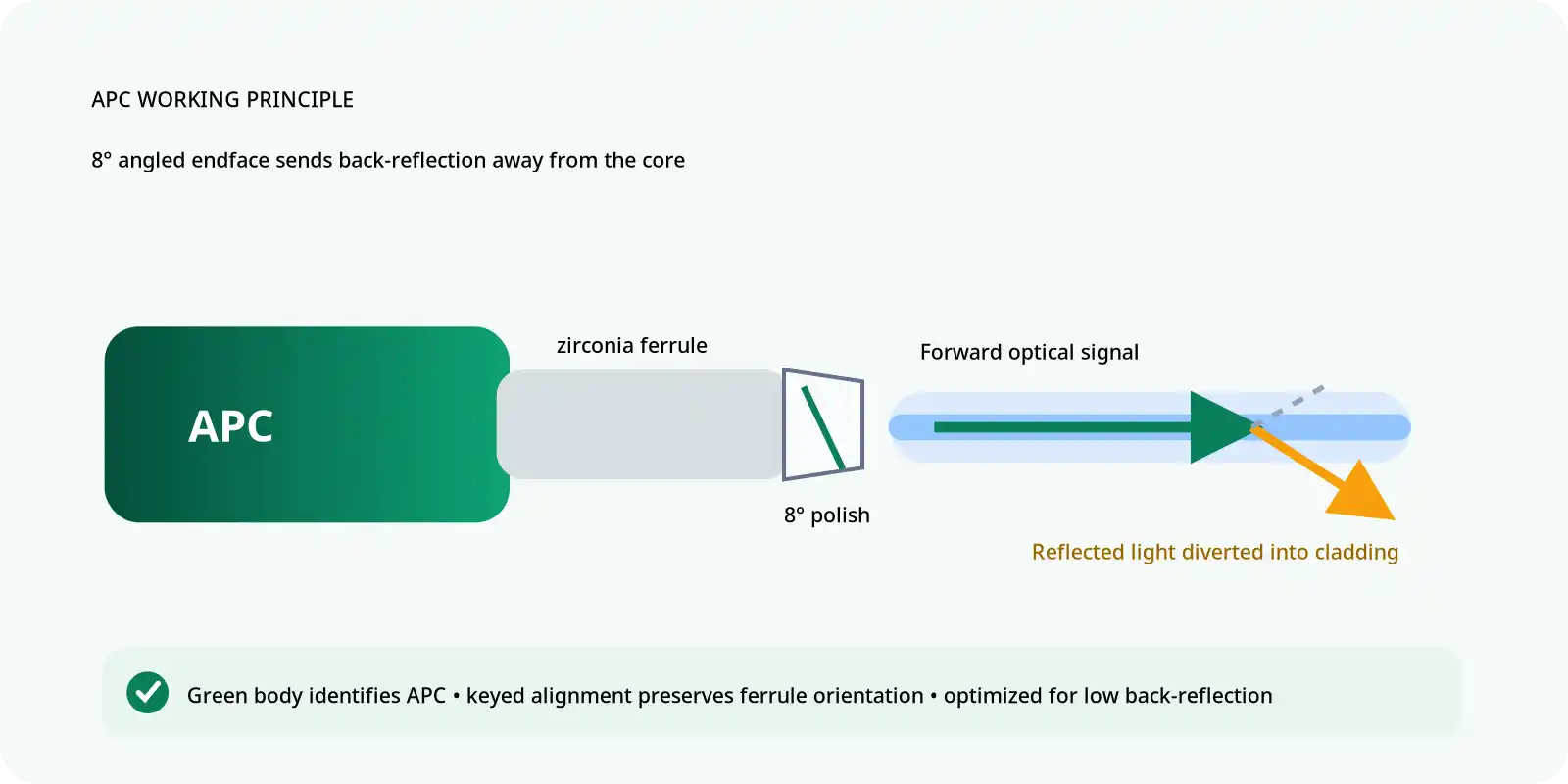
In addition to helping determine the fiber positions, the key ensures that the connector can only be inserted into the MPO adapter or transceiver port in one manner. For MPO APC connectors, the "peak" formed by the 8-degree angle will be on the same side as the key.
Connection Methods

Each individual MPO component (backbone, adapter, patch cord) is categorized by type (A, B, or C) to help maintain the required polarity so that the correct transmitter communicates with the correct receiver. However, when referring to an end-to-end system, the standard refers to the "connection method," which can also be A, B, or C. This should not be confused with the type of each individual component. The A, B, or C connection method only corresponds to the type of MPO backbone cable.
The end-to-end parallel signaling method A connection will use one Type A trunk, two Type A matching adapters, one Type A patch cord at one end, and one Type B patch cord at the other end. This shows the "key up to key down" mating setting for the MPO connector. This method is used to maintain fiber polarity.
The Importance of Polarity Verification: Why is polarity verification important? Your primary goal is to ensure the correct transmitter (TX) is connected to the correct receiver (RX). For accurate data transmission and reception, MPO connectors must be correctly aligned and mated. Poor coupling will impede signal transmission because signals may be sent in the wrong direction.
This is also important because a cable with a different polarity than the others can change the polarity of the entire link. For example, if all components are Type A (cable, mating adapter, etc.), but one component is Type B, then the entire link becomes Type B. As a rule of thumb, Type A components maintain their polarity, while Type B components reverse their polarity.
Furthermore, when using fan-out cables, always pay attention to polarity for correct connections; otherwise, you may end up with incorrect polarity types.
Consequences
Undiagnosed polarity issues increase capital expenditures and workload (i.e., operating expenses) for technicians. Technicians might unnecessarily tear open and replace expensive short-distance MPO patch cords, mistakenly believing they are faulty when they actually lack the correct polarity. If polarity issues are not corrected before commissioning, trying to determine which cable connections have polarity problems after installation becomes a frustrating and tedious guessing game.

Pre-connection inspection diagram
Inspection and Cleaning
Given that 80% of fiber optic network problems are caused by contaminated connectors, and that connector contamination is the leading cause of network failures (according to a 2010 study by NTT Advanced Technology), inspection and cleaning are paramount.
Critical links must be disconnected for cleaning or repair, which can negatively impact the service provided. This is time-consuming, and more importantly, this situation is easily preventable.

According to the scheme specified in ANSI/TIA-598-D, the fibers within a multi-core fiber optic cable are color-coded, as shown below. Inspection and cleaning are especially important for MPO connectors, as each port represents a potential point of failure. Additional fibers create more surface area, meaning a higher risk of contamination and failure. Poorly connected connectors are a significant cause of loss of service, and the impact is even greater for MPO links, where a single contaminated or damaged connector can affect up to 12 or 24 fibers.
Furthermore, to ensure your network is future-proof and meets ever-increasing bandwidth demands, ensuring connectors are in good condition is crucial. Since there are various types of connectors on the market, using a single tool to inspect all types of MPO cables (including multimode or single-mode fiber, APC, UPC male (with pin) and female (without pin) connectors) can greatly simplify network testing.