Hollow-core fiber (HCF) replaces the glass core of a traditional single-mode fiber (SMF) with an air-filled center. In essence, an HCF is constructed as a microstructured glass "shell" surrounding a central air channel. Light is guided not by total internal reflection in the glass, but rather by a photonic band gap or antiresonance effect in the cladding. Figure 1 shows a common "rotator" antiresonance design: a central air core surrounded by a ring of thin quartz tubing. This allows over 99% of the light mode to remain in the air, significantly reducing interaction with the glass. In contrast, an SMF consists of a solid germanium-doped silica core (approximately 9 μm in diameter) within a low-refractive-index glass cladding. Because the HCF core has a much lower refractive index (n≈1) than the cladding, a specialized cladding structure is required to confine the light.
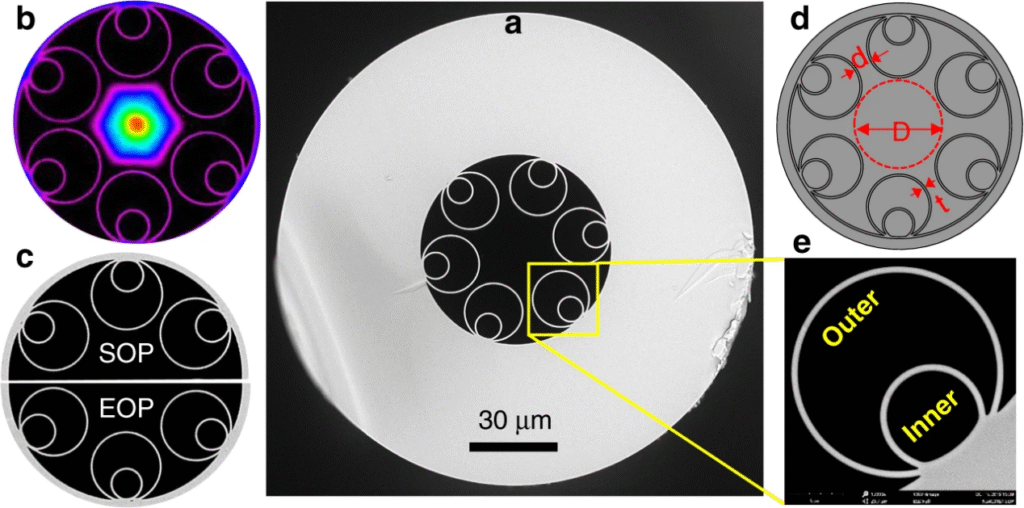
Figure 1: Hollow-core fiber design. (a) Schematic of a tubular antiresonant hollow-core fiber (HCF): Light is confined in a central air core surrounded by nested thin glass capillaries. (b) Traditional single-mode fiber uses a solid glass core. The geometry of the HCF core and cladding (e.g., honeycomb glass rings) causes light to reflect back into the air channel through either the photonic bandgap effect or the antiresonance effect.
Attenuation (loss)
Traditional single-mode fiber (SMF) has very low loss in the C-band (approximately 0.2 dB/km). For example, Corning SMF-28 ULL fiber has a loss of less than 0.16 dB/km at 1550 nm. Real-world, high-quality SMF has a loss range of 0.16–0.2 dB/km at 1550 nm. In comparison, early HCF prototypes exhibited losses in the 1–10 dB/km range. Thanks to technological advances (nested antiresonant designs, "rotated" HCFs, etc.), HCF losses have decreased significantly: from approximately 1.3 dB/km in 2018 to approximately 0.65 dB/km in 2019, and then to approximately 0.28 dB/km in 2020. Modern designs are approaching SMF levels: recent demonstrations have reported HCF losses below 0.2 dB/km, and laboratory prototypes have achieved approximately 0.11 dB/km. In short-reach data center links (tens of kilometers), even 0.2–0.3 dB/km is acceptable, so HCF is close to practical loss parity.
Attenuation benchmarks: SMF (1550 nm) ≈0.16–0.2 dB/km; HCF (currently) ≲0.2–0.3 dB/km (target ~0.1 dB/km).
The practical implication is that direct HCF links can span distances similar to those of single-mode fiber (SMF) without the need for repeater amplifiers. Because HCF avoids the glass core, its remaining losses primarily come from leakage and surface scattering. Notably, Rayleigh scattering is negligible in air, allowing further reduction of losses through improved anti-resonance structures. The result is that well-designed HCF can rival conventional optical fiber in attenuation, at least over short to medium distances.
Delay (propagation delay)
Because HCF conducts light in air, its effective refractive index is close to 1 (compared to approximately 1.47 in glass). This means that light propagates significantly faster in HCF. In practical applications, HCF can reduce propagation delay by approximately 30% to 50%. For example, the group delay of single-mode fiber (SMF) is approximately 2.0 µs/km, while published HCF designs have a group delay of approximately 1.54 µs/km. In other words, the latency of an HCF link is reduced by approximately 31% per kilometer. Figures 2a-b illustrate this acceleration effect. (Note: Some sources report speed improvements as high as approximately 47%, depending on the specific refractive index difference.)
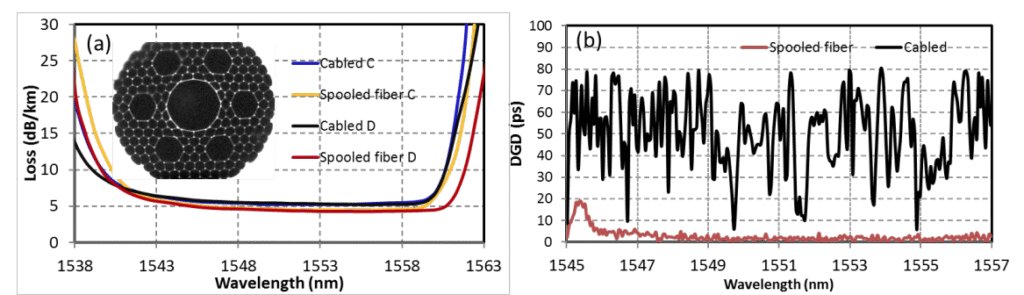
Figure 2: The speed advantage of hollow-core fiber. In hollow-core HCF (right), light pulses propagate approximately 50% faster than in glass-core SMF (left). This reduces group delay (latency) per unit length by approximately 30% to 50%. The figure shows that an HCF link transmits the same data in approximately two-thirds the time of an SMF link. In real-world applications, a 10 km HCF link has a propagation delay of approximately 15 µs (5 ns/m), while an SMF link has a propagation delay of approximately 20 µs, resulting in an end-to-end latency savings of approximately 5 µs. OFS measurements confirm that HCF has a latency of approximately 1.54 µs/km, while SMF has a latency of approximately 2.24 µs/km (a reduction of approximately 31%). This latency reduction is critical for AI/HPC data exchange and high-frequency trading. In fact, industry tests consistently report latency improvements of approximately 30%. (In a recent Madrid trial, a 1.386 km HCF link reduced round-trip latency by 4.287 µs compared to SMF.) Summary:
Latency benchmark: SMF ≈2.0 µs/km; HCF ≈1.5–1.6 µs/km, representing a latency reduction of approximately 30–35%.
This "speed of light" advantage enables data centers to be distributed over greater distances within a given latency budget. Similarly, within a single data center or campus, HCF links can significantly reduce hop latency, helping to meet the sub-microsecond end-to-end latency requirements of distributed AI trains.
Dispersion and nonlinear effects
HCFs inherit extremely low dispersion. Since most light resides in air, material dispersion (the wavelength-dependent variation of the glass's refractive index) is negligible. A carefully designed anti-resonant HCF exhibits near-zero dispersion in its low-loss band. This effectively minimizes pulse broadening, improving the bandwidth-distance product. Similarly, polarization mode dispersion (PMD) in HCFs is minimal, and the effects of environmental factors (temperature and stress) are minimal. By comparison, SMFs exhibit dispersion of approximately 17 ps/(nm·km) at 1550 nm (with greater variation across the C/L band), and PMD in high-end optical fibers is approximately 0.05–0.2 ps/√km.
In HCFs, nonlinear effects (such as Kerr nonlinearity, SPM/XPM, and four-wave mixing) are several orders of magnitude weaker. With over 99.99% of the modes in air, the effective nonlinear coefficient is approximately 100 to 1000 times smaller than the equivalent nonlinear coefficient in silica. This means that HCF can support higher optical powers before nonlinear distortion occurs, potentially improving spectral efficiency per channel or simplifying modulation formats. As some proponents point out, it can also improve security (making it easier to eavesdrop or inject fibers through the fiber).
Overall, HCF significantly reduces the bandwidth limitations and nonlinear constraints associated with dispersion. Data centers can utilize wider wavelengths (beyond the standard C-band) to achieve high-capacity links without the need for dispersion compensation. Many HCF designs feature a wide "first antiresonance window" covering much of the 1.5 to 1.6 µm band with flat loss, while the second window can extend into the L-band and even the visible band with lower loss. Overall, the bandwidth potential of HCF is at least comparable to, and potentially even greater than, that of SMF, especially when considering multiband operation and high transmit powers.
Bandwidth and capacity
HCF's high speed and low nonlinearity give it exceptional capacity. Metaphorically, HCF is like a faster optical fiber with wider lanes: it can carry more "cars" (bits) at a faster speed. Figure 3 (right) illustrates this: an HCF "super truck" can carry more data at a higher speed than an SMF "car." In practice, HCF has demonstrated extremely high aggregate data rates in laboratory experiments. For example, experiments have achieved channel rates of 800 Gb/s and 1.2 Tb/s using antiresonant HCF employing coherent wavelength division multiplexing (WDM). In real-world networks, HCF has supported 6 x 100 Gb/s channels and similar multi-wavelength payloads on a single fiber.
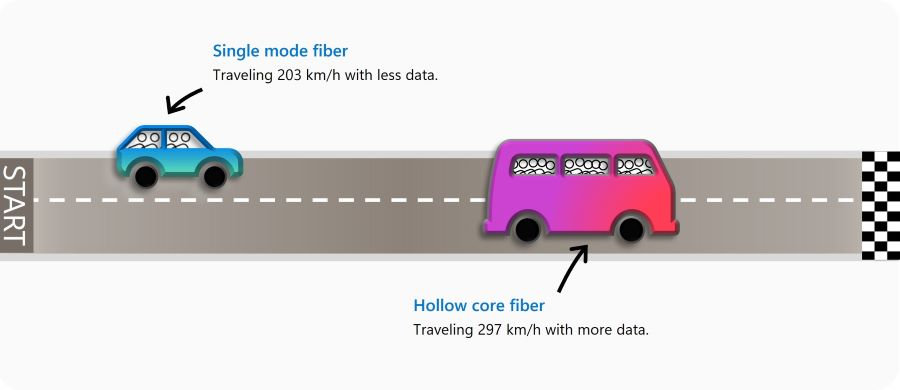
Figure 3: Data throughput analogy. HCF can be likened to a faster, high-capacity "truck," while SMF is likened to a "car." This reflects the combination of HCF's high bandwidth (more wavelengths/modes, lower distortion) and higher propagation speed. Unlike SMF (left), HCF avoids glass nonlinearities and can utilize a wider spectral window, enabling data rates exceeding terabits/second on a single fiber.
Key points on HCF capacity:
● Wavelength range:HCF is not limited by the silica absorption "water peaks" and UV absorptions of SMF. New HCF designs work well from ~1200 nm up to ~1700 nm, and even into visible for specialized types.
● WDM channels:Early tests show HCF carrying dozens of WDM channels (C+L band) with minimal nonlinear crosstalk.
● Modulation formats:Because nonlinearity is low, HCF can more easily carry high-order modulation (e.g. 64QAM) at high power per channel.
● Bit-rate:With coherent detection, HCF should support the same per-channel bit-rates as SMF (100 Gb/s+ per wavelength); early trials at 100–600 Gb/s wavelengths have succeeded.
In summary, HCF offers at least the same potential bandwidth as SMF and, in multi-channel links, can often exceed it through higher launch power and lower crosstalk. The only caveat is that many HCF types have a finite low-loss window, so full fiber C+L+U band use may require multiple fiber types or optimized dispersion-engineered designs.
Fabrication and Practical Challenges
While HCF's physics are promising, several engineering challenges remain:
● Complex Preforms:HCF preforms (the glass rod structures) are intricate. They require stacking multiple thin capillary tubes, which demands high-precision fabrication and draw control. As a result, current HCF is made in limited volume. Scaling manufacturing to the tens of thousands of km of DC fiber links will take more development and new production lines.
● Splicing and Connectors:HCF cannot directly mate with standard fiber connectors. So terminations use short conventional SMF pigtails. In practice, industry uses fusion splicing of HCF to SMF holders in LC/SC connectors. Reported splice losses range from ~0.5 dB (optimized) up to ~2.5 dB. Any connector/pigtail adds ~0.5 dB. These extra losses (per link) are significant compared to a transceiver budget in a DC. Low-loss HCF splices and new low-cost connector solutions are active R&D areas.
● Bend and Packaging Sensitivity:HCF (especially large-core designs) is more sensitive to bending and micro-bending than SMF. Bends introduce loss and can convert modes. To mitigate this, HCF cables use loose-tube or ribbon construction with large bend radii. Special attention is needed to prevent strain during installation. In lab tests, HCF on rigid reels showed acceptable behavior, but real cabling (with minimal disturbance) can actually increase higher-order mode interference unless designed with mode filters. OFS and others have added "shunt" structures to deliberately strip higher-order modes and suppress modal dispersion.
● Splice and Fiber Loss:The record low losses (≪0.2 dB/km) have been measured on "bare" HCF strands. Cabling, splicing, and environmental factors (contamination, humidity) typically raise loss. For example, OFS reported that cabling their HCF added ~0.1–0.7 dB/km loss in C-band. Thus, real-world deployed loss might be ~0.3–0.5 dB/km until processes mature.
● Cost and Availability:HCF currently carries a price premium, as noted by industry experts. Early deployments (e.g. BT/Lumenisity for the London Stock Exchange) are niche use-cases where cost is justified. To become mainstream in DC interconnects, production volumes must scale and material costs fall. Several new ventures (Relativity Networks, Lumenisity, SilenFiber, etc.) are building out HCF production with VC funding and acquisitions.
In summary, practical HCF links today may require careful handling: fusion spliced connectors, large slack loops, and specialized cables. The industry is actively developing standards and best practices. For example, OFS AccuCore™ cables are now offered for HCF with standard form factors. However, every HCF link still incurs roughly 0.5–3 dB of extra loss for cabling/splices, limiting reach and necessitating power budgeting.
Trials and Prototypes in Datacenter Settings
HCF is already moving out of the lab into real networks. Recent field trials and pilot deployments show promising results:
● DC-to-DC Links:In February 2024, Spanish operator Lyntia teamed with Nokia, OFS|Furukawa and Digital Realty to deploy a hollow-core cable between a POP and a Madrid data center. Over a 1.386 km HCF link, they achieved a round-trip latency reduction of 287 µs (>30%) compared to SMF, while carrying 600 Gb/s on a single wavelength. This real-world test used coherent transponders at 100 Gb/s per λ. The trial confirmed that HCF can be spliced into existing infrastructure (OFS AccuCore® cable) with standard coherent gear, opening the door for DC interconnects.
● Short-Reach Links:OFS Labs demonstrated a 3.1 km HCF link carrying 10 Gb/s DWDM traffic (10 wavelengths) for trading networks. This was the first cabled HCF transmission, showing bit-error-free 10Gb/s over fiber+cable with a 31% latency reduction. Similarly, Nokia/Bell Labs have tested HCF at 800–1200 Gb/s aggregate (8×100Gb/s) in lab setups.
● Financial and Trading Networks:HCF's latency savings have attracted high-frequency trading (HFT) use-cases. In 2021, Lumenisity (now part of Nokia) and euNetworks deployed hollow-core links to connect London's Stock Exchange. By using HCF for the last-mile to trading venues, microsecond latencies are reduced. Such deployments mark some of the first commercial uses of HCF. (BT and others have also piloted HCF for mobile backhaul and secure networks, though these are outside DCs.)
● AI/HPC Data Exchanges:While public data is limited, major cloud providers are investigating HCF. Microsoft Azure has formed a team (formerly Lumenisity) to prototype HCF links between data centers. Relativity Networks (a US start-up) is developing HCF specifically for AI datacenter fabrics. These efforts aim to exploit HCF's speed to alleviate latency bottlenecks in distributed AI training. Although still early, these initiatives underline the technology's potential in hyperscale and HPC environments.
In all these trials, performances met expectations: significant latency drops (typically ~30%) and multi-hundred-Gbps capacities on short links. However, none of these trials yet extend HCF hundreds of km – that remains future work. For now, HCF is best suited to metro-scale or intra-datacenter links (up to ~10–20 km), where its benefits shine without requiring active repeaters.
Outlook: AI/HPC and Future Datacenter Networks
The push toward AI and ultra-fast HPC is heightening demand for ultra-low-latency, ultra-high-bandwidth links. HCF is uniquely positioned to address these needs. By reducing link delay ~30% per km, HCF lets DC operators stretch geographic coverage: analyses suggest data centers could be placed 1.5× farther apart for the same latency. This "geographic flexibility" can be crucial as AI clusters span multiple sites. Likewise, within a data center, HCF can cut inter-rack and inter-pod latencies, feeding large models with minimal data transfer lag.
Beyond raw speed, HCF's low nonlinearity and broad spectrum support mean future transceivers can push data rates even higher. Combined with advanced modulation and parallel fiber schemes (e.g. multicore HCF), the overall throughput could greatly exceed today's SMF links. Providers envision HCF carrying terabit-per-second traffic per strand in the next decade, meeting the exascale I/O needs of AI chips.
Industry is taking notice. Major cloud/HPC players (Microsoft, Google, Meta) have funded HCF R&D or acquisitions, and startups (Relativity, Lumenisity) have secured millions in venture and government backing. Standards bodies and consortia are beginning to include HCF in future network plans. While many uncertainties remain (cost, reliability, integration), the trend is clear: HCF is on track to become a key building block for next-generation low-latency, high-capacity datacenter networks.
In conclusion, hollow-core fiber represents a compelling advancement for data-center optics. By swapping glass for air, it cuts loss and latency while expanding bandwidth and linearity. Early trials prove its viability, and ongoing developments are rapidly overcoming practical hurdles. For AI and HPC deployments that demand "light-speed" networking, HCF offers an unmatched path forward – provided its remaining engineering and cost challenges can be solved.