The Success of DeepSeek: Opportunities and Challenges for Optical Communications and AI Data Centers
The success of DeepSeek not only highlights the immense potential of AI technology but also opens up new opportunities and presents challenges for the optical communications industry and AI data centers.
DeepSeek's Technological Breakthrough
As a pioneering company in the field of AGI (artificial general intelligence), DeepSeek's technological breakthroughs are primarily reflected in the demand for high-performance model training and inference computing power. For instance, DeepSeek's 175-billion-parameter MoE model requires tens of thousands of GPUs for a single training run, far exceeding traditional AI computing power demands. Moreover, the growing popularity of multimodal applications has driven a surge in inference computing power requirements, which are now more than ten times higher than those for training. The DeepSeek-R1 smart assistant, for example, handles tens of millions of daily requests, necessitating distributed inference clusters, thus further driving innovation in AI data centers and optical communications.
Compared to OpenAI, DeepSeek possesses several key technological advantages:
Enhanced Computing Power:
Through advanced parallel computing and large-scale distributed nodes, DeepSeek has significantly boosted its computing power, greatly reducing data processing times.
Intelligent Algorithm Upgrades:
By integrating cutting-edge technologies such as reinforcement learning and transfer learning, DeepSeek's algorithms can self-learn and optimize based on specific task requirements.
Optimized Model Architecture:
DeepSeek employs a multi-layer neural network architecture, enhancing both the depth and width of the network. The use of advanced mechanisms like attention networks allows the model to efficiently extract key information from vast datasets.
Revolutionary Advances in Optical Communications and AI Computing
Innovation in Data Center Network Architecture
Heterogeneous Computing: The hybrid architecture combining CPU, GPU, and ASICs has grown significantly, while optoelectronic collaborative designs have significantly reduced transmission delays.
Liquid Cooling: As the power density per rack surpasses 50kW, traditional air cooling methods have become less efficient, driving the adoption of liquid cooling technologies.
Software-Defined Infrastructure: Intelligent optical networks now enable dynamic bandwidth adjustments, while advanced resource scheduling systems have greatly enhanced hardware utilization.
Market Growth Driven by Demand
Optical fiber communication, known for its ultra-high bandwidth, low latency, and minimal signal attenuation, perfectly meets the stringent requirements for AI server data transmission. As a result, optical communication technology has become a critical component of AI servers.
DeepSeek's advancements have reduced AI training costs, fueling the adoption of AI technology. This, in turn, drives the expansion of data centers, increases computing power demands, and leads to a surge in high-speed interconnection needs. Optical modules have also evolved to enhance data transmission efficiency and reduce power consumption. Global shipments of optical transceiver modules above 400Gbps are expected to reach 6.4 million units in 2023, growing to around 31.9 million by 2025, with an annual growth rate of 56.5%.
Industrial Upgrades
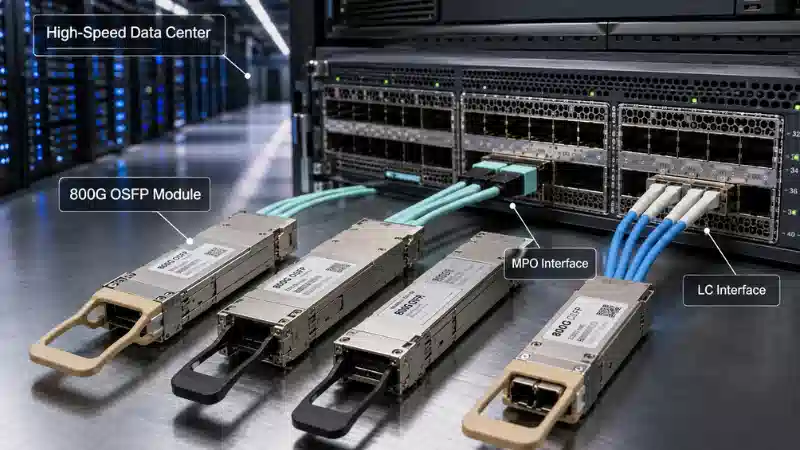
The rapid growth in AI server demand is propelling the development of optical transceiver modules at 800Gbps and 1.6Tbps speeds. Simultaneously, DeepSeek's progress is fostering the co-evolution of hardware and software technologies across the optical communication industry chain, from optical fibers to devices. This is accelerating product iterations and setting new technical standards, leading to significant improvements in the overall technical landscape of the optical communication industry.
Reconstruction of the Industrial Chain
DeepSeek's innovations are not only popularizing AI applications but also prompting the deployment of micro data centers at the edge, including in enterprises, factories, and wireless base stations. By offering innovative technology at lower costs, DeepSeek enables small and medium-sized data centers to compete with larger players in providing AI computing services.
For large data centers, DeepSeek presents both a challenge and an opportunity, urging them to upgrade their technologies, optimize resource allocation, and expand their AI service offerings. Small and medium-sized centers can leverage these opportunities to reduce costs, enhance competitiveness, and transition from basic data storage to AI computing services.
Optical Connection Products and Solutions for the AI Era
The rapid growth of cutting-edge AI technologies like DeepSeek is ushering in an era with unprecedented demands for data processing and transmission speeds. These technologies have not only pushed the boundaries of intelligent transformation but also created a significant demand for high-performance connectivity devices across industries.
To meet the growing needs for real-time analysis and high-speed computing in the AI-driven world, the market requires more efficient and stable optical connection solutions. FOCC offers advanced optical connection products designed for AI data centers, delivering high reliability, low latency, and precision-perfectly suited for the evolving demands of AI applications.
As AI technologies like DeepSeek continue to advance, Aidetai is committed to increasing its investment in R&D and innovation for optical devices and connection equipment. We aim to enhance our presence in key areas such as AI intelligent computing centers and explore the vast possibilities ahead. Through the development of more efficient, intelligent, and sustainable optical solutions, Aidetai will continue to meet the demands of evolving AI technologies, supporting the growth of AI applications. Additionally, Aidetai will strengthen collaborations with industry partners to jointly promote the progress of the optical communication industry and AI data centers