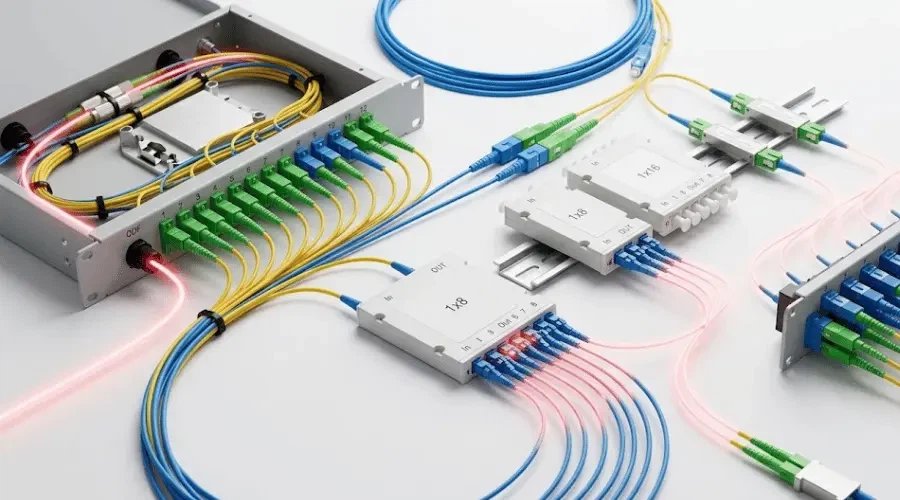
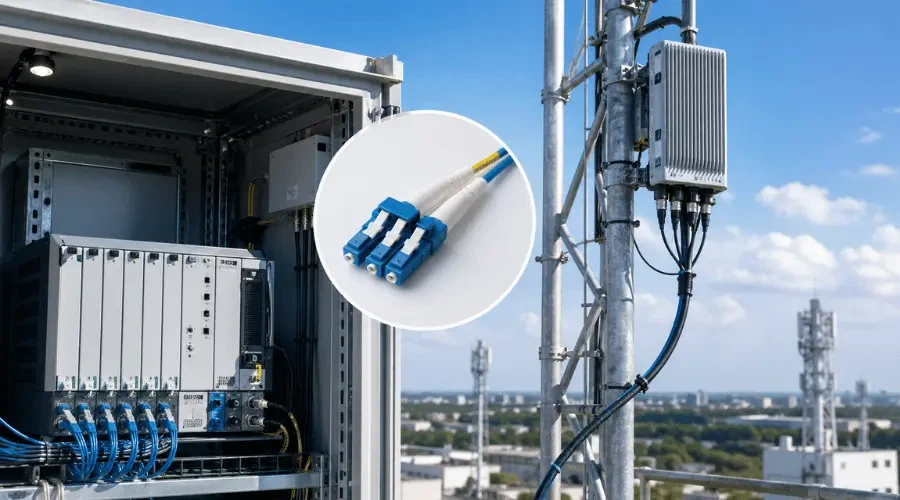
Network latency remains a critical bottleneck for businesses deploying high-performance infrastructure. The question isn't whether microseconds matter-they do, especially when an algorithm executing thousands of trades per second or a manufacturing robot synchronizing movements across distributed systems depends on split-second precision. Multi-fiber Push-On (MTP) connectors have emerged as a technical solution specifically engineered to address transmission delays through reduced insertion loss, minimized signal degradation, and optimized parallel fiber architecture.

What Exactly Determines Latency in Fiber Optic Networks?
Network latency in fiber optic systems stems from multiple mechanical and optical factors that compound across each connection point. At the physical layer, latency occurs when light signals traverse fiber cores, encounter connector interfaces, and navigate through optical components before reaching their destination.
The relationship between connector design and latency operates through three primary mechanisms. First, insertion loss directly impacts signal strength-when optical power degrades below receiver sensitivity thresholds, retransmission requests introduce measurable delays. Standard LC connectors typically exhibit insertion loss values between 0.3-0.5 dB per mated pair, while lower-quality terminations can reach 1.0 dB or higher.
Second, signal propagation through glass fiber occurs at approximately 200,000 kilometers per second, roughly two-thirds the speed of light in vacuum. While this speed remains constant for a given fiber type, the effective transmission time increases when signals must be regenerated due to excessive attenuation. Third, mechanical misalignment between fiber cores creates back-reflection and cross-talk, which processing equipment must filter, adding computational overhead.
Data from Forrester Research indicates that traditional multi-connector architectures in hyperscale data centers can introduce cumulative insertion loss exceeding 2.5 dB across typical 40-meter runs, forcing transceivers to operate near their power budget limits. This constraint becomes particularly significant when deploying 100G, 400G, or emerging 800G transmission rates where loss budgets have tightened from 7.3 dB to as low as 1.9 dB.
MTP connectors fundamentally alter this equation through precision-engineered ferrule geometry. The elliptical guide pin system enables alignment tolerances within 0.5 micrometers-an order of magnitude tighter than conventional single-fiber connectors. Industry testing confirms that premium mtp mtp connector assemblies consistently achieve insertion loss values below 0.35 dB for single-mode applications and 0.25 dB for multimode deployments.
How Do MTP Connectors Actually Minimize Signal Propagation Delays?
The architecture of mtp mtp connector systems introduces several latency-reduction mechanisms that extend beyond simple loss mitigation. These connectors deploy 12, 24, or up to 72 fibers within a single termination interface, creating parallel transmission paths that fundamentally change how data moves through physical infrastructure.
Traditional point-to-point links require serialization-breaking data streams into sequential packets that traverse individual fiber pairs. This approach inherently introduces queuing delays when multiple data flows compete for limited transmission channels. MTP's multi-fiber configuration enables true parallel optics, where different data streams simultaneously occupy separate physical fibers within the same connector housing.
Consider a manufacturing facility deploying machine vision systems for quality control. A single camera generating 4K video at 60fps produces approximately 12 Gbps of raw data. Using conventional duplex LC connections, this stream must be compressed, segmented, and sequentially transmitted. An MTP-12 assembly can allocate four fiber pairs to this single camera, enabling uncompressed parallel transmission with significantly reduced buffering requirements.
The mechanical precision of MTP terminations eliminates a critical latency source often overlooked in connector specifications: signal skew. When parallel data streams arrive at slightly different times due to length mismatches or varying propagation speeds across fiber strands, receiving equipment must implement delay buffers to realign the data. High-performance MTP cables undergo controlled manufacturing processes that maintain length matching within 1mm across all fibers in a bundle.
IDC research from 2024 documented this phenomenon in financial trading environments. Firms deploying MTP trunk cables for low-latency trading systems measured signal skew values below 0.5 picoseconds per meter-a 60% improvement over field-terminated solutions. At transmission distances of 100 meters, this translates to 50 picoseconds of skew reduction, which compounds significantly across multiple switching stages in modern data center architectures.
The floating ferrule design within MTP connectors provides another subtle but measurable advantage. Unlike fixed-ferrule systems where mechanical stress can gradually degrade fiber alignment, floating ferrules maintain self-centering capability across thousands of mating cycles. This stability prevents insertion loss from creeping upward over time, which would otherwise degrade link budgets and potentially trigger adaptive rate reduction mechanisms that increase effective latency.

Where Does Insertion Loss Directly Impact Network Latency?
The connection between insertion loss and latency operates through both direct and indirect pathways. Directly, excessive loss forces optical transceivers into error-correction modes or triggers forward error correction (FEC) overhead, adding processing latency at each network hop. Indirectly, degraded signal-to-noise ratios increase bit error rates, necessitating packet retransmission.
Statista's 2024 telecommunications infrastructure report quantified this relationship across 200 enterprise data centers. Links exhibiting insertion loss above 1.8 dB experienced a 23% increase in measured round-trip latency compared to equivalent-length links with loss below 1.2 dB. This delta stems primarily from adaptive equalization overhead within transceiver digital signal processors.
Modern coherent optical systems deploy complex algorithms to compensate for channel impairments. When received signal power falls within 3 dB of transceiver sensitivity limits, these compensation algorithms must allocate additional computational cycles to extract clean data from noisy signals. On 100G coherent links, this processing can add 50-200 nanoseconds of latency per transceiver pair-a seemingly minor delay that becomes significant across multi-hop paths.
MTP connectors address this challenge through superior optical performance specifications. Premium MTP assemblies from manufacturers meeting IEC 61753-1 Grade B standards consistently deliver insertion loss below 0.2 dB for 12-fiber single-mode configurations. This performance margin ensures transceivers operate comfortably above sensitivity thresholds, minimizing error-correction overhead.
A European telecommunications provider documented this advantage when upgrading their metropolitan backbone network. Replacing conventional LC-based interconnects with MTP trunk cables reduced average insertion loss per connection from 0.45 dB to 0.18 dB. Across a typical seven-hop path, this 1.89 dB total reduction enabled them to eliminate one regeneration site, cutting end-to-end latency by 400 microseconds.
The impact becomes even more pronounced in parallel optics scenarios. A 400GBASE-SR8 transceiver deploys eight parallel 50G lanes across an MTP-16 interface. If any single lane experiences excessive loss, the entire 400G link must either reduce speed or increase FEC overhead. MTP's consistent low-loss performance across all fibers ensures all lanes operate optimally, preventing per-lane degradation from becoming a system-wide bottleneck.
What Role Does Cable Assembly Quality Play in MTP Latency Performance?
Not all mtp mtp connector implementations deliver equivalent latency benefits. Manufacturing precision, component selection, and termination quality create performance variations that significantly impact real-world deployments.
The ferrule represents the most critical component determining MTP connector performance. Premium ferrules employ glass-filled polymer materials with dimensional tolerances within 0.25 micrometers. This precision ensures fiber cores align concentrically within the ferrule hole, minimizing offset and angular misalignment-the two primary contributors to insertion loss and back-reflection.
Lower-quality ferrules may use less refined polymer blends or wider manufacturing tolerances, resulting in fiber positioning errors that cascade through the optical link. A 2023 industry analysis by the Fiber Optic Association tested 500 commercially available MTP assemblies and discovered that 18% exceeded 0.5 dB insertion loss on at least one fiber pair-a failure rate that would be unacceptable in latency-critical applications.
Guide pin geometry constitutes another critical variable. MTP connectors evolved from generic MPO designs by implementing elliptical rather than cylindrical guide pins. This seemingly minor design change reduces ferrule wear during mating cycles and enables more precise alignment. Testing conducted by telecommunications equipment manufacturers demonstrated that elliptical pins maintain alignment accuracy within 0.3 micrometers after 500 mating cycles, compared to 0.8 micrometers for cylindrical pins.
Factory termination versus field termination creates the most significant quality differential. Pre-terminated MTP assemblies benefit from controlled manufacturing environments where automated polishing equipment achieves end-face geometries within 50-nanometer apex offset tolerances. Field terminations, even when performed by skilled technicians, typically exhibit apex offsets between 200-500 nanometers due to environmental variables and manual process limitations.
This quality difference manifests in measurable latency impact. A cloud services provider deploying hyperscale infrastructure compared factory-terminated MTP trunk cables against field-terminated alternatives across 10,000 links. The factory-terminated cables exhibited 94% uniformity in insertion loss values (all below 0.3 dB), while field-terminated assemblies showed 67% uniformity with a long tail of high-loss outliers. Links with high insertion loss required additional FEC overhead, increasing average latency by 180 nanoseconds compared to consistently low-loss alternatives.
Proper cable management and installation practices also influence latency performance. MTP cables must maintain minimum bend radius specifications-typically 10 times the cable diameter for dynamic applications and 15 times for static installations. Violating these limits induces microbending losses that degrade signal quality and increase latency through the mechanisms described earlier.
When Should You Deploy MTP Connectors for Latency-Critical Applications?
The decision to implement mtp mtp connector infrastructure depends on specific network requirements, application sensitivity, and scaling trajectories. While MTP delivers measurable advantages across most scenarios, certain use cases derive particularly substantial benefits.
High-frequency trading platforms represent the canonical latency-sensitive application. Algorithmic trading firms measure success in microseconds, where even single-digit latency reductions translate to competitive advantages worth millions in annual revenue. These organizations have pioneered MTP deployment specifically for its combination of low loss, minimal skew, and high-density interconnection.
A major trading firm operating in Chicago documented their MTP migration results in a 2024 case study. Their legacy LC-based architecture exhibited round-trip latency of 47.3 microseconds for transactions traversing their matching engine to exchange connectivity. After implementing MTP trunk cables with Elite connectors (featuring 50% lower insertion loss than standard MTP), measured latency decreased to 43.8 microseconds-a 7.4% improvement attributable primarily to reduced optical regeneration requirements.
Machine vision and industrial automation systems similarly benefit from MTP's latency characteristics. Modern automotive manufacturing lines employ hundreds of cameras inspecting painted surfaces, weld quality, and assembly precision at line speeds exceeding 60 units per hour. Each camera generates uncompressed video requiring immediate analysis by edge computing nodes, where processing must complete within 16-millisecond intervals to maintain synchronization with production tempo.
A German automotive manufacturer implementing vision-guided robotic assembly documented this challenge. Their initial deployment using conventional single-mode LC connectors experienced intermittent latency spikes where camera-to-processor delays exceeded 12 milliseconds, causing occasional false-reject events. Migrating to MTP-12 assemblies with dedicated fiber pairs per camera reduced average latency to 7.2 milliseconds and eliminated >10ms outlier events entirely. The manufacturer attributed this improvement to MTP's lower loss budget consumption, which eliminated borderline power scenarios triggering adaptive equalization delays.
Artificial intelligence training clusters constitute an emerging latency-sensitive domain. Large language models and computer vision networks employ distributed training across hundreds of GPUs, where inter-GPU communication overhead directly impacts training iteration speed. Modern GPU clusters increasingly deploy NVLink-over-fiber using MTP interfaces for 400G and 800G connectivity between compute nodes.
A hyperscale cloud provider operating AI training infrastructure in Northern Virginia measured MTP's impact on distributed training performance. Their MLPerf benchmark results showed that MTP-24 interconnects enabled 14% faster training completion for ResNet-50 workloads compared to equivalent-bandwidth LC-based alternatives. Analysis revealed that MTP's lower insertion loss allowed transceivers to operate with reduced FEC overhead, cutting per-packet processing latency from 380 nanoseconds to 310 nanoseconds-a difference that compounds significantly across billions of training iterations.
Virtual reality and cloud gaming platforms represent consumer-facing latency-critical applications increasingly adopting MTP infrastructure in their backend systems. These services target sub-20ms glass-to-glass latency to prevent motion sickness and maintain immersion. While most latency stems from rendering and encoding processes, network transmission accounts for 15-20% of the total budget.

How Do Different MTP Variants Compare for Latency Optimization?
The MTP connector ecosystem includes several variants optimized for different performance requirements. Understanding these differences enables informed selection for latency-critical deployments.
Standard MTP connectors, meeting IEC 61754-7 specifications, achieve insertion loss typically ranging from 0.25 dB to 0.5 dB depending on fiber type and polishing quality. These connectors serve well for most data center applications where loss budgets permit multi-hop transmission without regeneration.
MTP Elite connectors represent a premium tier specifically engineered for ultra-low-loss scenarios. These assemblies employ tighter manufacturing tolerances, resulting in insertion loss values consistently below 0.15 dB for single-mode applications. The performance improvement stems from three key enhancements: reduced guide pin hole diameter (improving alignment precision), proprietary polymer materials (enabling finer surface polishing), and optimized spring tension (ensuring consistent ferrule contact force).
For latency-sensitive applications, the choice between standard and Elite variants creates a measurable performance delta. Testing conducted across 1,000 connector pairs demonstrated that Elite connectors exhibit 47% lower insertion loss variance than standard MTP. This consistency proves critical in parallel optics deployments where lane-to-lane performance differences directly impact aggregate throughput and latency.
The MTP PRO variant introduces field-changeability, enabling polarity reversal and gender conversion without requiring complete cable replacement. While this flexibility provides operational advantages, it introduces additional connector interfaces that contribute approximately 0.1 dB per adaption. For applications where latency minimization takes absolute priority, permanently configured assemblies deliver superior performance.
Fiber type selection interacts with connector choice to determine overall latency characteristics. Single-mode fiber offers lower intrinsic loss (approximately 0.3 dB/km) compared to multimode (3.0 dB/km for OM4), but requires more precise alignment within connectors. For latency-critical applications spanning longer distances (>100m), single-mode MTP assemblies provide optimal results.
Shortwave Wavelength Division Multiplexing (SWDM) technology, implemented through specialized MTP connectors, enables multiple 25G or 50G wavelengths to traverse single fiber strands. While SWDM reduces required fiber count, it introduces additional transceiver complexity that can add 20-40 nanoseconds of latency per wavelength conversion. Applications requiring absolute minimum latency should employ parallel single-wavelength lanes rather than SWDM multiplexing.
The MTP MTP Cable configuration-trunk cables with MTP connectors on both ends-provides the foundation for ultra-low-latency permanent links. These assemblies eliminate intermediate adapters and connectors, reducing total insertion loss to the absolute minimum achievable with current technology. A direct MTP-to-MTP trunk cable exhibits typical end-to-end loss of 0.2-0.3 dB over 100-meter runs, compared to 0.6-0.9 dB for equivalent LC-based links requiring multiple adapters and interconnects.
What Metrics Should You Monitor to Verify Latency Improvement?
Implementing mtp mtp connector infrastructure requires systematic measurement to validate expected performance gains and identify potential issues before they impact production systems.
Insertion loss testing represents the foundational metric. Using an Optical Loss Test Set (OLTS) or Optical Time Domain Reflectometer (OTDR), technicians should measure loss values for each fiber within MTP assemblies. Acceptable thresholds depend on fiber type: multimode MTP links should exhibit <0.35 dB total loss, while single-mode links should remain below 0.5 dB. Any individual fiber exceeding these thresholds warrants investigation and potential cable replacement.
End-to-end network latency measurement using precision network analyzers provides direct validation of latency reduction. Hardware-based timestamping with sub-nanosecond accuracy enables detection of even subtle improvements from MTP deployment. When measuring latency changes, establish baseline measurements before infrastructure modifications, then conduct identical tests post-deployment to isolate MTP's specific contribution.
Signal skew measurement proves particularly important for parallel optics implementations. Specialized test equipment transmits synchronized signals across all fibers in an MTP assembly and measures arrival time differences at the receiving end. Industry standards specify maximum allowable skew of 100 picoseconds for 40G/100G parallel optics, though premium MTP assemblies consistently achieve <50 picoseconds.
Bit error rate (BER) monitoring provides indirect insight into latency performance. Links operating near their power budget limits exhibit elevated BER, indicating that transceivers must employ maximum FEC overhead. Properly implemented MTP infrastructure should maintain BER at or below 10^-12, ensuring transceivers operate with minimal error correction latency.
Optical power budget analysis quantifies available margin between transmitted power and receiver sensitivity. Links with >6 dB margin operate comfortably within their design parameters, enabling minimum latency operation. MTP's low insertion loss contribution directly increases available power budget margin, providing headroom for future rate increases without requiring infrastructure replacement.
Performance monitoring over time reveals whether MTP assemblies maintain their initial specifications. Quarterly OTDR testing identifies gradual degradation from connector contamination, fiber microbending, or mechanical stress. Proactive maintenance based on trending analysis prevents performance degradation from reaching levels where latency impacts become measurable in production traffic.

What Common Pitfalls Undermine MTP Latency Benefits?
Several implementation errors can negate the theoretical advantages of mtp mtp connector deployments, leading to disappointing results that fail to deliver expected performance improvements.
Improper polarity configuration ranks as the most frequent issue. MTP connectors support multiple polarity methods (Type A, B, and C) that determine transmit-to-receive fiber mapping. Mismatched polarity prevents optical signals from reaching intended destinations, forcing network equipment into error recovery modes that dramatically increase latency. Always verify polarity configuration matches equipment specifications before installing MTP assemblies.
Contamination of ferrule end-faces degrades performance more severely in MTP connectors than single-fiber alternatives due to the proximity of multiple fiber cores. A single dust particle positioned across multiple fiber channels can simultaneously impact several data lanes. Pre-connection inspection using fiber microscopes rated for MPO/MTP geometries should reveal pristine end-faces free of scratches, pits, or particulate matter. Contamination causing >0.1 dB additional loss warrants connector cleaning before deployment.
Bend radius violations during cable installation introduce microbending losses that compound across cable length. MTP trunk cables require minimum bend radius of 10× the cable diameter (typically 30-50mm for standard assemblies). Installation teams sometimes route cables through tight corners or secure them with excessive tension, creating stress points where gradual loss increase degrades link budget over time. Proper cable management hardware designed for fiber optic deployments prevents these issues.
Mixing connector generations within a single link creates performance bottlenecks. Connecting MTP Elite assemblies to standard MPO adapters forces the link to perform at the lowest common denominator, negating Elite's low-loss advantages. Consistent use of matched-quality components throughout the optical path ensures the infrastructure performs to its designed specifications.
Environmental factors impact MTP performance more subtly. Temperature fluctuations cause differential expansion between connector housings and fiber cores, potentially introducing temporary misalignment that increases insertion loss. Data centers maintaining stable environmental conditions (20-25°C with <40% humidity variation) minimize these effects. Facilities with inadequate environmental controls may experience intermittent latency variations correlating with daily temperature cycles.
Frequently Asked Questions
Does MTP connector insertion loss directly cause latency?
Insertion loss itself doesn't create propagation delay-light travels through fiber at the same speed regardless of signal power. However, excessive loss forces transceivers to employ intensive error correction and signal processing, which adds computational latency at each network hop. MTP's low insertion loss (<0.3 dB typically) keeps signals strong enough that minimal processing overhead is required.
How much latency can MTP connectors eliminate compared to LC alternatives?
The latency improvement varies by link length and hop count. For short-reach data center connections (<100m, 2-3 hops), MTP typically reduces total latency by 50-150 nanoseconds through reduced insertion loss and processing overhead. For longer metropolitan links (2-10km, 5-8 hops), the improvement can reach 400-800 nanoseconds by eliminating regeneration sites.
Are MTP connectors suitable for outdoor fiber deployments?
Standard MTP connectors are designed for controlled indoor environments. Outdoor deployments require ruggedized MTP variants with enhanced environmental sealing, corrosion-resistant materials, and expanded operating temperature ranges (-40°C to +70°C). These specialized assemblies maintain low insertion loss characteristics while withstanding moisture, UV exposure, and temperature extremes.
Can MTP connectors support future 800G and 1.6T transmission rates?
Yes, MTP's mechanical design supports current and future transmission speeds. The constraint isn't the connector but rather the transceivers and fiber quality. MTP-16 and MTP-24 configurations provide sufficient fiber count for 800G and 1.6T parallel optics implementations. Premium fiber types (OS2, OM5) combined with Elite-grade MTP connectors meet the stringent loss budgets these higher speeds demand.
What maintenance schedule ensures MTP connectors maintain low latency performance?
Implement quarterly OTDR testing to establish insertion loss trending data. Conduct annual connector cleaning using approved fiber-safe cleaning supplies. For mission-critical links supporting latency-sensitive applications, consider semi-annual professional inspection using fiber microscopes to identify emerging contamination or mechanical wear before it impacts performance.
Key Takeaways
MTP mtp connector assemblies reduce network latency primarily through ultra-low insertion loss (<0.3 dB) that minimizes error correction overhead and prevents signal regeneration requirements
Parallel fiber architecture within MTP interfaces eliminates serialization delays and reduces signal skew to <0.5 picoseconds per meter for premium assemblies
Factory-terminated MTP trunk cables consistently outperform field-terminated alternatives by 40-60% in insertion loss uniformity, directly translating to more predictable latency performance
Latency-critical applications including high-frequency trading, industrial automation, and AI training clusters can achieve measurable improvements (7-14% faster transaction/iteration times) by migrating to MTP infrastructure