I've been down this rabbit hole myself. You need MPO cables for your data center or network upgrade, you start searching online, and suddenly you're drowning in acronyms-MTP, MPO, Type A, Type B, OM3, OM4, polarity methods, pin configurations. It's a lot. And frankly, most of the "guides" out there read like they were written by someone who's never actually had to make a purchasing decision under budget pressure.
So here's the deal. I'm going to walk you through what actually matters when you're picking MPO cables. Not everything-because honestly, some of the technical details only matter if you're designing military-grade telecommunications infrastructure. For the rest of us working in regular enterprise environments or managing standard data centers, certain things are critical and other things are just noise.

The MTP vs MPO Thing (Let's Get This Out of the Way)
People get confused about this all the time. MPO stands for Multi-Fiber Push-On-it's a connector type standardized by the IEC. MTP is basically a premium version made by US Conec. They're compatible with each other. The MTP connector has some engineering improvements: floating ferrule design, elliptical guide pins that reduce wear over thousands of mating cycles, tighter tolerances overall.
Here's my take: if budget is tight and you're doing a smaller installation that won't see constant reconfiguration, standard MPO connectors work fine. But if you're building infrastructure that needs to last 10+ years with technicians plugging and unplugging things regularly? Spring for MTP. The durability difference is real. I've seen standard MPO connectors start showing degraded performance after maybe 200-300 mating cycles in some cases, while MTP holds up much longer.
That said-and this is important-a well-manufactured MPO connector from a reputable vendor will outperform a cheap MTP knockoff any day. Brand matters less than actual quality control and testing standards.
Fiber Count: More Isn't Always Better
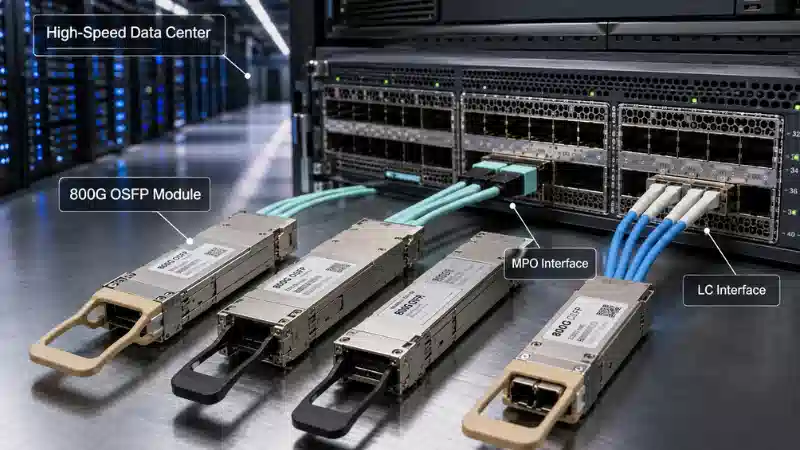
MPO connectors come in different fiber counts: 8, 12, 16, 24, even up to 72 for specialty applications. The 12-fiber configuration has been the workhorse of the industry for years, partly because it lines up nicely with duplex LC breakout applications (12 fibers = 6 duplex pairs).
But here's where it gets interesting. 8-fiber MPO cables have been gaining traction, especially for 40G and 100G parallel optics applications. Why? Because 40GBASE-SR4 only uses 8 fibers-4 for transmit, 4 for receive. If you're buying 12-fiber cables for these applications, four of those fibers are just sitting there doing nothing. You're paying for glass you're not using.

What Should You Actually Buy?
For 40G/100G switch-to-switch backbone connections, 8-fiber cables make sense economically. For structured cabling where you need flexibility to break out to LC duplex connections, 12-fiber or 24-fiber trunk cables give you more options. The 24-fiber option is particularly good if you're planning for 100G or 400G infrastructure-400GBASE-SR16 uses 16 fibers, and having 24 available means room for growth.
I wouldn't go crazy with high fiber counts unless you have a specific application requiring them. Higher counts mean more complexity in polarity management, more potential points of failure, and significantly higher costs per termination.
Multimode vs Singlemode: The Distance Question
This one's actually pretty straightforward once you know your distance requirements.
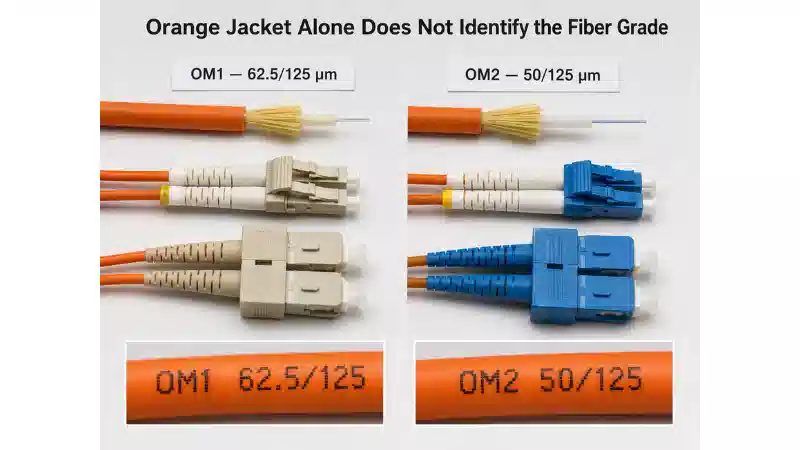
OM3 multimode gets you about 100 meters at 40/100G speeds. OM4 multimode pushes that to around 150 meters. Beyond that, you're looking at singlemode OS2, which can go tens of kilometers without breaking a sweat.
Here's the thing people miss: OM4 doesn't cost that much more than OM3 anymore. The price gap has narrowed considerably. So unless you're doing a massive deployment where the cost difference adds up to real money, just go OM4 for multimode applications. It gives you headroom for future speed upgrades and slightly better performance margins.
For inter-building connections or anything approaching campus scale, don't even think about multimode. Singlemode is your only realistic option, and honestly, it's more future-proof anyway. The transceivers cost more, sure, but the fiber infrastructure itself will handle whatever speeds we throw at it for the foreseeable future.
Polarity: This Is Where Everyone Gets Confused
Okay, deep breath. Polarity is probably the most frustrating aspect of MPO cable selection because it's genuinely confusing, the terminology isn't intuitive, and getting it wrong means your link just... doesn't work.
The basic concept is simple: transmit fibers on one end need to connect to receive fibers on the other end. TX to RX. In a duplex LC patch cord, this is trivial-you just flip the connector. In a 12-fiber MPO cable where fiber position 1 needs to map to the correct position at the far end? It gets complicated fast.

Type A, Type B, Type C-What's the Difference?
Type A (straight-through): Key up on one end, key down on the other. Fiber 1 connects to fiber 1. Simple, but it doesn't flip polarity by itself-you need cassettes or patch cords to handle the TX/RX alignment.
Type B (reversed/crossover): Key up on both ends. Fiber 1 connects to fiber 12, fiber 2 to fiber 11, and so on. This is the go-to for direct transceiver-to-transceiver links in parallel optics because it automatically handles the TX/RX flip.
Type C (pairs flipped): Each pair of fibers is swapped-1 goes to 2, 3 goes to 4, etc. Honestly? This one is less common now. It was popular for duplex applications but has largely been superseded by Type A and Type B for modern parallel optics deployments.
My Honest Recommendation
Pick one polarity method and stick with it throughout your installation. Mixing methods is asking for trouble. Most hyperscale and enterprise data centers I've seen standardize on Type B for direct MPO-to-MPO connections (like SR4 transceivers) and Type A trunks with cassettes for structured cabling that breaks out to LC duplex.
If you're unsure, go with Type B for parallel optics applications. It's the path of least resistance for 40G/100G/400G deployments and eliminates a lot of potential headaches.
Loss Budgets and Why 0.1 dB Matters More Than You Think
Here's something that trips up a lot of first-time MPO buyers: insertion loss specifications. Standard MPO connectors are typically rated around 0.5 dB maximum insertion loss. "Low loss" or "elite" connectors bring that down to 0.35 dB or lower.
Sounds like a small difference, right? But consider a link with four connection points-two at each end plus two in the middle for patching. With standard connectors, you're looking at up to 2 dB just from connections alone. With low-loss connectors, maybe 1.4 dB. That 0.6 dB difference could be the margin between a working 40G link and one that throws errors.
40GBASE-SR4 has a channel insertion loss budget of just 1.5 dB over 150 meters of OM4. That's tight. Really tight. Once you account for fiber attenuation (about 0.003 dB per meter at 850nm), connector losses eat most of what's left.
Bottom line: For anything 40G or above, don't cheap out on connector quality. Low-loss connectors are worth the premium. Test your cables and verify insertion loss before deployment-TIA-568.3-D specifies 0.3 dB maximum for test reference cords, and your production cables should be tested against similar standards.

Jacket Ratings: OFNP, OFNR, LSZH
This is actually pretty simple once you know the rules.
Plenum-rated (OFNP): Required for air-handling spaces like drop ceilings and raised floors. Most data center installations need this. It's more expensive but non-negotiable if code requires it.
Riser-rated (OFNR): Fine for vertical runs between floors that aren't in plenum spaces. Cheaper than OFNP.
LSZH (Low Smoke Zero Halogen): Common in European installations and anywhere with strict fire safety requirements. Doesn't release toxic fumes when burning. If you're in a country that follows IEC standards rather than NEC, this is probably what you want.
Check your local codes and building requirements before ordering. Getting this wrong can mean ripping out and replacing cable-an expensive mistake.
A Quick Word on Gender
MPO connectors come in male (with pins) and female (without pins). Equipment ports-like those on transceivers-are always male. So any cable plugging directly into equipment needs a female connector on that end.
Trunk cables are typically male-to-male, with female adapters or cassettes in the middle. This protects the expensive transceiver pins from damage. The last thing you want is to break the pins on a $500 transceiver because someone yanked a cable wrong.
Think through your connection path: transceiver (male) → patch cable (female) → adapter panel → trunk cable (male-to-male) → adapter panel → patch cable (female) → transceiver (male). Getting gender wrong anywhere in that chain means things don't connect.
Choosing a Vendor
I'm not going to name names here, but here's what to look for:
Test reports. Any reputable manufacturer will provide insertion loss test data for every cable. If they can't or won't, walk away.
Certifications. Look for compliance with TIA, IEC, and ISO standards. AS9100D certification indicates aerospace-level quality control. ITAR certification matters if you're in defense-related industries.
US Conec MTP components. If they're advertising MTP connectors, verify they're actually using genuine US Conec parts and not generic MPO connectors with misleading labeling.
Custom capabilities. Being able to order exact lengths and specific configurations (fiber count, polarity, connector type) saves time and money versus buying standard lengths and dealing with excess cable.
Warranty and support. Good vendors stand behind their products. If something arrives damaged or fails prematurely, you want a company that makes it right without a fight.
So What Should You Actually Buy?
Let me just cut to the chase with some practical guidance:
For 40G/100G backbone links under 100m: 8-fiber or 12-fiber OM4 Type B cables with low-loss MTP connectors. Female on equipment-facing ends.
For structured cabling with LC breakout: 12-fiber or 24-fiber OM4 Type A trunk cables with corresponding MPO cassettes. This gives you flexibility to serve duplex applications while maintaining a clean, manageable infrastructure.
For campus or inter-building connections: Singlemode OS2. Don't even consider multimode for these distances. Plan for APC polish if you're doing anything wavelength-multiplexed.
For future-proofing: Go with 24-fiber trunks where possible. The incremental cost now is way cheaper than pulling new cable later when you need to support 400G or 800G.
The MPO cable market has matured significantly over the past few years. Quality has gone up while prices have come down. The main risk now isn't buying bad cable-it's buying the wrong configuration for your specific application. Take the time to map out your connectivity needs, understand your speed requirements, and plan for at least one technology generation ahead. The cable infrastructure you install today should serve you for 15-20 years. Make it count.
And hey, if you're still unsure after all this? Call a vendor's engineering team and ask questions. The good ones will help you spec the right solution. The ones who just want to push product... well, you'll figure that out pretty quickly.