MPO/MTP type fiber optic connectors

High-density fiber optic connectors that support more than two fiber optic cores in a single connector are currently commonly used, with 12-core MPO/MTP connectors being the most common type.

Primarily used in data centers for terminating fiber optic cables, supporting 40G (12 cores) and 100G (24 cores) fiber channels.
MPO/MTP connectors come in two types: those with guide pins (male) and those without (female).
MTP connectors are an upgraded version of MPO connectors, offering better transmission performance, lower loss, and higher fiber density tolerance. MPO/MTP connectors cannot be field-terminated; even with manufacturers developing field-fabrication methods, they are no longer suitable for widespread use.
BFOC type fiber optic connector

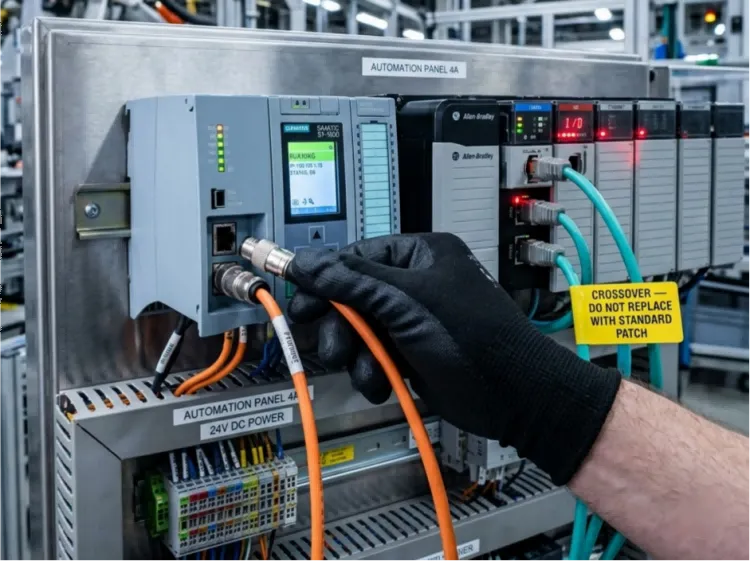
The appearance is very similar to the ST connector, and the snap-fit method is exactly the same. The only difference is that the ceramic core is slightly shorter than the ST connector. It is generally used in industrial Ethernet network equipment, such as industrial switches or microcontrollers (this type of connector is commonly used in German-made industrial equipment).
DIN47256 Fiber Optic Connector

This is a connector developed in Germany. The pin and coupling sleeve of this connector have the same structural dimensions as the FC type, and the end face is treated with PC grinding. Compared to the FC type connector, its structure is more complex, with a pressure-controlling spring in the internal metal structure to prevent damage to the end face due to excessive mating pressure. In addition, this connector has higher mechanical precision, resulting in lower insertion loss.
FDDI type connector

FDDI is primarily used in full-duplex fiber optic systems. FDDI backbones and IEEE 802.4 token bus conform to the ANSI 3T95 FDDI PMD specification.
MU type connector

The MU (Miniature Unit Coupling) connector, developed by NTT, is the world's smallest single-core fiber optic connector, based on the most widely used SC type connector. This connector features a 1.25mm diameter sleeve and a self-retaining mechanism, enabling high-density installation. Utilizing the MU's 1.25mm diameter sleeve, NTT has developed a series of MU connectors. These include socket-type connectors for fiber optic cable connections (MU-A series); backplane connectors with a self-retaining mechanism (MU-B series); and simplified sockets for connecting LD/PD modules and plugs (MU-SR series). With the rapid development of fiber optic networks towards greater bandwidth and capacity, and the widespread application of DWDM technology, the demand for MU-type connectors will also grow rapidly.
The widespread application of DWDM technology will also lead to a rapid increase in the demand for MU-type connectors.
Biconic Connector


The most representative product of this type of fiber optic connector was developed by Bell Labs in the United States. It consists of two precision-molded cylindrical plugs with truncated conical ends and a coupling assembly containing a double-conical plastic sleeve inside.
SMA fiber optic connector

SMA connectors are used in specific applications within fiber optic communication systems, such as testing equipment, data networks, military instruments, and medical equipment. SMA connectors primarily use two different types of ferrules: ceramic and metal.
D4 type fiber optic connector

The D4 connector is an older type of connector featuring a locating ring and a pressure control spring to prevent damage to the end face from excessive mating pressure, resulting in lower wear. The pin diameter is 2.0mm. The D4 crimp connector body is made of nickel-plated brass and is available with various colored end sleeves.
E2000 Fiber Optic Connector

The E2000 fiber optic connector features a push-pull locking mechanism for easy installation. Its housing is made of engineering plastic, facilitating dense installation. Primarily used for single-mode fiber, the connector includes a dust cover.
OPTI-JAKC Fiber Optic Connector

The OPTI-JACK fiber optic connector is a type of (SFF) fiber optic connector. The OPTI-JACK fiber optic connector was first used in fiber-to-the-desktop applications.
VF45 fiber optic connector

The VF-45 fiber optic connector, also known as the SG (per TIA/EIA-604-7) connector, was introduced by 3M in the late 1990s. It allows for optical signal connections without a ferrule and is generally preferred for use in optical networks at the receiving end.
LX5

LX.5 is a particularly robust Small Outline (SFF) fiber optic connector specifically designed to meet the field requirements of the cable television industry.
In the labeling of pigtail connectors, we often see "FC/PC," "SC/PC," etc., which have the following meanings:
The part before the "/" indicates the connector type of the pigtail.
The part after the "/" indicates the fiber optic connector cross-section manufacturing process, i.e., the polishing method.
"SC" indicates that the pigtail connector type is SC connector, and "PC" indicates the fiber optic connector cross-section manufacturing process, with PC being the most common.