MTP fiber cable is best suited for high-density network environments requiring 40G, 100G, 200G, or 400G data transmission speeds. These multi-fiber connectors terminate 8 to 72 fibers in a single interface, making them ideal when space constraints, installation time, and scalability matter most.
High-Density Data Centers
Data centers face constant pressure to increase bandwidth while minimizing physical footprint. MTP fiber cable can replace up to 12 traditional fiber connectors with one single small form factor connector, reducing installation time and labor costs. This density advantage becomes critical when rack space costs hundreds of dollars per square foot.
An MTP-24 cable system can manage almost 1,152 fibers in just 1U of rack space, compared to traditional LC connectors that would consume 6-8U for the same fiber count. The math is straightforward: MTP solutions offer 12 times the density when compared to a similarly sized SC connector.
Modern hyperscale facilities deploying AI workloads and machine learning clusters benefit significantly from this density. MTP connectors support multiple fiber strands in a single connector, allowing for higher density cabling and easier upgrades, which makes them ideal for hyperscale data centers where the ability to quickly expand and reconfigure networks is critical.
Parallel Optics Applications
When transmission equipment uses parallel optics technology-sending and receiving data across multiple fibers simultaneously-MTP fiber cable becomes necessary rather than optional. 40GBASE-SR4 and 100GBASE-SR4 applications use 8 fibers with 4 transmitting and 4 receiving. Without MTP's multi-fiber interface, you'd need to manually manage 8 separate duplex connections, increasing failure points and complexity.
With 50 and 100 Gbps per lane encoding technology, 8-fiber MTP connections support 200 and 400 Gbps applications with 4 fibers transmitting and 4 receiving at either 50 or 100 Gbps. The 800 Gig standard extends this further: 800 Gig applications use 16-fiber MTP connections, with 8 fibers transmitting and 8 receiving at 100 Gbps.
Standard transceiver modules including QSFP28, QSFP-DD, and OSFP are designed with MTP interfaces. If your equipment has MTP ports, matching cable infrastructure is the natural choice.
Pre-Terminated Backbone Links
Traditional fiber installation requires skilled technicians to terminate each fiber individually in the field-a time-consuming process prone to human error. Traditional tight-buffered multi-fiber cable needs to have each fiber individually terminated by a skilled technician, while MTP fiber cable which carries multiple fibers comes pre-terminated from the factory.
Compared with traditional fiber systems, the installation time of the MTP system is shorter, which can be reduced by up to 75%. This speed advantage matters during initial buildouts, but proves even more valuable during emergency repairs or rapid expansions when every hour of downtime costs thousands in lost revenue.
MTP-terminated trunk cables used in duplex backbone links take up less pathway space, ease cable management, and offer faster deployment compared to using individual duplex cables. The factory termination also ensures consistent quality-each connection is tested before shipping, eliminating the variability of field terminations.
Rapid Network Upgrades
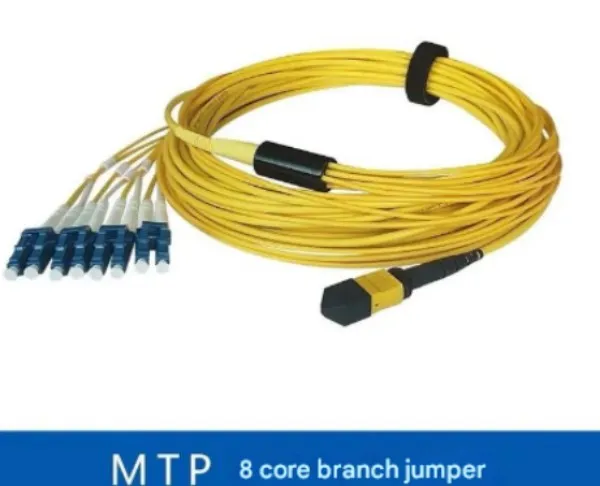
Network evolution from 10G to 40G, or 40G to 100G, often requires complete re-cabling with traditional fiber-unless you've deployed MTP infrastructure. When upgrading to 40G from 10G, an MTP-12 to LC duplex breakout fiber cable with one QSFP-SR4-40G transceiver and four 10G SFP+ transceivers can achieve this connection.
The same physical MTP trunk cable supports multiple migration paths. MTP breakout connectors can break into 4, 6, 8 or 12 connectors, and these connectors can be LC, SC, ST or other. This flexibility means your backbone investment remains relevant through multiple technology generations.
Breakout configurations provide additional versatility. MTP harness cables terminated with a female/male MTP connector on one end and 4/6/8/12 duplex LC/FC/SC/ST connectors on the other end are ideal for short-range 10G-40G and 25G-100G direct connections.

Long-Term Infrastructure Investments
While MTP fiber cable carries higher upfront costs than traditional LC cables, the total cost of ownership tells a different story. MTP connections are more reliable, and the fiber systems terminating in those connections will typically last much longer, making MTP worth considering when making long-term investments in fiber optics infrastructure.
The enhanced mechanical design contributes to longevity. MTP connectors adopt a slidable locking structure allowing connectors to maintain good physical contact with the ferrule under external force during connection. Metal pin clamps and elliptical guide pins reduce wear compared to standard MPO connectors. The optimized elliptical guide-pin greatly reduced wear and dust on the guide hole caused by multiple insertions and removal, improving stability and durability.
MTP fiber cable is designed to be more durable and robust, especially when used in structured cabling systems, with its higher durability and resistance to physical stress making it a more reliable choice for the demanding environment of a hyperscale data center.
Space-Constrained Installations
Physical space constraints drive MTP adoption in multiple scenarios. Telecommunications equipment rooms with limited pathway capacity benefit from MTP's reduced cable volume. Ribbon cables are 1/3 the size of tight buffered fiber optic cables, which enables them to fit into tight spaces and have a smaller minimum bend radius.
Campus backbone connections running through crowded conduits experience similar benefits. When conduit space is 90% full, running additional traditional fiber becomes nearly impossible. MTP fiber cable carrying 12 or 24 fibers occupies the space of 2-3 traditional duplex cables while providing 6-12 times the connectivity.
Cabinet-to-cabinet connections in dense equipment rows particularly benefit from MTP's compact form factor. The reduced cable mass improves airflow around equipment-critical for thermal management in high-density racks where every degree affects reliability and energy costs.
Equipment With Native MTP Ports
Some network equipment ships with MTP ports as the standard interface. All MPO equipment ports are male, so any MTP fiber cable that connects to equipment must have a female connector. Using MTP cables in these scenarios isn't a choice-it's a requirement.
Core switches, optical distribution frames, and structured cabling patch panels increasingly feature MTP interfaces. MTP jumper cables with an MTP connector on both ends are ideal for connecting different pieces of equipment within a cabinet, such as from a fiber patch panel to a switch or from one switch to another.
Blade servers and modular networking equipment also adopt MTP for their high port density requirements. When equipment manufacturers design around MTP interfaces, the rest of your infrastructure should align accordingly.
Broadcast and Industrial Applications
Beyond data centers, MTP fiber cable is suitable for applications including telecommunications, broadcast communication, and industrial control applications. Broadcast facilities moving uncompressed 4K and 8K video require enormous bandwidth-parallel fiber links using MTP become the enabling technology.
Industrial environments with programmable logic controllers (PLCs) and distributed control systems increasingly rely on fiber for immunity to electromagnetic interference. When connecting dozens of controllers to a central SCADA system, MTP's multi-fiber trunk cables simplify installation while maintaining the ruggedness industrial environments demand.
When NOT to Use MTP Cable
MTP fiber cable makes less sense in several scenarios. Small office installations with 10-20 fiber connections rarely justify the investment-traditional LC patch cords remain more cost-effective at this scale.
Low-speed applications under 10G typically don't benefit from MTP's capabilities. If you're connecting 1G switches or legacy equipment, duplex LC or SC connectors cost less and work perfectly well.
Budget-constrained projects where future growth isn't anticipated should stick with traditional options. While it's true that MTP solutions require additional investments in transceivers such as QSFP-DD and OSFP, which increases the overall cost compared to DACs and AOCs, these costs only make sense when you'll leverage the scalability benefits.
Outdoor long-haul installations rarely use MTP fiber cable. Single-mode fiber runs spanning kilometers typically deploy traditional connectors at each end since density isn't the primary concern-signal integrity over distance matters most.
Field-terminated scenarios where you need custom lengths on-site present challenges with MTP. Traditional tight-buffered multi-fiber cable needs to have each fiber individually terminated by a skilled technician, but at least you can terminate to any length. MTP requires factory termination or specialized field-installable connectors that cost significantly more

Critical Implementation Considerations
Polarity management separates successful MTP deployments from troubleshooting nightmares. Three polarity methods are generally available: Polarity A, Polarity B, and Polarity C. Once you select a way, you must stick with it throughout the channel. Mixing polarity types creates dark fibers that appear physically connected but carry no signal.
A common mistake installers make is trying to mate two MTP female connectors together with an MPO coupling-the connectors will fit together and you may think everything is OK, but no light will pass through because the alignment pins are not present. Gender matching requires attention: male connectors have pins, female connectors have holes, and they must pair correctly.
Fiber count compatibility matters equally. You cannot connect an MTP 12-strand connector to an MTP 24-strand connector because the rows of fiber strands will not line up correctly. Your entire system must use consistent fiber counts or employ proper conversion cables.
Cleaning procedures differ from single-fiber connectors. MTP's multiple fiber end-faces require specialized cleaning tools and more careful inspection. Contamination on one fiber position can affect signal quality across the entire connector, and once one connector is polluted, the dirt can migrate to another one.
Frequently Asked Questions
Can I mix MTP and MPO connectors in the same network?
Yes. MTP is a brand name for an MPO connector manufactured by US Conec, and in cabling MTP and MPO connectors are compatible with each other. All MTP connectors are MPO compliant, though MTP offers enhanced performance features.
What's the maximum distance for MTP fiber cable?
Distance depends on fiber type, not connector type. Multimode MTP fiber cable using OM3 or OM4 fiber supports the same distances as duplex LC multimode cables-typically 100-400 meters depending on speed. Single-mode fibers have a small core diameter allowing long-distance transmission with lower attenuation rates and high data rates over very large areas, suitable for metropolitan area networks and long-haul telecommunication systems.
How do I identify MTP cable polarity in the field?
All MTP connectors are equipped with a key and an indicator light (usually a white dot) to indicate the location of the first fiber, and the direction of this key is critical to polarity. Key-up to key-down indicates Type A straight-through, while key-up to key-up typically indicates Type B reversed polarity.
Can I use MTP fiber cable outdoors?
Standard MTP fiber cable is rated for indoor plenum or riser installations. Outdoor applications require cables with UV-resistant and moisture-resistant jackets. While MTP connectors can handle outdoor conditions when properly protected in enclosures, traditional single-fiber connectors remain more common for outside plant deployments due to easier field termination requirements.