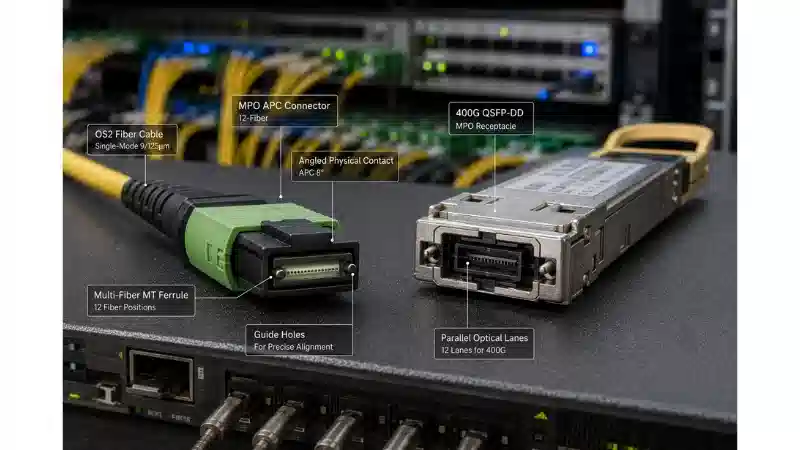
If you've been in the data center game long enough, you've probably stared at a cable tray overflowing with individual fiber runs and thought-there has to be a better way. There is. MPO cables. But here's the thing nobody tells you upfront: they're not always the right call.

The Short Answer (Before We Dive In)
Use MPO when you're dealing with density problems, speed upgrades, or you're just sick of managing individual patch cords one by one. Don't use it for small office setups or when your budget screams at you every time you look at the quote.
That's oversimplified, obviously. Let me break it down.
High-Density Environments-This Is Where MPO Shines
Data centers. Hyperscale facilities. Enterprise server rooms where rack space costs more per square foot than Manhattan real estate. These are MPO territory.
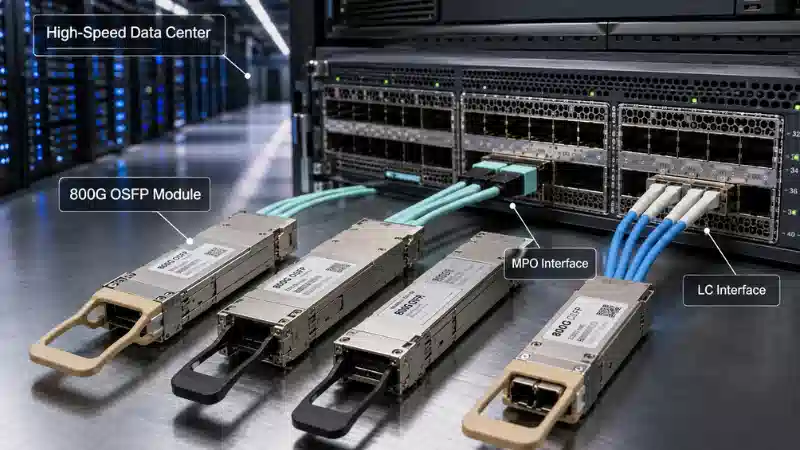
When you're cramming 40G, 100G, or 400G connections into Top-of-Rack switches, running twelve separate LC duplex cables starts looking ridiculous. An MPO trunk cable does what those twelve cables do-one connector, one pull, done. The space savings alone justify the switch for most operations above a certain scale.
I've seen facilities cut their cable volume by over 60% after migrating to MPO-based structured cabling. Airflow improved. Cooling costs dropped. Technicians stopped losing their minds during moves-adds-changes.
But-and this matters-if your environment has fewer than, say, 48 ports per rack? Maybe just stick with traditional patching. The overhead of MPO cassettes and the learning curve for your team might not pay off.
Speed Upgrades: 40G/100G/400G and Beyond
Here's where it gets interesting.
40GBASE-SR4 uses four fibers transmit, four receive. 100GBASE-SR4 does the same thing at higher speeds. 400GBASE-SR16 pushes sixteen parallel lanes. You see the pattern? Parallel optics need multi-fiber connectors. That's literally what MPO was designed for.
If you're still running 10G everywhere and have no plans to upgrade, MPO is overkill. Period. LC duplex handles 10G just fine.
But the moment your roadmap includes 40G switches, QSFP+ transceivers, or anything with "parallel" in the spec sheet-start thinking MPO. Retrofitting later costs more than doing it right the first time. Trust me on this.

A Quick Note on Transceivers
Not all transceivers play nice with all MPO configurations. The 8-fiber vs 12-fiber debate? It's real, and it matters. 40G QSFP+ SR4 uses 8 fibers (4Tx/4Rx). But 100G CFP SR10 needs 20 fibers. Mismatched fiber counts mean adapters, conversion cables, or wasted cores sitting dark in your trunk.
Check your transceiver specs BEFORE ordering cables. Seems obvious, but you'd be surprised how often this gets overlooked.
Rapid Deployment Projects
Got a new data hall coming online in six weeks? Field terminating hundreds of fiber ends isn't happening. Not cleanly, anyway.
Pre-terminated MPO assemblies solve this. Factory-made, factory-tested, shipped ready to plug. Your install team pulls trunk cables, snaps cassettes into panels, and moves on. What used to take days takes hours.
The trade-off? Less flexibility. Pre-terminated lengths mean you're committing to specific distances. Order wrong and you're either coiling excess cable behind the rack or coming up short. Measure twice, order once.
When NOT to Use MPO
This part usually gets glossed over in manufacturer literature (shocking, right?). But there are legitimate scenarios where MPO is the wrong choice.
Small-scale deployments: Under 24 ports? Standard LC/SC patching works fine. The cost premium of MPO hardware won't deliver meaningful ROI.
Extremely long runs: MPO connections introduce insertion loss-typically around 0.35dB per mated pair for quality products, sometimes higher for cheap ones. On long-haul links where every tenth of a dB counts, additional connection points hurt you. Direct fusion splices or fewer connectors might be smarter.
Budget-constrained projects: Let's be honest. MPO trunk cables, cassettes, adapters-they cost more upfront than traditional cabling. If the density and speed benefits don't apply to your situation, you're paying premium prices for capabilities you won't use.
Legacy equipment: Running gear that only accepts LC/SC? You'll need breakout cables or cassettes to adapt. Extra components, extra loss, extra cost. Sometimes keeping the whole thing simple beats chasing marginal optimization.
Multi-Mode vs Single-Mode: Yes, It Changes Things
MPO works with both, but the use cases differ.
Multi-mode (OM3/OM4/OM5) dominates in-building and data center applications. Shorter distances, lower transceiver costs, simpler alignment tolerances. Most 40G/100G parallel optics deployments use multi-mode OM4 MPO.
Single-mode MPO exists for longer reaches and higher bandwidth requirements. 400G-ZR, coherent optics, campus backbone runs-single-mode territory. But here's the catch: single-mode MPO demands tighter tolerances. The connectors cost more. Cleaning matters even more (more on that later). Random insertion loss issues that wouldn't faze a multi-mode link can kill a single-mode one.
If your application is purely intra-rack or intra-row connectivity under 100 meters, multi-mode MPO probably makes sense. Cross-building or anything approaching distance limits? Evaluate single-mode carefully.

The Polarity Question
Nobody wants to talk about polarity until something doesn't work. Then everyone's suddenly an expert.
MPO cables come in three polarity types: A, B, and C. The whole system-trunks, patch cords, adapters-has to maintain proper transmit-to-receive alignment end-to-end. Mess this up and your link either doesn't work or works intermittently (worse, honestly).
Type A cables are straight-through with one key-up and one key-down connector. Type B cables have both connectors oriented the same way, reversing fiber positions. Type C flips adjacent pairs.
Most data center structured cabling specs mandate specific polarity methods. TIA-568 defines three connectivity methods (confusingly also called A, B, and C) that use different combinations of cable types. Getting this wrong means troubleshooting sessions that eat hours.
My advice? Pick one polarity method, document it obsessively, and stick to it across your entire infrastructure. Mixing methods within the same facility invites chaos.
Practical Deployment Scenarios
Let me give you some real-world examples.
Scenario 1: New 400G Spine-Leaf Fabric
You're building a spine-leaf architecture with 400G-capable switches. Each spine switch connects to every leaf. Dense port counts, short cable runs, parallel optics transceivers.
Use: 8-fiber or 16-fiber MPO trunk cables between spine and leaf rows. Pre-terminated assemblies matched to your rack layout. High-quality connectors with IL under 0.35dB.
Scenario 2: Enterprise Campus Backbone
Main distribution frame connecting three buildings. Distances range from 80 to 300 meters. Mix of 10G and 40G uplinks.
Use: Hybrid approach. Single-mode MPO for the 40G paths; standard LC duplex for the 10G. Over time, as 10G equipment ages out, migrate those paths to MPO. Don't force everything at once.
Scenario 3: Colocation Cabinet
You rent a single cabinet in a colo. Eight servers, two switches, cross-connects to the meet-me room.
Don't use MPO: Overkill. LC patch cords work fine. Save your money for something that matters.
Cleaning and Inspection: Non-Negotiable
This section won't be long, but it's important.
MPO connectors have 8, 12, 16, or 24 fiber end faces packed into one ferrule. Each face is a potential failure point. Dust, oil, scratches-any contamination that might barely affect a single-fiber LC connector gets amplified when you've got two dozen surfaces to worry about.
Inspect before mating. Every time. Use a fiber scope with an MPO adapter. If dirty, clean using a cassette-style cleaner (dry cleaning preferred). Re-inspect. If still dirty, try wet cleaning followed by dry.
Skip this step at your peril. I've seen entire trunk cables rejected at acceptance testing because someone touched the ferrule during installation. One fingerprint can ruin twelve fibers.
Cost Considerations-Being Realistic
Upfront, MPO systems cost more than equivalent LC-based infrastructure. The connectors are precision components. Factory termination isn't cheap. Cassettes, adapter panels, high-density enclosures-it adds up.
But total cost of ownership tells a different story for large deployments. Faster installation means lower labor costs. Higher density means fewer racks and less floor space. Easier MAC work means reduced ongoing operational expense.
The breakeven point varies by facility. For data centers running 100+ high-speed ports, MPO usually wins over a 3-5 year horizon. For smaller deployments, maybe never.
Run the numbers for your specific situation. Don't just believe the marketing.
Final Thoughts
So when should you use MPO fiber optic cable?
When you're scaling. When you need density. When parallel optics dominate your hardware roadmap. When installation speed matters more than component cost. When managing individual fiber runs has become operationally unsustainable.
When shouldn't you? Small environments. Extreme budget constraints. Legacy-dominated infrastructure with no upgrade path. Long-distance links where every decibel counts.
It's a tool. A good one. But like any tool, it works best when matched to the right job.