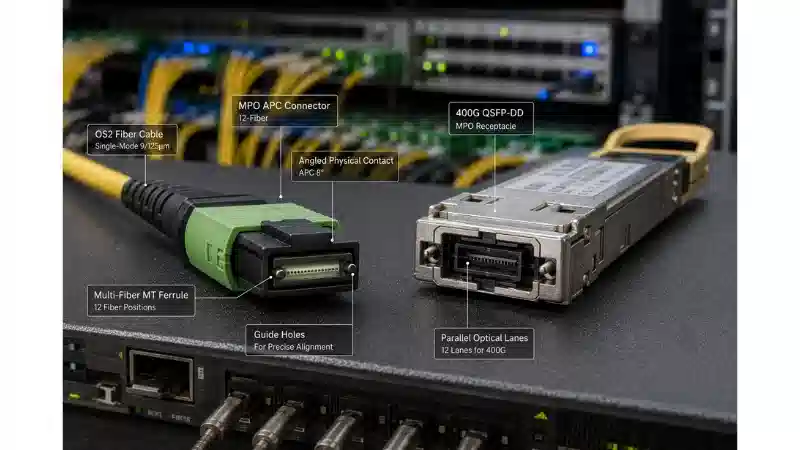
In high-capacity optical networks, the power carried by a single strand of glass can be surprisingly unforgiving. A receiver optimized for weak photon arrivals can suffer distortion when bombarded by excess optical power. Engineers don't install attenuators because they enjoy adding components - they install them because photodiodes, EDFA pre-stages, and DWDM channels have limits that refuse negotiation. A fiber optic attenuator deliberately wastes light energy, doing so in a manner that is predictable across changing wavelengths, temperature swings, and inevitable connector wear.
When the Light Is Too Good
The stronger the optical signal, the more dangerous it becomes for the network's equilibrium. Modern transmitters are rarely tailored precisely to the distance they travel. A jumper only 3 meters long connecting equipment designed for 40 km? The resulting optical overload is a classic reason receivers scream for attenuation.
It isn't just about hardware protection - dense networks demand uniformity. A single overly bright channel can ruin OSNR planning in DWDM systems. So engineers quietly insert 5 dB here, 7 dB there, restoring a delicate truce.
The Physics No One Escapes
Every fiber already loses light: Rayleigh scattering in the silica lattice, faint absorption by OH⁻ ions or transition metals, even infrared lattice vibrations drinking photons like heat. But attenuators introduce intentional degradation.
Sometimes this is done brutally: a tiny air gap so the mode diffracts away. Other times, exquisitely: doped glass engineered to eat photons with mathematical discipline. Misalignment - normally a splice engineer's nightmare - here becomes a controlled design tool.
There is a certain elegance in weaponizing the very defects we spent years trying to eliminate.
Not Everything Is Evenly Distributed
Engineers rarely talk about it openly, but attenuators have quirks:
Wavelength favoritism - 1310 nm and 1550 nm do not always attenuate equally. The flatter the curve, the higher the praise.
Polarization dependency (PDL) - Those annoying dB tenths that shift when you twist the patch cord.
Temperature tantrums - A -5 dB spec in a cozy lab becomes -6.1 dB in a rooftop enclosure under August sun.
These subtleties often matter more than the number printed on the housing.
Fixed or Volatile? (A Practical Divide)
Fixed Attenuators
You know what they'll do: 1 dB, 3 dB, 10 dB - the common building blocks. Often built as SC/APC or LC/UPC connectors so installers can deploy them without second-guessing fusion joints. You plug them in and move on.
Variable (VOA)
A different creature entirely. In labs, technicians slide optical power like audio engineers balancing a mix:
- Neutral density filters
- MEMS-based micro-mirrors tilting photons into oblivion
- Liquid crystal elements responding to electric fields
- None of these feel "passive." They are instruments.

The Quiet Villain: Return Loss
Everyone obsesses about attenuation values, yet reflections corrupt coherent systems far more dramatically. A PC polish returns enough light to disrupt laser biasing; APC angles bury the reflection so deep it forgets its origin.
Typical expectations (realistic, not marketing)
| Connector polish | Return loss |
|---|---|
| PC | ≥ 40 dB |
| UPC | ≥ 50 dB |
| APC | ≥ 60 dB |
Attenuators must respect these numbers - otherwise they fix one problem while creating another.
A Quick Calculation (Before Coffee Gets Cold)
A link budget isn't poetry, but it keeps networks alive:
Total Loss=Fiber Loss+Connector Loss+Splice Loss+Attenuation
If you find yourself below the receiver's optimum threshold, add a 5 dB attenuator and watch the BER calm down. Sometimes it feels like magic. It isn't - it's just logarithms.
Where They Matter Most
CATV. Metro DWDM rings. Data centers where the distance from spine to leaf is insultingly short. OADM modules that dislike surprises. On-bench diagnostics when you want to see how much pain a link can tolerate before it breaks.
Attenuators do their work quietly, not celebrated like amplifiers, but if you remove them from the ecosystem, you uncover chaos.
Choosing One - Don't Overthink It but Don't Be Casual Either
Three questions usually decide everything:
- How many dB must be buried?
Precision within ±1 dB is a sane expectation.
- What wavelength(s) need obedience?
Better broadband performance costs more - usually worth it.
- Connector and power compatibility
A mis-matched polish type can sabotage the entire link.
If it feels too easy, double-check the power rating. Some transmitters are not gentle.

A Closing Thought
Network design is often a contest between order and entropy. Fiber optic attenuators, humble as they look, are mediators in that contest. They negotiate peace by subtraction - and sometimes, subtraction is the most intelligent engineering choice of all.