MPO adapters-also referenced as couplers or flanges in various regional markets-function as the intermediary alignment mechanism enabling two MPO-terminated fiber assemblies to mate within structured cabling infrastructures. Their operational significance extends beyond mere physical connection; proper adapter selection directly influences insertion loss budgets, polarity integrity, and long-term network scalability across 40G, 100G, and emerging 400G/800G parallel optic deployments. This guide addresses practical deployment considerations drawn from enterprise and hyperscale implementation experience.
The Polarity Problem Will Find You Eventually
I want to get this out of the way early because it's where most MPO deployments go sideways.
Polarity management with MPO isn't complicated in theory. You've got three methods-Type A, Type B, Type C-and they exist to ensure that fiber 1 on one end talks to the correct fiber on the other end. Simple enough on a whiteboard. In a live environment with 400 trunk cables, six different installers over three years, and documentation that stopped being updated sometime around 2019? That's when things get interesting.
Type B (key-up to key-up) has become the de facto standard for most enterprise deployments. The TIA-568 standard pushed this, and frankly it works. Straight-through trunks, straight-through patch cords, everything lines up. But here's what the standards documents don't tell you: the moment you inherit a brownfield environment or integrate equipment from a vendor who decided Type A made more sense for their patch panels, you're spending a Tuesday afternoon with a polarity checker and a spreadsheet trying to figure out why half your 100G links won't train.
The fix is usually a polarity-flipping adapter or a Type A-to-B conversion cable. Keep a few in your parts drawer. You'll need them.
Why 12-Fiber Still Dominates (But Maybe Not Forever)
The 12-fiber MPO connector emerged from a historical accident more than deliberate engineering optimization. Ribbon fiber came in 12-strand configurations. Connector manufacturers built around that. And now we're stuck with it-for better or worse.
For 40G SR4 and 100G SR4, 12-fiber works fine. You're only using 8 fibers anyway (4 transmit, 4 receive), leaving 4 dark. Wasteful? Sure. But the ecosystem exists. The pricing is commoditized. Every distributor stocks 12-fiber assemblies.
The 24-fiber variant gained traction with 100G PSM4 and is becoming essential for 400G SR8 applications. If you're building new infrastructure today and expect to run 400G within three years, seriously consider 24-fiber trunking with Base-24 patch panels. The cost premium isn't dramatic-maybe 15-20% over equivalent 12-fiber deployments-and you avoid the forklift upgrade later.
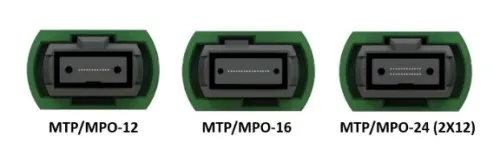
8-fiber MPO exists too. I've seen it in a few carrier installations. Wouldn't recommend it for enterprise unless you have a very specific use case and enjoy explaining to vendors why their standard patch cords won't work.
On Adapters Specifically
Right. This is supposed to be about adapters.
The physical adapter itself is deceptively simple: a housing that aligns two MPO ferrules, maintains the key orientation, and provides a mounting interface to your panel or cassette. What differentiates products:
Flange style
Full-flange adapters mount to standard D-cutout panels. Reduced-flange versions enable higher port density-you can fit more adapters per rack unit-but require compatible panel designs. Check your patch panel specs before ordering.
Key orientation
Adapters are manufactured as key-up/key-up (Type B compatible) or key-up/key-down (Type A compatible). This is fixed at manufacturing. You cannot change it. Order the wrong type and you've got expensive plastic.
With or without guide pins
One side of an MPO connection has guide pins; the other side has holes.
The "pinned" connector mates to the "pinless" adapter side. Sounds obvious until someone orders all-pinned patch cords and wonders why nothing seats properly. Standard convention: trunk cables are pinned on both ends, equipment patch cords are pinless. Adapters accommodate this.
The insertion loss contribution from a quality adapter should be under 0.35 dB. I've measured cheap units from questionable suppliers at over 0.6 dB. On a short link, who cares. On a 300-meter backbone where you're already approaching your loss budget ceiling, that extra 0.25 dB matters.
Cleaning: The Part Everyone Skips
This deserves its own section because I've seen more MPO links fail from contamination than from any other cause. And I've seen technicians who should know better plug in connectors without inspection.
The MPO ferrule face presents 12 or 24 fiber end-faces in a roughly 2.5mm × 6.4mm area. A single particle of dust-we're talking 1 micron-on one fiber core creates insertion loss, back-reflection, or both. Multiply that across 12 fibers and you've got a link that might work, might not, and will definitely generate intermittent errors that drive you crazy.
Cleaning protocol:
Inspect with a fiber microscope (400x minimum for MPO). Every time. No exceptions.
Dry-clean first using an MPO-specific cleaning tool. The IBC brand units work well. So does the NTT-AT stick cleaner.
If contamination persists, wet-clean with IPA, then dry-clean again.
Re-inspect. Still dirty? Repeat.
The adapters themselves collect debris too. That recessed ferrule alignment sleeve is a dust magnet. Use compressed air (filtered, moisture-free) or adapter-specific cleaning sticks.
Time investment: maybe 30 seconds per connection once you're practiced. ROI: links that actually work.

Guide Pins Deserve Respect
The guide pins on MPO connectors are precision-ground stainless steel or ceramic. They align the ferrules to within microns. They're also fragile.
I've watched a technician force a connector into an adapter at a slight angle. The guide pin bent. Not visibly-you'd need magnification to see it-but enough that the ferrule alignment shifted. Every subsequent connection with that patch cord showed elevated loss on fibers 3 and 4.
Handle MPO connectors like the precision instruments they are. Straight insertion, straight removal. If it doesn't seat smoothly, stop. Something's wrong. Check for debris, check alignment, check that you haven't accidentally grabbed a pinned cord for a pinned adapter port.
Replacement guide pins exist but installing them requires specialized tools and a steady hand. Easier to replace the connector-or the whole cable if it's a short patch cord.
Single-Mode vs. Multimode: Not Interchangeable
This seems elementary but I'll state it anyway: single-mode and multimode MPO adapters are not interchangeable, and mating the wrong types creates problems.
The physical form factor is identical. They'll physically connect. But the ferrule geometry optimizations differ-multimode tolerates slightly looser alignment because the core diameter (50 microns) is more forgiving than single-mode (9 microns). Single-mode adapters and connectors demand tighter tolerances.
More critically: APC (angled physical contact) single-mode MPO exists and is increasingly common in carrier and long-haul applications. The 8-degree angle on APC ferrules is incompatible with UPC (ultra physical contact) components. Mating APC to UPC damages both ferrules. The color coding helps-APC is green, UPC is blue-but verify before connecting.
For most enterprise data center applications, you're using multimode (OM3/OM4/OM5) or single-mode UPC. APC MPO shows up in CATV, 5G fronthaul, and coherent transport applications. If you're reading this guide for enterprise connectivity basics, you're probably not there yet.
Cassettes and Modules: Where Adapters Live
Standalone adapters exist but most enterprise deployments use cassette-based systems. An MPO cassette-sometimes called a module or conversion box-contains MPO adapters on the rear (for trunk cable connection) and LC or SC adapters on the front (for equipment patch cords). Internal fanout cables convert between MPO and duplex connections.
This approach offers several advantages. Polarity is managed at the cassette level-buy Type B cassettes, use Type B trunks, polarity just works. The MPO connection lives inside the cassette, protected from repeated access. Technicians interact with familiar LC connectors on the front.
Cassette options vary by density. Basic models provide 12 LC ports from one 12-fiber MPO input. High-density Base-12 cassettes pack 24 LC ports (two MPO inputs) in the same 1U footprint. Base-24 configurations accommodate 24-fiber MPO connectivity for migration toward 400G.
If you're deploying new infrastructure, standardize on one cassette family. Mixing vendors creates compatibility headaches-mounting hardware differs, labeling conventions conflict, and good luck finding replacement parts five years later when the original supplier exits the market.
A Brief Tangent on Bend Radius
MPO trunk cables are thick. 12-fiber ribbonized constructions run 3mm diameter minimum; 24-fiber and armored variants exceed 5mm. The minimum bend radius matters.
I've seen installers coil excess cable length into tight loops behind patch panels-the same technique that works fine for duplex LC cables. It doesn't work for MPO. Exceeding bend radius specifications introduces macrobend loss that may not appear during commissioning but manifests as the cable settles and temperature cycles stress the jacket.
Follow manufacturer specifications. For most MPO trunk cables, minimum bend radius is 10x cable diameter under no-load conditions, 20x when tensioned. Use proper cable management-horizontal trays, vertical managers, service loops at appropriate radius. The cable isn't expensive relative to the labor cost of diagnosing mysterious loss issues two years later.
Testing: Do It Right or Don't Bother
Commissioning an MPO infrastructure without proper testing is malpractice. I'll die on this hill.
Tier 1 testing (insertion loss measurement) is the baseline. Use an MPO-compatible OLTS-Fluke Networks' Versiv platform handles this, as do units from EXFO and VIAVI. Set reference correctly (critical with MPO due to the complexity of test reference cord arrangements). Document every link. Compare against TIA-568.3 loss budgets or your calculated budget for the specific link architecture.
Tier 2 testing (OTDR trace) adds fault location capability. If a link fails loss testing, OTDR shows where. That splice at 47 meters? The connector pair at the patch panel? The crushed cable where it passes through the conduit? OTDR finds it. Some will argue Tier 2 is overkill for short enterprise links. I'd argue spending an extra hour during commissioning beats spending eight hours troubleshooting a problem link during a production outage.
For MPO, test every fiber. Yes, all 12. Or 24. The "test fibers 1 and 12 only" shortcut that works for duplex runs doesn't apply when any individual fiber in the array might have contamination or alignment issues.
Vendor Landscape
I don't have strong brand loyalties, but observations from deployments:
Corning and CommScope (formerly Systimax, TE Connectivity's fiber business) produce premium product with tight tolerances. Expensive. Worth it for backbone infrastructure you'll live with for 15 years.
01
Panduit offers solid enterprise-grade options, integrates well if you're already using their cable management.
02
FS.com has become the value-engineering choice. Quality has improved substantially over the past five years. I'd use their patch cords and cassettes without hesitation; for permanent trunk infrastructure, I'd still lean toward the premium brands.
03
Amphenol, Senko, and US Conec (who actually invented MTP) supply components to many of the above. Knowing the OEM source can help when troubleshooting compatibility issues.
04
Avoid: no-name marketplace sellers, "equivalent to" products without actual specifications, anything without published insertion loss and return loss data.
What About the Future?
400G is here. 800G is shipping to hyperscalers. 1.6T is on the standards roadmap.
The 12-fiber MPO ecosystem gets awkward at these speeds. 400G SR8 needs 8 fibers each direction-16 total-which maps poorly to 12-fiber infrastructure. Hence the push toward 24-fiber and even 32-fiber MPO configurations.
Competing connector formats are emerging. The SN (Senko) and MDC (US Conec) connectors offer higher density than LC with lower cost than MPO. CS connectors (also Senko) provide a duplex alternative. Whether these gain enterprise adoption or remain niche carrier/hyperscale plays is unclear.
My guess: 12-fiber MPO remains dominant in enterprise through at least 2028. The installed base is enormous, 100G isn't going anywhere soon, and the upgrade path to 400G SR4.2 (which uses 4 fibers at 100G PAM4 per fiber) extends 12-fiber viability. But if you're building greenfield infrastructure and planning for 10+ year lifecycle, Base-24 provides better optionality.
That's probably more than anyone wanted to know about MPO adapters. But this is foundational infrastructure-get it wrong and you're living with the consequences for years. Get it right and it disappears into the background, doing its job invisibly.
Which is exactly what good cabling should do.