Your network planning team is projecting 3x capacity growth by 2028. Your fiber plant was sized for 2019 traffic. New construction across a 5km campus route costs $50k+ per kilometer once permits, conduit, and labor stack up. Dark fiber leases in tier-1 metros run $4,000-8,000 per strand-kilometer annually.
Wavelength multiplexing turns one fiber into eight, sixteen, or eighty independent channels. The technology works. We've been shipping WDM equipment for over a decade. What trips up most procurement teams is the CWDM versus DWDM decision-and the hidden costs that don't show up until commissioning.
Where the Real Money Goes
Most evaluations start and end with transceiver unit pricing. That's maybe a third of what you'll actually spend. The honest comparison looks at five line items: passive equipment, transceivers, installation labor, power draw, and ongoing maintenance.
Here's what an 8-channel deployment actually costs in 2025-2026:
| Cost Element | CWDM | DWDM | Why It Matters |
|---|---|---|---|
| Mux/Demux pair | $1,600-3,000 | $4,000-8,000 | DWDM filters need tighter tolerances |
| Transceivers (10G × 16) | $2,400-6,400 | $6,400-12,800 | Cooled lasers cost more |
| Installation | $800-1,200 | $1,200-2,000 | DWDM alignment takes longer |
| Annual power/site | $50-80 | $200-400 | TEC cooling adds up |
| Year-1 Total | $4,850-10,680 | $11,800-23,200 | - |
These are enterprise-grade prices. Carrier specs with extended temp ranges add 30-50%.
The math changes at scale. Below 16 channels and 60km, CWDM wins almost every time. Push past 24 channels or need amplification for longer spans, and DWDM becomes your only real option. ACG Research found that QSFP28 DWDM transceivers deployed directly in switches cut TCO by 58-67% versus standalone transport gear for DCI under 80km (datacentrereview.com).
The Laser Physics Behind the Price Gap
CWDM uses uncooled DFB lasers. ITU-T G.694.2 allows 20nm between channels-plenty of room for wavelength drift without active temperature control. Power consumption sits around 0.5-1W per transceiver.
DWDM packs channels at 0.8nm or 0.4nm spacing. That demands thermoelectric coolers holding wavelength within ±0.1nm. Each transceiver pulls 3-5W just for temperature stabilization.
Run the numbers on a 40-channel DWDM system: 120-200W burned on cooling alone. At $150-200 per kW-month for rack power, the five-year electricity bill can exceed your initial hardware spend.

The Water Peak Problem Nobody Mentions During Sales Calls
ITU specifies 18 CWDM wavelengths from 1271nm to 1611nm. Sales decks show 18 channels. Your actual fiber might support ten.
G.652.A and G.652.B fiber-the stuff installed through the early 2000s-contains hydroxyl ions that create a nasty attenuation spike around 1383nm. That water peak sits dead center in the CWDM spectrum and kills wavelengths between 1350-1450nm on runs over 20-30km.
G.652.D fiber fixed this at the manufacturing level. Post-2008 installations generally comply. Older plants? Uncertain. If your documentation doesn't confirm low water peak performance, spend the money on spectral characterization before you commit to hardware. VIAVI publishes solid test procedures (viavisolutions.com).
DWDM sidesteps the issue by staying in the C-band (1530-1565nm) where water peak attenuation doesn't matter. For fiber plants with sketchy documentation, DWDM might be the safer bet despite higher component costs.
What 5G Taught Us About Volume Economics
The 5G fronthaul buildout validated something we'd been telling customers for years: CWDM hits the sweet spot for high-volume, distance-limited deployments.
Operators standardized on 6-wavelength CWDM (1271, 1291, 1311, 1331, 1351, 1371nm) for connecting antennas to baseband units. The reasoning came down to laser economics.
G.652 fiber's chromatic dispersion increases with wavelength. The DML lasers in standard 25G SFP28 transceivers can't handle dispersion on longer CWDM wavelengths over 10km spans. Going to 1471-1571nm requires EML lasers at roughly 2x the unit cost. When you're deploying tens of thousands of cell sites, that multiplier kills your business case.
China Mobile pushed this further with MWDM-shifting each short-wave CWDM channel by ±3.5nm to get 12 wavelengths while staying on DML technology. Same principle: squeeze capacity from existing supply chains before jumping to expensive alternatives.
The enterprise parallel is obvious. Campus interconnect, metro access, short-haul DCI-same economics apply.
Three Things That Actually Break WDM Deployments
We've shipped enough systems to know where the support calls come from. It's not exotic failure modes. It's basics that get skipped.
Link budget math that ignores connectors.
Mux specs show 1.5dB typical. Your unit might measure 2.3dB. Each connector pair adds 0.3-0.5dB. String 12 connections together and you've burned 3.6-6.0dB before counting fiber loss. Engineers who calculate margin using only fiber attenuation and spec-sheet typicals show up 3-5dB short at commissioning.
We ship measured insertion loss data with every mux/demux. Not spec maximums-actual test results from your specific unit. If it doesn't meet published specs, we swap it.
Dirty fiber ends.
One dust particle introduces reflections exceeding return loss specs. Intermittent errors, unexplained BER spikes, troubleshooting hours that accomplish nothing. A $200 inspection scope and cleaning kit prevents thousands in wasted time. Inspect and clean before every mating. No exceptions.
Green connectors mated to blue ports.
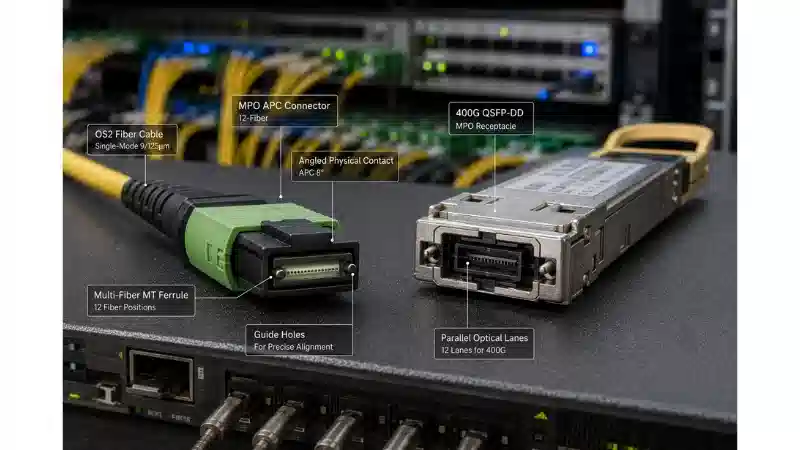
APC and UPC polishes don't mix. The air gap from mismatched endface angles can hit 3dB loss. CWDM/DWDM mux ports are UPC (blue). If your patch inventory includes APC (green), keep them physically separated.
How We Compare to Your Other Options
FOCC runs a 5,000m² dust-free facility in Guangzhou. 100+ employees. 1.5 million connectors monthly capacity. We've been exporting WDM gear to 130+ countries since 2014, with CE, RoHS, FCC certifications and Telcordia GR-1209/1221 compliance.
CWDM line: 2 to 18 channels in LGX, 1U rackmount, and ABS pigtailed packages. DWDM: 100GHz and 200GHz spacing, 8 to 40 channels. Every passive WDM unit includes expansion ports for future growth and monitor ports for power measurement without service interruption.
Where do we fit against alternatives?
Corning and Lumentum own the tier-one telecom space. Their documentation packages satisfy carrier procurement requirements that would take us months to duplicate. You pay for that positioning. If your RFP mandates specific qualification certifications, they're probably your answer.

FS.com wins on price transparency and online ordering convenience. Solid products. Good documentation. Works well if your team can validate performance independently and doesn't need hands-on design support.
We compete on three things: custom configurations (non-standard wavelength plans, unusual channel counts), technical consultation during design phase, and delivery speed. Standard 8-channel CWDM ships in 2 weeks. Custom wavelength plans add 1-2 weeks.
Not every project fits our model. High-volume commodity orders where you just need the lowest unit price? FS probably beats us. Carrier-grade projects requiring extensive compliance documentation? Go tier-one.
Mid-volume deployments with custom requirements and real timelines? That's where we add value.
Getting Started
Send us your requirements: topology distances, channel counts (current and projected), data rates per channel, any compliance or documentation needs. Our applications team will map that against product specs and flag integration considerations before you commit to anything.
Contact: focc@focc-fiber.com | Online inquiry at www.focc-fiber.com
Product datasheets available on request. For projects with unusual distances, high channel counts, or hybrid architectures, the design consultation is worth having early-it surfaces constraints that affect both technical specs and commercial terms.
FOCC Fiber Co., Ltd | Shenzhen/Guangzhou, China
Manufacturing partner for WDM solutions since 2014