Analog voice signals are sampled, quantized, and encoded into a 64 kbit/s digital signal. To improve line utilization and transmission capacity, time-division multiplexing technology is adopted to interleave and multiplex multiple 64 kbit/s digital signals on a bit-by-bit basis. In Europe, 30 independent 64 kbit/s voice channels and two information control channels are combined to form a signal structure with 32 time slots, with a transmission rate of 2.048 Mbit/s. In North America and Japan, 24 64 kbit/s channels are interleaved and multiplexed to form an information stream of 1.544 Mbit/s.
To further increase the transmission capacity, several information streams of 2.048 Mbit/s (or 1.544 Mbit/s) can be multiplexed into higher-rate information streams. For example, in Europe, 4 information streams of 2.048 Mbit/s are multiplexed into one information stream of 8.448 Mbit/s; 4 information streams of 8.448 Mbit/s are multiplexed into one information stream of 34.368 Mbit/s; and 4 information streams of 34.368 Mbit/s are multiplexed into one information stream of 139.264 Mbit/s.
The PDH technology in our country adopts the European standard. The rates, deviations, frame periods, and number of circuits of each hierarchy in the European standard are shown in Table 1-1.
Table 1-1 Rates and Frame Periods of Each PDH Hierarchy in China
| Hierarchy | Rate | Deviation | Frame Period | Number of Circuits |
|---|---|---|---|---|
| Primary | 2.048 Mbit/s | 50 ppm | 125 μs | 30 |
| Secondary | 8.448 Mbit/s | 30 ppm | 100.38 μs | 120 |
| Tertiary | 34.368 Mbit/s | 20 ppm | 44.69 μs | 480 |
| Quaternary | 139.264 Mbit/s | 15 ppm | 21.03 μs | 1,920 |
In the past more than 20 years, PDH technology has played a huge role in backbone networks and local networks. However, as communication networks develop towards large capacity and standardization, PDH technology has been basically eliminated in the public communication networks of operators. The defects of traditional PDH technology are reflected in the following points.
(1) There are three major regional standards for existing PDH technology in the world, as shown in Figure 1-1, which makes international interconnection difficult.
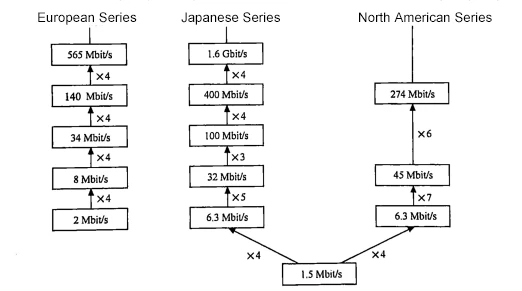
(2) There is no worldwide standard optical interface specification. This leads to different optical interfaces of devices from different manufacturers, and even different models from the same manufacturer, which cannot be interconnected, that is, horizontal incompatibility.
(3) Difficulty in adding/dropping branches. The frame lengths of each rate level of PDH are different, and the starting point of the lower-order frame has no fixed position and no regularity in the higher-order frame. This situation leads to the necessity of using back-to-back equipment for adding/dropping branches, which requires step-by-step demultiplexing to drop the required branches and then step-by-step multiplexing the remaining branches.
(4) Only asynchronous multiplexing can be used, that is, the rates of each branch need to be adjusted to be synchronous before multiplexing.
(5) Weak network management capability. Due to the small number of overhead bits, it cannot provide sufficient operation, administration, and maintenance (OAM) capability. The OAM of the network mainly relies on manual digital cross-connection and service interruption detection, which cannot meet the requirements of the evolving telecommunication network.