Selecting a fiber optic attenuator seems straightforward until you actually need one. The device reduces optical signal power-simple enough in theory. But walk into any procurement decision without understanding the nuances, and you'll end up with equipment that either doesn't fit, doesn't perform, or sits unused in a drawer.

Why You Even Need One
Here's the thing most people don't realize: too much light is a problem.
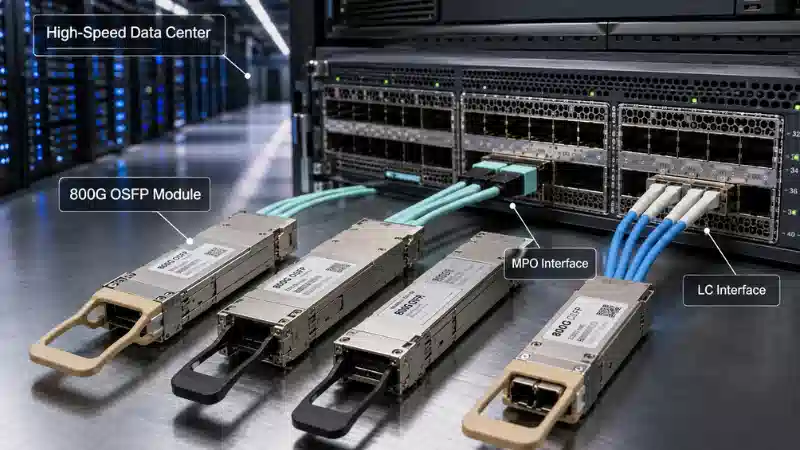
Receivers have sensitivity ranges. Push a signal beyond the upper threshold, and you get saturation-distorted data, bit errors, sometimes permanent damage to photodetectors. Short fiber runs between high-powered transmitters and sensitive receivers create exactly this scenario. Data centers with patch panels mere meters apart. FTTH installations where the optical network terminal sits close to the splitter. Test benches where you're simulating conditions that don't match your actual setup.
Attenuators solve this by eating up excess power. Nothing fancy about the concept.
The Attenuation Value Question
Getting the number right matters more than most other decisions.
Calculate it wrong, and you're either still overloading the receiver or starving it of signal. The math isn't complicated but requires actual measurements:
Required attenuation = Transmitter output – Link loss – Receiver sensitivity – Safety margin
Say your transmitter pushes +5 dBm. The receiver handles -3 dBm to -22 dBm. Your link loss measures 2 dB. You want maybe 3 dB of margin because things drift over time and temperature.
That puts your target receive power around -6 dBm. So: 5 – 2 – (-6) = 9 dB attenuation needed.
But here's where people mess up-they forget the receiver has a range. The minimum sensitivity (-22 dBm in this example) is your floor. The maximum input power (-3 dBm) is your ceiling. Stay comfortably between them.
I've seen technicians grab whatever attenuator is handy. A 10 dB when they needed 5 dB. Works fine until environmental losses increase and suddenly the link drops.

Fixed vs. Variable: Not Always Obvious
Fixed attenuators handle most production environments. They're cheap, reliable, and you install them once. Values typically run from 1 dB to 25 dB in standard increments.
Variable optical attenuators (VOAs) cost significantly more-sometimes ten times the price. But for test and measurement applications, they're indispensable. Characterizing receiver sensitivity across a range? Simulating different link conditions? You need adjustability.
The mechanical variable types use a thumbwheel or micrometer adjustment. Resolution around 0.1 dB is common. Electronic VOAs offer remote control and faster adjustment but add complexity and failure points.
One thing: variable attenuators drift. Check calibration periodically. Fixed types don't have this problem.
Connector Compatibility
This should be obvious but causes endless headaches.
Your attenuator's connectors must match your system. LC to LC. SC to SC. FC to FC. Mixing requires adapters, which add insertion loss and reflection points.
The less obvious issue: polish type.
UPC (Ultra Physical Contact): Blue connector. Flat end face. Works for most telecom and datacom applications.
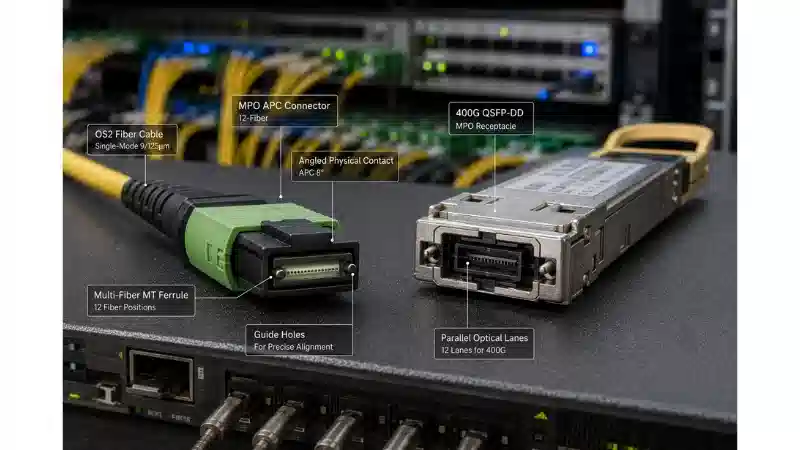
APC (Angled Physical Contact): Green connector. 8-degree angle on the end face. Mandatory for analog video, CATV, and anything requiring return loss better than 60 dB.
Never-and I mean never-mate APC with UPC. The angle mismatch damages both ferrules and creates terrible reflection. I've watched experienced technicians make this mistake because the connectors physically fit together. They shouldn't.
Singlemode vs. Multimode
Match the fiber type. Period.
Singlemode attenuators work at 1310 nm and 1550 nm windows. Sometimes 1490 nm for PON applications. Core diameter is 9 µm.
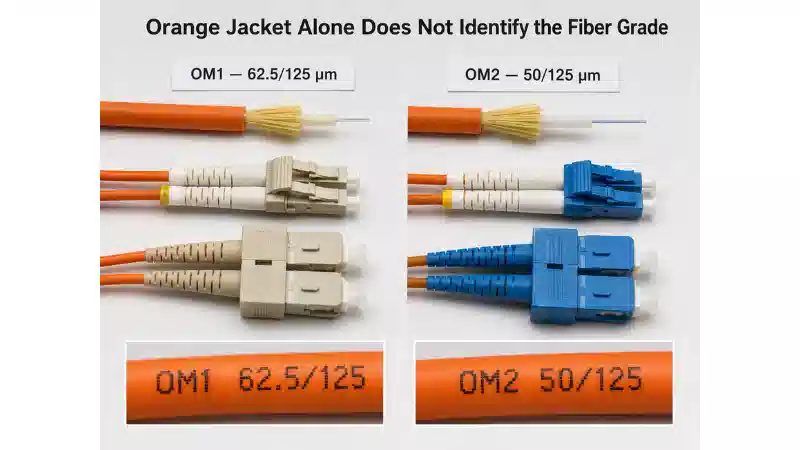
Multimode attenuators target 850 nm and 1300 nm. Core diameters of 50 µm (OM3/OM4/OM5) or 62.5 µm (OM1).
Using a singlemode attenuator on multimode fiber? The smaller aperture blocks most of your light-you'll get attenuation, but nothing predictable or consistent. Going the other direction causes modal dispersion issues.
Some manufacturers make mode-specific versions with identical housings. Check the specifications. The label should clearly indicate SM or MM.
The Build-Out vs. In-Line Decision
- Plug-style (build-out) attenuators attach directly to equipment ports. One connector plugs into the transceiver; the other accepts your patch cable. Clean installation, minimal added length. These work well when you need attenuation right at the source or receiver.
- In-line attenuators have pigtails on both ends and splice or connect into the cable run. More flexible positioning but adds cable management complexity.
- Adapter-style attenuators fit inside patch panel couplings. Useful for permanent installations where you want the attenuation invisible and protected inside the panel.
For most data center applications, plug-style makes sense. For outside plant or premises cabling, in-line types offer more options.
Wavelength Dependence
Attenuators aren't perfectly flat across all wavelengths. The specified attenuation value applies at specific wavelengths-usually 1310 nm and 1550 nm for singlemode, 850 nm for multimode.
At other wavelengths, actual attenuation varies. Sometimes by a decibel or more.
For CWDM and DWDM systems, this matters significantly. A 5 dB attenuator might provide 5.3 dB at 1550 nm but only 4.6 dB at 1310 nm. High-quality units specify attenuation across the full operating band.
Wideband attenuators exist for multi-wavelength applications. They cost more. Whether you need them depends on your wavelength plan.

Return Loss Specifications
Every connection point reflects some light backward. Return loss quantifies this-higher numbers mean less reflection.
For most digital telecom applications, 45-50 dB return loss suffices. Analog systems and coherent transmission demand 60 dB or better.
APC attenuators inherently provide superior return loss due to the angled interface. If your system specification calls for >55 dB return loss, APC is probably required.
Cheap attenuators often underperform on return loss. The specification sheet says 50 dB; reality delivers 40 dB. This causes problems in OTDR testing and sensitive receiver applications.
Power Handling
Standard attenuators handle 200-300 mW without issue. Perfectly adequate for typical telecom signals running a few milliwatts.
High-power applications-fiber lasers, EDFA outputs, CATV systems-require attenuators rated for higher power levels. Some specialized units handle several watts.
Exceed the rating and the attenuating element degrades. Absorption-based attenuators are particularly vulnerable; the absorbing material literally burns.
Check your transmitter specifications. If you're running anything above 50 mW, verify the attenuator's power handling capability explicitly.
Temperature Stability
Attenuator performance shifts with temperature. Better units hold specification across -40°C to +85°C. Consumer-grade products may only guarantee performance at room temperature.
For controlled environments-data centers, central offices-this barely matters. For outside plant installations, especially in extreme climates, it matters a lot.
Telcordia GR-910 provides standardized testing requirements. Attenuators certified to this standard have verified temperature performance.
Practical Selection Process
Start with these questions:
- What's your calculated attenuation requirement?
- Fixed or adjustable?
- What connector type does your system use?
- UPC or APC?
- Singlemode or multimode?
- Any special requirements for return loss, power handling, or temperature range?
Then find products matching all criteria. Don't compromise on connector type or fiber mode-those are non-negotiable. Attenuation value has some flexibility; if you need 7 dB, both 5 dB and 10 dB might work depending on your power budget margins.

Common Mistakes
Buying the wrong attenuation value for testing.
If you're troubleshooting a marginal link, adding attenuation makes things worse. Attenuators reduce power; they don't fix problems caused by insufficient power.
01
Forgetting about connector loss.
Every mated connector pair adds roughly 0.3 dB. An attenuator with two connections adds perhaps 0.5 dB beyond its rated attenuation. Include this in calculations.
02
Ignoring cleanliness.
Dirty ferrules cause variable loss and back-reflections. An attenuator can't compensate for contaminated connectors.
03
Over-specifying.
Unless you have specific requirements, standard commercial-grade attenuators work fine. Paying premium prices for ultra-low PDL specifications you don't need wastes budget.
04
A Note on Quality
The fiber optic component market includes excellent manufacturers and terrible ones. Brand-name products from established companies-Corning, AFL, Thorlabs, JDSU/Viavi-reliably meet specifications. Unknown suppliers from overseas marketplaces? Sometimes fine, sometimes not.
For production networks, buy quality. For bench testing where you'll verify performance before relying on it, cheaper options can work. Just don't assume the label is accurate.
Some distributors test incoming attenuators and provide certificates. That's worth something.
Choosing an attenuator ultimately comes down to understanding your system requirements and matching them to available products. The technology itself is mature and reliable. Most failures trace back to specification mismatches or contamination-problems entirely within the installer's control. Get the basics right, and these simple passive devices will quietly do their job for decades.