What is Fiber Connector?
The fiber connector is also called fiber optic connector or optical fiber connector. It is a precise coupling device to join fiber optic cables quickly, enabling fast connection and disconnection than splicing. The connector mechanically orients the fiber cores, allowing light to pass and travel through the cable without interruption.
Unlike electrical connectors, the fiber optic connector allows light signals instead of electrical signals. That requires the connector must be much more precise. They are low insert loss, best insertion repeatability, high return loss, and long lifetime.
Although the manufacturers have launched over 100 fiber connectors, only a few types are the most popular and widely used in the industry. Next, we will talk about the main types of fiber optic connectors.
SC Connector

The SC (Standard Connector, Subscriber Connector) is a fiber optic connector released by the NTT in the mid-1980s. The connector is a snap-on square connector with a simple push-pull motion, similar to the push-pull latching mechanism of ordinary audio and video cables. It uses a 2.5mm diameter ferrule, twice the size of the later-developed LC connector.
Initially used in Gigabit Ethernet networks, the SC connector was adopted by the TIA-568-A specification in 1991. It has slowly gained popularity as manufacturing costs have decreased. Due to its outstanding performance, it has dominated the fiber optic field for more than decades. Still, In today’s fiber optic networks, SC connectors are among the two most common fiber optic connectors.
Due to the larger size of this connector, which requires more space for the same number of ports, it has slowly been replaced by more modern, streamlined connectors, such as LC and MPO connectors.
LC Connector

LC stands for “Lucent Connector”. Like the name, it was developed by Lucent Technologies. The LC connector has a 1.25mm ferrule, which is half the size of the SC. This small form-factor connector is extremely popular in datacoms and is perfect for high-density applications. Nowadays, many people prefer high-efficiency cabling with LC fiber optic connectors. It is currently the most often used and successful one.
Modern optical transceivers and active networking components feature LC connectors, expanding massive deployments and applications.
FC Connector

FC stands for “ferrule connector”. It is the first fiber optic connector to use a ceramic ferrule. However, unlike the plastic-bodied SC and LC, it uses a circular screw-type fitting made of nickel-plated or stainless steel. The end face of the FC fiber optic connector is inserted using an alignment key and then screwed into the adapter/jack using a fiber collet. Despite the added complexity of manufacturing and installation, FC connectors still offer options for precision instruments such as OTDRs. In addition, FC’s screw-in collet is ideal for application scenarios in high-vibration environments because it ensures a solid fit with a spring-loaded collar.
It was initially designed for data center and telecom applications, but its use has declined since the advent of SC and LC fiber optic connectors. That is because it costs more, and the connection speed is slower than the SC and LC.
ST Connector

AT&T developed and licensed the ST (Straight Tip) fiber connector shortly after introducing the FC type. It features a bayonet mount and a long cylindrical 2.5mm ceramic ferrule to retain the fiber. Because ST is spring-loaded, you must ensure that they are correctly seated. If you have a lot of loss, reconnect them to see if it helps.
ST connectors are commonly suitable for long-distance and short-distance applications, such as campuses and developing multimode fiber applications, enterprise networks, and military applications.
MPO Connector

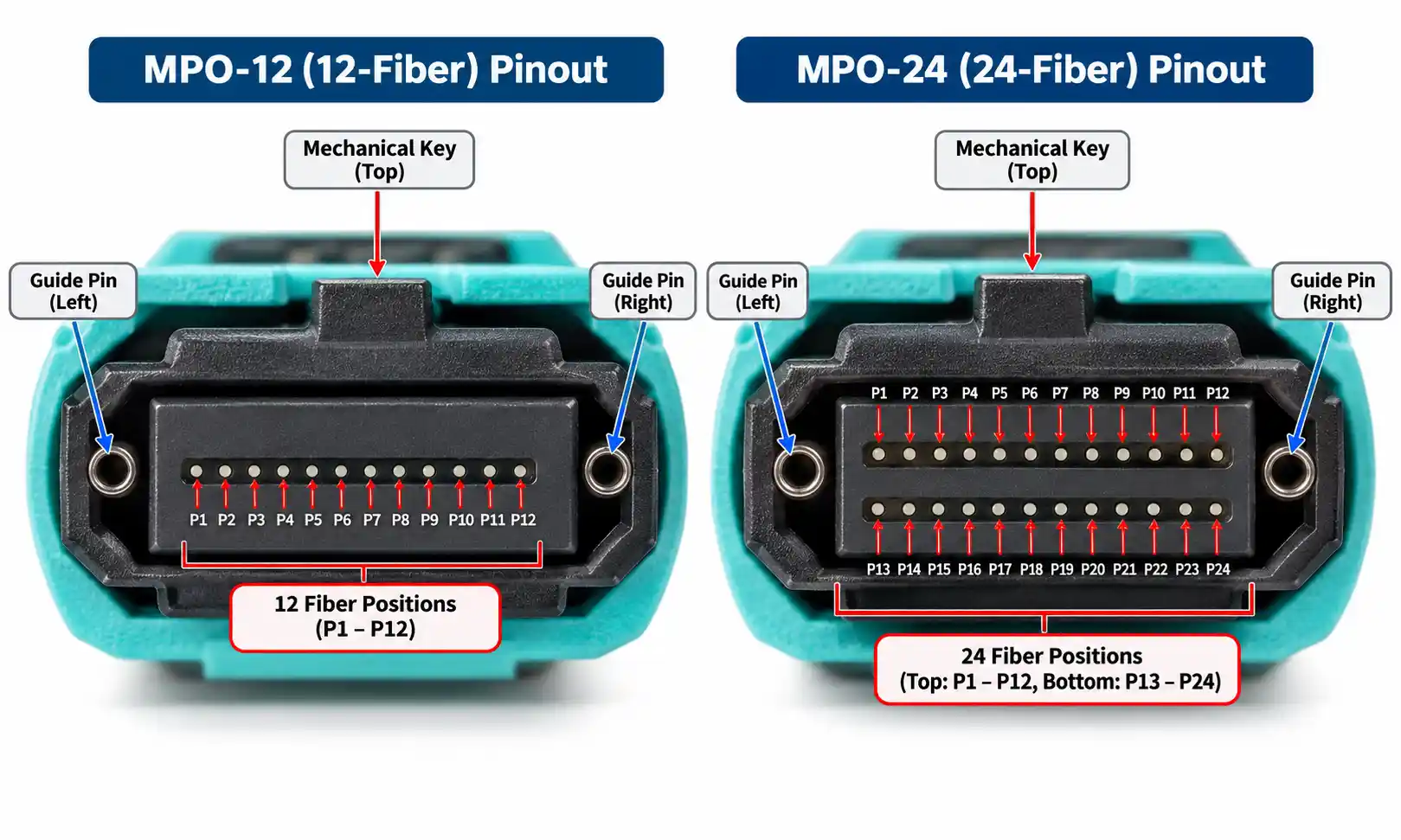
MPO stands for Multi-fiber push-on connector. Unlike the conventional fiber connector, an MPO connector includes a fiber array that supports multiple fibers up to 12, 24, or 36 strands. Due to complexity, the Multi-fiber connectors are not yet suitable for field-fit applications and must be factory terminated. It is widely used in high-density data center or fiber cabling system that requires space-saving.
Although the total cabling pricing is much higher than standard LC or SC, MPO fiber optic connector provides significantly fast deployment and inexpensive cost based on a ”per-fiber” basis.
MT-RJ Connector

MT-RJ stands for Mechanical Transfer Registered Jack. It is a duplex connector with female and male variants employing alignment pins. Currently, it is almost no longer in use. Specific systems, however, may still require these connectors for maintenance. MT-RJ is only compatible with multimode duplex cables. Both fibers enter the ferrule, connected to its mated half via pins and holes, much like MPO/MTP connector.
MU Connector

The MU (Miniature Unit Coupling) connector was developed by NTT, just like the Mini-SC. But unlike the SC, the MU connector has a 1.25mm zirconia ferrule. It uses a simple push-pull design, a compact miniature body, and a self-holding mechanism for backplane applications.
E2000 Connector

Diamond SA develops the E2000 connector. Also referred to as an LSH connector, it features a spring-loaded shutter mechanism to protect the ferrule end-face from dust and laser beams. The E2000 fiber optic connector has a one-piece design for easy and quick termination and is suited for high safety and power applications.
MDC Connector

Short for Miniature Duplex Connector, the MDC connector is created by US Conec. It is a Push-Pull-Boot duplex fiber connector using industry-standard 1.25mm ferrule while providing three times the density of LC connectors. As part of the Very Small Form Factor (VSFF) connectors portfolio, it targets SFP-DD, QSFP-DD, OSFP transceivers, and other high-density patching applications.
CS Connector

The CS connector is a new high-density, very small form factor (VSFF) fiber optic connector for QSFP-DD, OSFP, and COBO transceivers. Compared to an LC duplex, it delivers a 40% size reduction and doubles the density of patch panels.
SN Connector

The SN connector is a new duplex fiber optic connector developed by SENKO. Delivering higher density than the CS connector, the SN connector uses the industry-standard 1.25mm ferrule but reduced ferrule pitch; therefore offers a 4x duplex fiber connector with the same LC size. It is ideal for next-generation hyperscale data centers, Edge, Enterprise, or co-location DCI.
DIN Connector

DIN stands for Deutsches Institut für Normung, or German Institute for Standardization, a German manufacturing industry standards body. DIN connector is the fiber optic connector compatible with DIN 47256. These fiber connectors are rare, and very few users are in the market.
D4 Connector

The D4 connector is an older generation single mode fiber optic connector developed by NEC. It was most likely the first connector to use ceramic ferrules. This connector has a thinner ferrule than SCs or FCs. It was widely used in telecom networks from the 1980s through the early 1990s, and part of it may still be in use today.
ESCON Connector

IBM developed Enterprise Systems Connection (ESCON) in the early 1990s as a serial half-duplex optical fiber interface to improve connectivity by incorporating fiber optics into a network. The ESCON fiber optic connector uses 2.5mm ferrules, so they can mate with SC or ST connectors via fiber adapters. But to this day, ESCON is now being displaced by the industry’s newer and more efficient SC and LC connectors.
FDDI Connector
FDDI is an abbreviation for Fiber Distributed Data Interface, which refers to a local area networks technology such as Ethernet or Token Ring. Like the ESCON connector, the FDDI connector, also known as a MIC (Media Interface Connector) connector, is the termination on the fiber optic cable itself. It has two ferrules in a huge, heavy plastic housing with a squeeze-tab retention mechanism.
Non-Contact Fiber Connector
We also see some enterprises develop non-contact fiber connectors.
Unlike the regular fiber optic connector, the non-contact fiber connector doesn’t require physical contact between the fiber end-face or a beam-forming lens. Thereby achieving lower insertion loss, improved return loss, assured random mating, and dust and dirt immunity. However, this new style connector has barely been deployed because of the much higher cost and manufacturing complexity.